
Introduction
There are some differences in software development over the years. In the traditional software engineering world, software developers are primarily concerned with designing, coding, testing and fixing software applications. Operations teams, meanwhile, took care of servers, infrastructure, deployments and system reliability. This separation frequently posed communication issues as new features were pushed, operations teams were busy working on stability, security and the elimination of failures. The more complex software systems and the need for speedy delivery by businesses led to a shift in thinking that led organizations to use new methods, which helped promote collaboration between development and operations teams.
To address these problems, DevOps was born: DevOps is a combination of development and operations, with development and operations combined through automation, collaboration, continuous integration, continuous delivery, and better monitoring. DevOps is about more than just creating software products; it’s about delivering, maintaining, and operating software in the real world. The differences between DevOps and software engineering can help students, developers, and businesses build a better team and enhance the software development lifecycle.
Software engineering and DevOps are not mutually exclusive. Instead they are various fields of expertise, all with the aim of developing reliable, secure and efficient software systems. The software engineers create the applications that users interact with, whilst DevOps helps ensure that these applications can be deployed, scaled, monitored and maintained effectively. In today’s software world, both disciplines are increasingly required to collaborate to create faster innovations and user experience.
What is Software Engineering?
Software Engineering is a systematic process for designing, developing, testing, deploying and maintaining software applications. A software engineer uses programming knowledge, problem solving ability, software design concepts, and software development methodologies to develop software solutions to meet the software, business, and user requirements. They handle customer needs, software design, coding, code review, defect resolution and enhancement of existing applications.
Typical software engineering tasks tend to be related to application development life cycle. A software engineer can understand the requirements, design parts of the system, choose technologies to work with, build system capabilities, write automated tests, and interact with other software engineers to enhance code quality. They oversee the functionality, efficiency, maintainability, and adherence to technical specifications of software. They may have knowledge of programming languages, databases, algorithms, software architecture, user interfaces, and application security.
Different software engineers can focus on particular software areas of interest based on their interests and the needs of the organization. Front-end engineers work on user interfaces and client-side applications, while back-end engineers build server-side logic and APIs, as well as databases. Full stack engineers do work in both spheres, and specialized engineers like embedded software engineers, machine learning engineers, and mobile engineers specialize in technology. The general practice of software engineering revolves around the development and enhancement of software products, irrespective of the specific type of software.
What Is DevOps?
DevOps is an approach to software development that merges development and operations practices, aiming to enhance collaboration, automation, and software delivery processes. DevOps promotes collaboration between the development and operations teams, viewing them as part of a single team responsible for the entire software life cycle. This strategy can help organizations release software quicker without compromising reliability, security and software performance.
DevOps engineers are tasked with developing and maintaining systems that enable developers to build, test, deploy and monitor applications efficiently. DevOps engineers are more likely to be involved with cloud platforms, deployment pipelines, automation tools, infrastructure management systems, and monitoring solutions. They are concerned with bridging the gap between application development and the contexts in which they are executed.
Continuous integration, continuous delivery, infrastructure as code, automated testing, monitoring, and collaboration are all key components of DevOps. DevOps teams automate repetitive tasks to cut down on human error and boost efficiency instead of doing it by hand. For instance, a DevOps engineer might create an automated pipeline to automatically test new code, package applications and deploy them to production environments.
DevOps is not just about automation, it’s about building a culture where teams work collaboratively to maintain software quality and reliability. During development, all stakeholders, from developers and ops to security and business, collaborate. This partnership enables organisations to meet customer requirements rapidly and maintain well balanced and secure systems.
Differences Between Software Engineering and DevOps
There are a few differences between software engineering and DevOps.Although there are some differences between software engineering and DevOps.
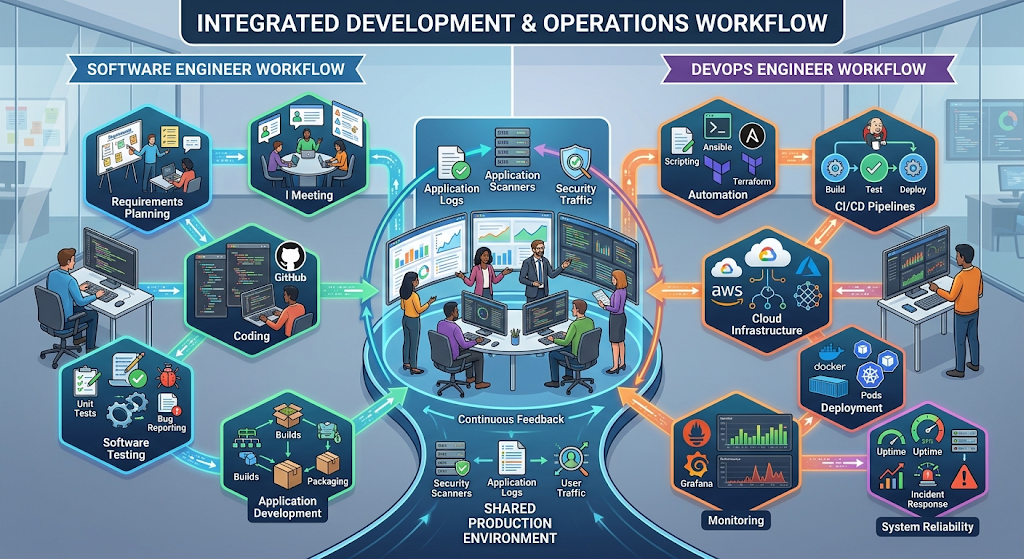
While there are several commonalities between software engineering and DevOps, there are also distinct differences between them. A software engineer is primarily concerned with software application development, whereas a DevOps engineer is concerned with delivering, operating, and maintaining the software application(s) in production environments. The difference is more pronounced in areas like development, infrastructure, deployment, automation and monitoring.
Development Responsibilities
Much of the work of software engineers involves writing and improving the code for applications. They create features for a software, add function to software, troubleshoot software problems, and verify programs satisfy user needs. They are responsible for identifying suitable programming methods, developing efficient programs, and ensuring the code is of high quality by conducting code reviews and testing.
Other DevOps pros write code, but typically it’s code for automation purposes, not to create application features. They develop scripts, configuration files, as well as tools to aid software delivery processes. For instance, a DevOps engineer could write scripts to automate the configuration of servers, deployment or monitoring system performance.
A DevOps engineer concentrates on how the application gets from the developer to production and then stays in production and running well.A DevOps engineer is more concerned with the way that the application gets from the developer to production and then continues operating well. Technical knowledge is needed for both jobs, but for different purposes. Software Engineering focuses on product development, DevOps focuses on delivering efficiently, reliably, and effectively.
Testing Responsibilities
While testing is a crucial part of the responsibilities for both the software engineer and the DevOps, there are some differences in how they go about it. Typically, software engineers are involved with testing the functionality of an application. They develop unit tests, integration tests, and other automated tests to test that each part is functioning correctly. They want to get the bugs in the software fixed before users can get hold of them.
DevOps teams are more likely to be concerned with incorporating testing into automated delivery pipelines. They assist to develop environments in which tests can automatically be executed as soon as new code is delivered by the developer. Continuous integration systems continuously test changes to see if there are errors, security weaknesses, or compatibility problems before they are deployed.
It is common now to use a mix of both strategies. Software engineers write tests to verify the behavior of the applications, and DevOps engineers build processes that automatically run the tests during the development process. This partnership minimizes the risk of a bugged software and helps teams to put out updates with a sense of assurance.
To Deploy and Manage Infrastructure
The primary distinctions between traditional software development and DevOps is that DevOps takes responsibility for deployment and infrastructure. In traditional environments, developers would write code and pass it out to operations to deploy. This separation may lead to delays as it requires operations teams to have to get to know and control applications that they haven’t built.
DevOps flips this on its head, by fostering a sense of shared responsibility for deployment activities. DevOps engineers develop automated pipelines to help deploy applications from Dev to Production environments with very little human interaction. Typically, these pipelines have stages for application development, testing, security validation, and deployment.
DevOps is also crucial in managing infrastructure. Cloud platforms are now a target for modern applications and cloud infrastructure is required to be scalable to meet ever-changing requirements. DevOps engineers are responsible for infrastructure management, which involves the use of technologies like containers, cloud services, and tools for infrastructure-as-code. They provide automated systems for creating consistent and repeatable environments, rather than manually configuring servers.
Infrastructure can be involved in software development, particularly when software relies on DBMS, APIs, or cloud services. Generally, DevOps professionals have more responsibilities concerning infrastructure reliability, scalability, security, and performance.
Automation in Software Engineering and DevOps
The automation aspect of software development has emerged as one of the most crucial components, easing repetitive tasks, enhancing accuracy, and enabling teams to create software more efficiently. Automation is primarily used by software engineers to enhance the software development process. They develop automated tests, scripts, and tools that can confirm the behavior of software, minimize bugs, and perform routine development activities faster. For instance, developers can program unit testing to make sure that new code modifications don’t cause old functions to lose their usability. They can also help automate code formatting, quality assurance, and security testing to ensure consistent coding practices throughout a project.
DevOps engineers are more concerned about automation on a system level. Their aim is to automate the processes of application building, testing, deployment and maintenance. DevOps teams write automated workflows for software to go through various stages, eliminating the need to manually configure servers or repeat deployment tasks. Automation tools assist organizations to minimise deployment errors, achieve consistency and deliver software updates on a regular basis.
The key difference between software engineering automation and DevOps automation is in terms of scope. Typically, software engineers automate tasks associated with application development, and DevOps engineers automate tasks associated with software delivery and operations. But both are interdependent as efficient software delivery must be achieved through automation throughout the software lifecycle. Application-level automation, coupled with infrastructure and deployment automation, is a successful development team that creates faster and more reliable workflows.
Continuous Integration and Continuous Delivery (CI/CD)
DevOps environments are typically characterized by the use of continuous integration and continuous delivery (CI/CD). These enable development teams to incorporate code changes often, automatically test the applications and provide the updates to the end-users in an efficient manner. Typical software development cycles involved building up many changes prior to the release of a new software application. This might make releases hazardous as a lot of changes could have been added simultaneously, making it difficult to pinpoint the cause of issues.
However, Continuous integration addresses this problem by getting developers to regularly push their updates into a single repository. With every change, a series of tests and quality checks can be automatically made. In the event of issues being identified, the developers are provided with prompt feedback, and issues can be addressed before they grow into larger problems. One of the key stages of this process is automated testing, which software engineers help with by writing clean code and developing automated tests to verify the functionality of the application.
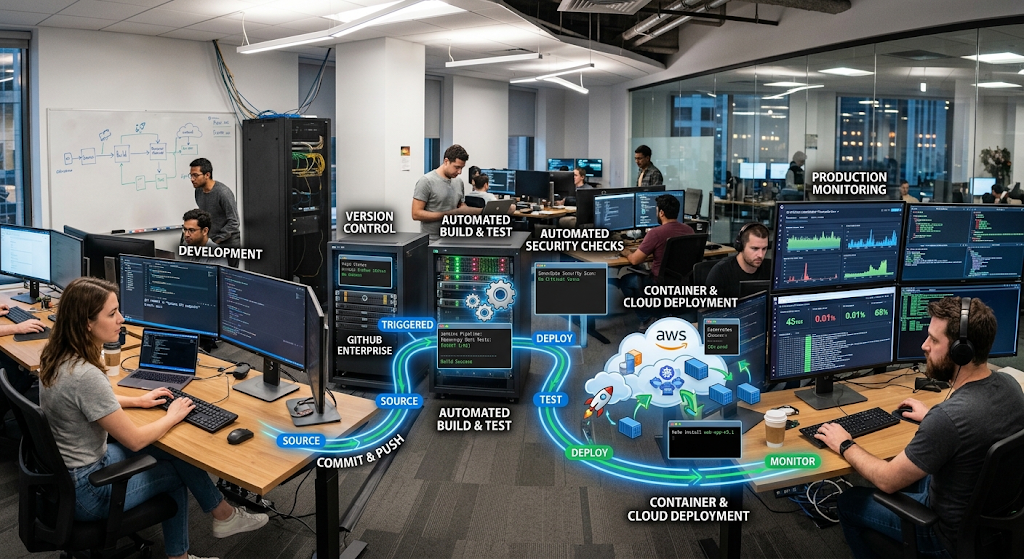
Continuous delivery takes this one step further, by automating the act of building software releases. DevOps engineers create and manage CI/CD pipelines that automatically package software, configure environments, and deploy software. Others also use continuous deployment, meaning that the changes that have been approved are automatically deployed to production without manual effort.
CI/CD is an example of how software engineering can be combined with DevOps. DevOps teams build systems that enable developers to make valuable software changes, quickly and safely. They work together to accelerate the development of improvements while keeping the software quality and reliability.
Monitoring and System Reliability
Another place in which DevOps is different from conventional software engineering is monitoring. Typically, software engineers will concentrate on making sure software applications function properly when they’re in progress and during testing. They look at mistakes, enhance performance, and resolve bugs in the application code. But after an application is released, an organization must have ongoing insight into the way the system is performing in real application environments.
DevOps engineers must develop monitoring solutions that ensure the applications are healthy, infrastructure is performing well, security events are monitored, and user experiences are monitored. They manage to gather data on server availability, response times, application errors, database performance and resource consumption using monitoring tools. This information can be used to detect issues early and avoid large-scale service downtimes.
Observability is a modern DevOps principle and a key element of DevOps practices in which teams gain insight into the causes of a problem, in addition to monitoring. Observability is the combination of metrics, logs and traces, giving a complete picture of system behavior. If the application slows down, for instance, engineers can use observability tools to identify that it is either the application code that is slow, or the performance of the database, network issues, or limitations in the infrastructure.
When tackling production challenges, software engineers and DevOps engineers work closely together. DevOps personnel can look into the root cause of infrastructure-related issues, and developers can resolve issues inside the application. This collaboration enhances the reliability of the system and provides users with a seamless experience.
Software Engineer vs DevOps Engineer: What is the difference and what is a DevOps Engineer?
While there are many similarities between software engineers and DevOps engineers, each has different daily responsibilities and priorities. The main role of a software engineer is to develop software solutions. They spend a considerable amount of time developing features, coding, optimizing application performance and fixing technical issues that arise with software functionality.
A DevOps engineer’s job is to develop efficient processes and environments to ensure the effective delivery and maintenance of software. They are typically involved in the management of cloud infrastructure, developing deployment pipelines, automation of workflows, monitoring systems, enhancing security protocols, and ensuring the reliability of applications.
Some of the common differences are highlighted below:
| Area | Software Engineer | DevOps Engineer |
| Main Focus | Building software applications | Governing software delivery and operations |
| Primary Skills | Programming, algorithms and software designs. | The SDLC for automation, infrastructure, cloud platforms |
| Coding Work | The features and functionality of the applications. | Scripts, Automation tools, Configurations |
| Testing Focus | The degree of correctness and quality of the application | Automated Testing Pipelines and Environments |
| Deployment | Conscientious work on applications for release. | Managing deployment processes |
| Infrastructure | Uses infrastructure resources | Creates and manages infrastructure systems |
| Monitoring | Fixes application issues | Monitors conditions of systems and reliability |
| Main Goal | Build effective software | Install and use software effectively. |
These differences aside, there are many professionals today who have a skill set that is similar across both disciplines. A software engineer can pick up the skills of cloud technologies and deployment automation, and a DevOps engineer can build very good programming skills. As cloud computing and modern development methods have evolved, there are more flexible roles and multiple teams sharing responsibilities.
Related Roles in Modern Software Teams
In modern software companies, there are a number of specific roles that are involved in both development and operations. It’s important to recognize these roles to begin to appreciate the various roles played in software delivery.
Site Reliability Engineer (SRE)
The Site Reliability Engineer’s goal is to ensure the reliability of systems using software engineering approaches to solve operational problems. SREs frequently develop and maintain systems for automation, enhance monitoring, manage availability needs, and develop solutions that stop service failures. The role will be a mix of software engineer and DevOps and will carry a heavy emphasis on reliability.
Cloud Engineer
Cloud engineers are responsible for designing and managing the cloud infrastructure. They build scalable, secure and efficient environments on platforms like cloud computing services. They can be involved in setting up cloud resources, monitoring networks, cost optimization, and enhancing infrastructure performance.
Platform Engineer
Platform engineers create internal platforms to enable developers to more easily create, test, and deploy applications. Platform engineers provision reusable infrastructure and systems that help developers be more productive, rather than having individual teams provision their own infrastructure.
Security Engineer and DevSecOps Specialist
Security has become a fundamental aspect of software development. DevSecOps and Security engineers embed security into the development and deployment lifecycle. They help to identify vulnerabilities, automate security checks and ensure that applications comply with security requirements.
Tools used by Software Engineers and DevOps Engineers
A variety of tools are used by software engineers and DevOps engineers, but for different purposes. Programming environment, version control system, database, testing framework, and software development platform are all common tools used by software engineers. These tools help them develop, structure and maintain the code of the applications.
DevOps engineers employ tools that are centered on automation, infrastructure management, deployment and monitoring. Both parties rely on version control systems as they enable teams to work on code changes together. It provides the ability to deploy and test applications automatically with CI/CD platforms, and to run them consistently across environments with container technologies.
Typical types of tools are:
Version Control Tools: These tools are used for managing and collaborating on source code.
CI/CD Tools: These tools are for automating the building, testing, and deployment of software.
Container Platforms: These are used for packaging applications and the dependencies that are required.
Infrastructure-as-Code Tools: Tools that are used to automatically create and manage infrastructure.
Cloud Platforms: These are used to host applications and manage computing resources.
Monitoring Tools: These are tools that are used to monitor the application and system performance. The type of tools they choose will vary from organization to organization depending on their technology, business needs and infrastructures. But the goal is always the same: to enhance software quality, speed and system reliability.
How DevOps and Software Engineering Teams Collaborate
Any organization that is successful in software does not view DevOps and software engineering as distinct activities. Instead, they encourage collaboration throughout the entire software lifecycle. A collaboration between developers, operations folks, security teams and others from planning to deployment and maintenance.
For instance, when software engineers are developing a new application feature, they create and code the feature, while the DevOps engineers contribute to infrastructure and deployment preparations needed to deliver the feature. DevOps teams add the automated tests to CI/CD and developers implement them. Once released, each team reviews monitoring data and collaborates to enhance performance.
Collaborative approach makes it a shared responsibility. Developers start to pay more attention to operational issues and DevOps professionals start to know more about the requirements of the application. This leads to a more efficient development process with quick responsiveness to changes, combined with high quality and reliability standards.
Conclusion
DevOps and software engineering are two key aspects nowadays in the software development field. While software engineers work on creating, developing and enhancing software, DevOps engineers prioritize automating the software delivery process, infrastructure management, and ensuring software reliability. Both are important and neither replaces the other in order to be able to develop successful software products.
The primary distinction between the two jobs is that they focus on different areas. Software engineering focuses on software functionality, DevOps focuses on the effective delivery and maintenance of software. In the modern era, however, these skills are often used together as efficient software development means strong operations and solid engineering skills.
As technology continues to evolve, the boundaries between software engineering and DevOps will continue to change. DevOps professionals have been acquiring programming skills, and developers are gaining knowledge on infrastructure and automation. The collaborative efforts of these disciplines when executed within an organization are poised to build secure, scalable and reliable software systems to meet the demands of modern users.