Introduction
Today’s stock exchanges are fueled by high-tech technology that links the buyers and sellers. The stock market trading process may appear simple, like pressing a button in the trading program, but every transaction involves various systems that carry out the trade, decide on the price, move financial data and supply ownership information. The core of this infrastructure are electronic trading systems, which enable traders to place orders and make trades without having to be on a trading floor. They function via brokerage platforms, exchange networks, order books and automated, matching engines that operate in real-time, in mere seconds. Students, investors, and technology enthusiasts will gain insight into the interplay of these technologies and how they enable today’s stock markets to be fast, accurate, transparent, and provide reliable access to financial markets.
Comprehensive overview of the Electronic Stock Exchanges
An electronic stock exchange is an online exchange where buying and selling of stocks is done via computer networks, and not just in a physical trading floor. The exchanges, such as the New York Stock Exchange and the NASDAQ, provide electronic facilities to receive orders, post prices and facilitate trades under certain trading rules. Investors normally engage in trading within these markets by means of one of the brokerage firms that supply both software and other features that enable a person to purchase and sell investments. The exchange’s systems then review eligible orders, and decide if they are able to match with orders on the other side. With high volume this allows thousands or millions of orders to be processed. There are also alternative trading systems operating in electronic markets that enable continuous trading, opening and closing markets as well as other trading that is utilized for efficient price formation and orderly markets.
Order Book, Organizing Buyers and Sellers
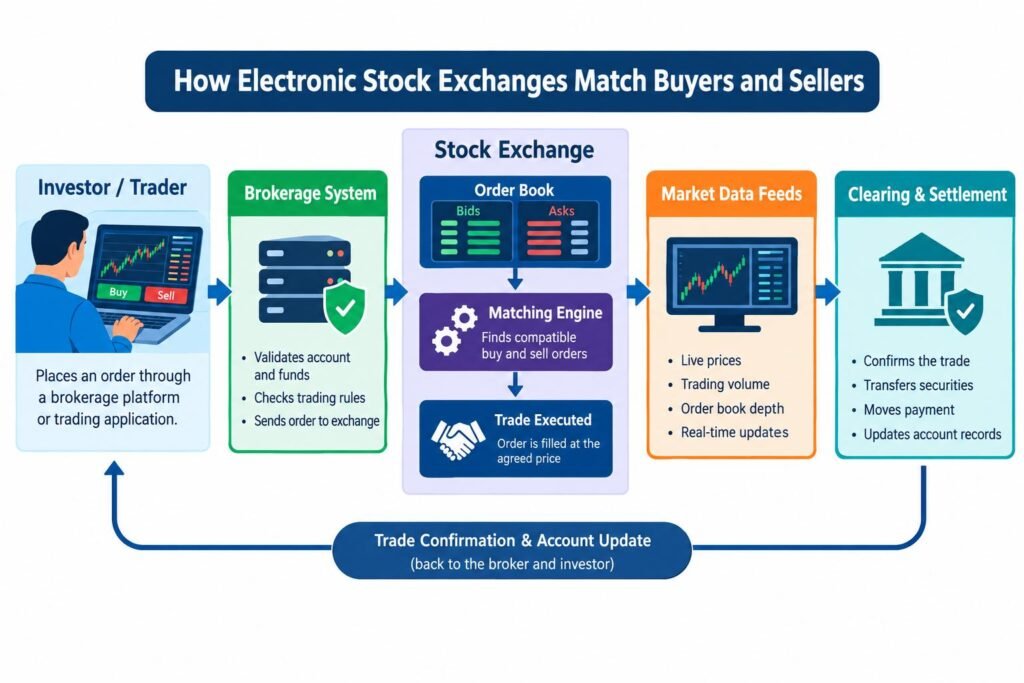
The order book is one of the most crucial aspects of an electronic exchange as it keeps track of pending purchases and sales of a security. Purchases are generally referred to as bids and sales as asks or offers. Orders may contain information like the number of shares, the range of prices, and instructions for the execution of the order. The best displayed buying and selling prices in a typical order book are the highest bid and lowest ask prices. The gap between these two prices is called the “bid-ask spread. Exchanges group eligible orders based on the rules that are typically used to determine the order’s priority, which is usually based on price and then by the time of the order. This orderly record enables the order book to facilitate the searching of compatible orders, and allows the trading parties to gain knowledge of liquidity and trading interest.
Matching Engines: Order to Trade
A matching engine is specialized software that identifies orders that can be matched up against each other. As a buy order comes in, the engine checks sell orders to see if they match the buy order and its instructions. When the price of sale is agreed upon by a seller and a buyer and the system is able to offer the shares at that price, the system can trade the shares (as long as the exchange rules allow). For instance, one investor places an order to buy 100 shares and another investor places an order to sell 100 shares at N500 per share, the matching engine could match the orders for the whole 100 shares. An order may be filled in part if there are only 60 shares on hand and the order will be partially cancelled if the order allows for a partial fill and there are shares left to cancel. Competing orders need to be processed in a consistent and timely manner by matching engines and they must adhere to the price limits, order priorities and trading controls. Their performance is critical as any delay or error could impact on the quality of the execution, confidence in the market and the orderly running of the exchange.
Process Transfers from a Brokerage Application to the Exchange
Typically, a stock trading starts with an investor placing an order using a brokerage application or website. The instruction is passed to the broker’s system, which validates the pertinent data from the accounts and imposes controls like available funds, share ownership and restrictions on trading that may exist in the accounts. After acceptance, the order is sent to a venue for execution, which could be a stock exchange or some other permitted venue, depending on the broker’s agreements and rules. Connectivity technologies and financial messaging protocols enable the exchange of order, acknowledge, cancel and execution reports between brokers and exchanges. Certain market users have developed special interfaces such as the Financial Information eXchange (FIX) protocol to send trading orders electronically. Once an order is received at the venue, the venue executes and matches the order, according to its matching rules and execution policies. Details of executed trades are then passed back via the appropriate channels and the broker can adjust the application and account records of the investor. This entire process can occur within milliseconds, but the actual speed is dependent on network speed, system performance and order’s destination.
Market Data Feeds and Real-Time Prices.
Market Data Feeds are a network of information that sends information on trading activity to the market to the brokers, institutional investors, data vendors and any authorized recipients. These feeds might include active bids and offers, trade prices, trading volume and updates to the order book. Some services only make available the highest prices available, others make available deeper order book with multiple price levels. This information is generated and/or consolidated by exchanges and passed on via special data distribution systems. Incoming feeds help brokerage applications to show the share price, charts, market depth and transaction updates. The various price systems, the different patterns of data updates, coverage of markets, and subscription arrangements, however, may cause differences in the prices displayed on various platforms, and the differences in pricing consolidation. Market data technology is equally vital not only for assisting investors in making educated choices, but additionally for boosting automated trading approaches and monetary analysis. There is reliable and timely information provided that allows the participants to make a proper assessment of the fluctuations in liquidity and prices, although the prices shown may be subject to change before it reaches the exchange.
Compliance with the Convention
Not all trades actually result in the sale of the shares and/or money. Once the execution is done, the clearance and settlement facilities make sure that the execution is performed properly. Clearing arrangements set out the duties of the participants in the trade, determine the obligations and risk of the transaction once completed and handle some of the risks involved in completing trades. In central counterparty (CCP) based markets, the central clearing house might interpose itself as a middleman between the parties involved in the transaction, with the rules applicable, and manage counterparty exposure. Settlement, on the other hand, requires that the securities be transferred to the buyer, and the payment made to the seller via the appropriate financial institutions and securities infrastructure. In the United States, the majority of eligible transactions for stock will be settled under the new T+1 settlement cycle in May 2024, which provides for the settlement to occur one day after the trade date. There are other markets, which have their own settlement times and schedules. They rely on the proper record-keeping, secure communications, reconciliation procedures, and risk management to minimize failed transactions and the trust in the financial system.
High-Frequency Trading and Low-Latency Technology
The high-frequency trading (HFT) is a trading strategy that involves sending, altering, and canceling orders at extremely fast speeds through the use of an automated computer system. Companies practicing these tactics can study market information, find out minor price distinctions, offer liquidity, or adjust to altering trading circumstances. HFT participants invest in low-latency networks, powerful computing infrastructure and optimized software. To minimize communication delays, some host their servers in data centres near to exchange systems, which is referred to as co-location. But the fastest computer isn’t the only thing that matters when it comes to high-frequency trading. Costs of transactions, rules of the markets, execution risks as well as competition from other participants are also to be considered in the development of strategies. While automated trading can under certain conditions help to improve the liquidity and to narrow spreads, its effects depend on market circumstances. Sub-optimal algorithms may also create over buying or over selling high frequency price swings. To detect unusual trading activity and to assist in keeping markets fair and orderly, exchanges and regulators employ surveillance tools, trading limits and safeguards.
Security and Operational Ethics
Security and operational resilience are critical components of an electronic exchanges’ technology infrastructure, as they work important assets and sensitive financial information. Systems need to be secured from unauthorized access, data manipulation, service interruptions or other risks for all exchanges, brokers, and other market participants. The safety measures which help can be: encryption, identity verification, access control, network monitoring and frequent software testing. Other elements that exchanges need to have are effective backup systems and recovery protocols, to ensure that key services are quickly restored in the event of a technical failure. Automated monitoring can identify abnormal trading patterns, explosive behavior and potential breaches of trades rules. The obligations of the regulators differ by jurisdiction, but include requirements on market conduct, reporting, operational risk and investor protection. However, technology must be there to allow for the accurate tracking of transactions and incidents, allowing for a review if there is any suspicion of fraudulent transactions. These functions are significant especially given that a prolonged failure to keep the trading system operating or a failure of the trading system can have an impact on price discovery, investor confidence and financial institutions linked to the trading system.
Conclusion
Today’s stock exchanges are facilitated by an intricate system of technology that propagates orders between brokerage programs and the trading venues, and converts corresponding orders into trades. Order books are used to coordinate the buying and selling interest; order matching engines execute orders that are eligible for execution; market data feeds share price data; and clearing and settlement systems ensure the settlement of securities and money. Connectivity to the brokers gives investors access to these services, and high-frequency trading showcases the power of specialized computing, low-latency networks and the impact on today’s trading. Infrastructure security, surveillance and protection are important measures that ensure the reliability and fairness of this infrastructure. While it may appear to be a straightforward stock trading application to the investor, it takes several systems to execute a stock trade. By grasping these factors, investors can appreciate the stock market’s intricacies and how technology plays a pivotal role in ensuring the swift, efficient, and dependable functioning of today’s financial markets.
Get more well researched information about Stock market technology here.