Introduction
Accounts payable can be very important to the financial health of any business and, when managed by paper, can be one of the most time consuming administrative tasks. Staff can be spending hours on hours dealing with invoices, inputting data into accounting systems, looking up purchase orders, asking for approvals, answering supplier questions and booking payments. The more invoices you process, the more these tasks can add to processing costs and the risk of human error. By leveraging technology to capture and interpret invoice data, validate transactions, route for approval, schedule payments, and record financial transactions, business can automate many of these tasks and continue to manage and control their finances without relying on extensive manual processes.
What Is Accounts Payable Automation?
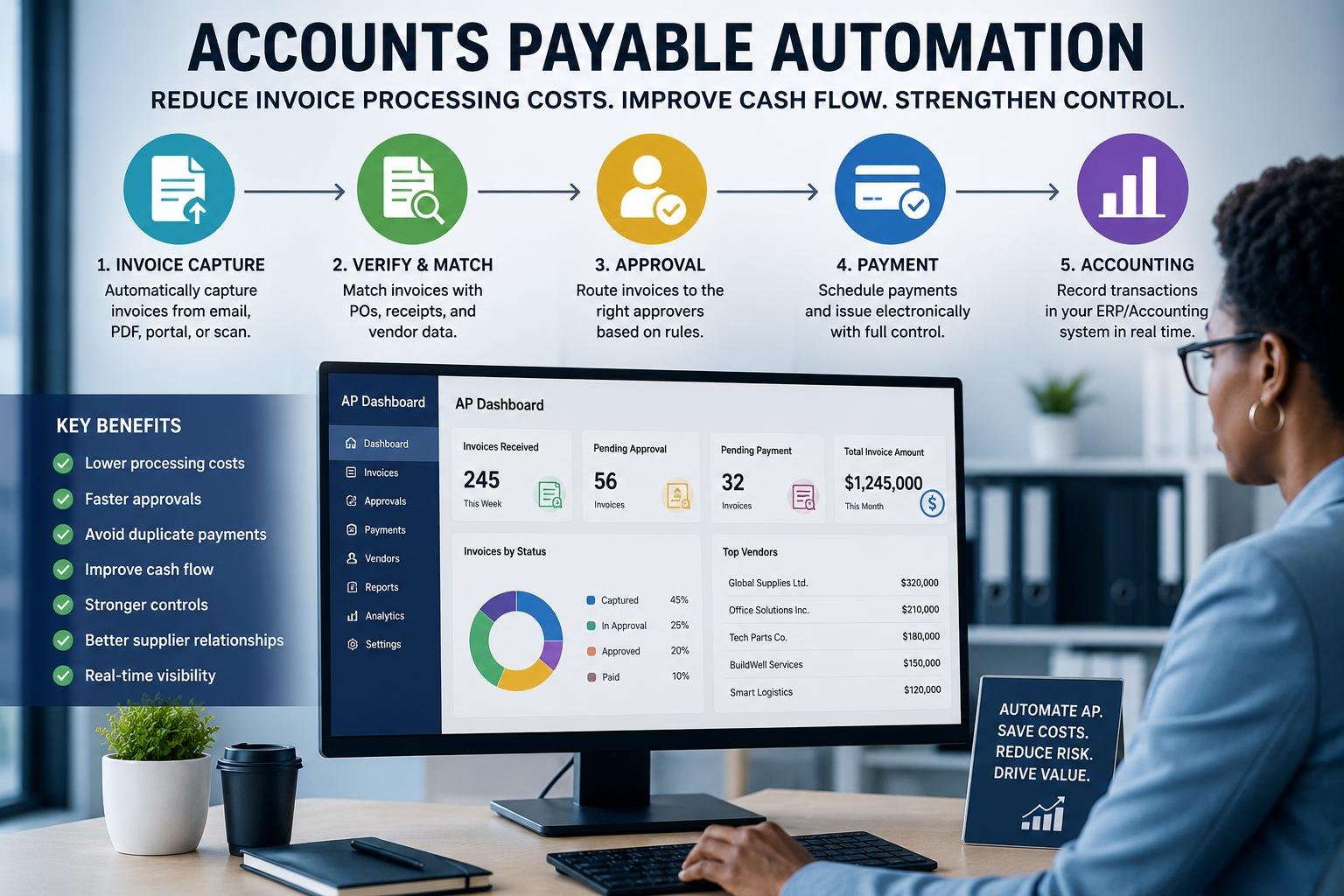
Accounts payable automation is the program and digital technologies used to automate repetitive tasks in receiving, processing, approving and paying supplier invoices. In an automatic system, the system will follow a predefined workflow in handling the invoices instead of the employee having to do each step, and rules can be applied to the invoice based on the company’s financial policies. When an invoice comes in via email or an electronic supplier portal, for instance, essential data like the vendor name, invoice number, invoice date, tax amount, purchase order number, and total value can be captured. It can then also make a comparison to the accounting or enterprise resource planning system in the company. This will save employees from data entry and will give finance staff more time to concentrate on other tasks that rely on their analytical skills, for managing suppliers, cash-flow, budgeting and similar tasks. The automation of accounts payable, in turn, transforms this mostly administrative process into a more regulated and efficient financial workflow.
How Automated Invoice Capture Can Cut Processing Costs.
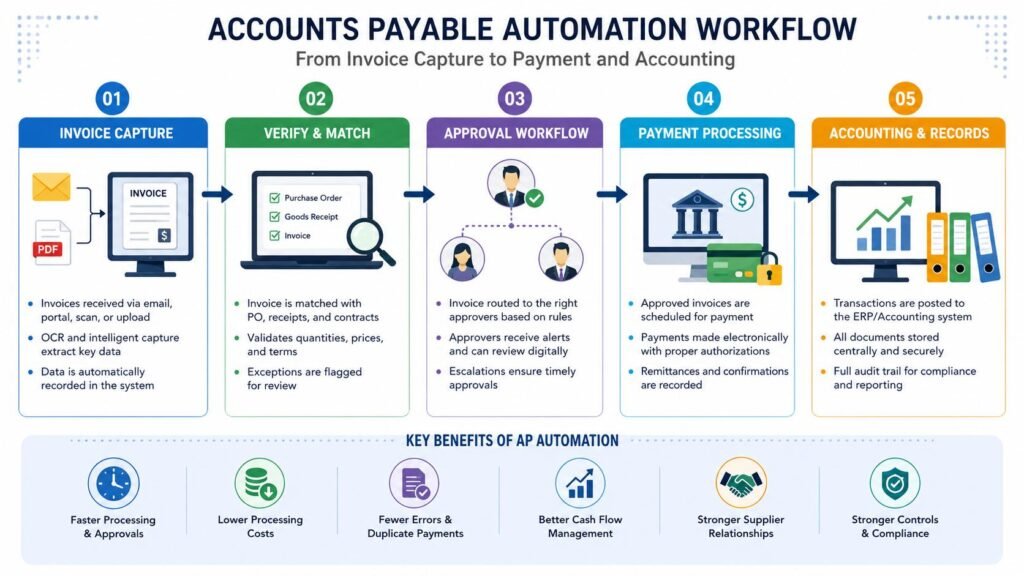
One of the first places where accounts payable automation can deliver measurable efficiencies is by capturing invoices. Employees could get invoices in various formats such as paper documents, PDFs, as attachments in emails, or even electronic files in a traditional process. That then has to be done by someone who reads each invoice, enters all the information into an accounting system, and verifies that it has entered the information correctly. This can take a long time and allow for typographical errors, lost documents, and missing information. Automated invoice capture can leverage technologies like OCR and intelligent data capture to recognize the data from an invoice and input it into the correct field within the financial system. After they’re captured, the invoice might be categorized and directed based on established rules. This allows employees to then view exceptions rather than handling each invoice from scratch. Minimizing manual data capture can not only save money on labor costs but also speed up the process of transferring invoices through the AP department.
Enhance Invoice Verification and Matching
Verification is the next key step after capturing an invoice. Businesses must ensure that the products or services on an invoice have been ordered, received and being billed for at the correct price. Employees may have to go through purchase orders, receiving records, contracts, and past invoices in order to manually verify. This can be streamlined with the use of accounts payable automation, which cross-references information on an invoice with other financial documents. A system can match an invoice with a purchase order or it can match an invoice with a purchase order and a receipt confirmation. In the case of the information being in line with the set rules, the invoice can proceed in the workflow automatically. The invoice can be flagged for human review if there is a discrepancy, for example, a wrong quantity or price. This exception-driven process enables finance teams to focus on any transaction that truly needs to be investigated and not spend the same amount of time on routine transactions like invoices.
Avoiding Double and Incorrect Payments
One of the major reasons of redundant financial losses is duplicate payments, especially in organizations with large volumes of invoices handled by various departments and locations. It is possible, for example, that a supplier may send the same invoice twice, or an employee may record the same invoice more than once. Manual systems are not always able to recognize these duplicates prior to payment. Automated accounts payable systems can search for any duplicate information like supplier name, invoice number, date, purchase order number, etc. The system can warn employees before the invoice is accepted or payment is made, which will enable the transaction to be investigated. Automation can even be applied to spot unusual amounts, missing data or invoices that are not in compliance with the set requirements. While technology can’t fix all accounting mistakes, automated validation adds another layer of security around the payment process. Even a single wrong or double payment can save an organization a significant amount of money in the long run, particularly if the company has a large amount of invoices to process.
Reduce and Speed up Invoice Workflows.
If the process for invoices continues from one employee to another via paper documents, emails or casual conversations, it can get quite a hold up. People may fail to act on an invoice for various reasons, such as missing the manager at the time of the invoice, receiving the invoice at the wrong time, or the responsibilities for approval are not clear. These disjointed processes can be streamlined and automated using accounts payable automation. Businesses can set rules that will approve an invoice based on the invoice amount, department, supplier, project, location, or expense category. As soon as an invoice is qualified for it, it can then be routed automatically to the correct approver. Digital notifications will remind responsible employees of what needs to be done and escalation rules can prevent bills from languishing for long periods. This simplifies the approval process and tracking. Approval speeds can also help minimize the chance of late fees or penalties and enable businesses to benefit from early payment discounts if available and if it makes financial sense.
Efficient Payment Processing
After getting approval of an invoice, businesses still have to make sure that the payment is accurate and timely. Manual payment processing may include making payment instructions, verifying bank information, securing final authorization and accounting once the payment has been made. The finance teams can process the scheduled payments from a single place, and automation can tie invoices to payment processes that are approved. Depending on the technology and payment methods that are supported, businesses may be able to accept electronic payments while keeping in place proper approvals. Payment scheduling can be useful to organizations in avoiding paying bills early on when there is a cash preservation requirement, as well as make sure that payments are not made overdue. This makes for greater control of the outflow of cash within the business. Keeping records with automation can also be helpful when checking payments with bank statements and accounting records. Finance personnel can spend less time handling the repetitive payment administration and more time keeping an eye on the organization’s overall finances.
Strengthening Cash-Flow Management
Good cash-flow control relies on the knowledge of what the business is owed, when it is due and the amount of cash available to pay these obligations. If accounts payable data resides in multiple accounting systems, on paper, in spreadsheets, and in emails, it can be hard for management to get a handle on what to expect. Automation provides a unified view of an invoice and when it has been paid, providing finance teams improved visibility of outstanding liabilities. The managers will be able to view the invoices received, pending approval, approved and paid. This information can help to make more informed short-term cash-flow planning decisions as payments can be more easily identified and can be more easily organized by due date. Businesses can also avoid the need for needless early payments and minimize the chance of a need for unexpected cash needs if enhanced visibility is achieved. Rather than waiting until a payment is due, finance teams can inform the decision-makers ahead of time on when payments should be made to suppliers.
Automation Enhances Supplier Relationships and Vendor Management
Another benefit of accounts payable automation is that it enhances the relationship between the business and their vendors. Often supplier enquiries will include queries about receipt of an invoice, whether an invoice has been approved, when the invoice can be expected to be paid and why it has not yet been paid. If a centralized digital system holds the information about invoices, employees will be able to find out more about the transactions and give suppliers a more precise answer. Automated workflows can also ensure consistency in supplier onboarding, invoice submission, tracking invoice status and maintaining all the documentation. As time goes on, businesses can leverage accounts payable data to identify trends, including those of the invoices that are likely to be disputed, those that are likely to be delayed, and those that are likely to provide the best payment terms. This information can be used for improved supplier negotiations and to find opportunities to enhance purchasing and payment processes. The more predictable the payment process is, the more likely suppliers are to get the correct, timely payments, and less likely to deal with administrative problems, therefore strengthening supplier relationships.
Proper Record keeping and Audit Trails
The proper maintenance of accounting records is critical to financial reporting, tax compliance, internal control, and auditing. Paper-based accounts payable can pose a challenge in keeping track of all documentation as it may be spread out in different places, such as invoices, approvals, purchase orders, receipts, payment confirmations, etc. These records can be combined into a single file and automation can produce a digital audit trail, tracking an invoice as it moves from the time it was received to the time it was finally paid. Authorized users will often be able to see who has approved or reviewed a transaction, when it took place, and whether or not an invoice was accepted, changed, or rejected while it was being processed. Digital documents that are organized centrally also make it easier to access documents when they are needed for auditors, managers or finance teams. Employees can find information in the accounts payable system, rather than having to look for it in filing cabinets or several email exchanges. Improved documentation increases accountability and facilitates financial transactions to be reviewed, especially if the companies have to show that they have adhered to suitable measures.
Minimizing the Risk of Late Payments
Late payments can cause businesses many issues, such as dissatisfaction with the supplier, late payment fees, a negative impact on customer credit ratings and the loss of discount for early payment. When it comes to manual workflows, there’s a higher risk of an invoice becoming overdue, as people can miss deadlines, and an approval can be lost. Automated systems can monitor the due dates of the invoices, and alert the users when they need to take some action. This enables the financial managers to discover the upcoming obligations earlier, prior to becoming urgent. Businesses can also create workflows that prioritize their invoices based on their due dates and payment terms. Automation can minimize workflow delays due to missing documents, manual routing, and slow approvals, which can help ensure that payments are executed in a more predictable manner. The advantage isn’t just that the penalties would’ve been avoided. Prioritization of payment procedures can increase the suppliers’ confidence and simplify the company’s negotiation of better payment terms. In this manner, automation helps in cost control, and in building stronger working relationships with the organizations providing goods and services.
The Strengthening of Financial Controls and Reduction of the Risk of Fraud
The right accounts payable automation software can help to improve the internal controls of a company, as it will guarantee that transactions are processed according to established processes. For businesses, rules can be set up to ensure adequate authorizations are in place before paying an invoice and access can be limited based on the employees’ role. By separating the act of the invoice entry, approval and payment authorization, there is less chance of any one person to be able to have a say in an entire transaction from its start to the finish. Automated systems can also keep track of the activity of users, making it easier to investigate unusual activity. Also, validation processes can be employed to detect irregular or contradictory transactions that need to be investigated. Whilst automation can be one of the solutions to fraud, it should not be considered as an end-to-end solution as fraud might be highly sophisticated and still requires human investigation. Technology, however, can provide more robust defenses against typical control weaknesses, by standardizing, visibility and traceability of processes. Automated accounts payable workflows, when paired with the proper policies and employee supervision, can play an integral part in a wider financial control strategy.
Successful Businesses that Automate Accounts Payable
Automation should be treated as a project to improve the processes, not just a software buy and then let it run. Prior to implementation, finance teams should map out the current accounts payable process and pinpoint the most time consuming, costly and error-prone aspects of it. The business can then decide what activities can be automated and what can’t be so much human effort should still be used to look at. The ability of the automation platform to integrate with current accounting, enterprise resource planning (ERP), procurement, banking and payment systems should also be considered. The employees must be trained properly to comprehend the new workflow and how to deal with exceptions. If suppliers are going to provide an invoice via a new electronic system, it may also require supplier communication. Last but not least, the management should define key performance indicators like invoice processing time, cost per invoice, duplicate payment rate, approval time, exception rate, on time payment performance. By monitoring these, the business knows if automation is providing the financial and operational benefits they are seeking.
Conclusion
Some of the benefits of Accounts payable automation include the ability to save time with invoice processing, increase data accuracy, speed up invoice approvals, avoid duplicate payments and gain visibility of invoices and payment charges. It can also integrate invoice capture, verification, approval, payment, vendor management and record keeping into a single streamlined and controlled workflow. This will provide finance departments with more visibility and reduce time spent on administration and increase time spent on analysis and decision making for employees. The most effective outcomes are obtained when policies and procedures are aligned with financial considerations, authorization is clearly in place, the supplier data is correct, staff training is scheduled and monitored regularly, and performance is measured. It’s also important to note that automation is not meant to replace the necessity to make human decisions; it’s designed to enable staff members to focus on exceptions, unusual transactions, supplier problems or strategic financial decisions. With the growing amount of financial data being processed by organizations, it’s clear that an effective accounts payable process can be a key driver in reducing costs, managing cash-flow, controlling finances and enhancing the performance of your business.
Get more well researched information about Accounts Payable Automation here.