Introduction
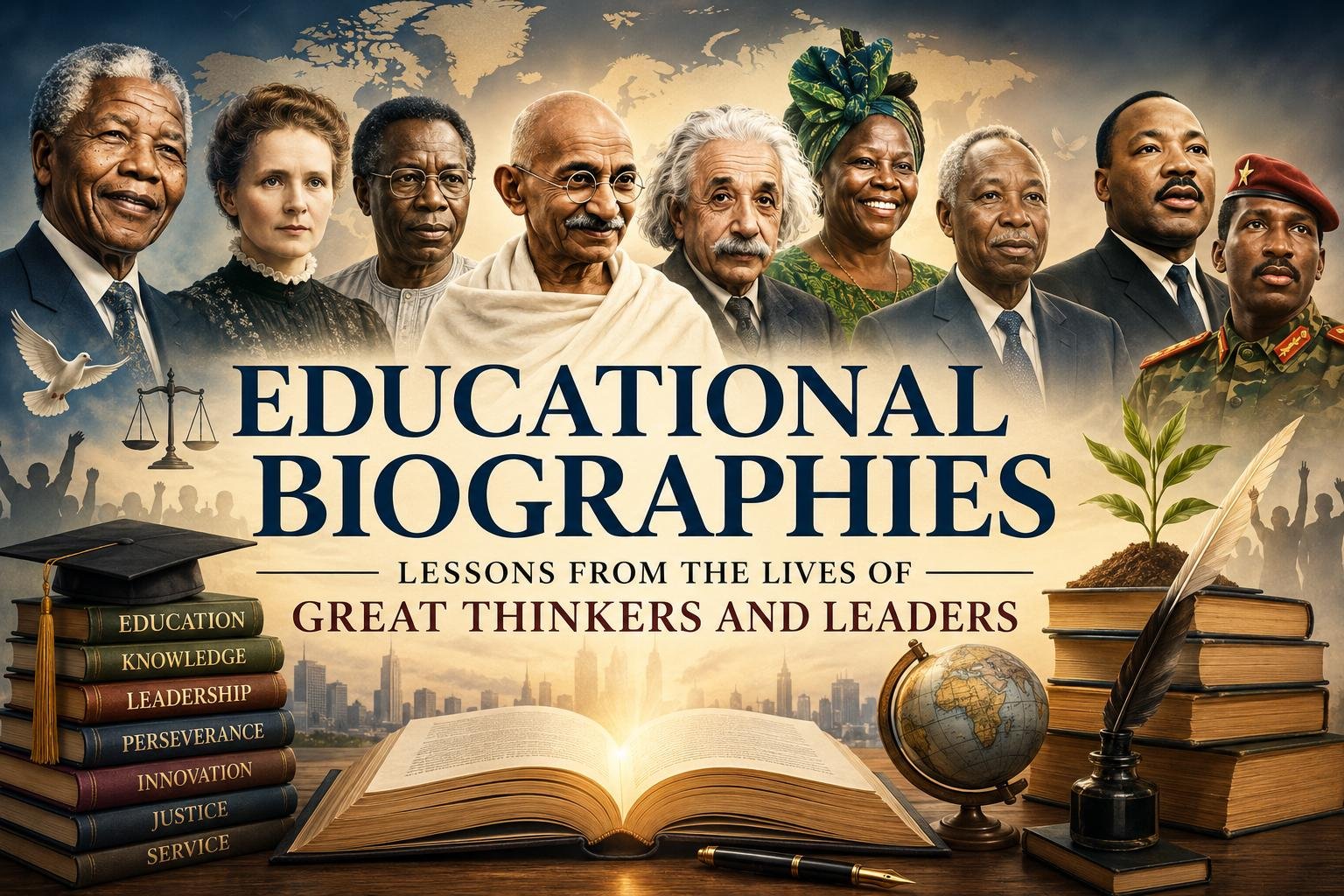
Through the ages great thinkers and leaders have formed societies with their ideas, determination, and commitment to better the lives of others. They faced many obstacles which at time turned in to failures and hardships but they overcame them to leave a legacy that still today we see as a constant source of inspiration. In looking at their lives we see also that we may learn from their experiences which play into personal growth, leadership, education and social change.
These educational biographies feature global and African leaders which have had great impact in the fields of education, human rights, science, leadership and social progress. We see in them examples of great resilience, dedication and vision. Also it is in these that we note that success did not come from talent alone or privilege but from perseverance, growth, and the effort to overcome issues at hand.
In this report we look at some outstanding individuals’ which through their amazing life stories of achievement and perseverance they continue to inspire people all over the world.
Understanding the Value of Educational Biographies
Educational biographies present much more than a timeline of a person’s life. They tell how individuals overcame issues, made key decisions which in turn shaped their lives and the world around them. Also they put forth practical examples which in which readers may see elements of their own lives.
Through the study of great personalities people see out:
- Persistence through tough times.
- The importance of education
- Leadership and responsibility
- Innovation and creativity
- Social justice and the welfare of all people.
- Lifelong learning and self-improvement
The following biographies present those principles through the stories of what successful people overcame.
Nelson Mandela: Power of Pardon and Willpower.
Early Life and Struggles
Nelson Mandela was born in Mvezo on July 18, 1918 in South Africa. From a young age he saw the issues that Black South Africans dealt with which were a result of racial discrimination. Out of his great desire for equality he got into political action.
Mandela dedicated himself to the struggle against apartheid which led to his arrest and imprisonment. For 27 years he was in jail, much of it in very poor health conditions. In the wake of such a great length of time in prison many may have lost all hope but Mandela did not waver from his goal of freedom and equality.
Achievements and Contributions
After his release in 1990 Mandela played a role in the end of apartheid. In 1994 he was elected as South Africa’s first Black president. His leadership focused on national reconciliation which in turn helped unite a very divided country.
Mandela pushed for access to quality education which he saw as a key agent of social change. Also, that which I am known for saying, “Education is the best asset you have in the fight for progress” today is still used to motivate students and educators all over the globe.
Life Lessons
- Never let what has happened define what is to come.
- Forgiving is a stronger force than revenge.
- Leadership requires courage and compassion.
- Education is a base for individual and social development.
Marie Curie: Overcoming Barriers in Science.
Early Life and Challenges
Marie Curie was born in Warsaw, Poland in 1867. At that time women put up with great difficulties which came with higher education. Instead of giving up which many would have at that time, Curie took up work as a governess to support herself through school which in turn saw her move to Paris.
Financial issues and social discrimination did not deter her from science.
Achievements and Contributions
Her research had great impact on the field of medicine, especially cancer treatment. Also she played a role in development of portable X-ray machines during World War I.
Life Lessons
- Determination can overcome social barriers.
- Through great effort very great achievements are made.
- Lifelong growth in skills and knowledge fuels innovation.
- Bravery is required when we challenge accepted norms.
Chinua Achebe: Giving Africa a voice.
Early Life and Challenges
Chinua Achebe was born in 1930 in Ogidi, Nigeria. In his educational journey he noted that many a time the image of Africa put forth in these books were that of the colonial past which in fact left out African stories and cultures. Achebe set out to present African stories in the words of Africans.
Achievements and Contributions
His book Things Fall Apart went on to become the preeminent work in African literature. Also it was translated into many languages and used as a textbook in schools and universities all over the world. Achebe’s work also brought to light issues of which people were unaware, in which the histories and cultures of Africa were concerned.
Life Lessons
- Your voice is in the global conversation.
- Cultural heritage should be embraced and passed down.
- Writing and education are agents of social change.
- Representation matters in storytelling.
Mahatma Gandhi: Peaceful Leadership.
Early Life and Struggles
In 1869 Mahatma Gandhi was born in India. In South Africa which is where he worked at the time he lived through racial discrimination first hand. Those experiences in turn strengthened his resolve to achieve justice and equality.
Achievements and Contributions
Gandhi put forth the idea of nonviolent resistance. Through peaceful protests and civil which he ran India’s campaign for freedom from the British. His strategies which spread to other countries’ civil rights movements and mentored future leaders who are dedicated to social justice.
Life Lessons
- Peaceful action brings about great change.
- Integrity strengthens leadership.
- Patience and perseverance are essential.
- True power is in self-discipline.
Wangari Maathai: Environmental Stewardship and Social Change.
Early Life and Challenges
Wangari Maathai was born in 1940 in Kenya. At that time she went on to pursue higher education which was not common for most African women. Throughout her career she had opposition.
Achievements and Contributions
Maathai started the Green Belt Movement which put forth environmental issues related to afforestation, conservation and women’s empowerment. Her work which put environmental sustainability in the fore front also brought economic opportunities to communities. In 1904 she won the first Nobel Peace Prize awarded to an African woman.
Life Lessons
- Education empowers individuals and communities.
- Leadership includes the ability to do what is right.
- Small acts produce large results.
Albert Einstein: The Value of Curiosity.
Early Life and Challenges
Albert Einstein was born in 1879 in Germany. Also it is a popular myth that he was a poor student which in fact he wasn’t, but also he tended to challenge traditional education and prefer independent thought. He had difficulty in the job market after he graduated and early in his career saw professional reverses.
Achievements and Contributions
Einstein put forth the Theory of Relativity which in turn changed how we as a species understand space, time and physics. Also he did work which became the basis for many scientific and technological advances. Beyond also he was a proponent of peace, education and human rights.
Life Lessons
- Curiosity drives discovery.
- Independent thinking fosters innovation.
- Defeat and rejection are a part of success.
- Never stop asking questions.
Julius Nyerere: Development through Education.
Early Life and Challenges
Julius Nyerere was born in Tanganyika which is present day Tanzania in 1922. He saw to it that education played a key role in the development of new independent African states.
Achievements and Contributions
As the first president of Tanganyika which became Tanzania, Nyerere put forward literacy and education as top issues. He pushed for educational changes which in turn empowered citizens and lessened which were the roots of inequality. His philosophy was of learning as a path to self-reliance and community development.
Life Lessons
- Education is at the base of national progress.
- Leadership should focus on service.
- Communities which stand on the shoulders of each other do better.
- Over time it takes that we invest in people.
Martin Luther King Jr: Dream of Equality.
Early Life and Challenges
Born in Atlanta, Georgia in 1929, little was for young Dr. King what at that time was known as an integrated world. Throughout his youth he bore witness to discrimination, inequality, and the segregated community.
King rose to be a preeminent figure in the American Civil Rights Movement. Through nonviolent protest, speeches, and advocacy he played a key role in advancing racial equality and passage of civil rights legislation. His great “I Have a Dream” speech is still at the top of the list of important historical speeches.
Life Lessons
- Bravery is key in the face of injustice.
- Visionary leadership can inspire millions.
- Equality requires persistent effort.
- Hope can drive social transformation.
Thomas Sankara: Integrity Based Leadership.
Early Life and Challenges
Thomas Sankara was born in 1949 in what is now Burkina Faso. He is known for his dedication to social justice, fight against corruption, and national self-sufficiency.
Achievements and Contributions
President Sankara pushed out reforms which included education, health care, and women’s rights. Also he promoted local production and did what he could to reduce poverty. Despite political opposition he was committed to bettering the lives of the common man.
Life Lessons
- Integrity is the foundation of leadership.
- Public welfare should be at the forefront.
- Courage is about going against what is familiar.
- Lasting change demands commitment and sacrifice.

Among Great Thinkers and Leaders’ themes
Although across time and place these elements which recur in their lives:
Resilience
Every individual in these stories overcame great odds. They put up with imprisonment, discrimination, poverty, social resistance which didn’t deter them at all.
Commitment to Education
In many aspects of their success education was a key element. Some pushed for educational reform, also some used their knowledge to achieve great social and scientific change.
Service to Society
These leaders put the betterment of others first which included.
Vision and Purpose
They had well defined goals which they stood by in the face of setbacks and criticism.
Lifelong Learning
Growth and development is a lifelong process.
How we as readers can put these into practice
These biographies present a practical guide for personal development. Readers may put these into practice by:
- Setting meaningful goals.
- Embracing lifelong learning.
- Developing resilience during difficult times.
- Seeking opportunities to serve others.
- Maintaining integrity and honesty.
- Remaining curious and open-minded.
- Pursuing excellence through consistent effort.
Success is a result of hard work which usually does not come easy. These examples show we often see in those that persevere, are disciplined, and are very dedicated rather than those which have natural talent or initial advantage.
Conclusion
Nelson Mandela’s, Marie Curie’s, Chinua Achebe’s, Mahatma Gandhi’s, Wangari Maathai’s, Albert Einstein’s, Julius Nyerere’s, Martin Luther King Jr.’s and Thomas Sankara’s lives tell the story of how one person can change the world. They transformed their countries, contributed to the body of world knowledge, fought for justice and inspired people for generations.
Also it is in the end what they go through that which challenges and failures are present that does not define one’s destiny. That through dedication, education, valor, and service common people may put forward extraordinary results.
These true accounts of success and perseverance tell us that personal development is a life time issue. By looking to the past we see great minds and leaders which in turn inspire readers to overcome barriers, pursue what is theirs to achieve and in turn better themselves and the world around them.
Get more well researched information about Educational Biographies here.