AI will not replace gardeners, but it is already reshaping how they work. Today’s tools can identify plants from a photo, diagnose diseases, automate watering through soil sensors, and predict frost from weather data. What AI cannot do is the sensory, physical, judgment-heavy work that gardening ultimately runs on. The realistic future is not replacement. It is the gardener who uses AI as a tool outperforming the one who ignores it.
AI writes production code, reads medical scans, and steers cars through city traffic. Against that backdrop, it is fair to ask whether something as old and hands-on as gardening is next in line for automation.
The question deserves a real answer, not a comfortable one. And the honest version is more nuanced than either “robots will do it all” or “technology could never.” Some parts of gardening are being automated right now, quickly and impressively. Other parts resist automation for structural, not temporary, reasons.
Understanding where that line falls tells you a lot, not just about gardening, but about which kinds of work AI actually absorbs and which it merely assists.
Why People Are Even Asking This?
From the outside, gardening can look simple. Put a plant in dirt, add water and sun, wait. If a task looks that mechanical, it seems like a natural candidate for automation.
That surface impression is exactly what makes the question worth examining. Because the moment you look closer, gardening becomes a dense stack of small judgment calls made under constantly shifting, local conditions. That is a very different problem from the clean, repeatable tasks AI has conquered so far.
So the useful question is not “can AI garden?” It is sharper than that. Which specific parts of gardening can be automated, and which parts break the moment you try? The answer splits cleanly, and both halves are instructive.
What AI Can Already Do in the Garden?
Let us give the technology its due first, because it is genuinely capable, and a tech-literate reader deserves specifics rather than hand-waving.
Plant and Pest Identification
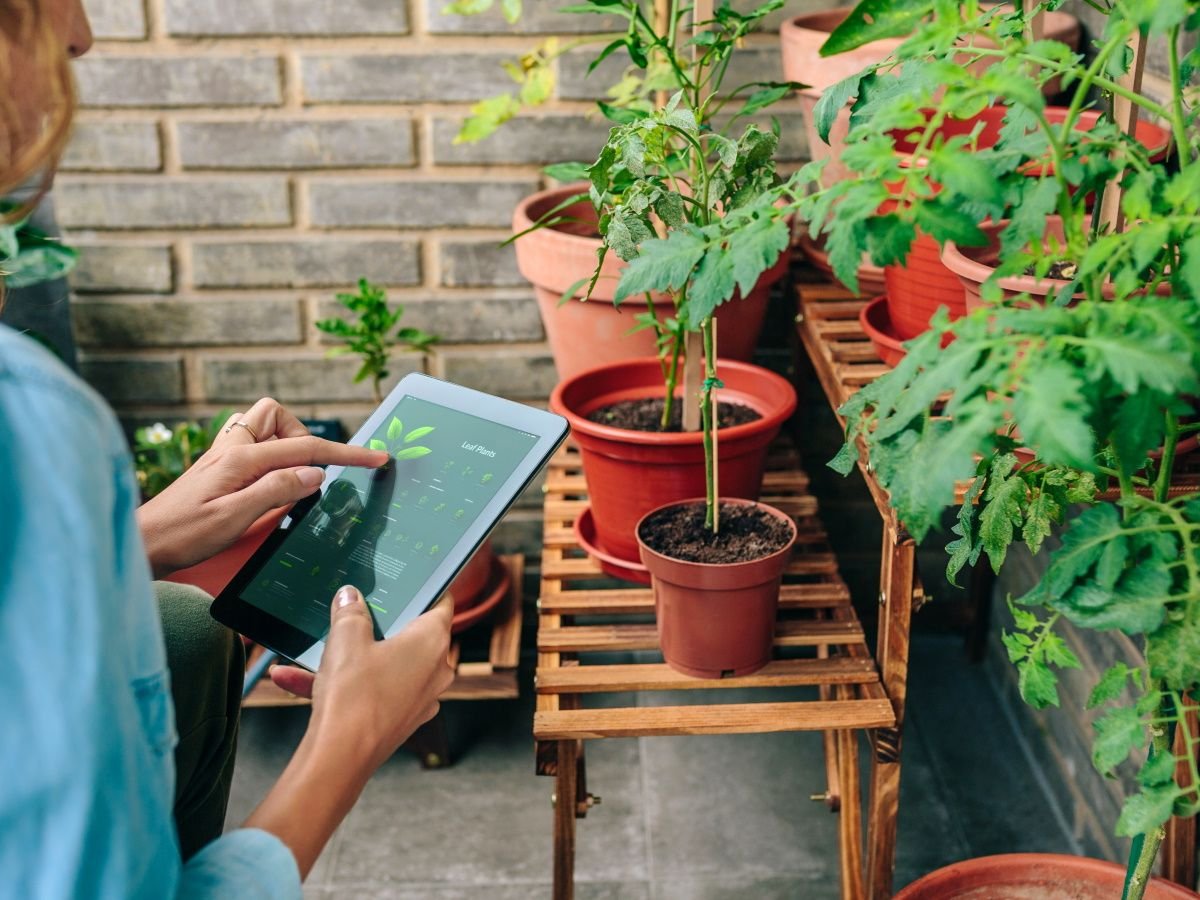
Image-recognition models are now very good at identifying plants and insects from a single photo. Point a phone at an unknown seedling or a bug on a leaf, and a computer-vision model trained on millions of labeled images will usually name it in seconds. This alone solves a problem that once required a field guide and real experience.
Disease and Deficiency Diagnosis
The same vision technology can flag plant diseases and nutrient deficiencies from visual symptoms. A yellowing pattern, a spotted leaf, a particular kind of wilt- these are visual signatures a well-trained model can often match to a likely cause faster than a beginner could.
Smart Irrigation and Soil Automation
This is where AI moves from advice to action. Soil-moisture sensors, connected to Internet of Things controllers, can water a garden only when the soil actually needs it, adjusting automatically for rainfall and forecasts. Commercial systems already blend live sensor data with weather prediction to cut water use while keeping plants healthier than a fixed schedule ever could.
Weather, Frost, and Harvest Prediction
AI models are strong at pattern-based forecasting. Fed historical and live climate data, they can predict frost windows, suggest planting dates, and estimate harvest timing. This turns raw weather data into concrete, timed decisions.
Robotics in Commercial Agriculture
At the industrial end, robots already weed, thin, and harvest crops on large farms. Vision-guided machines can distinguish crop from weed and remove the weed mechanically or with a targeted spray, working row after uniform row without tiring.
Taken together, that is a serious toolkit. Anyone claiming AI has nothing to offer the garden simply has not been paying attention.
The Line Between Farming Automation and Home Gardening
Here is the distinction that resolves most of the confusion, and it is one a systems-minded reader will appreciate immediately.
Large-scale agriculture is being automated aggressively, and for good reason. It is the ideal environment for machines: endless uniform rows, a handful of repeated tasks, predictable conditions, and budgets big enough to justify the hardware. Repetition and scale are exactly what automation feeds on.
Home and craft gardening is close to the opposite problem. Every yard has its own microclimates. Every pot drains differently. One corner bakes in afternoon sun while another stays damp and shaded. The tasks are varied, the conditions are messy, and the scale is tiny. AI thrives where tasks repeat and inputs are clean. Gardening at the human scale is a landscape of exceptions, and exceptions are where automation struggles most.
So the headline is not “AI is coming for gardening.” It is “AI is transforming industrial agriculture, while the backyard garden remains stubbornly, structurally human.”
What AI Cannot Replace, and Probably Will Not?
This is the core of it. There are parts of gardening that resist automation not because the technology is immature, but because of what the work fundamentally is.
The Sensory Read a Machine Lacks
An experienced gardener reads a plant with their whole body. The give of the soil under a finger, the specific droop of a leaf that means thirst versus the similar droop that means root rot, the smell of soil that has gone sour. A model can classify a photo, but it does not stand in the bed, touch the soil, and integrate a dozen faint signals at once the way a person does without even thinking.
Judgment Under Messy, Local Conditions
AI advice is, by nature, general. It answers for the average case. But gardening happens in a specific yard, in a specific season, in that one weird bed where nothing behaves. Deciding what to do with the actual conditions in front of you, and weighing this plant against that microclimate, is judgment, and judgment under unique local conditions is precisely what generic models handle worst.
The Hands-On Physical Craft
A great deal of gardening is skilled physical work that lives in the hands. Pruning a shrub to shape its future growth, transplanting without shocking the roots, or a propagation technique like layering propgation, where you coax a stem to root while it is still attached to the parent plant, all depend on feel and tactile experience that no app can perform for you. An AI can describe the steps. It cannot make the cut.
Care, Patience, and the Relationship Over Time
Gardening is also a relationship with living things that unfolds across seasons. Noticing that a plant is subtly off before any obvious symptom appears, and connecting that hunch to something you changed three weeks ago, is a kind of attentive care built over time. Reading early, ambiguous signs of stress, for instance, is closer to the intuition behind knowing when a plant actually needs water than to anything a sensor threshold captures. Machines optimize. Gardeners tend.
The Realistic Future: AI as the Gardener’s Tool, Not Their Replacement
Strip away the drama and gardening follows the same pattern as almost every field AI has touched. The technology does not replace the practitioner. It changes what the practitioner focuses on.
Think of AI as a co-pilot. It handles the lookup, the monitoring, and the number-crunching: identifying the pest, watching soil moisture, flagging frost. That frees the gardener to do the parts that need a human: judgment calls, physical craft, and care.
The interesting result is a three-way split. The gardener who ignores AI entirely gives up genuinely useful tools. The person who trusts AI blindly, with no hands-on skill to sanity-check it, gets burned by generic advice that did not fit their yard. The winner is the gardener who treats AI as an assistant and stays the decision-maker. That is not a threat to gardeners. It is an upgrade for the ones who adapt.
How Gardeners Can Use AI Today, Practically
If you garden and want to put this to work now, here is where AI earns its place:
- Identify unknown plants and insects instantly with an image-recognition app.
- Catch disease and deficiencies early by scanning worrying leaves before problems spread.
- Automate watering with soil-moisture sensors so plants get water on need, not on a rigid timer.
- Plan around data by using frost and weather prediction to time planting and harvest.
- Learn faster by asking AI to explain techniques, then verifying them in your own beds.
One honest caution runs through all of it. AI advice is generic until you ground it in your specific conditions. The sensor tells you the soil is dry, but you decide whether this particular plant wants water today. Use the tool, then trust your own hands to confirm it.
Final Thoughts
Will AI replace gardeners? No. But it will keep changing the gardener’s toolkit, and that is a genuinely good thing for anyone willing to pick the tools up.
The reason gardening resists full automation is the same reason people love it. It is sensory, physical, local, patient, and deeply human, hands in the dirt, reading a living thing that never behaves quite like the manual says. AI can hand you better information than any generation of gardeners has ever had. What it cannot do is stand in your garden, feel the soil, and decide. That part is still, wonderfully, yours.
FAQs
Can AI identify plants and diseases accurately?
Often yes. Image-recognition apps are strong at naming plants and flagging common diseases from photos, though they can miss context and still benefit from a human double-check.
Will robots replace farm workers?
In large-scale agriculture, robots already handle weeding, thinning, and harvesting for some crops. Uniform, repetitive fieldwork is far easier to automate than varied home gardening.
Can AI tell me when to water my plants?
Yes, through soil-moisture sensors and weather-linked controllers. Just remember the system reports conditions, while you still decide what a specific plant needs.
Is there an AI gardening assistant?
Many apps combine plant ID, disease diagnosis, and reminders into an assistant. They are helpful learning and monitoring tools, not a substitute for hands-on judgment.