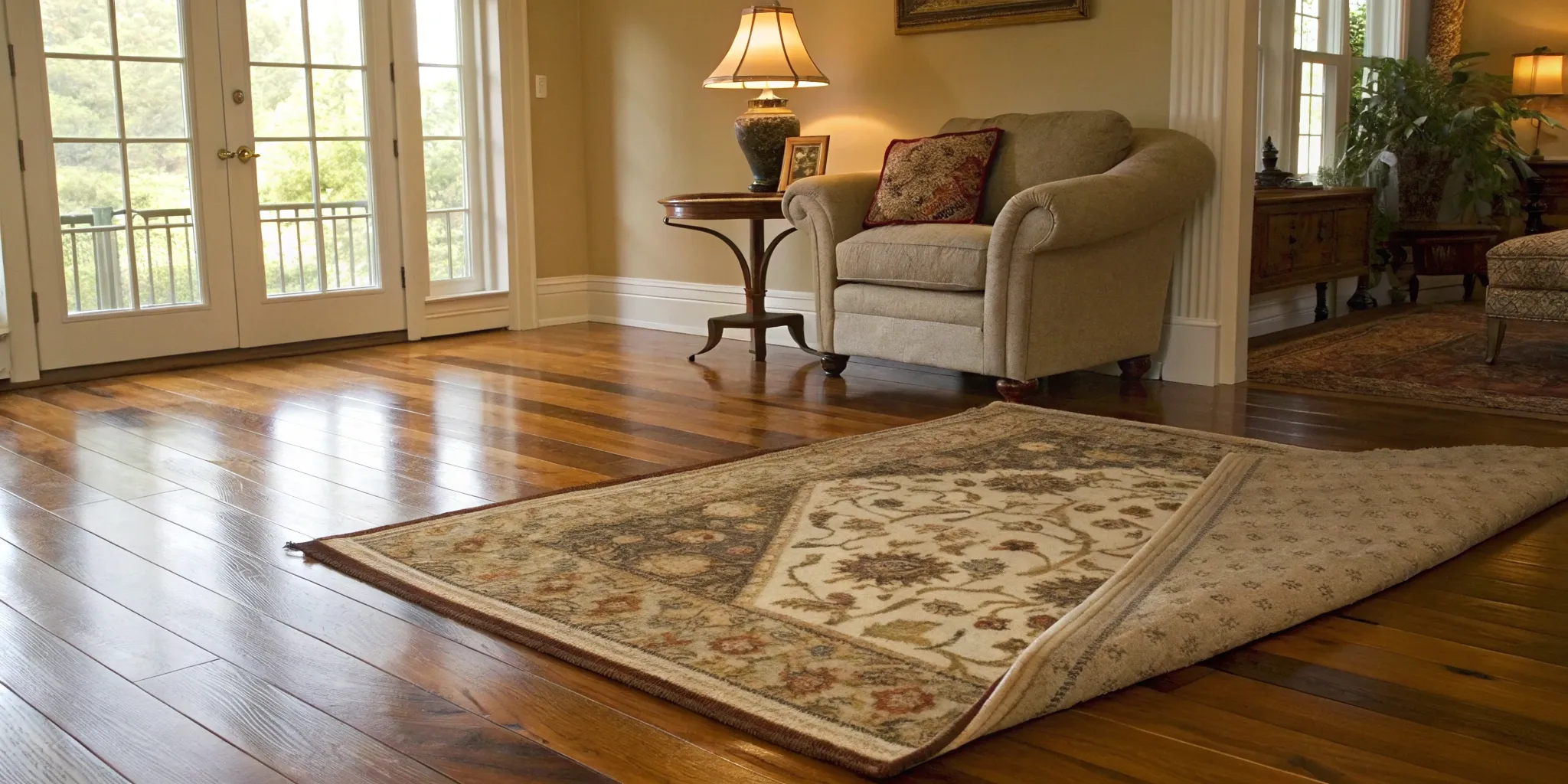
Most people assume a rug is enough on its own — a soft layer of wool or fiber sitting quietly on top of the wood, doing no harm. In reality, an unpadded rug behaves more like a slow-motion piece of sandpaper. Understanding why comes down to three mechanical and chemical processes that happen underneath the rug, mostly out of sight, over months and years of foot traffic.
The Hidden Abrasion Problem
Hardwood floors don’t usually get damaged in one dramatic moment — they wear down through repetition. Every rug traps a small amount of dust, sand, and grit inside its fibers, no matter how often it’s vacuumed. When someone walks across the rug, that trapped grit gets pressed and dragged against the finish underneath. Over thousands of footsteps, it works exactly like fine-grit sandpaper, slowly dulling the polyurethane topcoat and creating micro-scratches that catch light differently than the surrounding floor. A rug that also shifts and slides adds a second layer of friction on top of that — the backing itself scraping across the finish every time it moves.
Moisture Doesn’t Need a Spill to Cause Damage
Wood is porous, and hardwood finishes are designed to let a small amount of moisture vapor pass through rather than trapping it. A rug with no breathable layer underneath — or a solid, non-perforated backing — can hold humidity against the floor long enough to cause cupping, warping, or discoloration, even without an obvious spill. This is more common than most homeowners expect in humid climates or rooms with fluctuating temperatures, where moisture can cycle in and out of the wood every day.
Not All Backing Materials Behave the Same Way
This is where the science gets more specific, and where a lot of “non-slip” rug pads quietly cause the exact problem they’re supposed to prevent. Many synthetic backings rely on plasticizers to stay soft and flexible, and those plasticizers can migrate out of the material over time — especially under heat and pressure — leaving a sticky residue or a discolored patch bonded to the finish. It’s a chemical interaction, not a manufacturing defect, and it’s specific to certain material families rather than something that happens with rubber, PVC, or foam equally. If you’re comparing pad materials before buying, it’s worth understanding how TPE, PVC, and natural rubber actually differ at a material level, since that difference is usually what separates a pad that protects a floor from one that damages it.
Natural rubber tends to come up again and again in flooring-safety guidance for a reason: it stays flexible without relying on the plasticizer chemistry that causes most of the staining and residue complaints. It’s worth understanding where natural rubber comes from and how it’s processed before assuming every “rubber” pad on the market is made the same way — tapped latex, synthetic rubber, and rubber-blend backings don’t all perform identically once they’re under a rug for a few years.
What Actually Protects the Floor
Put those three mechanisms together — abrasion, moisture, and chemical migration — and the pattern becomes clear: a rug pad only protects hardwood if it’s breathable enough to avoid trapping moisture, stable enough to stop the rug from sliding and grinding grit into the finish, and made from a material that won’t react with the floor’s finish over time. Thickness matters too; something too thin won’t cushion or stabilize the rug, and something too thick can destabilize furniture sitting on top of it. For anyone shopping for a pad and trying to sort through the material and thickness tradeoffs, this guide to choosing the right rug pad for hardwood floors breaks down the options in more detail.
The short version: a rug pad isn’t just a courtesy layer between your rug and your floor. It’s doing real mechanical and chemical work every day, and the material it’s made from determines whether that work protects the floor — or slowly damages it.