Introduction: The Foundation of Modern Computing
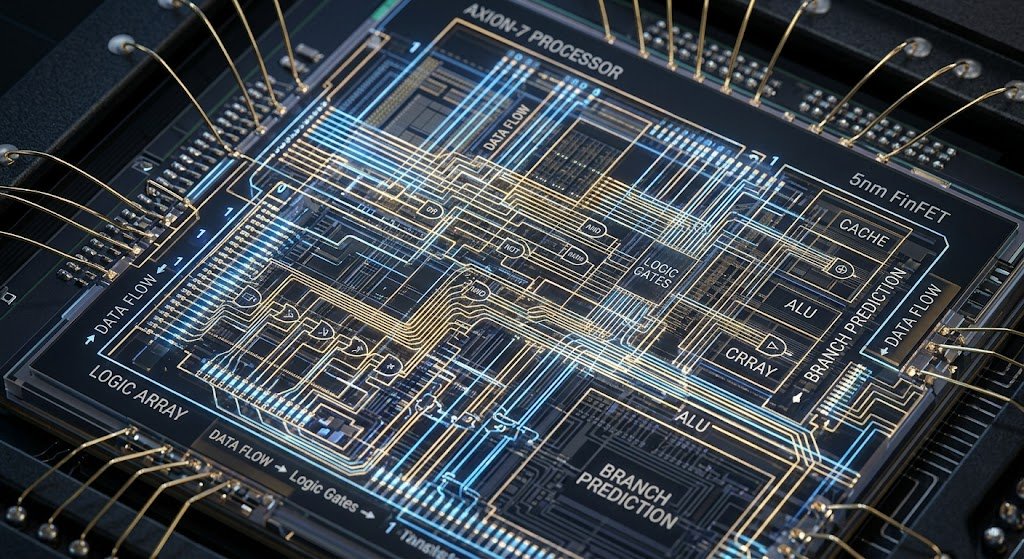
The development of the modern computer depends on the invention of electronic transistors. All the devices we use from computers to smartphones, tablets and so on are based on a world of electronic decisions occurring millions or billions times per second, all hidden from view. A processor executing a program, storing data, showing pictures, or calculating numbers is based on very small electronic devices making very simple decisions, which are stated as “0” or “1”. The two are the basis of digital electronics and the components that process these binary decisions are called logic gates. Logic gates are the components that make computers work, whether they’re used for simple comparisons or sophisticated AI computations. Despite the billions of transistors in a modern processor, the basic operations within the processor are still made up of a series of basic logic gates.
On the basic level, computers cannot read words, read pictures and understand instructions as we do. They process electrical signals that represent Binary values, rather. The higher the electric signal the closer to 1 and the lower the electric signal the closer to 0. These signals can interact in different ways and according to certain rules, which are specified by logic gates. All these rules use Boolean logic, a mathematical system that describes relationships between true and false values, developed by George Boole. With thousands or millions of logic gates, engineers can build circuits that do calculations, store data, control devices, and run software commands.
Digital logic gates are fundamental circuits that link the physical electronics and software operations of the computer. They are a concept that needs to be understood in order to understand the operation of the computer. All programs executed on a computer rely on instructions being translated into electrical signals and flowing through a succession of logic circuits. The concept of logic gates gives insight into how a computer transforms simple electrical changes in transistors into more sophisticated functions in today’s computers.
What are Digital Logic Gates
A digital logic gate is an electronic circuit which takes a number of binary inputs and gives one binary output which is determined by a logic gate. The values 0 and 1 are used to represent inputs and outputs, where 0 is a signal of low voltage, and 1 is a signal of high voltage. For example, an AND gate only produces an output of 1 when all of its inputs are 1. The output of an OR gate is 1 if either or both of its inputs is 1. The NOT gate is special in that it has only one input and outputs the opposite bit value: a 1 becomes a 0 and a 0 becomes a 1.
Logic gates are similar to decision making systems. Humans have rules to follow when making a decision, logic gates do too when they are dealing with electronic rules. One is a security system that needs two things to open a door: a security card, a correct password. This can be represented with an AND gate, as the gate will only allow the access when both conditions are met. Again, a warning system that is triggered by either a high temperature or the presence of smoke can be modeled with an OR gate since only one of these conditions need to be met for the warning to be activated.
The logic gates are simple logic elements, but their strength lies in the combination of these logic elements. With a large number of gates arranged in particular patterns, complex circuits like processors, memory units, graphics systems, and communication devices are made. Combinations can be used for arithmetic calculations, comparisons, decision making, and controlling the flow of information in a computer.
How Transistors Make Logic Gates
Transistors are electronic devices used to create logic gates. A transistor is a semiconductor device which is used to control electric current. It may act as a small switch, either opening or closing a circuit based on whether it receives a signal or not. A computer processor uses billions of transistors that have the ability to rapidly switch between states with very low power consumption.
Transistors can be turned on or off, so they are appropriate to represent 0s and 1s in binary numbers. If current is allowed through the transistor, it can be used for one logical state, and if it is blocked, it can be used for another logical state. Engineers can use various combinations of transistors to make circuits that handle logical operations. For instance, a NOT gate could be formed by having a transistor arrangement that inverts the input. If the input is high, the transistor switches the circuit state to make output low and vice versa.
More complex gates use more than one transistor. For instance, a NAND gate is a combination of an AND gate and a NOT gate. Within the circuit, the transistors are wired such that the output will only be 0 if all the inputs are 1. The basic idea of these transistor designs is used in integrated circuits, which are designed to allow for the operation of millions or billions of logic operations within a very small physical area.

From Transistors to Computer Systems
There are many layers of complexity that lead from a single transistor to a computer system. Logic gates are made from individual transistors, logic gates are combined to form functional circuits, and circuits are combined to form processors and digital systems. A processor is not directly able to interpret programs written in programming languages like Python, Java, and C++. Rather, those instructions are eventually converted into binary patterns that drive electronic circuits known as machine code.
For instance, the computer adds two numbers but not in the same way that a person writes their sum on paper. Rather, it employs circuits composed of logic gates which toggle binary numbers. These circuits are responsible for performing addition, carry, comparison, and storage operations. These operations are performed by millions or billions of gates, which are so fast that they are implemented using transistors.
Boolean Algebra and Logic Gate Operations
True and false, or 1 and 0. These present the rules for putting together and playing with these values which in turn allow engineers to design electronic circuits before they physically build them.
In Boolean algebra which maps to what we use in logic gates. For AND we use multiplication so A AND B is the same as A x B or AB. OR is represented by addition thus A OR B is A B. NOT is marked by a bar over the variable or an apostrophe which means that NOT A is A’. Also these math representations help out with the design of the circuits and in creating very efficient designs.
In Boolean algebra we see that identity, complement, and distributive laws are of great importance. These rules in turn enable designers to out do waste in gate use which in term makes for smaller, faster, and more energy efficient circuits. The field reports that modern processors which have to fit billions of elements into very small areas is a challenge which Boolean optimization helps to overcome.
Basic Logic Gates and Truth Tables
AND Gate
An AND gate outputs 1 when all inputs are 1. Should any input be 0 the output is 0. This gate is for when multiple conditions must be met at the same time.
| Input A | Input B | Output |
| 0 | 0 | 0 |
| 0 | 1 | 0 |
| 1 | 0 | 0 |
| 1 | 1 | 1 |
In the physical world we see a simple AND gate in a machine which will only turn on if the power switch and the safety switch are at the ON position, should any one switch be at the OFF position the machine will not start. In computer science AND gates are used for functions in which many criteria must be met before a certain process is set in motion.
OR Gate
An OR gate has an output of 1 when at least one input is 1. Also if all inputs are 0 the output drops to 0.
| Input A | Input B | Output |
| 0 | 0 | 0 |
| 0 | 1 | 1 |
| 1 | 0 | 1 |
| 1 | 1 | 1 |
In the real world we see an example in an alarm system that sets off at the detection of motion in either a door or a window. Also in this case only one condition has to be met and thus the function of an OR gate is very much at play.
NOT Gate
A NOT gate also known as an inverter has one input and outputs the opposite value.
| Input A | Output |
| 0 | 1 |
| 1 | 0 |
NOT gates are used in systems which need to reverse a signal. In digital circuits they are very important because many computer operations require a value as well as its complement.
NAND Gate
A NAND gate is a NOT AND. It produces the opposite of what an AND gate does. Also when both inputs are 1 the output is 0.
| Input A | Input B | Output |
| 0 | 0 | 1 |
| 0 | 1 | 1 |
| 1 | 0 | 1 |
| 1 | 1 | 0 |
NAND gates are very important as they are universal gates. Which means any other logic gate may be constructed out of them.
NOR Gate
A NOR gate is the inverse of an OR gate. Also it puts out 1 only when both inputs are 0.
| Input A | Input B | Output |
| 0 | 0 | 1 |
| 0 | 1 | 0 |
| 1 | 0 | 0 |
| 1 | 1 | 0 |
NOR gates are also universal in that with them you can build any digital system.
How Logic Gates Build Adders
A half adder uses XOR to determine the sum and AND to determine the carry. As two binary values are added the XOR gate determines if the bits are different which in turn produces the sum, at the same time the AND gate determines if both values are 1 which in turn produces the carry. By using many half adders and more logic gates engineers put together full adders which in turn are able to process larger binary numbers.
Full adders are a key component in processors which they use to do arithmetic on data. In today’s CPUs we see many arithmetic units which together carry out millions of calculations per second.

How Logic Gates Build Multiplexers
Another key use of logic gates is in the design of multiplexers. A multiplexer is a circuit which chooses one input out of many available inputs and puts it out at the output. It functions as a digital switch which determines which data signal will pass through the system.
For instance a four input multiplexer may see four different signals at the same time but will pass only one of them to the output at a time which is determined by the control inputs. Logic gates look at the control signals to figure out which input to put out to the output. That is a key feature in processors, communication systems, and memory devices as computers are always tasked with the efficient management of large sets of information.
Multiplexers show that from simple gates we can build out advanced control systems. A single AND or OR gate does a basic job, but by very thoughtfully arranging thousands of them we can create circuits which manage complex data paths in modern computers.
Real-World Applications of Logic Gates
In almost everything that is digital you will find logic gates which form the base of electronic decision making. In smart phones logic gates play a role in processor performance, touchscreen response, wireless transfer of data, and app running which is the equivalent of what we do with a desktop computer. In cars they are in safety features, engine management, navigation systems, and the automated elements.
Industrial machinery has use of logic gates in their automation. In manufacturing robots we see digital circuits which determine movement, sensor response, and operation sequences. Also in medical equipment logic circuits are used to process measurements and control functions. Even in simple devices like digital watches and calculators we see combinations of logic gates which display info and perform calculations.
Logic gates play a key role in converting simple electrical signals into what is useful and meaningful. They are the interface between the physical hardware and the software we use which in turn shapes our digital experience daily.
Conclusion
Logic gates are the basic elements that make up all digital technology. While they perform simple functions by themselves, it is in their ability to be put together in complex circuits that we see the power of modern computing. From transistors which switch electrical signals to processors which carry out billions of instructions, at each stage of computer operation we see the role of these small components in making logical decisions.
Comprehension of AND, OR, NOT, NAND, and NOR gates is key to see how at the most basic level info is processed by computers. In Boolean algebra we see that which engineers use to design efficient circuits it is also in the assembly of gates we find the building blocks for adders, multiplexers, memory systems and processors. As tech advances what lies behind logic gates is still the same which is proof that the very small scale electronic decisions power the most advanced machines we have in the world today.