Introduction
Digital lending has transformed the lending process of banks and financial institutions, allowing users to apply, upload required documents, get a credit rating and even keep track of loans repayments online. Applying for a loan in the branch involves completing several forms and going to the branch; the borrowers can now access loan services from almost anywhere by using websites or mobile apps. Underpinning these services is technology such as identity verification, income assessment, creditworthiness assessment, and technology-assisted loan processing. Technologies enable these services including identity verification, income assessment, creditworthiness assessment and technology assisted loan processing. Applications from borrowers can be submitted to these systems to ease the processing by the lenders and lenders can offer the borrowers a decision regarding the loan application within a shorter period of time. But responsible financial planning can’t be done away with in the digital lending world. Applicants should also have knowledge of the interest rate, fees, term and conditions of a loan, the risk to the borrower. It will help customers to make informed decisions to secure the right loan offer and not accept offers that may not be appropriate given the concept of digital loans.
What is it about a Digital Loan?
Digital loans are financial products that customers can apply for and manage via digital platforms, not entirely dependent on the traditional (face-to-face) banking procedures. Banks, authorized lenders (including microfinance institutions and fintech companies) can offer these services through mobile applications, internet banking platforms or through specially designed lending websites. The customer can get personal loans, salary advances, business loans or other types of credit from the provider. The digital platform integrates the different stages of a loan as discussed above: application, document verification, credit evaluation, loan approval, disbursement and loan repayment monitoring. Numerous lenders automate these functions, while some lenders even use digital with human review. While digital lending can be more convenient to borrow from, the requirements for eligibility and the loan amount that can be obtained varies from lender to lender. Before giving personal information or accepting an offer, it’s best for customers to verify that a lender is legitimate and know the conditions of the loan.
Digital Loan Application Process
1. Submit an Application and Document.
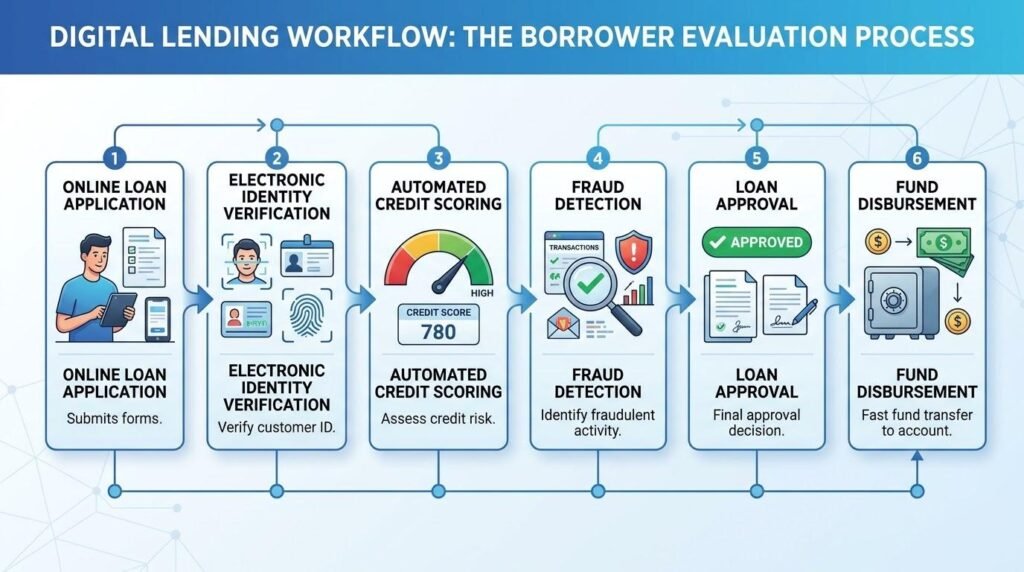
Typically starts with an applicant visiting a lender’s website or opening their mobile application. The customer registers an account, enters his or her personal details, selects the loan product and enters details of his or her employment, monthly income, loan request and desired loan term. The platform may require copies of documents like proof of address, business records, payslips, bank statements and an identity document from the government. These documents may be presented as a photo, scanned copy or on-line as an electronic statement, depending on the lender. In certain applications, when an automated form is submitted, missing information will be automatically detected before submission. This helps to minimize paperwork and ease the application process outside of banking hours. But applicants are advised to make sure that they are providing accurate information, that they are using encrypted Internet connections and that they review the lender’s privacy policy before submitting documents containing financial or identity sensitive information.
2. Electronic Identity Verification
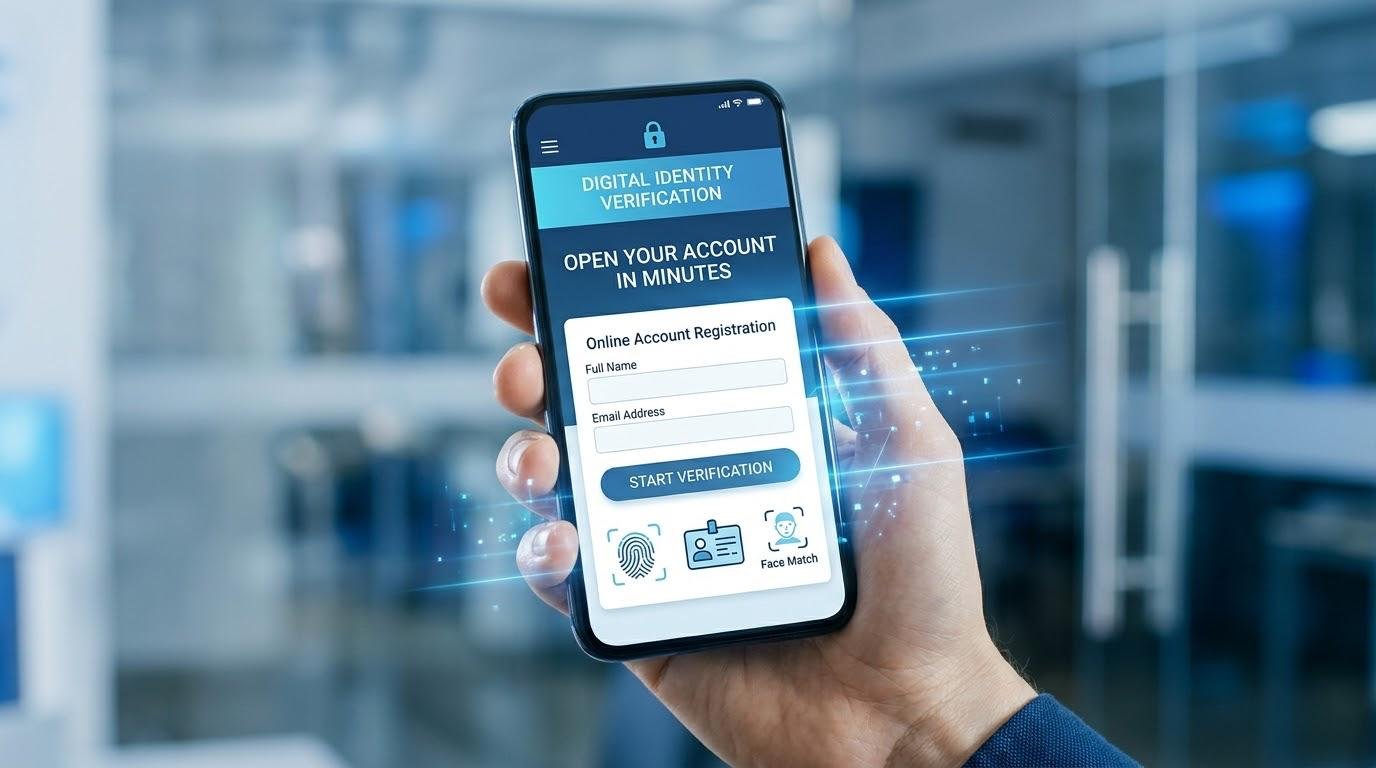
Lenders require the proof of identity of loan applicants before they will approve a loan. Electronic Know Your Customer (e-KYC): A process of electronic verification which helps to prevent money laundering, impersonation and fraudulent applications. The process can include verification of an identity number, cross-referencing the submitted documents with a trusted document, verification of a phone number, or matching a face image with a picture of an identity. There are also sites that have ‘liveness detection’ technology in place to determine if a camera is being operated by a real person or a re-created image or video recording. Customers can agree to terms without having to print and sign documents, using electronic signatures. Although these technologies can help to expedite the verification process, there is a potential for inaccurate verification caused by poor images, mismatching records, or technical problems. If a lender has “officially verified” an applicant, they should be advised to follow the instructions for “verification” and should not enter their password and/or one-time security code into any system they are told is operated by a lender.
3. Automatic Credit Scoring and Eligibility Assessment
After the identity verification process, lenders determine if a loan applicant has the ability to pay back the loan. Automated credit scoring systems use details like past borrowing, repayment history, current debts, how they use their credit, and the credit bureau records that lenders use to gain access to the borrower’s credit. The system might give a score or determine a risk class that guide the lender in deciding if a borrower is eligible for a loan, the loan amount, the interest rate, and the loan terms. Some platforms employ statistical models or machine learning algorithms to detect patterns linked to repayment issues. But the quality and relevance of the information available is critical to automated decisions. If an individual has no credit history, they may be given a different rating as an applicant than another person with similar incomes but with a longer history of borrowing, and paying their bills. It is important to applicants to note that it does not mean that they will be granted approval if they have submitted their applications online. Lenders could ask for more details, hand applications to manual review or refuse to accept applications that fail to meet their lending requirements.
Technologies Assisting Banks in Evaluating Borrowers
The traditional credit assessments are based on the people’s formal borrowing records, which may put people who have never used credit cards or taken bank loans at a disadvantage. Therefore, some digital lenders choose to look at alternative data, if lawful and in line with the proper consent. It can be anything from income that has been verified, business transaction information, regular bill payments or cash flow data from approved financial accounts. Transaction histories will provide a small business with evidence of whether income is steady enough to make repayments. Income assessment tools can be used to cross-check payslips against bank statements, and determine if a person is able to afford more debt. These techniques can allow access to credit to those with a less-than-strong credit history, such as some self-employed and small business owners. Alternative data needs to be used with care, though, as information that is out of date, incorrect or irrelevant can lead to unfair evaluations. Consumers should be aware of the information that the lender gathers, the purpose of collecting that information, and if the information is optional, whether it is available to them to refuse to provide that information.
How to Leverage Data to Detect Fraud and How to Use Automated Processing
Digital lending platforms integrate the application forms, identity verification, credit checks, document management, and approval processes with a single platform. Automation can route the applications to the right department, check if the documents are missing, indicate eligibility parameters, and alert applicants if they need to take any additional steps. Fraud detection mechanisms can identify duplicate app applications, suspicious info about the identity, unusual transaction patterns, or discrepancies or inconsistencies among documents. For more complex cases, you can refer them to trained staff who can further investigate them. The automatic checks combined with the manual quality control give lenders the safety and control to process high volumes of applications without depending on manual processes. But automation will not prevent all fraud and cannot ensure accuracy of all decisions. Stolen identity documents, tampering with the finances, and exploiting vulnerabilities in digital systems are just a few methods used by criminals. Banks need to ensure that they have secure databases and be vigilant about detecting fraud, verify their models, and offer mechanisms to correct inaccurate information. Customers should also ensure that they have their devices secured and only use trusted lending platforms.
Comparison of Digital Loans to Traditional Loans.
Unlike traditional lending, there is a key distinction between digital and traditional lending around how customers can access services and how it’s completed by the lender. For traditional loans, you might need to go to the branch, print out any documents, sign, and meet with various bank officials. These processes can be helpful if you require more information or have a complex financial situation, and may require more time and travel for applicants. These can be addressed by digital loans, which enable borrowers to input data online, monitor the loan application process, receive updates electronically, and pay off the loan via approved payment methods. For simple applications, automated checks can also help to reduce time to decision. However, not all digital services are necessarily quicker, easier or more accessible. Delays in decisions can be caused by technical problems, internet access issues, documentation problems and requests for additional information. Occasionally, a borrower may also want to meet with a loan officer prior to committing to a financial decision. It will depend on the circumstances of the borrower, the reliability of the lender, the complexity of the application and the quality of support that is available.
Valuation of Interest Rates, Fees & Repayment Obligations of the Loan
The convenience often isn’t the only criteria to look at when selecting a digital loan. Before accepting an offer, borrowers should carefully review the interest rate, the total amount of the repayments, the schedule of repayments and all the charges. The costs can be arrangement fees, service charge, late payment charge or other costs mentioned in the product. Even if the interest rate advertised on a loan is low, it can be costly if there are high fees involved or if there isn’t a long period of time to pay it back. Customers should work out the cost of borrowing from various lenders and consider if installments are affordable after paying essentials. They should also find out if the interest rate will be set or variable, if there’s any penalty for paying off the debt early, and what will happen if the debt goes unpaid. Customers can use a repayment calculator to get an idea of repayments, but should check the numbers against the formal loan agreement. Approval is not a sign that a lender will grant credit, it is only a way to show that a lender is willing to lend.
Major Risk of Data Privacy and Security
Personal and financial information will be needed to be collected and processed when lending digitally, and privacy is an important issue. Identity numbers, contact information, income history, bank transactions, photos and employment information may all be included in an application. When this information is accessed by others through poor security or weak authentication, it could result in identity theft, financial fraud or the disclosure of personal information. Good lenders need to employ suitable encryption, access control, secure authentication and the maintenance of clear data retention policies. They need to describe how the information of their customers is collected, used, shared and stored, consistent with the relevant data protection laws. Applicants should read the privacy notices, pay attention to the permissions that a mobile application is asking for, and shouldn’t upload any sensitive documents via unofficial links. They should also be wary if an app requires their contacts, images and other unrelated data. Being a professional-looking website or application does not mean that its operator is trustworthy.
Fraudulent Loan Applications and Predatory Lending
However, some unscrupulous players take advantage of the quickness and ease of online loans to target individuals who are in desperate need of cash. Predatory lenders might include exorbitant fees in their advertisements, require consumers to pay back in unusual ways, or collect in a threatening manner. Some fraudulent loans are also those where an application from a legitimate bank is accepted, and the finance is requested upfront for approval to be given; or where identity details are extracted for use in a criminal application. Red flags are: predatory loans where they are not required to pay, vague loan terms, pressure to take out a loan, advance fees that are not explained, and asking them to transfer money to their personal account. It is the borrower’s responsibility to confirm the identity of the lender, their regulatory status, contact information and official lending applications. The customers can refer to the appropriate official regulatory documents such as the Central Bank of Nigeria for regulated banking institutions and the Federal Competition and Consumer Protection Commission for relevant consumer protection information in Nigeria. They must thoroughly examine the terms on which they can get back the money and not accept any money from an untrustworthy lender. When a deal seems too good to be true, it probably is, and it’s better to take the time to figure out what is going on than to enter into a contract.
What is a Suitable Digital Loan?
Borrowers should determine the amount of funds they truly require and the best step to take before applying is to determine if they need to borrow funds. They should consider the offers of reputable companies, the eligibility criteria, the overall repayment amount, and the repayment schedule and if it is compatible with their earnings. It is also important that customers ask about the procedure used to deal with their complaints, if it is possible to repay early, and what help is on offer if their financial situation changes. They should review an offer at the time of acceptance and not just by looking at the approval email notification or a summary that appears in the application. Borrowers should keep a copy of the contract, the confirmation of payment and communications. If they don’t understand the terms, then they should ask questions before signing the agreement. One of the considerations in making a responsible decision is to take note of the possibility of a change in income, the unforeseen expenses that may arise as well as other debts that may already exist. While digital tools are useful for making comparisons and calculations easier, the borrower will have to determine whether the commitment is able to be managed.
Conclusion
Digital lending enhances the loan application process with the help of onboarding systems, alternative data, income verification, automated credit scoring and identity verification. These technologies can assist banks to assess applications, identify suspicious transacting, inform the decision and handle repayments with decreased paperwork compared to many conventional approaches. Meanwhile, they add key points related to privacy, automated decision mistakes, bogus providers, concealed charges and irresponsible borrowing. The customers should make sure to verify the lenders, compare the full cost of credit, safeguard the personal information and ensure repayment commitments are suitable for the customers’ financial situation. The most crucial part to note about digital approval is that it is not a measure of affordability. A loan is only of benefit if they know exactly what they are getting themselves into and they have a viable plan to pay it back. The convenience of digital services, coupled with sound financial considerations, enables customers to make informed borrowing decisions.
Get more well researched information about Digital loans here.