Introduction
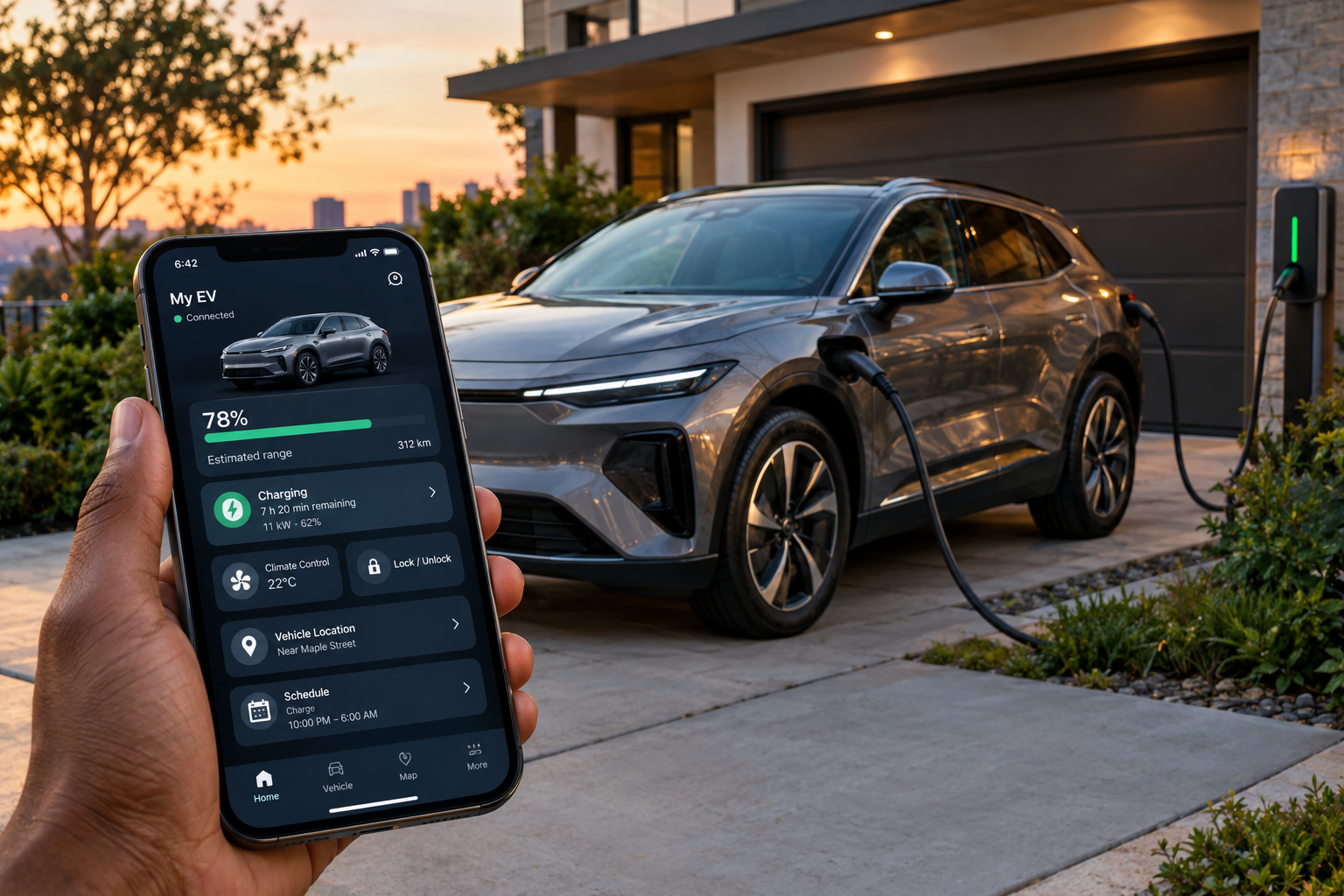
Smartphone engine monitoring allows drivers and car enthusiasts to view useful information from a vehicle’s electronic control system in real time. Today’s vehicles are equipped with electronic control units and sensors that constantly check and adjust the engine’s functions. The systems gather data from engine speed, temperature, airflow, fuel control, emissions, and other operational factors. Drivers typically only get a glimpse of this information on the dashboard, but a diagnostic system for the smartphone can show many more parameters in real time. This can aid drivers and car enthusiasts in comprehending how an engine performs when starting, idling, accelerating, and performing regular driving.
This sort of information can usually be tracked with a smartphone, a compatible diagnostic application, and an OBD-II adapter that links the vehicle to the smartphone. Many compatible smartphone diagnostic apps can display information from the vehicle’s electronic systems and sensors. The parameters that can be displayed are dependent on the vehicle, engine, model year, and diagnostic system.
What Is Live Data?
Live data is data that is provided from a vehicle’s electronic control system as the engine is running. Sensors feed data into the ECU, which adjusts various operations of the car, including fuel feed, ignition, emissions, and engine running. Some of this information can be requested by a diagnostic application and shown on a smartphone as numbers, gauge indications, or graphs.
Reading and checking out the diagnostic trouble codes is not the same as live data. A trouble code will tell you if there is a problem with the vehicle, and live data will tell you what is going on with various systems at the time. For instance, if an engine idles unsteadily, watching the RPM, coolant temperature, throttle position, and fuel-trim readings all in one go will help give a clue as to what is going on.
What You Need
Smartphone and Diagnostic App
The smartphone is equipped with a diagnostic application that shows information received from the vehicle. There are various features in various apps, and users need to select one that can be used with their smartphone, adapter, and vehicle. Some applications are able to show real-time gauges, log data, display graphs, and save data for later analysis.
But an application can’t show information that the vehicle does not provide via its diagnostic system. The standard OBD-II parameters are typically more prevalent, and manufacturer-specific data might need special equipment. Thus, the number of sensors and readings that could be used varies greatly from one vehicle to another.
OBD-II Adapter
An OBD-II adapter acts as the connection between the vehicle and smartphone. It connects to the diagnostic port, usually under the dashboard of the car. The communication to the smartphone will be either via Bluetooth or Wi-Fi, depending on the adapter.
Quality is important because if the adapter is not of good quality, disconnections, slow updates, or communication issues can occur. The adapter should be compatible with the diagnostic application and vehicle. It’s also important that the user read the instructions for the adapter and not assume that all adapters will fit all vehicles.
Engine RPM and Coolant Temperature
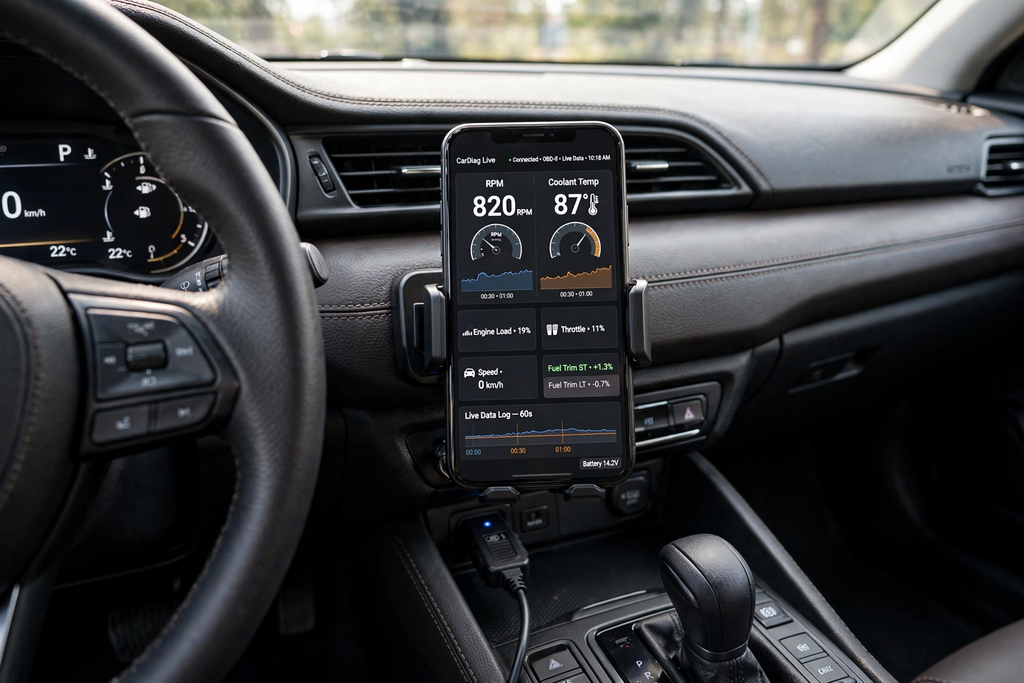
The RPM of the engine represents the rate at which the crankshaft in the engine revolves. Using a smartphone to monitor RPM can provide users with a way to see engine activity while starting, idling, accelerating, shifting gears, and decelerating. For instance, having an unstable engine idle would be more obvious if the RPM could be recorded to determine if the engine was fluctuating or idling at equal RPM.
The other useful parameter is the coolant temperature. The engine is cold when it is started and brings it to its operating temperature. The user can observe this warm-up process through coolant temperature monitoring and detect the abnormal temperature process. When the temperature acts abnormally, it can indicate a need to check out the thermostat, cooling fan, coolant system, or temperature sensor.
Vehicle Speed and Fuel-Related Data
Some diagnostic applications can display the vehicle speed, and the speed can be useful if measured in conjunction with other parameters. For instance, RPM, throttle, and engine load can be plotted together, along with speed, to illustrate the engine’s reaction to various driving conditions. The recorded speed also can be useful to pinpoint the moment that a specific engine behavior took place during the test drive.
Fuel-related information may help to gain more information about engine functioning. The short-term and long-term fuel trims are indicators of the changes the engine control system is making to fuel intake as a result of the sensor feedback. These readings are subject to change depending on the engine’s temperature, load, airflow, and other factors. Some applications may also offer an estimated fuel consumption, but this will also be dependent on the data that has been provided by the vehicle and should not be regarded as a measurement taken in the lab.
Oxygen-Sensor Information
Exhaust oxygen sensors check exhaust gas conditions and feed information into the engine control system that can be used to control exhaust gas and fueling. A smartphone diagnostic application can show the voltage of the oxygen sensors, the equivalence ratio, or other parameters depending on the vehicle.
The readings from the oxygen sensor(s) should be taken with consideration, due to the fact that they are made from various technologies for different vehicles. Just because a particular value is not the “normal” value doesn’t mean the sensor has failed. When combined with fuel trims, engine temperature, RPM, and diagnostic trouble codes, oxygen-sensor data can give a better indication of the engine’s operation.
Other Parameters That Can Be Monitored
Air Speed and Airflow Data
Some have a diagnostic system to give information about the throttle position. The accuracy of the application may show either actual throttle position or commanded throttle position, or the position of the accelerator pedal, depending on the type of throttle control. Some vehicles have electronic throttle control, and an application may show the accelerator pedal position, or commanded or actual throttle position. These are values which can be used to help the user understand the response of the engine to the driver’s actions.
Data on intake air may also be beneficial. The app can show the intake-air temperature, manifold pressure, mass airflow, or calculated engine load depending on the vehicle. These can be used in conjunction with RPM and fuel-related data to give a greater understanding of the relationship between the two.
Engine Load Data and Ignition Data
Engine load refers to the amount of load the engine is under within the vehicle control system. Load tends to change when the vehicle is accelerating, climbing a hill, and when more weight is added. All engine load, along with RPM and speed, can help engine enthusiasts understand how hard the engine is working.
Some vehicles also have information regarding the ignition, such as ignition timing. The values are dependent on the engine speed, load, temperature, and ECU control strategy. A single reading should not normally be used for diagnosis of a problem since many parameters are constantly adjusted by the ECU.
Investigating Problems Using Live Data
Live data can be useful when trying to diagnose symptoms: it lets you see multiple parameters at the same time. If an engine is having an unstable idle, for instance, a user could check RPM, coolant temperature, throttle position, intake-air information, and fuel trims. Recorded data can help identify a pattern if the issue only occurs after the engine has been warmed up.
The data logging feature is especially helpful since it provides a user with data after a drive. While operating the vehicle, the user does not need to simultaneously monitor multiple values; the values are recorded and can then be analysed in comfort. This information can also help a skilled technician with a diagnosis of the vehicle if a problem persists.
Limitations of Smartphone Diagnostics
Some limitations exist with regard to the use of smartphone diagnostics. An application can only show information that the vehicle can provide via its diagnostic system. In certain systems and modules, there may be the need for the use of manufacturer-specific diagnostic equipment. A basic OBD-II system also might give limited access to systems other than the standard engine and emissions data.
Live data can’t physically test each and every mechanical component. A smartphone can tell what an electronic system is telling it, but it does not automatically verify that a mechanical system is in good working order. Even a misreading sensor can give a false reading. As a result, it is recommended that smartphone monitoring is used to make a proper diagnosis and not as a substitute for mechanical inspection or a professional test.
Best Practices for Monitoring Your Engine
Check to ensure that the diagnostic adapter and application work with your vehicle before proceeding to monitor. Understand the meaning of each of the parameters and note if the engine is cold, warm, idling, accelerating, or under load. This is necessary as many readings naturally vary depending on driving conditions.
A baseline is also beneficial when the vehicle is operating normally. It can be easier to detect changes if certain parameters are recorded under the same conditions. Never make parts replacement decisions on the basis of one unusual reading. Rather, search for patterns and consider multiple related parameters before determining the need for further diagnosis.
Conclusion
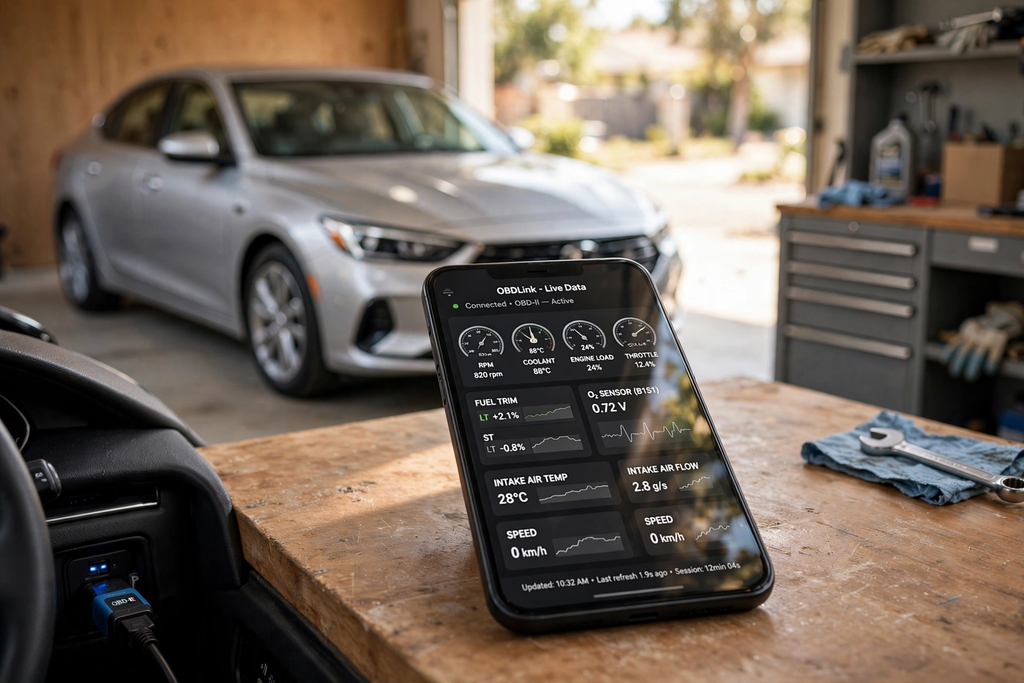
A smartphone and an OBD-II adapter can help the driver to monitor information that’s typically concealed from view. Depending on the vehicle, the user can see the engine RPM, the engine coolant temperature, the vehicle speed, fuel trims, oxygen-sensor information, throttle position, intake-air data, engine load, and much more.
The actual value of live data depends on comprehending the interaction between various readings. It can be a learning tool for drivers to familiarize themselves with normal engine operation, to investigate symptoms, to record unusual operation, and to give the driver some information to pass on to a technician. Smartphone diagnostics, however, are not meant to replace proper diagnostic procedures and diagnostic equipment but should be used for serious or persistent problems.