
Cloud Computing
Cloud computing has emerged as one of the most significant technologies affecting the use of digital services by individuals and groups. Nowadays, many tasks rely on technology that depend on cloud systems; from taking photos on a smartphone to running larger business applications. Despite its widespread adoption, the concept of “the cloud” remains elusive for many, even for the more advanced beginner, due to the fact that it is often perceived as being something online or something invisible. But in practice, the cloud is a way of providing computing services: storage, software, databases, networking and processing power – or any combination of them – over the internet, and not just with a local computer or local server.
To put it simply, cloud computing is the access to technology services without the investment in the expensive technology equipment that makes them possible. Users can remotely connect to super powerful servers managed by cloud providers rather than store all files on their personal computer or run all of the applications from a local machine. These servers are kept in secure data centers throughout the world and are created to deliver reliable access to digital resources that are flexible and quick. The idea has revolutionized the way people, small and large businesses alike, handle information, create applications and provide information services.
If you are just getting started to learn about cloud computing in simple terms, it’s better to consider it as renting computing power, storage space, or software services over the internet rather than purchasing and managing them alone. Cloud users don’t need to construct their own data centers to utilize computing resources, just like people don’t need to own a power company to use electricity. Using this method allows technology to be more affordable, scalable and accessible for various sizes and technical skill levels of users.
What is Cloud Computing?
Cloud Computing is the provision of computing resources via the web. They encompass data storage solutions, servers, databases, networking services, software applications, analytics tools, and AI capabilities. Users do not need to install and operate all applications on their local computers, but can use applications and information online, hosted by cloud service providers. The provider has control over the underlying infrastructure that provides resources, ensuring that they are available, secure, and well-maintained.
The core concept of cloud computing is the deployment of computing services over the Internet, shifting away from local hardware and installations to on-demand cloud resources. The traditional computing model involves businesses and people having to buy physical servers, install software, do maintenance on the machine and upgrade the equipment when it needs upgrading, when demand arises. Cloud computing eliminates much of this burden by shifting to an outside vendor that maintains a network of powerful servers that are designed for the performance and reliability of cloud services.
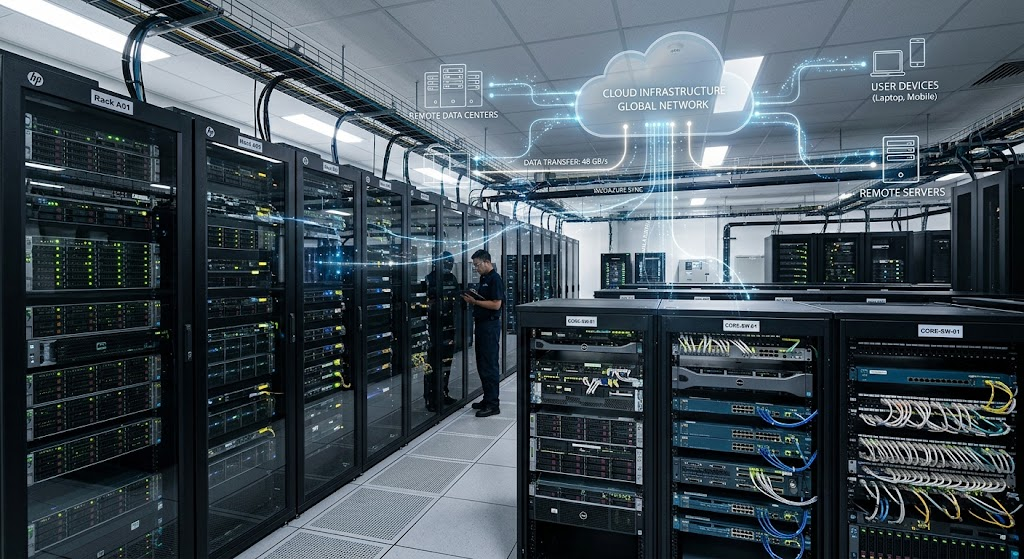
Cloud computing doesn’t necessarily imply that data is a floating cloud in the sky. The “cloud” is an inter-connected web of hardware computers and servers housed in a specialized facility called a data center. The data centres are home to thousands of computers that hold data and process user requests globally. As users use a cloud-based application, they send a device over the Internet to these applications to do the necessary calculations and then return the results.
Cloud computing is all about remote servers. They are very powerful computers installed in data centers for storing data, hosting applications and delivering computing services to users. Cloud servers, unlike personal computers that can be used by one individual, will be made to be able to be used by thousands or even millions of people concurrently. They rely on cutting-edge hardware, network and security systems to deliver steady performance.
If a user uploads a file to a cloud storage service, the file isn’t only stored on the user’s device. Rather, it’s pushed via the net to faraway servers provided by the cloud supplier. The data is replicated across the multiple servers in different sites to minimise the risk of loss. The user can access the data at a later time, and the cloud system fetches the data and returns it over the internet.
Organizations can also use the remote servers to run complex applications without the need for costly equipment. For instance, software-developing firms can use cloud servers for testing software, storing customer data, and offering on-line services. The business doesn’t have to construct a private data center, as the cloud provider provides the infrastructure.
Internet-Based Computing
Cloud Computing relies on the internet for connectivity. Cloud services rely on networks which enable devices, like computers, smartphones, and tablets to communicate with remote servers. When users request access to an application stored in the cloud, they’re making requests via the Internet and receiving responses from servers that are processing data.
Internet speed, reliability and security plays a key role in the quality of cloud computing. Users can quickly and seamlessly access cloud applications with a strong Internet connection, but a weak Internet connection can impact performance. But with the development of the internet network such as better broadband and mobile technologies, cloud services are now available to more people around the world.
Online computing brings flexibility as well since users no longer have to rely on a specific device or place. One person might start a document on a laptop, then make further edits on a smartphone, and finally finalize it on a computer. The cloud ensures that information is always up to date, streamlining collaboration and remote work.

Cloud Computing Key Features
On-Demand Access
On-demand access is one of the key features of cloud computing. This enables users to request and access computing resources at any point in time without having to wait for hardware installation and manual setup. New servers can be created, storage capacity can be expanded, and software applications can be added to servers with just a few clicks.
In the past, traditional technology systems may have needed an organization to make a guess at the future requirements and have to buy equipment ahead of time. This can result in excess resources being used if demand is less than anticipated, or insufficient resources available if there is a sudden surge in demand. Cloud computing addresses this issue by enabling users to access resources on-demand and also to save resources when demand wanes.
On-demand access is the ability to access services like online storage, streaming platforms, and web applications as and when required, for individuals. The user does not need to be aware of the technical processes which are going on behind the scenes, since the cloud provider is responsible for the infrastructure.
Scalability and Flexibility
Cloud Computing offers another significant benefit – scalability. Cloud elasticity is the capacity of cloud systems to scale up or down their resources as per the need. A start-up may require minimal computational resources initially, but as it expands, it can effortlessly add extra physical equipment to its cloud resources.
Large organizations often experience changing levels of demand. For instance, an online shopping site might have millions of visitors when it is having a sale during the holiday season but fewer visitors in regular seasons. Cloud platforms enable businesses to scale up and scale down their servers effortlessly during peak and off-peak hours. This flexibility can assist businesses to keep costs down and performance high.
Scalability also is a key enabler for innovation, as developers can test new concepts without investing in bulk amounts of hardware. A startup can develop and launch their digital product in the cloud without a huge investment in infrastructure expense.
Types of Cloud Computing Services
Infrastructure as a Service (IaaS)
Infrastructure as a Service offers fundamental computing services in the cloud, such as virtual servers, storage, and networking. Renting infrastructure from cloud providers, rather than buying on-premises hardware, allows companies to only pay for what they need, when they need it.
Businesses that require control over their computing environment but are looking for an alternative to managing physical equipment generally use IaaS. Companies can provision virtual machines on the cloud and install operating systems, applications, and security tools on them.
Platform as a Service (PaaS)
Platform as a Service offers the resources and infrastructure that can help developers build and run applications. It abstracts away the underlying infrastructure and lets the developers concentrate primarily on the development and improvement of software.
Programming tools, databases, testing environments, and deployment systems: With PaaS solutions, developers have access to these tools and systems in the cloud. This helps the software developer to develop the software in a shorter time as there are many technical aspects which are handled by the platform provider automatically.
Software as a Service (SaaS)
As a Service provides full software applications via the Web. Users neither need to install or maintain the software since it is handled by the provider. These can range from web-based email services, video conferencing solutions, customer relations management software, to document editing software.
SaaS has gained popularity due to the ease of access of powerful software by individuals and organisations without huge up-front investment. Usually users pay for this service via subscription, and they will get automatic updates, security patches and technical support.
Why Individuals and Organizations use Cloud Computing
Cloud computing offers numerous advantages that make using technology much simpler and more efficient. For people, cloud offerings offer easy alternatives to storing files, accessing applications, and safeguarding crucial information. Users can spread their data over several platforms, rather than depending on one device.
Cloud computing offers benefits to organizations in terms of increased efficiency, with fewer high-cost hardware purchases and more complicated maintenance. Businesses can concentrate on their products and services, and let cloud providers take care of infrastructure management. This is particularly important for small companies that could possibly not have big technology budgets or specialized IT staff.
Another important aspect of cloud computing is the ability to collaborate with others in teams and remotely. Shared documents can be accessed by employees at various locations, and communication is facilitated online, with the ability to collaborate in real time. With the spread of flexible working arrangements, this power is getting stronger and stronger.

Security is another reason for the many organizations that opt for cloud solutions. Cloud security technologies are crucial to professional cloud providers, and they invest heavily in them such as encryption, monitoring systems, access controls and backup solutions. Cloud security, as with any security measure, must be managed carefully, but many cloud security providers provide enhanced security features that might be challenging for the organization to create on its own.
Common Examples of Cloud Computing in Everyday Life
Cloud computing is used by many people without them knowing on a regular basis. Online email services provide for the storage of email on servers, as opposed to individual computers. Cloud infrastructure is used by video streaming platforms to stream movies and shows to millions of users. Cloud systems are the backbone of social media, storing photos, videos, and user data.
Cloud storage enables users to upload files to the cloud and retrieve them from various devices. Cloud-based accounting, customer management, and communication tools help businesses run their day-to-day operations. Cloud technology is also being applied in the field of education, with the creation of online learning platforms and digital resources for students.
Cloud computing is also crucial for modern technologies like artificial intelligence, machine learning, and data analytics. The technologies demand vast amounts of processing power and storage, and cloud platforms are able to offer this more efficiently than traditional platforms.
Challenges/Limitations of Cloud Computing.
While cloud computing has numerous benefits, there are also some drawbacks. Internet dependence is an important issue to consider. Users might have problems if their internet connectivity is down, as cloud services are web-based.
It’s also crucial to think about data privacy and security. To safeguard sensitive data, organizations need to be mindful of access permissions and select trusted cloud providers. Some industries may also have to take into consideration regulations and compliance which could impact the way they use cloud services.
One of the challenges is planning, skill sets, and investment are involved when existing systems are moved to the cloud. Older applications might need to be re-designed or reworked before they can be fully embraced as a cloud application.
The Future of Cloud Computing
Cloud computing has been in constant evolution, with the introduction of new technologies. The next generation of cloud applications will be smarter, more secure, and more efficient. AI, edge computing and automation are driving increasing capabilities for cloud platforms.
Cloud computing will remain a core element of the digital transformation, as more organizations go online. Cloud platforms will become even more crucial for businesses to analyze data and develop new products and enhance customer experience. People will also continue to use cloud services for personal productivity, education, entertainment, and communication.
Knowing about cloud computing gives a solid basis for modern technology. From the student to the professional, business owner, or simply the everyday technology user, understanding the working of the cloud can help them make better decisions about the tools they use.
Conclusion
Cloud computing is revolutionizing access and utilization of technology by people and organizations alike. Cloud systems are the platforms that make use of the Internet to provide computing resources, which means users don’t have to buy expensive hardware or maintain complex infrastructure to access powerful tools. Cloud computing has become an integral component of today’s digital world, thanks to its remote servers, online access, scalable resources, and flexible services.
The single most crucial concept to grasp is that the cloud is just a cluster of computing resources, which are powerful, in the sense that they are tied together into a network that provides services when users require them. Cloud computing has transformed technology for individuals and businesses around the world into more flexible, efficient, and accessible. With digital systems growing larger and larger, it is important to know the fundamentals of cloud computing to navigate the future of technology.


