
Introduction
Organising data effectively is a crucial part when designing a reliable database system. Organizing customers, employees, products or sales information correctly will help keep the data accurate and reduce any duplicate data. Database Normalization is a process used to help organise data into related tables. Rules are applied to create normal forms.
These normal forms are First Normal Form (1NF), Second Normal Form (2NF), Third Normal Form (3NF) and also higher forms such as Boyce-Codd normal, Fourth Normal Form (4NF) and Fifth Normal Form (5NF). Knowing and understanding database normalization will make designing a database easier to maintain, update and grow with the growth of an organisation’s data.

What is Database Normalization?
Database normalization is the process of organizing data within a relational database to eliminate redundant data and create logical relationships between tables. Data will be split into multiple tables to help reduce redundancy. Each table will contain data about a specific subject such as customers, employees, products, orders. Using primary and foreign keys relationships will be created between tables to allow data to be retrieved. This helps to create a well organized structure and reduces any inconsistencies.
The purpose of normalisation is to ensure data is stored correctly and relationships are in place. For example, an online store may have many sales for a customer. This means the customer’s name, phone number and address will be repeated across multiple records. Normalization will help to create a database to store customer data in a Customers table. By using a unique CustomerID each record will reference the customer information in the Customers table. This reduces the amount of redundancy and makes it easier to update the data. If the customer needs to change their address then the database administrator will only need to update one record. Normalizing the database will help to create a well organized database with less inconsistencies.
Importance of Database Normalization
Normalizing a database is an important part of creating a reliable information system. Poorly organized tables can cause issues when growing a database. Having redundant data can make it difficult to ensure the data remains accurate. Any small updates may need to be made in multiple places. If not all instances are updated then this can cause inconsistencies. Normalization will help to split data so there is no unrelated data and ensure relationships are in place. It will also help to make the database easier to understand as each table will have a clear purpose. Organizations who may have accounts for customers, employees, inventory and financial information will find this useful. Ensuring data is accurate is vital for everyday running of the organization.
Another benefit of normalizing a database is that it will prevent anomalies. Anomalies can occur when inserting, updating or deleting information from a poorly structured table. This can cause missing data, duplicate data and even accidental loss of important data. By organizing data with regards to dependencies the risk of this happening will be reduced. It helps to make databases more flexible so new records can be added or existing data can be updated without affecting unrelated data too much. Whilst it does not guarantee a perfectly performing database it will provide a solid base for creating accurate, manageable and reliable databases.
Understanding Database Anomalies
Anomalies are inconsistencies or issues that can occur when data is not efficiently stored. These often occur when data is not normalized and contains redundant data or multiple unrelated subjects. There are three main types of anomalies: insertion, update and deletion.
Knowing these will explain why database normalization is important. Imagine a business that stores customer information, product information and sales information in one table. If a customer purchases multiple products their personal information may be repeated. This causes unnecessary duplication. By normalizing the data the information will be split into the correct tables.
Insertion Anomalies:
An insertion anomaly occurs when new data cannot be added to a database without adding unrelated data. This usually occurs when multiple subjects are stored in the same table. Imagine a company’s database contains employee information, department information and completed sales. If the company creates a new department but no employee has been assigned to it the company may not be able to add a new department as they need to add employee information.
This causes an unnecessary relationship between two pieces of data. By normalizing the database employee information will be stored in one table and department information will be stored in another table. New departments can be added without needing to add new employees.
Update Anomalies:
An update anomaly occurs when the same data appears in multiple records. This means that if you want to update the data you need to update it in multiple places. If some records are not updated then the database may contain inconsistent data. Imagine if a customer appears in 20 different sales. Their address will be repeated in each record.
If the customer moves to another location all 20 records will need to be updated. If this is not done then the database may contain outdated information. By normalizing the database customer information will be stored in a Customers table. The sales will reference the customer using a CustomerID. This will make it easier to update the data.
Deletion Anomalies:
A deletion anomaly occurs when deleting one record will cause other important data to be deleted. This often occurs when multiple unrelated data is stored in one table. Imagine a university database contains student information and course information. If the only student taking a course is withdrawn then by deleting the student record the only information about that course may also be deleted.
This causes unnecessary loss of data as the course should exist independently. By normalizing the data student information will be stored in one table and course information will be stored in another table with an enrollment table in between. This will help prevent the data being deleted.
Types of Database Normal Forms
There are several normal forms that can be applied to databases. These are known as normal forms. The most commonly known are First Normal Form, Second Normal Form, Third Normal Form, Boyce-Codd Normal Form, Fourth Normal Form and Fifth Normal Form.
Each form helps to improve on the issues that may exist within a database. Smaller databases may only require a few normal forms to be applied but complex systems may benefit from using more advanced forms. Usually database designers will apply the rules in order. They will look at dependencies between attributes and primary/ candidate keys to decide if tables need to be restructured.
- First Normal Form (1NF)
First Normal Form is the first step to normalizing a database. A table will be in 1NF if all the columns contain atomic values. Each record should be uniquely identifiable and there should be no repeated groups. A database should not contain multiple phone numbers, product names or email addresses in one column. By applying the 1NF to tables the tables will be standardized. This will make it easier to search, filter and update data. It also provides a good base to apply more advanced rules.
Imagine a customer’s database. The database may contain the following table:
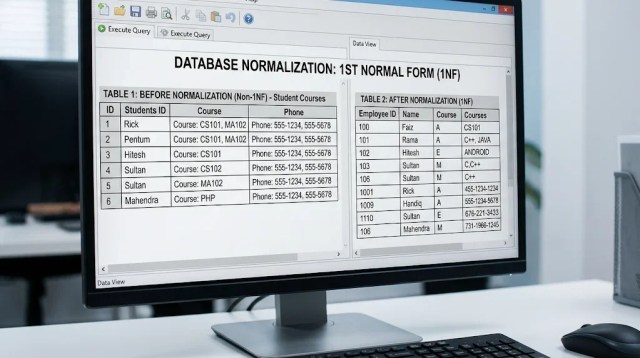
Un-Normalized Customer Table
| CustomerID | CustomerName | PhoneNumbers |
| 101 | John | 08012345678, 08098765432 |
| 102 | Mary | 08123456789 |
| 103 | David | 07012345678, 09012345678 |
This table is not in 1NF as the PhoneNumbers column contains multiple values in some of the records. A better way to structure this data would be to have each phone number in a separate record:
Normalized Customer Table
| CustomerID | CustomerName |
| 101 | John |
| 102 | Mary |
| 103 | David |
Customer Phone Table
| PhoneID | CustomerID | PhoneNumber |
| 1 | 101 | 08012345678 |
| 2 | 101 | 08098765432 |
| 3 | 102 | 08123456789 |
| 4 | 103 | 07012345678 |
| 5 | 103 | 09012345678 |
The customer information is now separated from the phone numbers. Each phone number is in its own field. The CustomerID will help to link each phone number to the correct customer. This makes it easier to add, delete or update contact details. There is also no dependency on complex lists of information. 1NF is very useful for managing customer information, contact databases and multiple values per record.
- Second Normal Form (2NF)
Second Normal Form builds on the requirements of the 1NF. A table will be in Second Normal Form if it meets the requirements of 1NF and all non-key attributes are fully functionally dependent on the candidate key. A composite key contains two or more columns in the primary key. A partial dependency occurs when a non-key attribute only depends on one of the composite key attributes. This can cause unnecessary duplication. To help this issue attributes will be separated into different tables.
Imagine a sales database that contains product information purchased by customers. The table may have a composite key containing CustomerID and ProductID. However, CustomerName only depends on CustomerID and ProductName only depends on ProductID. This means neither attribute is fully functionally dependent on the composite key.
Table not in 2NF
| CustomerID | ProductID | CustomerName | ProductName | Quantity |
| 101 | P01 | John | Laptop | 2 |
| 101 | P02 | John | Mouse | 3 |
| 102 | P01 | Mary | Laptop | 1 |
To meet 2NF the information should be split into three tables:
Customers Table
| CustomerID | CustomerName |
| 101 | John |
| 102 | Mary |
Products Table
| ProductID | ProductName |
| P01 | Laptop |
| P02 | Mouse |
Sales Details Table
| CustomerID | ProductID | Quantity |
| 101 | P01 | 2 |
| 101 | P02 | 3 |
| 102 | P01 | 1 |
By splitting the information this table is now free from partial dependencies. The customer names are in the Customers table, the product names are in the Products table and the quantity of products purchased is in the Sales Details table. The composite key will help identify each customer/product combination. In real sales systems there may be a separate OrderID and OrderDetailsID. 2NF is very useful for systems with many to many relationships such as student enrollment platforms, product ordering applications and employee project assignments.
- Third Normal Form (3NF)
Third Normal Form focuses on eliminating transitive dependencies. A table will be in 3NF if it meets the requirements of 2NF and non-key attributes are not transitively dependent. Basically every non-key attribute should only depend on the key, the whole key and nothing but the key. Transitive dependencies occur when one non-key attribute determines another non-key attribute. By removing this issue unnecessary duplication can be avoided and data can be easily maintained. 3NF is widely used in relational databases to provide a good balance between keeping data consistent and keeping tables manageable.
Imagine an employees database that contains EmployeeID, EmployeeName, DepartmentID and DepartmentName. If the department name depends on the DepartmentID then this will cause a transitive dependency as it will be repeated in the Employees table.

Table not in 3NF
| EmployeeID | EmployeeName | DepartmentID | DepartmentName |
| E01 | James | D01 | Finance |
| E02 | Sarah | D02 | Marketing |
| E03 | Peter | D01 | Finance |
The DepartmentName depends on the DepartmentID which is a non-key attribute. This can be resolved by splitting the information into two tables:
Employees Table
| EmployeeID | EmployeeName | DepartmentID |
| E01 | James | D01 |
| E02 | Sarah | D02 |
| E03 | Peter | D01 |
Departments Table
| DepartmentID | DepartmentName |
| D01 | Finance |
| D02 | Marketing |
The DepartmentID in the Employees table is a foreign key. This means the department information will only be stored once and can be linked to multiple employees. If the Finance department changes its name the administrator will only need to update the department record. This will help prevent inconsistent department names. 3NF is very useful for Human Resources Management systems, organizational databases and businesses that have repeated information about departments, locations, suppliers etc.
- Boyce-Codd Normal Form (BCNF)
BCNF is a more advanced version of Third Normal Form. A table will be in BCNF if every determinant is a candidate key. A determinant is an attribute or set of attributes that determines another attribute. A table may be in 3NF but still contain instances where a non-superkey determines another attribute. BCNF helps to solve this issue by having stricter rules for functional dependencies. It is particularly useful if there are overlapping candidate keys or multiple relationships between attributes.
Imagine a university database that contains information about what instructor teaches a course and what classroom they use. The university may have a rule that each instructor can only teach one course but multiple instructors can teach the same course. The table may contain InstructorID, CourseID and ClassroomID. If InstructorID determines CourseID and CourseID does not uniquely determine the instructor then there may be dependencies. Depending on how the keys are set up there may be dependencies that meet 3NF but not BCNF. Database designers will need to carefully analyse the candidate keys and functional dependencies to decide how to decompose the table. This will help prevent inconsistencies.
Imagine a database that contains multiple relationships between instructors, courses and classrooms. If the same instructor/course relationship is repeated across multiple records then changing the classroom may mean multiple rows need updating. By decomposing this table into BCNF the relationships will be split into smaller tables. Every determinant will be a candidate key in its relation. This will reduce redundancy and increase consistency. However decomposition must be done carefully to ensure important relationships are not lost. Where possible the original information can be reconstructed using joins. BCNF is very useful for complex academic, scheduling and organizational databases that contain multiple candidate keys and functional dependencies.

- Fourth Normal Form (4NF)
Fourth Normal Form deals with multivalued dependencies. This occurs when two or more independent sets of data are associated with the same key. A table will be in 4NF if it meets BCNF and does not have any non-trivial multivalued dependencies unless the determinant is a superkey. This is an important normal form as a table may be in BCNF but contain unnecessary combinations of independent data. If this information is stored together then multiple rows may be generated with no meaningful relationship. 4NF will help to resolve this issue by splitting independent multivalued relationships into separate tables.
Imagine an employees database that contains information about employees, their skills and languages they speak. An employee may have multiple skills and speak multiple languages. However the skills may have no relationship to the languages. If everything is stored in one table then the database may produce duplicate combinations.
Table not in 4NF
| EmployeeID | Skill | Language |
| E01 | Programming | English |
| E01 | Programming | French |
| E01 | Networking | English |
| E01 | Networking | French |
This table is creating combinations between the skills and languages. As the amount of skills and languages increase the amount of records will increase unnecessarily.
A better design would be to split the relationships:
Employee Skills Table
| EmployeeID | Skill |
| E01 | Programming |
| E01 | Networking |
Employee Languages Table
| EmployeeID | Language |
| E01 | English |
| E01 | French |
This format allows us to separate the skills and languages each employee has, without creating any extra combinations. This means if an employee picks up a new programming language or professional skill, we can easily update the table relating to that without affecting the other relationships. The Fourth Normal Form would be useful in scenarios such as employee management, education systems, membership systems, and any other databases where individuals can have multiple independent characteristics.
- Fifth Normal Form (5NF)
The Fifth Normal Form also known as the Project-Join Normal Form deals with complex JOIN dependencies. A table will be in Fifth Normal Form if every non-trivial JOIN dependency is implied by the candidate keys. This means that we cannot decompose the table further without losing information or creating incorrect combinations when joining the tables. Fifth Normal Form would be useful in databases with complex many-to-many-to-many relationships between different entities. Whereas other normal forms have focused on making sure our data is atomic, there are functional and multi-valued dependencies, Fifth Normal Form looks at if we can split the information into smaller relations and JOIN them back correctly. This ensures that we do not create false relationships when decomposing.
Suppose we have a database for a business that contains information about the relationships between suppliers, products and projects. A supplier can provide various products, and they can be used for multiple projects. However, not all of these combinations will be valid. If all relationships are stored within one table we may have duplicate information. A well designed database using the Fifth Normal Form may split this information into the Supplier-Product, Supplier-Project and Product-Project tables. This is because the business rules state that these relationships can be represented separately. We can JOIN the tables together to get the original information.
The Fifth Normal Form would be useful in specialist databases where there are complex relationships between multiple entities. This can be seen in supply chain management, manufacturing, procurement, and project management. However, not all databases will require this level of normalisation. Many will function well using Third or Boyce-Codd Normal Forms. If we apply Fifth Normal Form without having a true JOIN dependency it can cause the database structure to become unnecessarily complex. Therefore it is important to look at the relationships within the business before decomposing further. We aim to have the right amount of tables, not the maximum amount, to ensure accurate information is stored and the relationships can be made.
Seven Key Principles to Ensure Effective Database Normalisation
While normalisation can be described using the normal forms, there are several principles to consider when designing an effective database. By understanding the principles behind normalisation we can determine how to best store our data, relationships and create a reliable database.
The following seven principles will help you to design efficient relational databases.
1. Store Each Type of Information in its Own Table
Each table in your database should represent a distinct entity. For example, we should have a Customers table, an Employees table and a Products table. If we store unrelated information within the same table this will cause duplication and unnecessary dependencies.
By splitting your information into tables based on what the information is for, it will be easier to see what information needs to be added, updated and deleted. This is a key principle of normalisation as it ensures the database designer creates a logical structure to represent real-world business entities.
2. Unique Identifiers for Each Record
To ensure we have a reliable database we need a way to identify each record. This can be achieved using primary keys so each record has a unique value. For example, each customer can be identified using their CustomerID. Even though multiple people may have the same name, each person will have their own unique ID.
This can also be done with EmployeeID and ProductID. Using primary keys will help avoid duplication and allow us to create relationships between tables. Choosing the right primary keys will be an important part of designing normalised databases, especially if the organisation has thousands or millions of records.
3. Avoid Repeating Groups
Each field should only have one value. This is part of the First Normal Form and helps us to easily retrieve information from our database. For example, if we have multiple product names in an OrderProducts column it can become difficult to search, filter and update individual products.
A better design would be to have an OrderDetails table, so each product purchased can be stored as individual records. This allows us to store each quantity, price and product reference separately. Avoiding repeating groups will also reduce the need for complex data processing.
4. Avoid Partial Dependencies
Non-key attributes should rely on the full candidate key. This is especially important if the table has multiple columns to identify individual records. For example, a student enrolment database may have both StudentID and CourseID to identify an enrolment record.
However, the StudentName only relies on the StudentID and the CourseName only relies on CourseID. This causes unnecessary duplication if these attributes are stored in the enrollment table. By separating the student and course information we can avoid partial dependencies.
5. Avoid Unnecessary Transitive Dependencies
We should organise our information so that non-key attributes do not unnecessarily determine other non-key attributes. This supports the Third Normal Form and helps avoid duplication of descriptive information. For example, an employee’s DepartmentName should generally be stored in a Departments table.
This will make updates more reliable as there is one place to update department information. We can also add new departments without affecting employee information. Removing transitive dependencies is especially important in larger organisations where there are many records referencing the same departments, suppliers, locations and categories.
6. Maintain the Correct Relationships
Normalisation does not mean we should separate our information without any relationships. Primary and foreign keys can Be Used to link information between tables. For example, a sales record may have a CustomerID linking to the Customers table and an OrderID to identify the transaction.
Individual products can be stored in an OrderDetails table and linked using the OrderID. This ensures the records are linked together. Foreign keys can also Be Used to avoid invalid references, such as assigning a sales record to a customer that doesn’t exist in the Customers table.
7. Use Higher Normal Forms Where Needed
Database designers should consider whether they need to use higher levels of normalisation. BCNF, 4NF and 5NF deal with more complex situations involving candidate keys, multi-valued and JOIN dependencies. These will be useful in databases with complex relationships or business rules that cannot be properly represented using lower normal forms.
However, using higher normal forms without considering the requirements can cause unnecessary complexity. The most effective database structure will be one that fulfils the integrity requirements and is easy to understand. Consider the dependencies, relationships and application requirements before deciding how far to normalise your database.
Real World Example – Creating a Normalised Sales Database
Suppose we have a retail business that will need to store information about their customers, employees, products, sales and individual products purchased. If all this information was stored in one large table we may have duplication of customer names, employee information, product descriptions and prices. This can increase storage requirements and cause issues if the information needs to be updated. Using a normalised database will allow us to create related tables for each of the topics.
A practical database may have:
Customers Table
| CustomerID | CustomerName | Phone | |
| C001 | John Smith | john@email.com | 08012345678 |
| C002 | Mary James | mary@email.com | 08123456789 |
Employees Table
| EmployeeID | EmployeeName | DepartmentID |
| E001 | James Brown | D01 |
| E002 | Sarah White | D02 |
Departments Table
| DepartmentID | DepartmentName |
| D01 | Sales |
| D02 | Administration |
Products Table
| ProductID | ProductName | UnitPrice | StockQuantity |
| P001 | Laptop | 450000 | 15 |
| P002 | Mouse | 12000 | 50 |
| P003 | Keyboard | 25000 | 30 |
Sales Table
| OrderID | CustomerID | EmployeeID | OrderDate |
| O001 | C001 | E001 | 2026-11-01 |
| O002 | C002 | E001 | 2026-11-02 |
OrderDetails Table
| OrderDetailID | OrderID | ProductID | Quantity | UnitPrice |
| OD01 | O001 | P001 | 1 | 450000 |
| OD02 | O001 | P002 | 2 | 12000 |
| OD003 | O002 | P003 | 1 | 25000 |
Each table has been created for a specific entity within the business. The CustomerID links the sales to the customers. The EmployeeID identifies who processed the order. The ProductID links the order details to the products. The OrderDetails table allows multiple products to be included in one transaction without having multiple product IDs in one field. It also allows us to record how much of each product was purchased and what the price of the transaction was. It is important to have the price of the transaction within this table as the price of the product may change over time. We want to keep a record of what the price was when the transaction occurred.
This will help ensure the data is consistent as we have each piece of information stored separately. If we need to update a customer’s phone number we will not need to update previous sales. If we update the current price of a product it will not affect previous transactions. We can keep track of the StockQuantity in the Products table. Some more advanced systems may also have a Stock Movement and Warehouses table to track purchases, sales, movements and adjustments. This shows how normalisation can help ensure we have a reliable business and the tables can work together using clear relationships.
Database Normalisation and Denormalisation
Database normalisation and denormalisation are related concepts used in relational database systems. Normalisation aims to eliminate duplication and separate independent entities to ensure data integrity. Denormalisation is the process of adding some duplication or combining related information to make data retrieval more efficient.
While normalisation is generally favoured when designing transactional databases, denormalisation can be useful in scenarios where an application will frequently run queries on multiple related tables.
What is Database Denormalisation?
Database denormalisation is the process of adding deliberate duplication or reorganising normalised tables to make data retrieval more efficient. In a highly normalised database we may have to use multiple JOIN operations to retrieve information about customers, sales, products and employees. JOIN operations link related tables using primary and foreign keys. While this ensures data integrity, querying multiple large tables can be expensive depending on the database engine, indexes, amount of data and how the query is written. Denormalisation can help overcome some of these issues by combining frequently queried information. This can reduce the number of joins required for common queries however it will add extra work to ensure the duplicated information is kept consistent.
For example, an e-commerce platform may frequently display an order summary which includes the customer’s name, order date, product names, quantities and total. In a fully normalised database we may need to retrieve information from multiple tables (Customers, Sales, OrderDetails, Products). If this query runs millions of times the business may decide to create a summary table or materialised view to include frequently requested information. This can speed up common reports and dashboard queries as the database does not have to rebuild results from multiple tables. However, we must ensure that the summary information is updated when the underlying records change.
When Should I Denormalise My Database?
Denormalisation should only Be Used if the performance requirements of the database mean it is justified. Applications with high volumes of read requests such as reporting, analytics, product catalogues and business intelligence dashboards may benefit from carefully using denormalisation techniques. For example, an online marketplace may keep track of pre-calculated product ratings and sales summaries rather than calculating them from thousands of individual transaction records each time a customer visits a product page. A reporting database may also keep track of monthly sales figures to make financial analysis more efficient. This can reduce duplication of calculations.
However, you should not denormalise just because you have lots of tables. Having duplicated information adds extra work to maintain and can cause update anomalies. Before denormalising your database you should identify slow queries, analyse the execution plan, consider your indexes and see if the issue can be solved by optimising your query or using caching. If denormalisation is required then ensure you have reliable methods in place to keep your information consistent such as using database transactions, scheduling updates, using triggers where appropriate and/or controlling updates from the application. The best option will often be to keep your database in a normalised format but create carefully designed denormalised views.
Advantages of Database Normalisation
There are many advantages to using database normalisation. Along with reducing duplication it can help to make your database more reliable, flexible and easy to maintain. Organisations that require accurate records will want to ensure they can easily update their information without causing inconsistencies. Normalisation helps to do this by creating clear relationships and ensuring information is stored in the correct place. Depending on your database design and requirements the exact advantages will vary. However, using a properly normalised database will give you a solid foundation for applications that need to manage large amounts of related information.
- Reduce Duplication
One of the most important advantages of normalisation is reducing unnecessary duplication. If we have duplicate information relating to customers, employees or products this will cause the database to store the same information multiple times. By separating the entities into related tables we can ensure each piece of information is stored in the correct place. This can reduce storage requirements and make updates easier. For example, if we have thousands of sales records we do not need to store the whole customer profile for each transaction. We can instead use the Unique Identifier for each customer. This makes the database more organised and reduces the chance of inconsistencies.
- Improve Data Integrity
Data integrity refers to ensuring the data stored in your database is accurate, consistent and reliable. Normalisation helps to ensure data integrity by reducing the chances of having conflicting information. Primary keys ensure each record can be uniquely identified and foreign keys ensure valid relationships between tables. Constraints can also be applied to ensure invalid data is not stored. For example, sales should reference an existing customer rather than an unrelated or non-existent CustomerID. If these are properly implemented businesses can ensure they have more reliable records.
- Avoid Anomalies
Normalisation helps to avoid insertion, update and deletion anomalies by ensuring unrelated information isn’t stored unnecessarily. This means organisations can easily add new customers, employees, products and departments without unrelated records. Updates will also be easier as information will be stored in the correct table. Finally, deleting one record will not cause other independent information to be removed. This is especially important for databases where information changes frequently. Using a properly normalised database will make organisations feel more confident managing their records.
- Easier to Maintain
Generally databases will be easier to maintain if they are normalised. Each table will have a clear purpose and relationships. Developers will know where specific information should go without having to search through large tables with multiple unrelated topics. This will also make it easier to make changes to your database. For example, an organisation can easily add a new department without having to redesign their employee database. New product categories or customer contact information can also be added using appropriately related tables. Having a clear database structure will make it easier to troubleshoot, test, document and develop in the future especially if multiple developers or database administrators are working on the system.
- Scalable
As businesses grow they will often need to manage more customers, employees, transactions and products. Using a normalised database will give a logical foundation to manage this increase in information. As entities are separated into related tables we can easily expand sections of the database without unnecessary duplication. For example, a retail business can easily add thousands of new products without affecting customer and employee records. While normalisation does not guarantee a scalable database or faster performance it will help create an organised database that can be optimised and expanded as application requirements grow.
Challenges and Limitations of Database Normalization
Despite its advantages, database normalization also introduces certain challenges that developers must consider. One common concern is that highly normalized databases may require multiple JOIN operations to retrieve information from different tables. When an application needs to combine customer details, product information, sales records, and employee data, it may have to access several related tables. Depending on the size of the database and the query design, these operations can affect performance. However, the impact is not automatic because modern database management systems are designed to optimize many joins efficiently. Proper indexing, query planning, and database configuration can help maintain good performance without unnecessarily duplicating information.
Another limitation is that advanced normalization can make database structures more complicated for inexperienced developers to understand. As information is divided into smaller tables, developers must understand the relationships between entities and how foreign keys connect them. This may require more complex queries and additional application logic when retrieving complete records. Highly normalized structures can also make certain reporting operations less convenient, particularly when users frequently need aggregated information from several tables. These challenges do not mean normalization should be avoided. Instead, developers should select appropriate normal forms based on the database’s requirements and consider performance optimization techniques when necessary. A well-designed database balances data integrity, maintainability, and practical application performance.
Best Practices for Implementing Database Normalization
Implementing database normalization effectively requires more than applying normal forms without understanding the information being stored. Developers should first identify the entities, attributes, relationships, and business rules that define the database. This helps determine which information belongs together and which attributes depend on particular keys. For example, an employee management system may contain employees, departments, job roles, salaries, and attendance records. Understanding how these entities relate to one another makes it easier to create appropriate tables and identify potential dependencies. Database designers should also examine whether attributes are independent, whether composite keys are necessary, and whether certain relationships require junction tables to represent many-to-many associations accurately.
Another important practice is to apply normalization progressively and test the resulting structure using realistic data. Developers should begin by ensuring that tables satisfy 1NF before examining partial and transitive dependencies. More advanced forms should be considered when the database contains the relevant functional, multivalued, or join dependencies. Referential integrity constraints should be implemented to maintain valid relationships, while suitable indexes should support frequently executed queries. It is also important to document database structures so that other developers understand the purpose of each table and its relationships. Finally, database performance should be monitored as the application grows. If certain queries become inefficient, developers can evaluate indexing, caching, materialized views, or selective denormalization rather than compromising the integrity of the entire database.
Conclusion
Database normalization is an essential process for designing efficient, organized, and reliable relational database systems. By applying the principles of First Normal Form, Second Normal Form, Third Normal Form, Boyce-Codd Normal Form, Fourth Normal Form, and Fifth Normal Form, developers can reduce unnecessary duplication, eliminate problematic dependencies, and prevent insertion, update, and deletion anomalies. Practical examples involving customers, employees, products, and sales transactions demonstrate how information can be separated into related tables while remaining accessible through primary keys and foreign keys.
These practices improve data integrity and make database maintenance easier as organizations expand their operations. Although highly normalized structures may require additional joins for certain queries, denormalization can provide performance improvements when applied carefully. Ultimately, effective database design involves choosing an appropriate level of normalization while balancing accuracy, maintainability, scalability, and application performance.