Introduction
Car diagnostic scanners, computers, sensors and electronic control modules are critical to modern-day vehicles to track the performance of the engine, emissions, transmission, and other systems. If there’s a problem, the car may retain a diagnostic trouble code that can help you pinpoint the problem. Drivers can access this data with either a traditional diagnostic scanner or a diagnostic app with a cell phone and an OBD2 adapter.
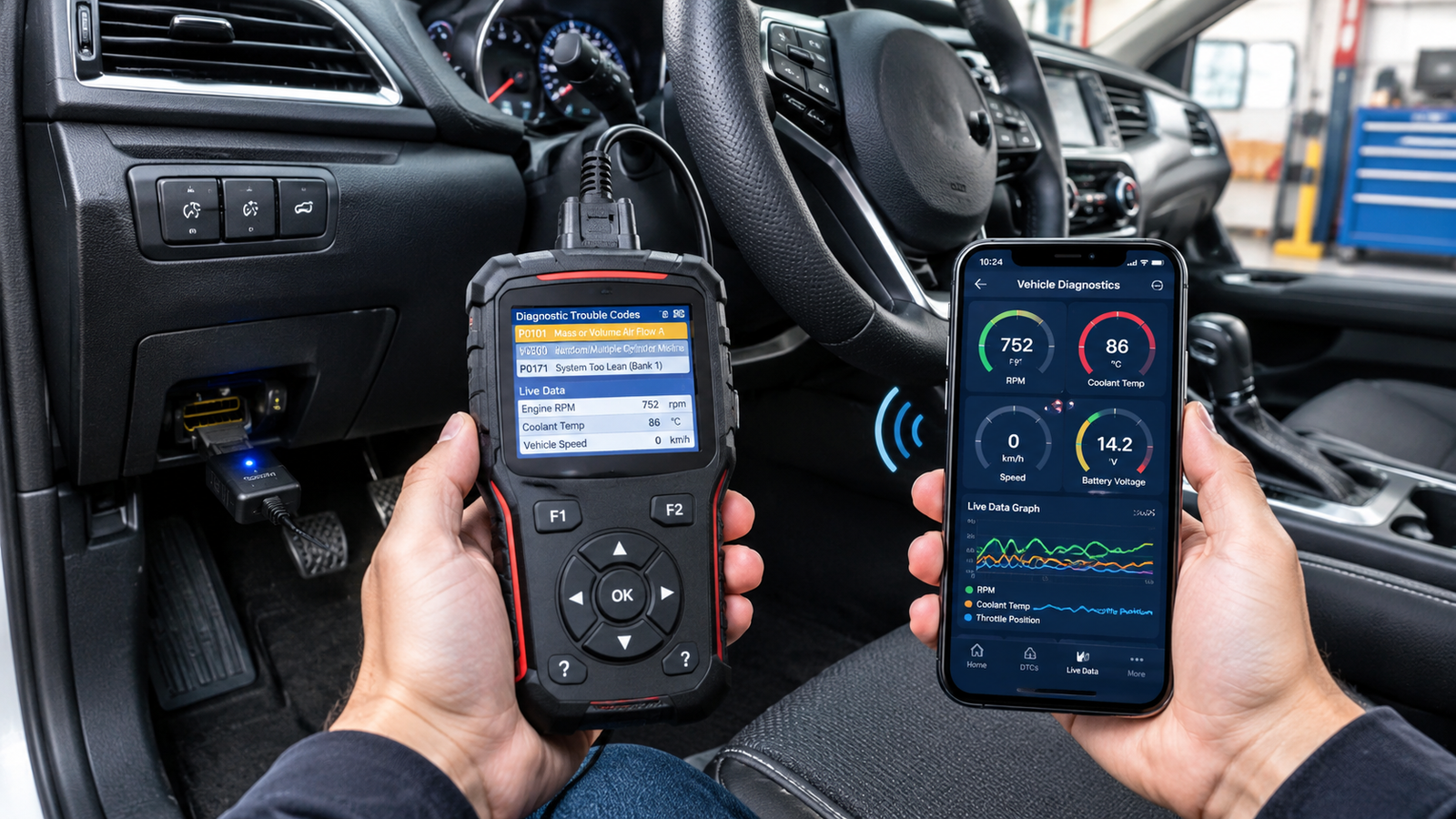
Either one of these can be helpful; they’re created for slightly different needs. Handheld scanners give a dedicated diagnostic experience, while smartphone apps give the convenience of using a smartphone that most drivers already have. The main differences have to do with the cost, portability, ease of use, compatibility with the type of vehicles, live data, code interpretation, data logging and advanced diagnostic capabilities. The features will make it easier to determine which deals the better value.
How to Use a Handheld Diagnostic Scanner
A handheld scanner is a special electronic machine that plugs directly into the vehicle’s diagnostic port. Basic scanners can read and clear some diagnostic trouble codes, and more sophisticated scanners can show live sensor data, talk to a number of vehicle modules, run tests on the system, and offer a variety of other service functions. The scanner is self-powered and self-controlled; it can work independently.
The best thing about it is that you have freedom! The driver doesn’t have to install an application, connect with the smartphone or rely on a wireless connection. Handheld diagnostic scanners are especially convenient for people who own vehicles and often do maintenance or for a tech who is diagnosing a number of vehicles. But professional vehicle coverage and functions can make their advanced handheld scanners a lot more costly than the basic ones, particularly when they are able to provide advanced features.
What is a Smartphone Diagnostic App?
An app for a smartphone that connects with a compatible OBD2 adapter to communicate with the car. The adapter connects to the vehicle’s diagnostic connection and transmits data via Bluetooth, Wi-Fi or one of the other available protocols to a smartphone. The application then will show codes, sensor data, dashboards and more diagnostic data on the phone.
The advantage is one that’s very clear — convenience. Most motorists already own a mobile phone, and they might just have to buy the adapter and (where appropriate for the application) extra software. Most of the apps also offer a contemporary user interface that consists of graphs, adjustable dashboards, code descriptions and data recording capabilities. But it is subject to the adaptability of the adapter and software, and it is not necessary that the choice of equipment is compatible.
Cost: Which Is More Affordable?
Diagnostics offered by a smartphone can be appealing to drivers on a budget. The user will typically only need an OBD2 adapter and an appropriate application as the smartphone itself is likely already available. There may be some applications with basic diagnostic functions that are available for little or no charge, and some applications might be available for additional payment that include advanced diagnostics. This will give drivers the flexibility to use a configuration that suits them rather than a specific diagnostic device.
Handheld scanners are as simple as code readers, or as advanced as diagnostic systems. Simple scanners may be in the easily accessible price range, while the more sophisticated scanners can cost much higher due to their broad range of vehicle coverage and other features. There are also devices that are professional and need software updates or software subscriptions. So, the diagnostics of a smartphone could be useful for occasional users while a handheld scanner could be a good investment for someone who performs diagnostics on cars frequently.
Portability and Ease of Use
The driver might have the primary display and control device on his/her smartphone, so a portability benefit is obvious. Typically, the size of the OBD2 adapter will allow it to be stored in the vehicle itself, and the phone would allow access to the application when needed. This can be particularly useful when on a trip or when a driver would like to use the warning light as a vehicle information monitor.
Other handheld scanners are also portable, but need to be paired with another device. The benefit of them is that they all come with the scanner, so you don’t have to bring anything else. No pairing of Bluetooth or notification on a cell phone, no application install, no need for the smartphone battery. This can help drivers with a dedicated device to handle the scanner more easily.
Vehicle Compatibility
One of the key features to consider in diagnostic scanners and smartphone applications is compatibility. OBD2 is utilized by a large number of vehicles for standardised communication, but the information available is dependent on the vehicle and equipment. Common equipment can only communicate with common engine and emission-related codes, whereas advanced equipment can communicate with ABS, airbag, transmission, body and other electronic modules.
Drivers should verify both options before buying them as there might be a make, model, year, or engine that does not work. Some smartphone apps are for wide coverage of cars, while others are specific to manufacturers. Likewise, although a handheld scanner might be capable of supporting a number of vehicles, it might lack certain capabilities in some vehicles. So, compatibility should always be tested in accordance with the specific diagnostic functions needed.
Live Data Capabilities
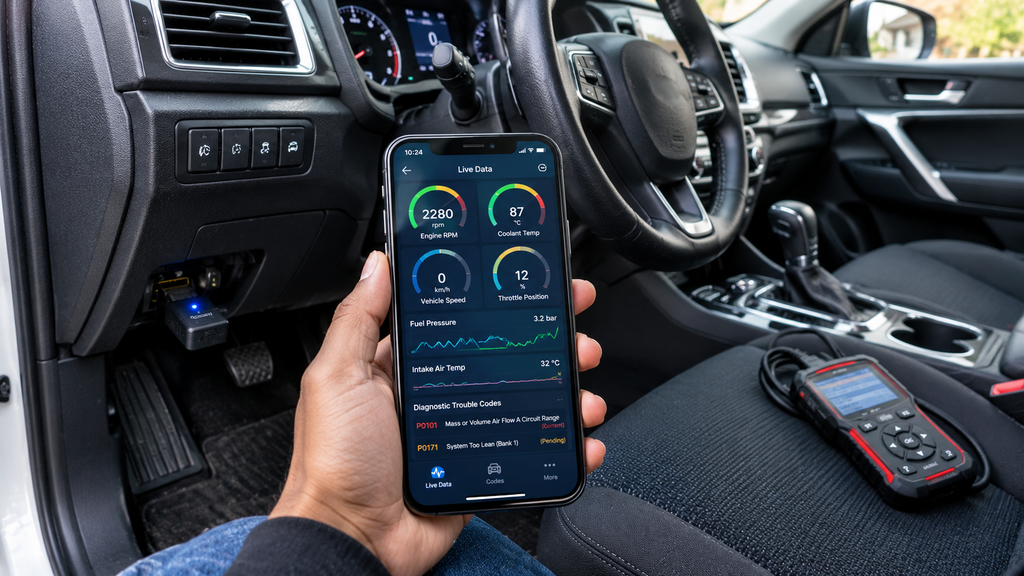
Live data enables drivers and technicians to see what data is being reported by sensors and control modules in a vehicle. This can be engine speed, coolant temperature, vehicle speed, throttle position, any fuel information or other parameters depending on the vehicle. Information from the live data may be helpful when solving issues that cannot be completely resolved from a stored trouble code.
It’s common for smartphone apps to give the edge, as smartphones have large and high-resolution screens that make it easier to display real-time data. There are applications that let users build dashboards of several gauges and/or graphs. Handheld scanners can also convey real-time information, especially the advanced ones, though the simpler handheld scanners might come with limited displaying features and a smaller screen. A good smartphone application can be very convenient for motorists who prefer to have a readable dashboard.
Code Interpretation
Although it’s useful to be able to read a diagnostic trouble code, it’s even more important to understand the code. Typically, a trouble code points to a system, circuit and/or condition detected by the vehicle computer. It doesn’t necessarily imply that the particular component in the code has failed. It is possible that similar codes can be generated due to wiring problems, connectors, electrical issues or mechanical problems.
It could be possible for diagnostic apps to help in code interpretation by simply showing descriptions and further information directly on the smartphone. Some applications might also offer explanations which are more easily understood by novices. There are different handheld scanners available, depending on the needs of the user. The diagnostic information that is returned on a basic scanner will only include a code and brief description, whereas the advanced systems will return much more detailed information. Drivers should therefore take (and consider) the quality of the software, instead of just whether a device can read codes.
Data Logging
If the problem in the vehicle occurs only occasionally, data logging is beneficial. A sensor, for instance, could read normally while the car was in the parking lot, but give strange readings while driving. With a diagnostic system that can capture live data, these can be reviewed later, and patterns can be identified, providing valuable information to a tech.
Data logging is especially convenient with smartphones as they have a large amount of storage and processing power. Some applications are capable of logging sensor data on a trip and then graphically presenting the data when the trip is finished. Some scanners, particularly professional scanners, have data logging capabilities built in, too. But basic scanners might be limited in their recording capacity, matching that of a smartphone app, so drivers with a need to monitor their vehicles’ behaviour over time might be better off using a smartphone app.
Advanced Diagnostic Functions
The differences between basic equipment and advanced diagnostic equipment are more pronounced in the level of diagnostics offered. Some scanners can only read and clear the engine trouble codes, but more sophisticated scanners can read codes from more than one control module and can do more. They range from ABS and airbag diagnostics to transmission information, to manufacturer-specific service resets, system tests, and more.
The use of the correct adapter and software may allow for advanced functions with some smartphone applications. These functions, however, might be paid features or specialized equipment. Whether it’s extensive vehicle coverage or more access to diagnostic information, these professionals typically have an edge with dedicated professional scanners. Professional-level functions might not be warranted in the case of basic drivers who require only basic troubleshooting.
Which Is Better For Everyday Use?
If you’re one of the commuters who primarily needs to know what warning lights mean and carry out some basic checks, a smartphone diagnostic app might be a good solution. It can offer helpful information on the code, live data, graphs and logging – and utilise a smartphone already owned by the driver. Another advantage of a relatively small-sized OBD2 adapter is that it is easy to carry it around while setting up.
For those who want to focus on a specific device, handheld diagnostic scanners will be explored and a comparison of the various models and their necessary features can be made. Handheld scanners can be especially beneficial for any individual that works with vehicles on a regular basis and doesn’t desire to rely on a mobile phone for their help. It can also be simpler to share among various vehicles if there are numerous compatible vehicles to check.
Which Is Better for Professional Users?
There are situations in which professional technicians and car enthusiasts need more than the basics in reading codes. They might require multiple control modules, specific live data, system testing, service functions and manufacturer-specific diagnostic data. These users would benefit from a more comprehensive and reliable diagnostic platform via a professional handheld scanner.
Gone are the days when smartphone apps were only useful for the more advanced users, though. An app can offer convenient dashboards, data logging and rapid diagnostic tests for road-testing. There are also apps with specific functionality for specific brands. Hence, for those who use scanners professionally, the functions they are interested in should be compared and an accurate judgment should not be made based on the same functions provided by all handheld scanners and apps.
Conclusion
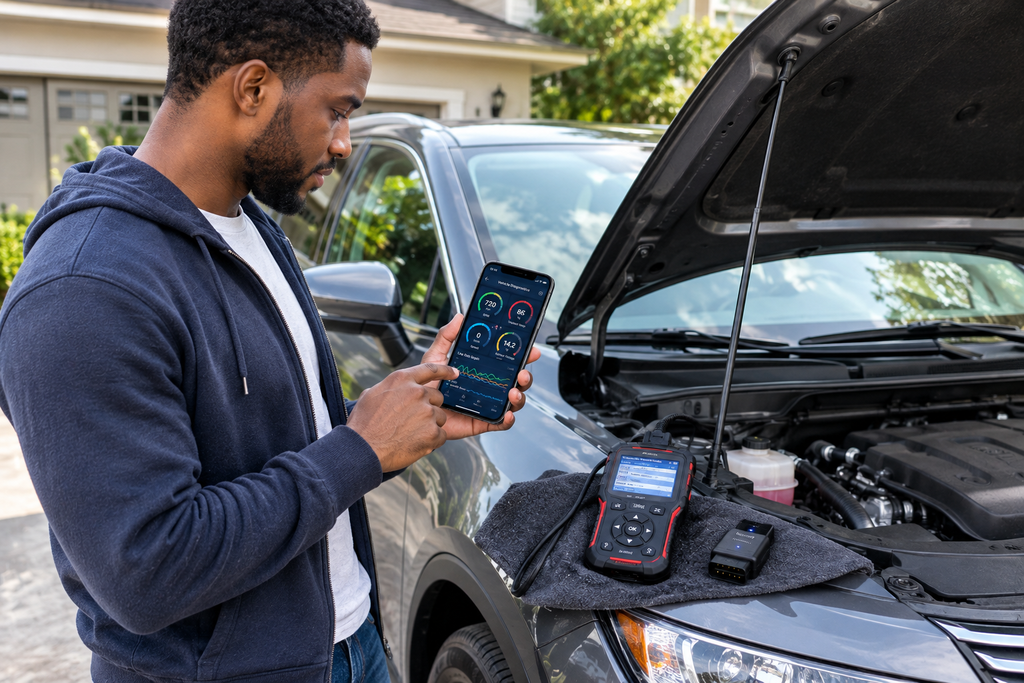
For drivers who want an affordable, portable, easily understood, live-data-displaying, and occasional troubleshooting diagnostic app on a smartphone, it is a better choice. It offers numerous useful features and doesn’t need to invest in any special equipment. If you’re looking to check some of the more common warning lights and get basic information about your vehicle, then you may never need anything more than a good app and a compatible adapter.
A diagnostic scanner that can be carried in the driver’s hand is typically the ideal option for drivers who wish to have a vehicle diagnostics tool or those who frequently perform vehicle maintenance. It’s an even more valuable asset when advanced diagnostics, a number of vehicle modules and professional functions are needed. In the end, both choices are not necessarily the best for all. Before deciding on the two options, drivers should think about the budget they have, compatibility of the vehicles, technical skills and the kind of diagnostic tasks that they are looking forward to doing.