Introduction
One of the most crucial financial planning tasks in a business is budgeting as it will help you to find out how the money is going to be earned, allotted, spent and saved. But not all business costs are the same. There are certain costs that are required to run the business day by day and there are costs that are planned over the medium and long-term to generate value in the business. Here’s where operating and capital budgets come into play. An operating budget is more concerned with the income and expenditure which are likely to be generated through normal business operations while a capital budget is more concerned with the major long-term investments in the business, such as equipment, facilities, technology, etc. Being able to differentiate between these two budgets helps the business owners and financial teams to allocate resources better, track financial performance, safeguard cash flow, and make better investment decisions.
This is particularly the case for operating budgets and capital budgets, as it is easy to get the two mixed up and make bad financial choices. For a firm that sees a major long-term investment as a normal operating cost, it could mistake the value of funds required and for one that treats its regular operating expenses as investments, it could misjudge its financial planning and performance analysis. Operating and capital budgets are therefore quite different, operate under different criteria for decision and may even have different approval processes. While they both are part of a comprehensive financial plan, they should not be used as substitutes for one another. If managed well, they can assist management in achieving a balance between short and long-term needs, and financial sustainability.
Operating Budgets
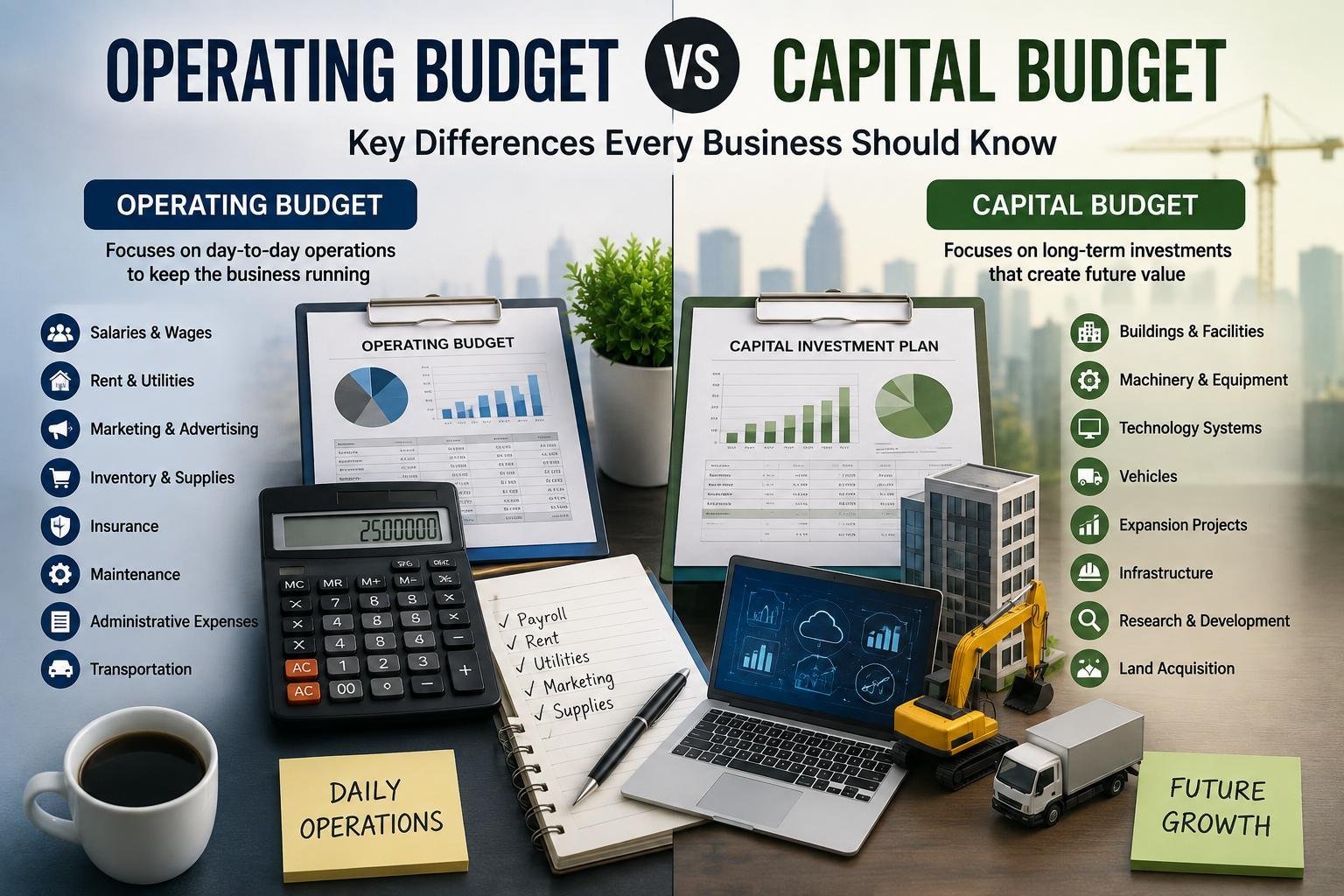
An operating budget is a financial plan that projects revenues and expenses for a typical business for a specific period, typically a month, a quarter or a financial year. It is responsible for the day-to-day tasks that are necessary to maintain the flow and operations of an organization and to provide products or services. An operating budget can contain the expenses associated with a business, such as salaries and wages, its rent, utilities, advertising, office supplies, transportation, insurance, maintenance, inventory, software subscriptions, professional fees and more. The operating budget basically addresses a real-world question: How much money will the business make and spend in its regular business operations during the planning period? When management can have an idea of what the income and costs should be ahead of time, then they are able to imagine what their financial goals are going to be and be able to detect potential issues before they get out of hand.
Operating budgets are especially beneficial in maintaining short-term financial performance. After a budget is approved the actual amounts can be compared to the budget amounts and favorable and unfavorable variances can be identified. For instance, if for a particular year a business has a budget of ₦2million for marketing activities, but actually spent ₦2.5million, management can check why the extra ₦500,000 was spent and if the marketing activities yielded the expected results. Likewise, when sales revenues are not as expected, management can decide if the issue was a drop in demand, a price cut, customer attrition, competition or unrealistic sales expectations in the initial forecasts. The operating budget is not just something that is created at the start of the year; it is a management tool that can be used on a regular basis to keep costs under control and to enhance the business.
What is an Operating Budget?
An operating budget may include several budgets, which can be combined to get a detailed view of the company’s operating performance. A sales budget can include the number of products or services that the company anticipates selling and the revenues that they can generate from these sales. A production budget can indicate the quantities of product to be produced and a direct materials and labor budget can indicate the amount of materials and labor needed to make products. Businesses can even have budgets for administrative costs, selling costs, salaries, marketing costs, utilities, rent, insurance and other overheads. These are then amalgamated into an overall operating plan. The aim is to determine the financial resources needed to sustain a “normal” business, provide the business with revenue and profit goals, and achieve these goals, although the structure varies depending on the size of the business and the industry.
Another important characteristic of an operating budget is that it tends to be for a fairly short time frame. A company can set up a yearly operating plan and then each month or quarter they can set their targets. This will help to pinpoint the seasonal variations, times when more money is going out, and foreseen fluctuations in income. For instance, if a retail store has more sales during holidays, it would be logical to increase its stock, number of employees and marketing promotion during that time of the year. Revenue and expenditure patterns are different in a school in academic sessions and during holidays. Identifying them in advance will enable management to better anticipate cash needs and resources than to be caught off guard by financial pressures.
What is a Capital Budget?
A capital budget is a plan to assess and control major expenditures that will reap returns for a long period of time, usually for many years. Capital expenditures, also known as CapEx, can refer to the acquisition of machinery, vehicles, buildings, land, significant technology systems, production equipment or anything else that is a long-term asset. Capital budgets can also consist of big expansion projects, renovations, research and development projects, and investments in infrastructure. They are typically costs that result in the acquisition or enhancement of assets that benefit the business over an extended period of time (not just the current accounting period) and are not considered operating expenses. Capital projects may take a lot of effort and several years to bring in and will yield returns for many years, so they must be carefully analyzed before management invests its business resources.
Capital budgeting is thus intimately related to the process of strategic decision making. When a business is thinking about buying a new producing equipment, opening an additional branch, installing an enterprise software solution or setting up a new facility, management has to decide whether the benefits they can expect are worth of the investment. Various considerations that could come into play in the decision include initial cost, expected cash flows, useful life, maintenance costs, expected future cost increase, cost reductions, and risk. Management can use financial techniques like net present value, internal rate of return, payback period and profitability index to review and assess competing investment options. The intent is not only to see if the company has enough money to pay for a project now, but whether the project is not the right choice for the company.
Key Differences between Operating and Capital Budgets
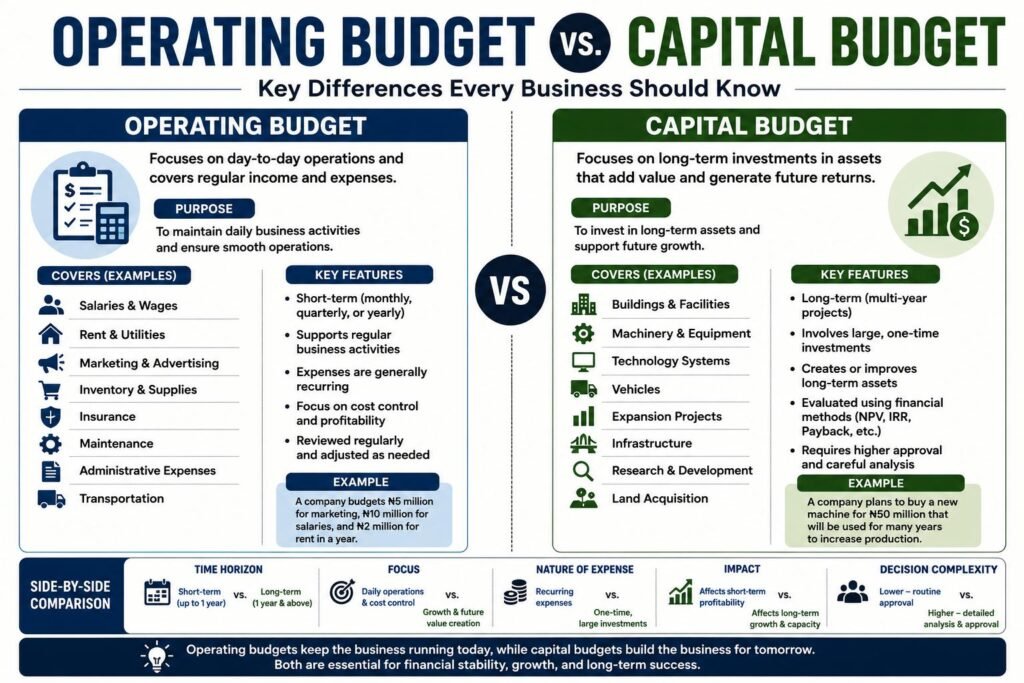
The most apparent difference between operating and capital budgets is that the former includes expenditures of funds while the latter are those to be spent on equipment. Operating budgets are for ordinary expenses and receipts of normal business operations while capital budgets are for major investments in long-term assets and projects. For instance, employee salaries, electricity costs, advertising, office rent and periodic repairs would be considered operating costs. The acquisition of a company vehicle, the construction of a new warehouse or replacing an entire production line, or the acquisition of a large technology platform, on the other hand, would be considered capital expenditures. The difference is important for management to know if the funds they are spending are working to support the existing operations of the organization or to enhance its capacity and earning power in the future.
The two budgets also differ in their planning horizons as well as evaluation processes. Operating budgets are usually drawn up for a one year period and periodically reviewed since operating circumstances may change rapidly. Capital budgets can have multi-year projects which will involve assumptions of a longer duration. Capital expenditure decisions are also likely to be given more attention since these may be significant in terms of their cost, and sometimes it is difficult or costly to reverse them. A company might have to spend less on advertising this month, if sales drop, but it’s difficult to sell off a building or a big piece of specialized equipment. Therefore, in the context of capital budgeting, management must understand the implications of long-term investments, their funding needs, strategic fit, risks, and returns before they approve an investment.
Process of Making an Operating Budget
The first step in preparing an operating budget typically is making realistic revenue projections. Management must forecast what it believes that the company will sell, subjective factors such as market conditions, pricing, customer demand, seasonal factors, sales capacity and economic factors. After determining the expected revenue, the business can then estimate how much it will cost them to earn that revenue. Variable costs vary with the level of business activity and fixed costs are relatively constant for a range of business activities. Careful review of the costs of payroll, rent, utilities, marketing, inventory, transportation, technology, and administration should be made. The use of historical financial data is helpful, but it is not advisable to repeat figures from the previous year as costs, prices, staff required and objectives of the business may have changed.
Once estimates for the revenue and expenses have been made, the business can set up projected operating results and decide if the business activities are financially feasible. Management should consider if the revenue they are expecting will be enough to meet operating costs and generate a satisfactory profit. Departments should also be part of the budgeting process as they are also often better informed than senior management about the resource needs than their sales, production, marketing, human resource and administration managers. After approval of the operating budget, a year’s actual results should be compared with the budgeted results. Any substantial differences should be explored right away (not at the end of the financial year). The regularly conducted review process enables the management to adjust their assumptions, avoid any unnecessary costs and react to changing business conditions.
Five Steps to Preparing a capital Budget.
Capital budgeting starts with the identification of investment opportunities which are likely to aid in the company’s strategic goals. They can be a management proposal, operational department, technology, production managers, or business development plans. A clear explanation of the investment needed, the benefits expected, the likely lifespan of the asset or project, risks to be faced, and the resources needed for implementation is required for each proposal. The management should then make an estimate of the expected cash inflows and cash outflows of the investment in the future. It is necessary because a project which seems to be a good business on paper cannot ensure the availability of cash on time to cover the initial investment. Accounting profitableness is thus only one factor and the cash-flow consequences should not be overlooked in the decision to make large investments.
Financial analysis can be used to evaluate and rank potential projects in terms of their value and strategic importance once they have been identified. NPV, for instance, subtracts the present value of the cash flows that you expect to receive in the future from the amount that you will invest in the project, and the IRR calculation estimates what the rate of return is from the project. Payback can be seen as the time period it takes to recoup the initial investment. But financial factors should not be looked at solely. A project that has a good financial return may not be appropriate if it is a high risk project for the company, if it is inconsistent with a company’s strategic goals, or if it demands resources for implementation that the company does not have. Financial analysis should be done in conjunction with operational, strategic, technological and risk considerations to combine the components of capital budgeting.
When should a Business Use an Operating Budget?
Operating budgets would be employed by a business when they have to plan, control and assess the financial impact of their day to day operations. This involves establishing annual revenue goals, staffing needs, marketing budget, administrative costs, production costs and profitability. Operating budgets are very useful for companies that have major fluctuations in sales or costs as they let them serve as a starting point for comparing actual results to the budget. Monthly budget reports can be relied upon to see if the business is spending more on some activities than is necessary and/or if the level of income is not the one the business is anticipating. This is why the operating budget is an integral part of financial discipline and can help ensure that day-to-day decisions align with long-term profitability goals.
Short-term decision making can also be facilitated with the use of operating budgets. In the event of a downward trend in sales, the budget will help management determine where expenditures can be cut to lessen the impact on critical functions. When revenue is better than expected, the company can decide to allocate extra funds into, among others, its inventory, staffing, marketing, or other opportunities. The budget will also allow managers to prevent the approval of expenditures due to the fact that there appears to be money available at a specific time. All costs must be evaluated in terms of the company’s budget. An operating budget forces managers to consider the financial implications of their operations, since they are connecting what they spend daily with expected revenues and profitability targets.
What is a Capital Budget and When to use it in a Business?
Any situation when a business is thinking about a major purchase that will be beneficial to it beyond the current operating term should be included with a capital budget. It could be buying a piece of land, investing in a high dollar machine, a new platform of technology, a new facility, increasing capacity, or replacing an important long-term asset. Capital budgeting is particularly critical when the investment has a large impact on the company’s financial situation or when the investment will require a significant amount of capital. Instead of simply relying on their hunches, or funding the projects on the basis of available funds, management can use capital budgeting tools to calculate the cash flow expected from the project, assess risk, compare options and decide whether the project will do what the company wants in the long-term.
Capital budgets can also be helpful when companies have multiple investment options, and a limited amount of money. Despite several well-received company proposals, a company might only have enough funds to attempt one or two large projects. Capital budgeting offers a systematic way of prioritizing the opportunities. Management is able to make comparisons of projected returns, investment needs, strategic significance, risk exposure, time to implementation, and impact on cash flows. This will stop resources from being invested in projects that don’t return the investment. It also prompts managers to think about opportunity costs, that is, the benefits which the company might have enjoyed had the money been invested in another project. Thus, capital budgeting can enhance the long-term investment decision making process.
Both Budgets are Essential for Businesses.
Operating and capital budgets are not mutually exclusive, as they are used for different, but complementary, purposes. Businesses require both a business budget and a capital budget; the business budget is designed to keep the business on track for its day to day operations and a capital budget is planned for investments that will affect the growth of the business. The two budgets are linked since capital investments have an impact on operating expenses and income. For instance, a large capital investment might be needed at the initial purchase of automated production equipment, but in future years may save on labor and maintenance costs. Likewise, opening a new branch involves an investment of money, but will result in additional salaries, utilities, marketing costs, inventory needs and revenue streams as soon as the branch opens. Management should ensure that the way they manage and spend the next few budgets will be affected by their capital decisions.
There are also cash-flow considerations as to the relationship between the two budgets. It is possible that a business can make money by operating expenses, and yet feel under financial strain if it takes too much cash out at the same time on capital projects. On the other hand, a company can be reluctant to make the investments that would boost their long-term operating performance since they are concerned with the short-term operating results. Any sensible financial planning needs to be a combination of adequate liquidity now and adequate investment tomorrow. Therefore, it is not a good idea to have a finance team plan operating and capital plans separately. The approach is holistic and enables businesses to see how their current operations, investments, financial requirements, cash flow and future business plans have an impact on each other.
Common Pitfalls that Businesses can make when managing these Budgets
A frequent error is not making a distinction between routine operating costs and capital costs. Misclassification of expenses can lead management to have a misrepresentation of the performance of the business and the investment needs. Another error is approving capital projects on the basis of the original cost of the equipment without taking into account maintenance, financing, implementation, replacement and future other costs. Another error that businesses can make is forecasting excessive revenues when they are creating their operating budgets. The result of this is that the expected sales have to be inflated and the expenses have to be deflated, which can lead to setting up a budget that sets impossible expectations for profits. These difficulties can be minimized and operating and capital budgets can be more reliable by conducting reviews regularly, assuming realistic scenarios, using historical data, and with input from relevant departments.
The second common error is when budgets are not updated when circumstances change. A budget is not a forecast, and it should not be the same year in year out irrespective of the economic climate. Operating and capital plans can be impacted by changes in customer demand or inflation, supplier prices, exchange rate, interest rate, technology, competition, regulations or business strategy. Therefore, it is necessary for businesses to have a regular budget review process. Monthly or quarterly budgets need to be monitored, and if a major capital project is in progress, it should be monitored at key milestones. If the assumptions that are used are significantly different from the projections, then management must be “willing to update the budget if the assumptions turn out to be wrong. In an uncertain and fast changing business environment flexible budgeting and rolling forecasts can be used to give extra support.
The Difference between Practical Examples of Operating Budgeting and Capital Budgeting
Let’s say a manufacturing firm has decided to expand its manufacturing in the upcoming fiscal year. Additional salaries for employees, electricity, raw materials, transportation, advertising, insurance, routine maintenance and other costs needed to produce more might be part of the company’s operating budget. These costs are linked to its routine business, and would be part of its operational budget. Meanwhile, management might realize the increase in production cannot be achieved using the current machines. A new production machine would be deemed as a capital expenditure as this machine would be anticipated to give service for a number of years. The company would consider the machine, in terms of its capital budget, and only invest the necessary amount once it has evaluated the machine.
The example shows the importance of the separation of the two budgets. The machine purchase shouldn’t be seen as just another monthly expense as it will be a big investment in the future productive capacity of the company. Meanwhile, management has to realize that the purchase of the machine will have implications for future operating budgets. The company may have to allocate funds for electricity, maintenance, insurance, training or hiring employees for the use of additional equipment, depreciation, repairs or anything else that goes with the new equipment. The capital decision thus brings about future operating implications. Combining both budgets allows management to figure out the total cost of the expansion, and decide if the investment is financially viable, strategically sound and will return a sufficient profit.
How to Incorporate Operating and Capital Budgets into Business Planning
The best budgeting systems combine operating and capital budgeting into a single system. The process can start by identifying the company’s strategic goals, e.g. gaining market share, becoming more efficient, opening new facilities, creating new products or cutting operating expenses. Management can then establish the operating resources and capital investments needed to attain those objectives. Operating budgets can determine the resources needed to sustain existing operations and capital budgets can determine the investments needed to expand future capacity. Finance teams need to then review the impact of these plans on profitability, cash flow, financing needs, liquidity and financial risk. This allows strategy and financial resources to be linked to one another rather than budgeting being just an accounting process.
It is also important for businesses to put in place defined responsibilities and approval processes for both these types of budgets. Depending on the size and organization of the department, a department manager may be responsible for keeping an eye on operating expenses in his or her department, and a major capital proposal can be forwarded to a finance committee or the board of directors based upon the size of the department. Regular reporting should then indicate to management if they are meeting actual performance to the approved plans. If there are major deviations, decision makers need to look into the reasons why and decide if something needs to be done. Such a mix of planning, accountability, financial analysis and monitoring can make budgeting more effective, and ensure that limited resources are used to produce maximum value for the business.
Conclusion
It’s important for businesses to grasp the distinctions between operating budgets and capital budgets, as this understanding is vital for ensuring financial stability and sustainable growth. An operating budget is about the income and expenditure of the business’ regular day to day operations, such as salaries, rent, utilities, marketing, inventory, transportation, administrative, etc. A capital budget, on the other hand, is a budget that is used to cover large long-term investments like property, machinery, technology, vehicles, expansion projects, and other assets likely to benefit the organization over several years. The two budgets go hand in hand but have different functions. Future operating costs and revenues might be affected by capital investments, and operating performance is what permits a business to be realistic about what it has to invest in the long haul.
The aim should not be merely to create two different types of budgets, but to employ each of the two budgets as a tool for decision making for the business and finance teams. Operating budgets enable businesses to manage short-term fluctuations and take control of their current expenditures, monitor profitability and make decisions based on profit or loss, whereas capital budgets allow businesses to evaluate investments, increase future capacity as needed. Realistic assumptions, analyzing investment returns, regular performance monitoring and synchronizing short and long term financial plans maximize the use of resources, safeguard cash flow and ensure better investment decisions. In the end, a well-managed operating budget ensures the business’s financial discipline today, and a well-designed capital budget ensures that the business has the assets, capabilities and opportunities it will need tomorrow for its growth.
Get more well researched information about Operating Budget vs Capital Budget here.