Introduction
Accounting is referred to as the language of business as it documents, systematizes and communicates financial information which assists organizations to make informed decisions. If you are just starting your commerce education or a new entrepreneur running a start-up or an existing business owner who is looking to scale your business, it’s imperative to understand the various fields of accounting. Each branch has a different function, ranging from providing investors with financial statements that they can use to assess the company’s performance, to monitoring production costs and helping make strategic business decisions. All branches are used to address various financial issues in an organization, but each has its own tasks.
Many people who are new to accounting think that it’s just one field and has one role. In practice, accounting has become a number of specialized branches which serve the needs of various users. Investors need to have reliable financial reports, managers need data for planning and government need to have the tax data, and manufacturers need to have a detailed cost analysis to improve their efficiency. This specialization enables businesses to collect accurate financial data and to make better decisions in the operations and strategy of the business. Once you know how each branch aligns itself into a business structure, you’ll understand why accountants would prefer to specialize in specific areas rather than being well-versed in all aspects of accounting.
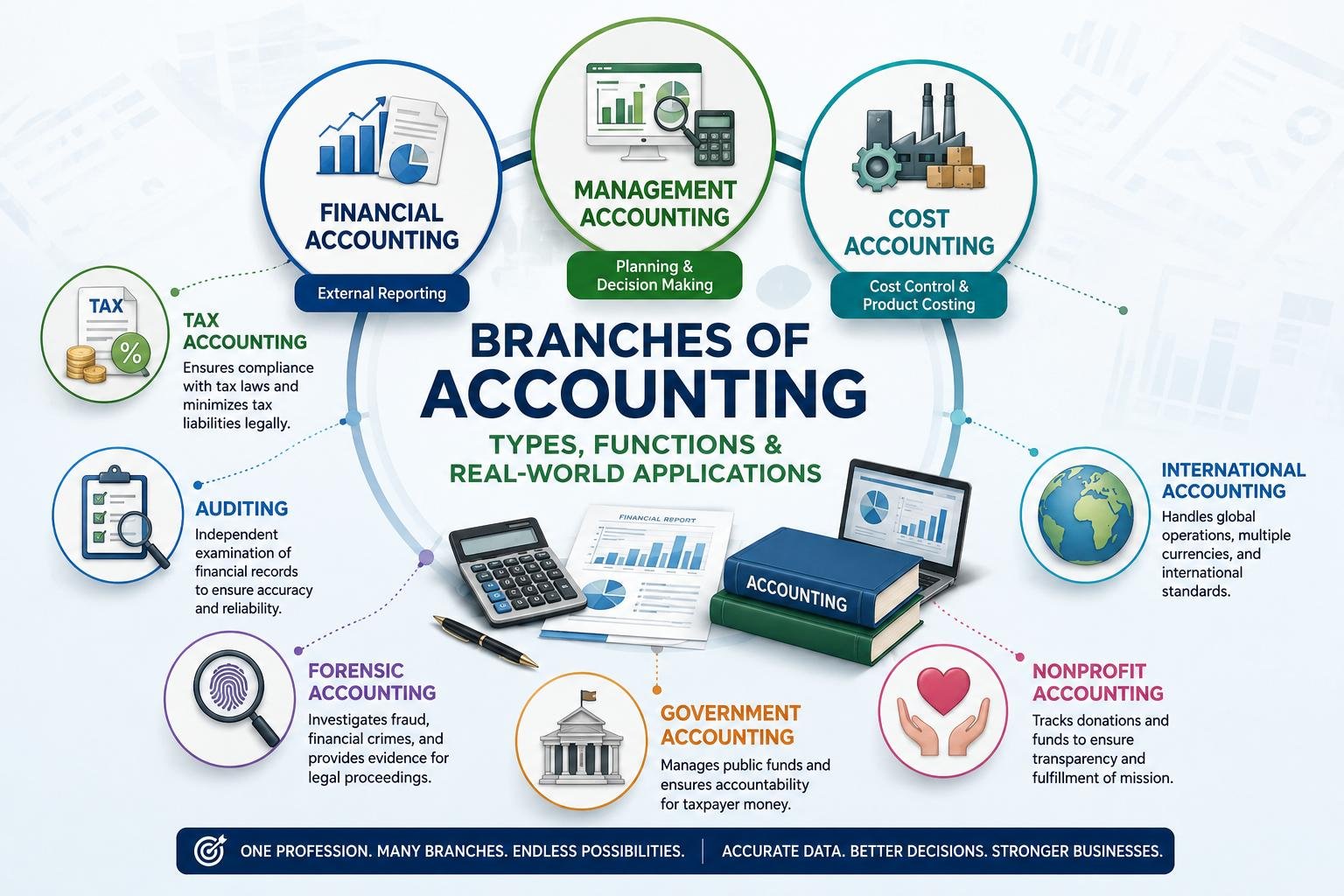
Financial accounting, management accounting and cost accounting, are regarded as the three pillars of accounting as these are directly affecting almost all the business decisions. Financial accounting is used to report to others, management accounting is used to plan and make decisions in the business and cost accounting is used to help the business control the cost and increase profitability. These are supported by the other functions of the branches such as taxation, auditing, public sector accountability, forensic investigations etc. By the end of this guide, you’ll not only know what each of the branches of accounting is about, but you’ll also know how it’s applied in the real world of business.
Why Discussing Branches of Accounting?
As businesses have evolved over time, so have the need for financial information. As the businesses evolved over time, so have the requirements for financial information. From a basic bookkeeping and financial reporting level, a small retail shop will be doing the same as a multinational manufacturing company, but the latter will also be keeping track of production costs, predicting future budgets, complying with tax laws, meeting investors’ expectations, facing audits, and investigating financial wrongdoings when needed. This is because these many goals can’t all be met in a single accounting system. This is the reason accounting split up into a number of specialized areas, each of which addresses a particular financial query. Financial accounting answers the question as to how the company did from a financial perspective during a reporting period. Management accounting is one of the ways that management is able to tell itself what to do next. Cost accounting provides information on the real cost to produce the product/service. The other branches offer specialized expertise to assist in boosting compliance, transparency and accountability in different sectors. This method allows businesses to make more informed decisions and meet legal, operational and financial reporting obligations.
If your readers need a longer introduction to the fundamental branches of accounting, this guide will build upon them, detailing how they are implemented in business and how they operate together in a real business.
Financial accounting: The Cornerstone of External Reporting.
Financial accounting is the area which keeps a record of business transactions and makes standardized financial statements for external users. Shareholders, investors, lenders, the government and possible business partners are examples of these. Financial accounting is conducted based on the accounting standards that have been adopted, like IFRS or GAAP, which makes the reports consistent, comparable and transparent across an organization. It’s not about improving day-to-day operations; it’s about accurately showing a company’s finances for a particular period of time.
Financial accounting is essential for all businesses in order to prepare financial statements like income statement, Balance Sheet, Statement of cash flows, and Statement of changes in equity. The reports allow investors to determine if the business is profitable, creditors to determine if the business can be paid back, and regulators to help them make sure the business is following the financial reporting standards. These reports are shared externally so accuracy and consistency is crucial. Financial accountants diligently keep track of the Revenue, Expenses, Assets, Liabilities and Equity of the company and ensure that each and every transaction follows the applicable accounting principles.
Think of a company that requires capital from a commercial bank. The bank will look at an individual’s audited financial statements in order to approve a loan. These reports indicate if the company is making enough money, has a positive cash flow, and a healthy debt management. If they did not have a system of financial accounting, it would be much more difficult for the lenders to evaluate risk, and financing would be much more difficult. This is just one example of the value of financial accounting for a business’s transparency and investor confidence.
Management Accounting: Supporting Better Business Decisions
The role of management accounting is to assist managers to make better decisions. Management accounting is different from financial accounting, which is used mainly for external people, and provides information for people within the business for planning, budgeting and forecasting, performance measurement and appraisal and strategic decision making. It is flexible and does not adhere to reporting requirements as all organizations have different management information requirements. Rather, reports are tailored to the decision makers’ specific needs to address a particular business problem or enhance operations.
Management accountants develop budget forecasts, sales forecasts, variance analysis, performance reports, profitability studies and investment evaluations. These reports can be used to determine whether new products should be introduced, new markets explored, production capacity enhanced, operating costs cut down or investment in new technology. While historical transactions are part of management accounting, it is more about planning for the future and the working in conjunction with financial information. This proactive strategy helps companies pinpoint risks early on and capitalize on potential growth opportunities before their rivals have a chance.
Now, let’s say there is a chain of restaurants that is thinking of a new plan to open 3 new branches in various cities. While financial accounting lists last year’s profits, management accounting considers the probable demand for products and services from customers, anticipated operating costs (such as the cost of the machine, repairs and maintenance, electricity, etc.), the number of people needed to operate the machines, and the likely profitability of the various locations. Managers can make and compare investment scenarios, recognize the most promising investment and allocate resources more efficiently. In a world full of uncertainty, management accounting is an essential instrument for strategic planning and growth in businesses.
Cost Accounting: Understanding and Controlling Costs
Cost accounting is a specialty that focuses on the identification, measurement, analysis and control of costs incurred in the production of goods or service. Cost information is utilized in the field of management accounting in decision making while cost accounting has a more specific responsibility of determining the cost of products, services or business activity. This information can aid in optimizing pricing strategies, reducing waste, increasing efficiency and maximizing profits. Cost accounting is essential for the manufacturers as it is required for production which includes raw materials, manpower, overhead, machinery, inventory, etc.
Direct materials, direct labor and manufacturing overhead are categories of costs that are used to determine the expenses of a specific product or production process for cost accountants. They also compare fixed costs, variable costs, marginal costs and standard costs to find opportunities to reduce costs. This will then help businesses identify any inefficiency and make a decision about improving their operations by comparing actual costs to expected costs. High accuracy in cost information also assists with inventory valuation and pricing in order to make sure that products have adequate profit margins.
Suppose that the furniture company starts to see a decrease in profit levels, but has an increase in its sales. Financial accounting shows that profits are down, but cost accounting shows that there are several causes; timber prices are up, there are more factory overheads and the utilization of manpower is suboptimal. This allows management to negotiate better supplier contracts, automate some parts of the manufacturing process or rethink manufacturing processes in order to cut costs. The following example illustrates how cost accounting data turns numbers into business operational adjustments that have a direct impact on business performance.
Tax Accounting: Legal Compliance.
Tax accounting involves preparing tax returns, determining the tax liabilities, keeping tax records and ensuring that the business follows tax laws. While financial accounting may be based on accounting principles to measure profitability, taxable income may be determined differently due to different rules on income recognition, allowable expense types, depreciation options and deductions among other things. These rules are comprehensible to tax accountants, and they can ensure that businesses can submit their tax returns on time and help them pay them as low as they can in a legal and ethical manner.
Tax accounting is a vital aspect of business, as tax laws change frequently, and businesses need to be aware of these changes to ensure compliance. Tax accountants are able to provide advice on value added tax, corporate income tax, payroll tax, withholding tax, capital gains tax, and international tax issues, if applicable, to organizations. They also help to fill out the tax returns and to present the supporting documents to the tax authorities when the tax returns are audited. Effective tax accounting is an effective way to minimize the risk of legal issues, avoid penalties, and enhance tax efficiency to manage cash flow in the best way for the business.
Auditing: Establishing Trust by Independent Review
Auditing is an examination of an organization’s accounts to see if they reflect the financial activities that have taken place. An internal auditor is an individual employed within an organization that will audit a company’s operational efficiency, risk management and internal controls, whereas an external auditor is an individual who will independently audit the financial statements of a company before such statements are presented to investors, regulators or lenders. Auditing helps to make financial information more reliable, and ensures that it is accurate and complies with the accounting standards.
For a publicly traded company, for instance, they typically have to undergo annual external audits prior to the release of financial statements. One of the most important roles of the auditor is to give an opinion for an investor to rely upon when making a decision about whether or not financial reports are reliable. Internal auditing can also be used to suggest improved internal controls that can avoid fraud, minimize operation risks and increase organization efficiency. Auditing contributes to good corporate governance and helps to safeguard stakeholders against incorrect financial reporting through these obligations.
Forensic Accounting: Investigation of Financial Fraud.
Forensic accounting is a hybrid of accounting and investigative skills that can identify financial crimes like money laundering, fraud, embezzlement, insurance fraud, asset misappropriation, and financial statement manipulation. Forensic accountants may also collaborate with the police, lawyers, insurance firms and regulators. The results could be presented in civil or criminal court cases as proof.
Suppose that a company finds that cash shortages are occurring over a number of years and cannot be explained. A forensic accountant reviews financial records, electronic transactions, payroll records, invoices, supplier contact and employee activities to see if fraud has taken place. Forensic accountants are able to follow the paper trail and determine if there are any irregularities in the financial transactions to assist organizations in recovering losses, internal control strengthening and prosecution of offenders. Their efforts show that accounting goes beyond just numbers to safeguarding businesses against financial misconduct.
Government Accounting: Managing Public Resources
Government accounting is about the administration of public money and accountability of the taxpayer’s money. Governments have other priorities than private businesses, such as transparency, adherence to budget and responsible use of public funds. Budget preparation, public financial resources monitoring, financial performance reporting and public financial management rules compliance are tasks of the government accountants.
However, citizens want governments to use the tax money wisely for the delivery of the services of health care, education, infrastructure and public services. Effective government accounting allows the public, oversight bodies and politicians to assess the effectiveness of the use of public resources. This branch is involved in accountability and provides information for policymaking on the national level for development and economic stability.
Nonprofit Accounting: Supporting Mission-Driven Organizations
Nonprofit accounting is used by charities, foundations, educational institutions, religious organizations and others with a social mission as their primary goal. These organizations need to closely monitor their donations, grants, program costs, restricted funds, and operational costs; and be accountable to donors, regulators, and beneficiaries. Nonprofit accounting is not about shareholder value, but about the stewardship of resources and sound finance practices.
If, for instance, a charity is accepting donations for educational scholarships, the charity must be sure that the money raised goes toward educational scholarships. Nonprofit accounting helps to ensure that donors trust that their funds are being used effectively for the nonprofit’s goals, by providing transparency to the financial aspects. Good fundraising is also fostered by good financial reporting since donors like to support organizations with good financial accountability.
International Accounting: Managing Global Business Operations
International accounting is a field of accounting that deals with financial reporting problems of businesses that conduct business activities in two or more countries. Multinational corporations face other currencies, taxes, accounting standards and regulations, making international accounting a vital necessity for them. Experts in this field know requirements for foreign currency translation, cross-border taxation and international financial reporting standards as well as global compliance requirements.
The challenge for a business whose head office is in one country but has subsidiaries in others is to present consolidated financial statements that are compliant with the local laws in subsidiaries’ countries and international reporting standards. International accounting provides a standardization of accounts to make them understandable and consistent in a legal and economic sense. Business opportunities are increasingly global, and so is international accounting. With the continued expansion of the scope of business activities, international accounting is gaining importance for businesses that are active outside their home countries.
The Importance of the Three Core Branches in Relation to One Another
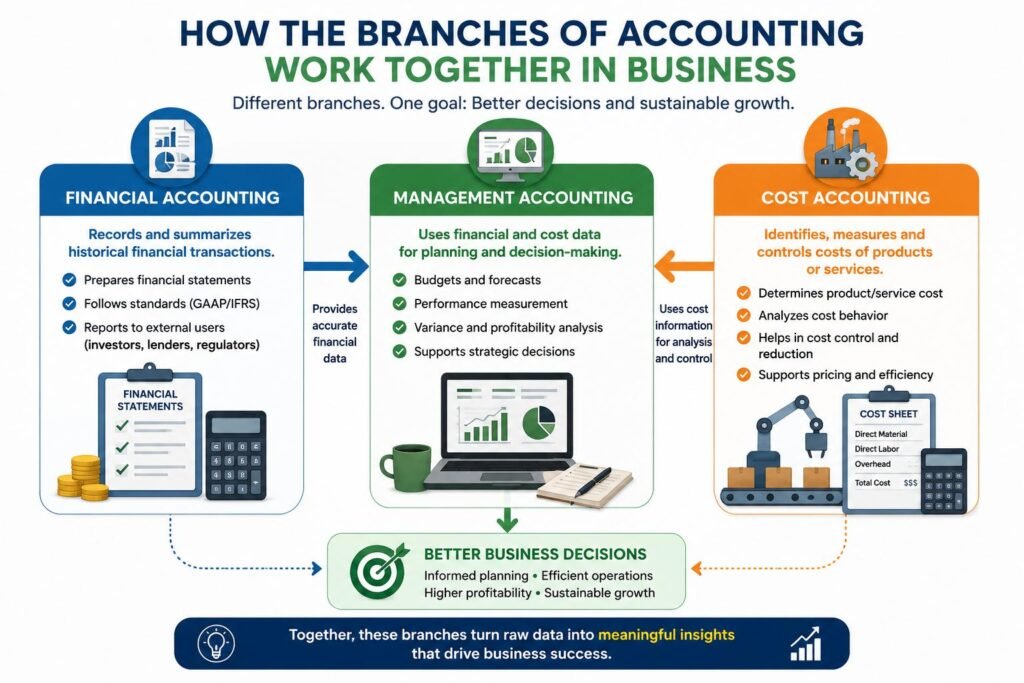
Financial accounting, management accounting and cost accounting are not separate disciplines, but are complementary in fulfilling different objectives. Financial accounting involved in the preparation of official reports to outside users, and in the recording of completed transactions. Cost accounting involves analyzing and evaluating production costs and operational efficiency based on detailed information regarding the production costs. The outcomes of financial accounting and cost accounting are then utilized in management accounting for the purposes of budgeting, assessing investment projects, projecting future performance and aiding executive decision making. This symbiotic connection can help enterprises convert raw financial data into valuable strategic insights for enhancing their performance, profitability, and sustainable growth.
Suppose that a manufacturing firm is introducing a new product. Cost accounting methods are used to determine the cost of production, management accounting is used to determine the pricing policy and profitability forecast, and financial accounting keeps a record of the sales and prepares the financial statements at the end of the year for investors. These branches put together offer a full financial administration system that assists at any point of the business activity, from production arranging to outer reporting. This sense of the relationship can lead students to understand that accounting is a lot more than just a system for recording transactions, it is an integrated information system that can be used to aid in almost all aspects of an organization’s decision making.
Choosing the Best Accounting Specialization
Accounting students need to be aware that there are different opportunities available in each branch of accounting depending on their interests and career objectives. Financial accounting can be a fun course for people with an interest in corporate reporting and in preparing financial statements. Management accounting is a preferred choice for others who prefer business strategy, planning and executive decision support. Cost Accounting is particularly satisfying for students who are interested in manufacturing processes, efficiency and operational analysis. For those interested in the taxation or auditing aspects of accounting, a specialized career is available, as well as public finance and forensic accounting for those interested in more fraudulent aspects. Businesses appreciate the accountant who can offer expertise in multiple areas, as more and more modern-day accountants build a variety of expertise to ensure that they can help business organizations achieve success.
Conclusion
The branches of accounting have arisen due to various types of accounting information that are needed to meet the information needs of business various stakeholders and objectives. Financial accounting offers clear reports to investors or regulators, management accounting helps with planning and strategic decision making and cost accounting helps with detailing the costs involved to increase efficiency. These three are accompanied by four other accounting specialties, tax accounting, auditing accounting, forensic accounting, government accounting and nonprofit accounting that also serve specialized functions to complement other accounting areas and enhance financial management in different areas of industry.
The three fundamental branches offer great benefits to students starting out on their accounting career as an excellent base to build on for all other accounting specializations. Entrepreneurs can also learn the value of the different branches of the business as they relate to its success, with the ability to make better financial statements, manage costs, and make better business decisions. Instead of just a set of numbers, accounting is a complex system of branches that can be understood as a powerful decision making system that can guide to transparency, accountability, efficiency and sustainable business growth.
Get more well researched information about branches of accounting here.