Introduction
Financial accounting is the bedrock of all businesses that are successful as it offers an organized methodical record, summarization and reporting of financial transactions. Financial accounting applies to small start-ups, expanding businesses and even multi-national companies and makes sure that the monetary activities of any company are properly reported and are presented in a standard fashion. If it were not for it, investors would have a hard time assessing businesses; banks would be reluctant to lend money; governments would have a hard time collecting taxes and business owners would have no dependable financial information for long-range planning.
This complete guide to financial accounting will give you all the answers to your question: What is financial accounting? Its meaning, aims, characteristics, principles, financial statements, users, restrictions and significance in contemporary business will be taught to you. At the end of this article, you will know the importance of financial accounting and the need of all the organizations to keep proper accounting records.
If you don’t want to go through the detailed concepts, you can go straight to the Types of financial statements in Financial Accounting for an overview of the reports that businesses make on a regular basis.
What is Financial Accounting?
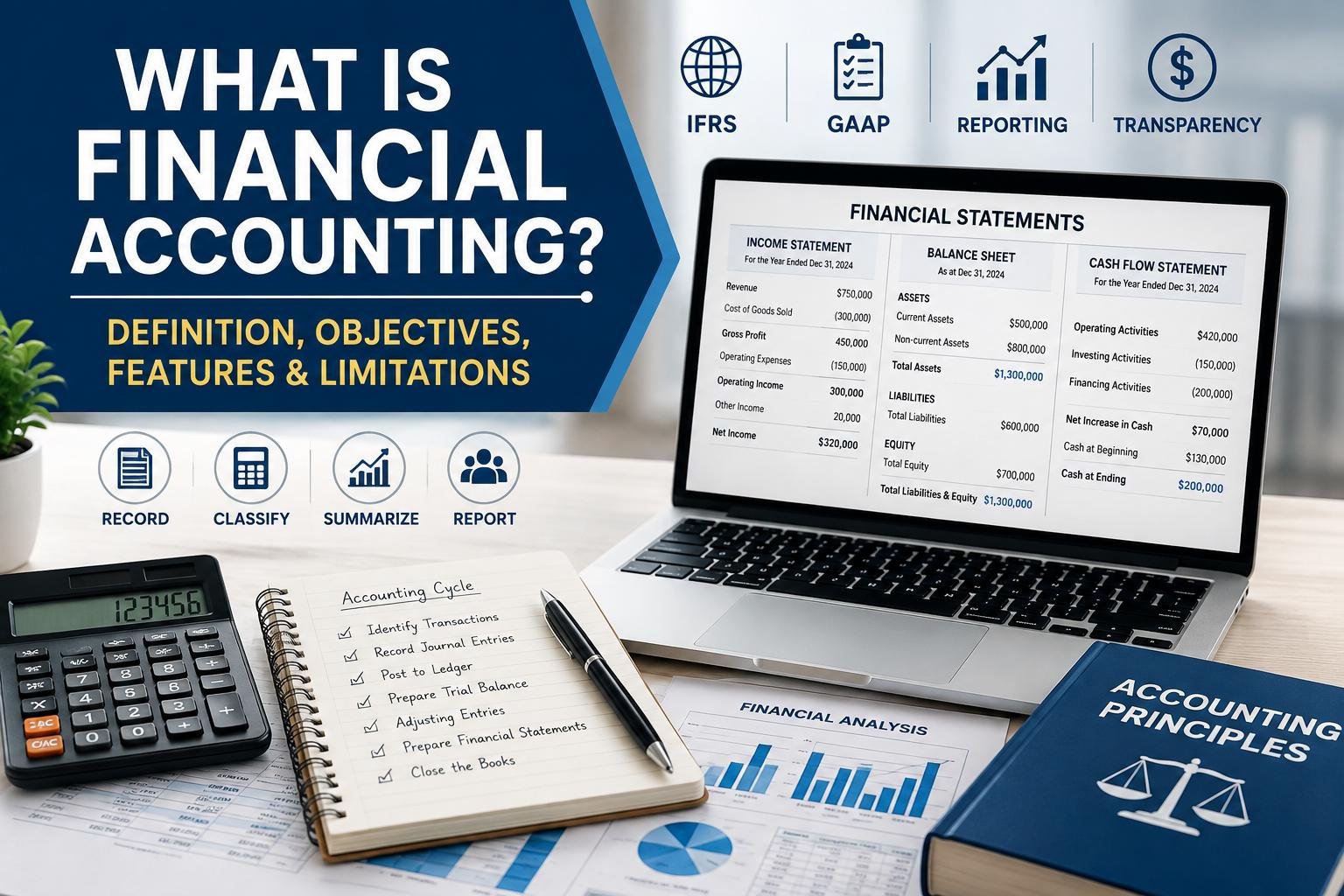
Financial accounting is the accounting that documents, categorizes, totals and communicates the financial operations of a business over an accounting period. The main function of financial accounting is to arrive at a standardized set of financial statements reporting the financial performance and financial position of an organization to external users like investors, creditors, lenders, governmental bodies and regulators.
The differences with management accounting are that financial accounting is bound by accounting principles, namely IFRS (International Financial Reporting Standards) or GAAP (Generally Accepted Accounting Principles) – the standards are internationally accepted. The standards will provide the consistency, transparency and comparability between the organizations in the same industry or between countries. Financial accounting is one of the most reliable sources of financial information for the stakeholders as it only includes those transactions which can be measured in money terms and is presented in an objective manner, with no personal bias. Financial accounting is essential for every business, big or small, to show accountability, track finances, meet legal obligations, and provide financial information to interested parties. Financial accounting is a crucial area of the accounting profession since it is important for investment decisions, loan approvals, taxation and regulatory supervision among other things.
Understanding the Importance of Financial Accounting
Financial accounting is more than just bookkeeping of receipts and disbursements. It offers reliable financial data which facilitates business development, strengthens confidence among stakeholders and ensures legal compliance. All the transactions that take place in an organization, from buying inventory, paying salaries, to receiving amounts from customers, eventually get reflected on financial statements that provide a description of the financial state of an organization. Good accounting records enable business owners to provide for future expansion, identify inefficient operations and profitable business operations. These reports are used by investors to make an investment decision before purchasing shares of a company, banks to make a decision before granting loans, and governments for deciding tax liability. If there were no standardized financial accounting, businesses would not be able to prove credibility and thus it would be hard to get investment or financing. Financial accounting is considered as “language of business” because it allows the organization to communicate financial information using a universally agreed reporting framework in today’s competitive economy.
Goals of Financial Accounting
To ensure financial records are maintained accurately. The main aim of financial accounting is to keep full and accurate records of each of the financial transaction of a business. All sale, purchase, payments, receipts, loans, investments and expenses should be systematically recorded in order to prevent any financial transaction from escaping the record. Keeping accurate records helps to minimize errors, avoid fraud, make audits easy, and ensure there is a reliable historical record for future reference. Good bookkeeping allows companies to keep track of the transactions, so that if they have any questions about the payments, assets, liabilities, or taxes, they can follow the transaction. If there were no financial records, businesses would be unable to provide accurate financial reports, or defend themselves against financial audits or regulatory inspections.
To Measure Business Performance booklet
Financial accounting can be used to identify whether or not a business has made a profit or suffered a loss over a particular accounting period. Standardized reporting enables businesses to review their financial performance against that of past years, track the growth of the business, assess the efficiency of the operations and determine their profitability. These financial statements are used by managers, shareholders and investors to judge the performance of the business, and determine if the business is getting better, staying the same or getting worse. The measurement can also help management check to see if the business goals are being met and if any corrective measures are needed.
To determine Financial Position
Another key goal is providing a statement of the financial position of a business at a certain point in time. The information function of financial accounting is to give information about the assets, liabilities and owner’s equity of a company so that the information can be used to see how strong the company is when viewed by stakeholders. This information is particularly important for a lender to consider when determining credit worthiness, an investor when evaluating financial stability and a supplier when determining if they should provide trade credit. A good knowledge of financial position also assists businesses in making investments, managing debt and allocating resources effectively.
To Aid Decision Making by External Users
The main purpose of financial accounting is to provide financial information that is useful and reliable for its external users who need reliable information before taking economic decisions. Investors look at profit before buying shares, banks look at financial stability before giving a loan and government agencies look at financial reports to check tax compliance. Suppliers can review the liquidity prior to extending credit and customers can assess financial stability prior to signing long-term contracts. Standardized financial statements also minimize uncertainty and the confidence that the information reported in the financial statements is true.
To Ensure Legal and Regulatory compliance
In most countries the rules governing the accounting record keeping and preparation of financial statements for registered companies stipulate that such financial statements be prepared in compliance with the relevant accounting standards. Financial accounting helps companies to adhere to the tax laws, company policy, auditing standards, and financial reporting standards. Compliance ensures that businesses are not subject to legal penalties, can be more transparent, and can gain regulators’ and investors’ confidence. Those that don’t keep proper accounting records may be subjected to fines, legal action or damage to their reputation.
Financial Accounting Features
Financial accounting has some unique features which differentiate it from other types of accounting. A key quality that makes it unique is historical reporting, since it doesn’t predict future events, but rather records past ones. Objectivity is another feature that is important, since financial reports do not rely on assumptions or opinions but are based on verifiable information like bank statements, contracts, receipts and invoices. Financial accounting also adheres to a set of accounting principles set by IFRS or GAAP, which is followed by all organizations and industries, for consistency. Another significant characteristic is comparability, as businesses follow the same accounting systems, which would enable investors and analysts to make accurate comparisons of the financial performance. Financial accounting focuses on reliability, accuracy, transparency and consistency and provides financial information in a structured format which is easily understood by external users. Also, financial accounting is done in monetary terms and only transactions measured in dollars and cents are entered into the books, whereas other softer qualitative considerations such as employees’ morale or customer satisfaction do not typically appear in the financial statements.
The Principles of Financial Accounting
Financial accounting is based on some basic principles which ensure that financial reports are accurate, consistent and reliable. The transactions are recorded on the accrual basis, which provides a more realistic view of the financial performance, as opposed to being recorded when cash is handed out. The going concern principle is that business will continue to operate in the foreseeable future unless evidence indicates that this is not the case. The consistency principle means that the methods used in the accounting process should be consistent for a particular business for each reporting period, allowing comparisons between periods. The matching principle enables expenses to be matched with the revenues with which they are associated; this makes it easier to measure the profit. The principle of prudence/ conservatism has a conservative approach by accounting for the loss as soon as possible before the gain can be expected to happen. The full disclosure principle is also a significant one; it calls for the presentation of all material financial information which would affect the decisions made by users. All these principles contribute to the reliability and value of the financial statements as well as transparency in financial reporting.
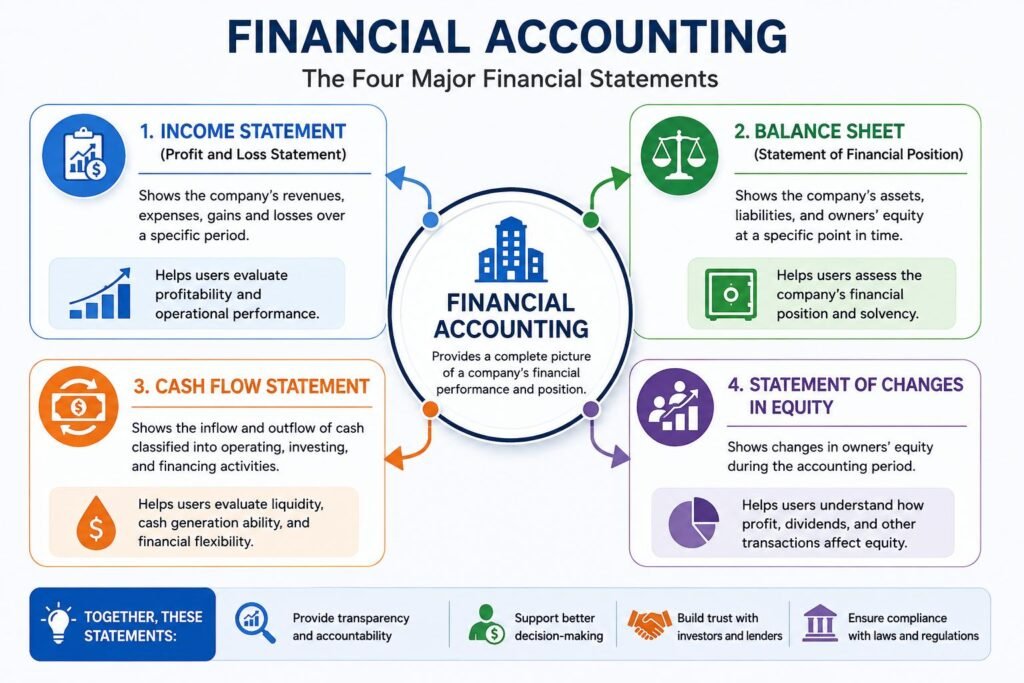
Types of Financial statements
Income Statement
The income statement (also called a profit and loss statement) is a summary of a company’s revenues, expenses, gains and losses for a certain accounting period. It ultimately reflects on whether the company made any profit or loss. Investors often use the income statements to gauge the profitability of a company’s operations, and management uses the income statements to determine whether its operations are efficient. Analyzing revenue and expenses can help businesses pinpoint areas for increased profitability, cost cutting, and improving the bottom line.
Balance Sheet
The balance sheet is a financial statement that shows the value of a company at a particular moment in time. It provides information on its assets, liabilities and shareholders’ equity based on the basic accounting equation: Assets = Liabilities + Equity. This statement is designed to show what the business is worth, what the business is liable to pay and what is the interest of the owners in the business. The balance sheets are reviewed by banks before granting loans as they indicate the financial stability and solvency of the bank. Balance sheets are also useful to investors to assess the ratio of debt to equity financing that a company keeps.
Cash Flow Statement
Cash flow statement shows how cash flows in and out of business in an accounting period. It classifies cash flows as operating, investing, and financing cash flows. A firm could be making a lot of money in the business, but it might face cash flow problems because there’s not enough cash to pay bills. This claim, then, offers good information on the liquidity, sustainability of operations, and the organization’s capacity to finance future growth.
Statement of Changes in Equity
Changes in equity are a statement that reports the changes in owners’ equity during the reporting period. It contains retained earnings, dividends, change in share capital and comprehensive income adjustments. This statement is analyzed by investors to evaluate profit retention and distribution, and to determine ownership changes over time. It is presented along with the other financial statements to give a full financial picture of the organization’s financial activities.
The Users of Financial Accounting Information
There are a variety of external parties who rely on accurate financial information for decision making and for whom financial accounting would be of benefit. Before investing in a business, investors will assess profitability, growth potential and financial stability. Financial statements are examined by commercial banks and other lenders to assess if businesses are able to pay back their loans on time to agreed conditions. Financial reports are used by government to determine tax liabilities, to track regulatory compliance and to monitor financial reporting requirements. In determining whether or not to extend trade credit, suppliers look at financial information, and customers may consider financial stability when deciding to enter into long-term supply agreements. During the negotiations with employees or labor unions, financial reports are sometimes reviewed by employees or labor unions. Standardized financial statements are essential to financial analysts, auditors, researchers and regulators when analyzing a company’s performance, industry trends and economic conditions. Financial accounting is objective, comparable and provides information which enables informed decision-making in all areas of the economy.
Why Financial Accounting is necessary for all kinds of business?
Financial accounting is required since it helps to ensure financial reporting is accountable, transparent and consistent. Governments have a need for businesses to keep accounting records for two purposes:
(1) To determine the correct amount of taxes to be paid.
(2) To ensure that regulatory requirements are complied with. To protect investors, public companies are required to submit audited financial statements so that the information presented in the financial statements is a reflection of the business operations. Businesses also reap rewards from keeping accurate financial records as it is easier to apply for loans, invites investors, supports business expansion and allows for better business financial control. Standardized financial reporting mitigates fraud risk, enhances investor confidence and facilitates effective capital markets through the provision of uniformly reported information for investors to compare companies. If no financial accounting is required, it will be much harder to make economic decisions since the users will not have information they rely on to make objective decisions.
Different Types of Accounting besides Financial Accounting.
There are a few significant differences between management accounting, financial accounting, and cost accounting. The aims of financial accounting are mainly for external users, and they are the preparation of standardized financial statements, following IFRS or GAAP. Management accounting, however, is concerned with the supply to internal management of information for planning, budgeting, forecasting and strategy. Cost accounting focuses on the identification, measurement and management of production costs for the purposes of enhancing the efficiency of operations. Management and cost accounting focus more on the operations in the organization and future plans, while financial accounting focuses on financial performance of the past and reports for external stakeholders. These branches work together and don’t overlap, providing the business with a way to meet both external reporting needs and internal management needs.
General rules for Financial Accounting limitations.
While financial accounting has many advantages, it is also subject to a number of drawbacks. It has the drawback of being mainly historical, as opposed to future, meaning it is not as helpful in predicting future results. In financial accounting, too, only measurable monetary transactions are included in the accounts, so that valuable non-financial assets like the skill of employees, their customer loyalty, their innovation and their brand reputation are not generally reported in the financial statements. Another restriction is that financial statements are delivered at regular intervals, not continually, so significant developments of the business that happen since the date of the statements may not be reflected in the statements at once. Financial accounting also has rules that are set out in a standard manner, which may not allow for flexibility when there are special business situations. Further, inflation can make historical cost measures less meaningful as the market values of assets bought a long time ago can no longer be the same. In addition to financial accounting, companies may combine financial accounting with management accounting and cost accounting to get a wider range of information to make strategic decisions.
Conclusion
It’s so vital to know what financial accounting is – students, entrepreneurs, investors and others in business should understand its significance. Financial accounting is used to record transactions, to prepare standardized financial statements and to communicate financial information to other external parties. With its transparent objectives, principles clearly defined and consistent reporting, and legal standing, it ensures transparency, accountability and informed business decision-making.
While financial accounting does have its limitations, especially because it can only provide historical information and monetary transactions, it is undeniable that this is important. Regulations require precise financial record keeping, and financial stability, investment, financing and compliance are all key to every business. With the increasing complexity of business organizations, financial accounting acts as a common language for businesses and their stakeholders, lending them the confidence with which they understand their financial performance, and is an essential part of contemporary commerce.
Get more well researched information about financial accounting here.