
The area of mathematics dealing with the counting, arranging, selecting and analysis of finite sets of objects is called combinatorics. It can be explained using easy topics like arranging books on a shelf or picking students for a sports team, but combinatorics is vital to computer science because computers often have to handle a large number of possible choices. When a program has to decide how many configurations, routes, schedules, passwords, and so on are possible, without having to check each one, combinatorial reasoning may be used to find the number of possibilities. Because of this, combinatorics is particularly useful in the field of algorithm design, particularly for probability, optimization, cybersecurity, artificial intelligence, and network analysis. The students will learn the basic concepts of Multiplication principle, Addition principle, Permutation and Combination, and Pigeonhole principle which will help them build a foundation to analyse problems with finite possibilities and make computational decisions efficiently.
Combinatorics in Computer Science is a subject that every computer scientist needs to grasp. Many problems in computer science can be formulated as a query of choices that can be solved. For instance, a system could be designed to calculate the number of possible passwords that can be generated from a set of given characters, calculate the number of ways several tasks can be sequenced, or calculate the number of paths that can be taken between nodes in a network. If there are a limited number of possibilities, a computer can list and test all possibilities. But the number of possibilities can increase rapidly as a problem becomes larger in size. One of the reasons combinatorial reasoning is important is that a search space can be calculated or estimated beforehand by both programmers and computer scientists, and then they can choose the appropriate approach to the problem. A mathematical counting method can show the structure of a problem, and in some cases make it possible to discard vast numbers of irrelevant computations.
Other fields of computer science are closely related to combinatorics as well. Counting methods are used to calculate the probabilities of events in probability theory and in algorithms, there is combinatorial analysis involved to understand how many operations might be needed. Cybersecurity relies on the ability to predict how many credentials an adversary might have to consider, while scheduling relies on the ability to consider different schedules for jobs, resources and time periods. Optimization problems are usually those that have to select the best solution from a vast number of possible solutions. For determining the possible connection, route or configuration of computer networks, combinatorial methods can also be used. Thus, combinatorics is not an abstract mathematical subject, but rather a set of tools for coping with the complexity generated by a large number of outcomes.
The Multiplication Principle
One of the most basic and most useful methods in combinatorics is the multiplication principle or fundamental counting principle. It claims that if a process can be broken down into a number of independent processes, with each of which there are a number of choices, then the number of possible processes can be determined by multiplying the numbers of choices for each process. Let’s say that a computer program enables a user to select one of five interface themes and one of four font styles. There are 20 possibilities for the theme and font (5 x 4 = 20). When a process has many steps, the principle becomes even more powerful because multiplication allows one to determine the size of the whole possibility space without having to list all the individual possibilities.
The multiplication principle is also a very common principle in programming and algorithm analysis. Suppose one has a password system with a number of positions where a given position may have a given set of characters in it. If there are multiple characters that can be placed in each position, then the number of possible passwords is the product of the number of choices for each position. For example, if a first stage of an algorithm yields 5 different outcomes, a second stage yields 10 outcomes for each of the 5 first stage outcomes, and a third stage yields 4 outcomes for each of the 10 second stage outcomes, then there are 5 × 10 × 4 = 200 possible combinations of outcomes associated with the algorithm. This structure is identified to help programmers make some sense of estimating search spaces and why some brute force ways may be impractical as the number of choices grows.
The Addition Principle
The addition principle is applied when there are choices that are not mutually exclusive. Instead of multiplying the possibilities, the number of possibilities in each alternative is added together. Suppose that a computer program provides the user with a choice of six possible image formats and four possible audio formats and the user selects one format. The number of choices is the sum of the choices of each group, which is 10. Important concept: Add when choices occur as separate; multiply when choices occur as stages.
The addition principle can be used to analyze programs that execute in different ways in algorithm design. Suppose there are two types of inputs, and suppose that one type of input uses an algorithm that has 8 possible cases and the other type of input uses an algorithm that has 12 possible cases, and the input could only be of one type. The total number of cases can be summed up to obtain the number of cases overall. In general, computer scientists tend to break up a complex counting problem into smaller subproblems and then solve each subproblem separately. The number of cases can be added if the cases are designed such that an outcome can be assigned to only one case. This method is particularly helpful when a problem is too difficult to solve, and it helps break the problem down into distinct alternatives.

Permutations: Counting Arrangements
A permutation is the arrangement of objects where order is important. When more than one object is being placed into more than one position, its being placed in a different order results in a different permutation. For instance, the letters A, B and C can be permuted into ABC, ACB, BAC, BCA, CAB and CBA. There are six separate arrangements. In general, the number of ways that n different objects can be arranged is given by the number n! that is defined as the product of all positive integers from n to 1. The number of possible arrangements of 5 different objects is 5! If there are n objects and only r positions are being filled, the number of ordered arrangements may be found by using a formula for permutations.
Permutations are useful in computer science because often a problem will need some ordering as well as a selection. One such example is scheduling jobs. When a processor is required to perform multiple tasks with the order of the tasks having an impact on the performance of the processor, different sequences of tasks can yield different outcomes. Likewise, a program may require to consider alternative ways of storing data, check the various orderings of data for a search problem, or consider a different ordering for operations in a problem. Permutations can grow very large, however, very quickly. One of the reasons why algorithms that try every possible ordering can get expensive is because of this. The number of permutations is important so that developers can know when it is reasonable to use brute force to find all permutations and when a more efficient method is needed.

Combinations: Counting Selections
A combination is a group of objects where the order is not important. This is contrary to combinations which are different from permutations. So, for a committee of 3 from a larger group, the committee Alice, Brian, Charles and the committee Charles, Alice, Brian are the same. Thus, multiple combinations of the same combination of objects are not considered a different combination. The number of ways of choosing r objects from a set of n objects is frequently denoted as “n choose r” and found by the formula of factorials.
There are a lot of problems in which we are not required to arrange the items but just select them and that is why combinations have many uses in computer science. For example, if the application requires a subset of servers to do a specific job, a network administrator might want to choose a subset of those servers. A machine-learning process could be used to analyze different subsets of features, and a database application could be used to select certain records for machine learning. Combinations are particularly useful in probability when trying to determine the number of times a specific set of results can be obtained. This is why the difference between permutations and combinations is key: For permutations, the order of the outcome matters; for combinations, the order of the outcome does not matter.
The Pigeonhole Principle
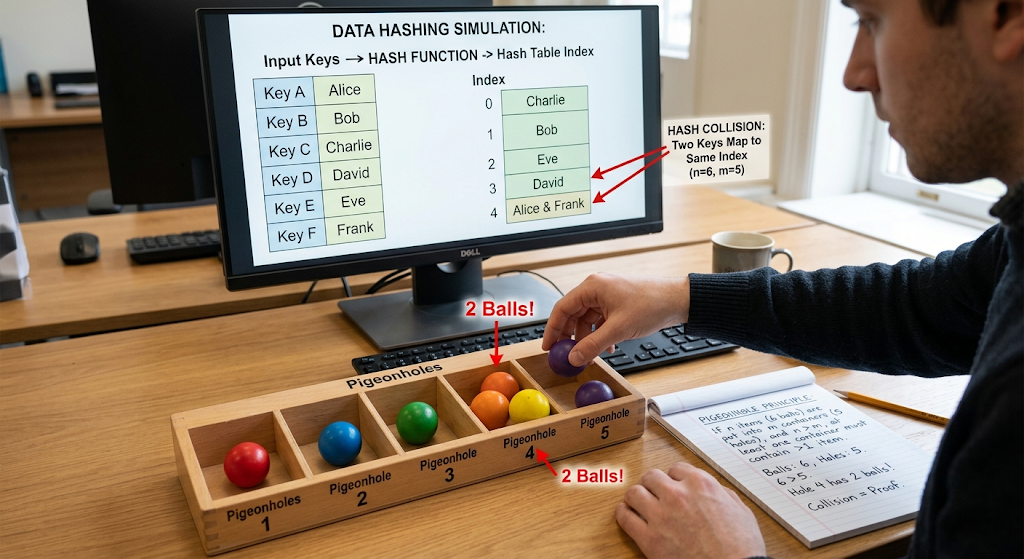
The pigeonhole principle is a basic but very useful counting principle: When more objects are put into fewer containers than objects, then there must be more than one object in at least one container. The principle is simple, but it is important to be able to use it to show facts about computer systems, algorithms, data structures and mathematical problems. For instance, if 101 users are assigned to just 100 possible identifiers, at least two people would have to be assigned the same identifier unless the system was designed to not allow it. The principle doesn’t necessarily specify which objects share a container, but it is sufficient to show that a repetition must happen.
The pigeonhole principle is a very useful example of exploring this concept and shows that this basic counting fact has applications well removed from its original analogy. This principle has been used in computer science to account for collisions in hashing systems, the fact that duplicate values have to occur with some restrictions, and the inability of finite systems to represent an infinite number of objects uniquely. It can also be applied in theoretical computer science to prove that there are repeated states or outputs. The value of the principle is that it can be used to prove that a certain situation is to occur without needing to specify all the individual situations, for which a computer would need to run a specific program.
Combinatorics and Algorithms
Counting techniques are related to algorithm design as algorithms are usually applied to a set of possible solutions. If there are a limited number of possibilities, a brute-force approach can systematically consider all candidates and evaluate them. For instance, a program can produce all possible combinations of a small set of objects, and test each combination against some condition. Combinatorial calculations can be used to determine what the size of that collection is. Exhaustive search can be done if the number of possibilities is not large. But if the number increases quickly, then some other method (e.g. dynamic programming, greedy, backtracking and pruning, optimization, etc.) might be necessary.
Therefore, combinatorial analysis can have an impact on algorithm selection prior to implementation. If a problem has a few hundred possible solutions, then a programmer might be OK with an enumeration approach, but if the problem has billions or trillions of possible solutions, a different approach is required. This is particularly significant since many problems in computer science involve an exponentially or factorial-sized search space. Knowing how those spaces grow will help the developer get a handle on how hard the computation is. Sometimes counting is a key piece of information needed to solve an algorithm problem but sometimes it is not. Counting is always a necessary step to characterize the work that an algorithm may have to do and whether a proposed algorithm will scale.
Applications in Password Security
An example of combinatorial reasoning is in the security of passwords. A password system might be able to use upper case, lower case, numbers and special characters. Assume that each position in the password may have a specific number of possible characters, then the multiplication principle can be used to approximate the total amount of possible passwords for the length of the password. A longer password and/or the larger the set of characters that can be used, the more combinations are possible. This is one reason that security systems take into account the length of the password as well as the number of different characters used when assessing the size of the search space.
Security professionals can also use combinatorics to make intelligent decisions about authentication systems instead of just relying on intuition. The pigeonhole principle can be used to assess why collisions or repeated identifiers can become unavoidable in a credential system with a limited number of possible identifiers. Likewise, if the set of possible credentials is finite, such as the set of token spaces, access codes, etc., then counting techniques can be used to evaluate it. The goal isn’t just to generate as many as possible, it’s to see how the security system is structured affects the number of possible outcomes. This analysis can assist designers in uncovering weaknesses and designing systems with the appropriate margins for possible credentials.
Probability & Combinatorial Reasoning
Probability and combinatorics are closely related, as probabilities frequently are based on counting the number of favorable outcomes and comparing that number with the number of possible outcomes. If all outcomes are equally likely, then the probability of an event can be determined by dividing the number of outcomes that are favorable by the number of possible outcomes. There are two ways of working out these quantities, using combinations and permutations. Sometimes a simple card problem will require counting the number of ways to obtain a group; at other times a card problem will require counting the number of possible ordered sequences. The correct combinatorial approach is applicable when the order of items in the problem being discussed is important or not.
These principles are applied in computer science to study randomized algorithms, simulations, networks with reliability, sampling of data, and machine-learning algorithms. Mathematical counting can offer a good estimate or exact value of the probability of an event rather than finding it by actually producing each of the possible outcomes. This can be very helpful if the entire possibility space is too big to list out explicitly. The combinatorial probability is thus an intermediary step between theoretical mathematics and computational analysis to interpret the probability of events that occur in complex systems.
Application of Combinatorics
Another large application of combinatorics is in scheduling. A scheduling system can allocate employees who are going to work on shifts, jobs to processors, classes to rooms, or tasks to time periods. Assignments can generate a different configuration and there may be many configurations as the number of tasks and resources grows. Permutations can be used where it is important to consider the ordering of tasks, and combinations can be used when choosing groups of tasks or resources. The principles of multiplication and addition can also be used to divide a scheduling problem up into smaller problems.
The problem is that not all schedule variations are desirable. Certain schedules might be in breach of deadlines, resources or other limitations. This makes it desirable to have scheduling algorithms that explore a large combinatorial space, while rejecting invalid or inferior schedules. Combinatorial reasoning enables computer scientists to assess the size of this space and develop methods to avoid having to consider the unnecessary. The objective in an optimization problem can be to find the optimum schedule based on a criterion like cost, completion time, resource use or efficiency. It is thus crucial to be able to comprehend potential scheduling configurations, and therefore, it is essential to develop efficient scheduling algorithms.
Optimization and Search Problems
There are many optimization problems where you have to pick the optimum value among a huge number of feasible solutions. This may involve finding the most efficient route, resource assignment, task scheduling, subsetting of data or selection of project portfolios. Combinatorics can be used to calculate the number of possible candidate solutions and can be used to explain why some optimization problems get more difficult as the inputs increase in size. Exhaustive search might be used to solve a problem with a few options but once the number of options grows significantly, it’s not going to be feasible.
Therefore, computer scientists are interested in devising algorithms that cut the amount of space that needs to be traversed. Pruning, dynamic programming, approximation, and heuristic search are all techniques that can reduce the number of possible configurations that are evaluated. To begin with, an understanding of these techniques needs to be based on combinatorial analysis. The number of candidate solutions can be estimated and then an exhaustive method can be considered viable or not and alternative methods compared. Thus, combinatorics is not just about enumerating possibilities, it can inform the design of algorithms that are able to work efficiently in very large spaces of possibilities.
Applications in Computer Networks.
There are also many combinatorial structures in computer networks. A network is made up of devices and connections, and could have several ways to get from one point to another. The more devices and connections there are, the more paths and network configurations can exist. With counting techniques, network engineers can analyze potential connections, routing options, and configurations. Useful paths can then be identified using graph-based algorithms without having to check all possible paths.
Combinatorial reasoning also can be used in network reliability, and resource allocation. Engineers need to calculate how many connections can break down before there’s no way to communicate, how resources will be allocated among devices, or how various routes will influence network performance. These problems may consist of a mix of nodes, edges, paths, and assignments. By knowing how many and what shape these options are, designers can create more efficient and reliable networks. Combinatorial analysis is useful in large scale systems, especially when all the configurations needed to be taken into account by hand would be too difficult.

Importance of Counting Principles in Computer Science
Combinatorics is significant for computer science because it can be used to convert complex sets of options into mathematical forms that can be examined in a logical way. The multiplication principle is used to determine the number of outcomes that result from several stages of a process, and the addition principle is used to determine the number of outcomes when the alternatives are mutually exclusive. Permutation is the number of ways of arranging items in which order is important, while combinations are the number of ways of selecting items in which order is not important. If there are more objects to distribute into fewer possible locations then at least one location must be repeated—this is the pigeonhole principle. These techniques constitute a simple arsenal for thinking with finite possibilities.
When computer systems get more complex, it becomes much more valuable to be able to understand these possibilities. There are often very large numbers of possible states or configurations in password systems, algorithms, or probability models, schedules, optimization problems or computer networks. While a computer can perform millions or billions of calculations, it can be inefficient in exploring every option and become impractical. Computer scientists use combinatorial reasoning to make estimates about the size of a problem, recognize relevant patterns, select algorithms to solve the problem and prevent overwork. It thus not only supports mathematical comprehension but is also useful for problem solving and system design.
Conclusion
In computer science, combinatorics gives computer science a language to use for discussing choices, arrangements, selections, and potential outcomes in a systematic manner. Simple counting concepts like the multiplication principle and the addition principle allow the counting of more complex cases to be carried out by decomposing the cases into simpler ones. Permutations are used to count ordered arrangements and combinations can be used to count selections of items that don’t have any particular order. The pigeonhole principle is a very useful tool for demonstrating that an event must repeat under certain circumstances. This material can start with basic math examples, and the applications are important, in areas of computing.
Combinatorial reasoning is used to evaluate password possibilities, to look at probabilities, to design algorithms, to create schedules, to optimize resources and to study computer networks, among other uses, to understand the scale and structure of computational problems. Most importantly, it fosters a mindset around possibilities rather than solutions. The number of choices and their interaction can be determined with the help of which developers and researchers can choose more suitable algorithms and avoid unnecessary calculations. So a solid grasp of these various aspects of combinatorics is a necessary basis for any computer scientist and is highly useful in problems involving large numbers of possible outcomes.