
Introduction to Boolean Algebra
Boolean algebra is considered to be one of the basic concepts in Discrete Mathematics and Computer science since it allows for representation and manipulation of logical values mathematically. Boolean algebra is similar to ordinary algebra; arithmetic operations are normally applied to numbers, but Boolean algebra involves only two possible values: true (1), and false (0). In binary, these values are used as the basis for digital computers, which translate and manipulate digital signals to calculate, store and run instructions. Boolean algebra offers a set of rules to combine these values and to see the results of logical operations. Boolean logic is used to make decisions and process information in computers, ranging from switches and calculators to more advanced processors and computer programs. This knowledge enables it to be grasped, and understanding why this occurs helps to elucidate how abstract mathematical concepts can be applied into real technologies which people use on a daily basis.
One of the reasons why Boolean algebra is significant is because computers need to convert complex jobs into tasks that electronic components can reliably perform. Logical conditions written using a Boolean expression can be used by a computer to compare two numbers, verify a password, show an image or determine what instruction to run next. Such expressions are used to show relationships between conditions, and to decide whether certain outcomes should occur. The relationships can be described in the language of discrete mathematics, and digital electronics uses discrete mathematics to implement these relationships in physical circuits. The study of Boolean algebra thus establishes a linkage between mathematical thinking, computer hardware and programming. It also assists students in comprehending the effectiveness of the binary representation in digital systems and how a limited set of logical operations can be linked together to accomplish more and more complex computational operations.
Boolean Values and Boolean variables
A Boolean variable is a variable whose value can only be true or false. These values are typically used in digital systems to represent the binary digits 1 and 0, with the exact meaning of these values depending on the hardware implementation. For instance, a digital circuit can recognize a high voltage as a logical 1 and a low voltage as a logical 0. The voltage values assigned to these states are dependent on the technology and circuit design. Boolean variables can be used to represent conditions in a straightforward and consistent manner. Switches could be represented by a variable called A, a sensor detecting the presence of an object could be represented by a variable called B. Each variable is a logical input that may be evaluated independently or in conjunction with other variables to provide a result.
In maths and programming, a boolean variable might indicate many different states; such as if a user is signed in or not, if a file exists or not, or if a specific condition has been met or not. A program could have a Boolean variable named isLoggedIn that indicates whether a user has successfully authenticated. The program could allow access to a protected page if the value is true; it could prompt the user to sign in if the value is false. The following examples show how Boolean values can help in reducing each individual condition to either true or false, aiding in the decision making process. For a formal explanation of the concept, see the Boolean variables reference. It is important to know about Boolean variables before moving on to logical operations since logical operations compare and/or combine Boolean values to create new values.
The Basic Boolean Functions
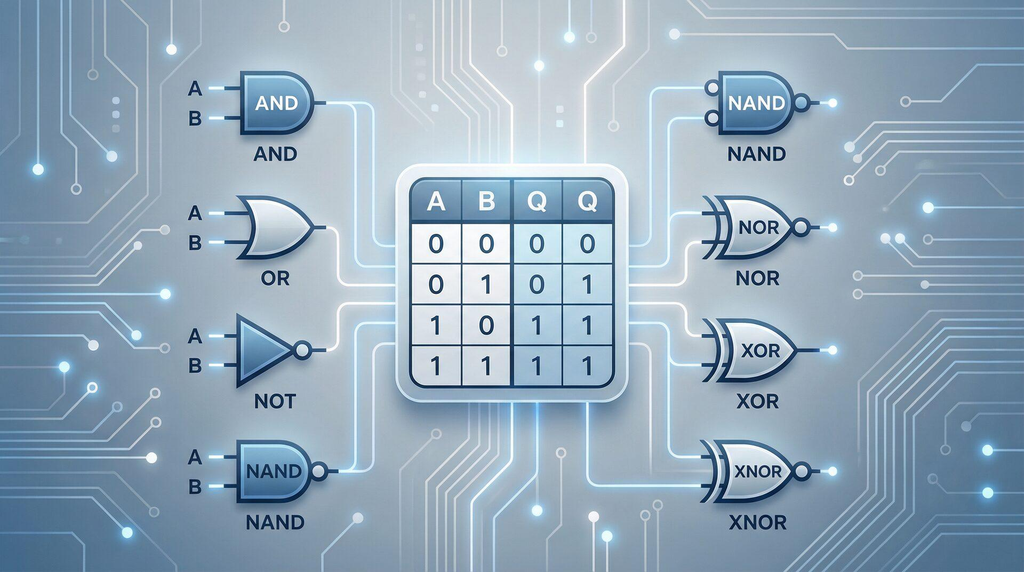
Boolean algebra is a logical algebra that can be used to combine, compare, or negate Boolean values. There are three basic operations: AND, OR and NOT, and many others can be built from these. Every operation has a rule which dictates what it will return, depending on the input or inputs that it receives. Digital electronics uses logic gates, electronic circuits which process binary signals.
Knowing how these operations work helps to understand the truth tables, write a Boolean expression, and how digital systems make decisions. While the operations are easy to perform mathematically, their sequence of performance is used in various combinations to allow the computer to perform complex calculations, to compare information or to control the flow of instructions during the execution of a program.
The AND Operation
The AND operation returns 1 (true) only if all its arguments are 1 (true). If A and B are boolean variables, then the operation is written as A⋅BA \cdot BA or ABABAB or A∧BA \land. It returns 1 only if both A and B are 1; all other combinations of input return 0. A practical example is an electronic system which only operates a machine when its safety switch is activated and its start button is depressed.
Case 1 is inactive if these conditions are not both true. An AND gate is a digital circuit that outputs one binary value which is only one when two or more binary values are input into the gate. AND logic will be especially useful in computer systems where several conditions must be met and an operation will not proceed unless all of the conditions are met.
The OR Operation
When at least one of the operands of OR is true, its result is true. It is represented by A+BA+BA+B or A∨B \lor A ∨ B for two boolean variables A and B. Only if both inputs are 0 will the output be 0; if either one input or both inputs are 1, then the output will be 1. Think about using a security system that sends an alarm if either a door sensor or a window sensor is opened.
The system doesn’t require both sensors to be true to act, it only requires one sensor to be true. This is a good example of how OR logic can be applied in a system where it is necessary to act in multiple ways. OR can also be used in programming to decide if a user should be allowed to perform an action, based on one of a number of allowed conditions. The operation enables digital circuits and software applications to merge with multiple alternatives into one logical output.
The NOT Operation
The NOT operation is used to inverse the value of a Boolean variable. For input of 1, the output is 0, for input of 0, the output is 1. Unlike AND and OR which typically take more than one input and return its output, NOT takes one input and returns its complement. The NOT isLocked expression, for instance, would return false if the Boolean variable isLocked is true.
If isLocked is false, the expression is true. Digital electronics: NOT gate, also known as an inverter, is a gate that inverts the logical value of its input. Inverter circuits are necessary when a signal is desired in the opposite polarity, such as an active-low control signal or when a specific function is only to be executed when another function is not simultaneously executing.
NAND and NOR Operations.
NAND and NOR operations are a combination of basic operations along with negation. NAND is NOT AND, and therefore the opposite of AND. NAND takes the value of 0 when both of its inputs are 1, and the value of 1 when at least one of its inputs is 0. The NOT OR (NOR) operation returns the opposite of an OR operation. NOR is only true when both of its inputs are false, and is false when either of its inputs is true.
In digital electronics, the NAND and NOR gates are called universal gates and these operations are particularly important. That is, using only NAND gates (or NOR gates) is sufficient to implement any boolean function, including AND, OR, and NOT. The versatility of these components enables circuit designers to construct complex digital circuits with a small number of gates.
Boolean Expressions and Truth Tables

Boolean expression is a mathematical statement depicting a logical relationship between the Boolean variables and operations. Defines an output by using variables and operators (AND, OR, NOT) For example, the expression F=A⋅BF=A\cdot BF=A⋅B means that F is true if-and-only-if A and B are true. If this is a more complex expression like F=A+B\cdot CF=A+B\cdot C, at least one of A or B has to be true and C has to be true in order for the final result to be 1.
Parentheses are used to make an expression unambiguous when it involves more than one operator. Boolean expressions can be used to concisely describe the operation of digital circuits and software conditions, and can be converted to logic gates or can be evaluated directly with mathematical rules.
What is a Truth Table?
A truth table shows all the possible combinations of the inputs to a Boolean expression and the results of the expression for each combination of inputs. It is a formal way of comprehending and proving the actions of logical operations. If there is one Boolean input, there are two possibilities; if there are two inputs there are four possibilities; if there are three inputs there are eight possibilities. For a system with nnn independent Boolean inputs, there are 2n2^n2n possible combinations of inputs. Truth tables are useful because they eliminate guessing: every row corresponds to a different combination of input values and the output is simply the result of the input logical operation defined. They are used by engineers in the design and testing of digital circuits and by computer science students when analysing logical expressions. Finally, truth tables can be used to determine if two expressions are logically equivalent by seeing if both expressions output the same value for any combination of values for their variables.
The following truth table shows the outputs of the principal two input operations. A and B are the inputs, and each other column notes the output for a specific operation. The operation NOT is displayed on its own since it requires only one input. By looking at the rows, it’s easy to see the differences between the operations: AND is true only if both are true, OR is true if either is true, NAND is false only if both are false and NOR is false if either is false. This table also illustrates the need to think of all possible combinations of inputs, and not just one! For a circuit that seems to work for one combination, it may give an unexpected output for another combination; therefore a complete truth table is useful for determining if the logical output of the circuit is correct.
| A | B | AND | OR | NAND | NOR |
| 0 | 0 | 0 | 0 | 1 | 1 |
| 0 | 1 | 0 | 1 | 1 | 0 |
| 1 | 0 | 0 | 1 | 1 | 0 |
| 1 | 1 | 1 | 1 | 0 | 0 |
The NOT operation has only one input column in its truth table since only one variable is involved. When A is 0, NOT A is 1; when A is 1, NOT A is 0. The table is not very large but it does show an important fact, and that is that, for every valid input to a boolean operation, there is a predictable output. If several gates are cascaded together, the output of one can drive the input to another, leading to more complex functions being designed. Truth tables can be used by engineers to test these connections prior to building the actual hardware. They also offer a basis for simplification of Boolean expressions: Two expressions whose output is the same for all possible input combinations are equivalent even if they look different.
Logical Identities and Laws of Boolean Algebra
Boolean algebra has a set of identities which define the behavior of logical expressions. These identities are analogous in their purpose to those of normal algebra, except they use Boolean values and logical operators. They can be used to transform expressions without altering their output, simplifying complex conditions and designing efficient circuits. For instance, A+0 = A, and A⋅1=A, that is, OR and AND with 0 do not change the value of the variable. The null laws are A+1=1A\cdot0=0A+0=0A\cdot1=1A+0=0, which tell us that the value of A does not affect the outcome of the addition of 1 and the value of A does not affect the outcome of the multiplication of 0 and 1. By knowing these rules, students (and engineers) can analyze logical relationships systematically rather than considering all possible combinations every time an expression must be analyzed.
There are also a number of other laws of value to know when dealing with Boolean expressions. The idempotent laws are used to show that adding the same variable to an OR operation does not change its value, as does adding the same variable to an AND operation (A+A = AA + A = AA + A = A and A⋅A = AA⋅A = AA⋅A = A). The complement laws are the following: A+A‾=1A+\overline{A}=1A+A=1 and A⋅A‾=0A\cdot\overline{A}=0A⋅A=0, since the values of a boolean variable and its complement are complementary. The double negation law is what is written above: A‾‾=A\overline{\overline{A}}=AA=A, which means that negating a logical value twice is equivalent to negating the value once. Commutative laws permit the order of inputs to be switched, such as A+B=B+A and AA+B=B+AA, AA+BB=AB+A, AB+BA=AB+AA=BA. Associative laws allow regrouping of the same type of operation, and distributive laws enable expressions to be expanded or factored. These identities are used together to simplify logical expressions and to analyze the behaviour of digital circuits mathematically.
De Morgan’s Theorems
De Morgan’s theorems describe how negation of AND and OR are related. The first theorem shows that the complement of an AND expression is the OR of the complemented inputs: AB‾=A‾+B‾\overline{AB}=\overline{A}+\overline{B}AB=A+B. The second is the following: The complement of an OR expression is equal to the AND of the complemented inputs: A+B‾=A‾⋅B‾A+B=A⋅B. These theorems are convenient for changing a Boolean expression into a different form that can be readily implemented using the logic gates available.
They are also useful for the implementation of signals that represent logical conditions (active-low signals). The circuit designer then can use De Morgan’s theorems to replace some combinations of these gates with equivalent gates without altering the desired function. This flexibility can be used to optimize circuits, and can be important in understanding why NAND and NOR gates can be used to build a variety of digital systems.
Boolean Expression Simplification Techniques
Boolean expression simplification is the process of converting a logical expression into a simpler equivalent expression which has the same output. It is an important step in the digital circuit design process because the simpler expression might not need as many electronic components, wires, or logic gates. Circuit complexity reduction can also boost performance, reduce power usage, and make a design simpler to maintain, depending upon implementation.
Simplification has nothing to do with being sloppy about removing conditions, each transformation must maintain the original logical behavior. Boolean identities, algebraic manipulation, truth tables, and graphical techniques are used by engineers to recognize opportunities for improvement. The best one to use depends on the complexity of the expression, the number of the input variables and the requirements of the circuit under design.
Laws of Boolean Algebra
Boolean laws can simplify expressions by removing duplication from their operations or by combining similar terms. Consider the expression F=A⋅1+A⋅0F=A\cdot1+A\cdot0F=A⋅1+A⋅0. Using the identity law, A⋅1=AA⋅1=A and the null law, A⋅0=0A\cdot0=0A⋅0=0. The expression is now F=A+0=AF=A+0=AF=0=F. If the example is more complicated, such as F=A\cdot B+A\cdot B, A can be cancelled, to obtain F=A(B+\overline{B})F=A(B+\overline{B}).
A variable (OR its complement) is always equal to 1. The original expression involves multiple operations but the simplified one only needs A. This example illustrates how to use Boolean algebra to eliminate unnecessary complexity without losing the result for each combination of inputs. Using these transformations helps students see patterns and build systematic problem solving skills.
Karnaugh Maps.
A Karnaugh map (also known as a K-map) is a graph that simplifies Boolean expressions by grouping together adjacent cells that have a 1 at the output. The organization allows a systematical identification of sets of adjacent cells corresponding to specific combinations of boolean variables. Groups in the map are 1, 2, 4, 8 or any other power of two cells, depending on the structure of the map. Designers can group together terms that stay the same in a group and group together terms that vary in a group by using adjacent terms to remove variables that vary in a group.
This is particularly convenient for expressions involving few variables and a visual method might be easier than repeated algebraic transformations. The use of K-maps can point out duplicated conditions, and create simpler implementations, but for a larger problem, computer-based optimisation tools may be necessary. They are commonly used as a hands-on way of learning to integrate Boolean mathematics with digital circuit design.
Boolean Algebra and its Application in Digital Circuits
Boolean algebra is significant when mathematical expressions are realised as physical electronic circuits. A digital circuit takes electrical signals, decodes them as binary numbers and performs processing according to the design of the circuit. The logic gates are the building blocks of these circuits and transistors are electronic switching elements which can be combined to form logical functions. Using gates, the engineers are able to build circuits that can compare the value of data, do arithmetic, choose data, and control the electronic devices.
A simple circuit can have just a few gates, whereas a modern processor has a huge amount of components, interconnected with one another. The intended logical behavior of these structures is specified in the form of boolean expressions and the input/output connections are depicted in circuit diagrams. This connection between math and hardware is the way in which abstract rules give rise to real mechanisms for processing digital information.
The Use of Logic Gates to Create Circuits.
The logic gates are electronic devices that execute Boolean logic based on their input and output. The basic operations implemented by AND, OR and NOT gates are complemented by NAND and NOR gates respectively. Using these gates, designers can then build circuits that are much more complex than any of the individual gates can. For instance, a control circuit could be designed to only turn on an indicator when a device is turned on and a safety condition is met.
The designer can write the requirement as a Boolean equation, build the corresponding truth table and convert the equation to a circuit diagram. The circuit can then be tested to ensure that it produces the desired output. This process is systematic and allows the design of a reliable electronic system and provides the identification of logical errors in the design phase or during the implementation.
Boolean Algebra in Arithmetic Circuits
Arithmetic operations (addition and subtraction) must be performed by computers and Boolean algebra can be used to implement these operations at the hardware level. The half adder is one such important component as it adds only two 1-bit binary numbers and generates a sum and carry. It can be represented with the exclusive OR operation and an AND operation for its sum and carry output, respectively. An exclusive OR (XOR) returns 1 if its two inputs do not match and 0 if they do.
A full adder extends this ability to add a third input that is the carry from the previous position. Several full adders can be cascaded to add multi-bit binary numbers. Further developed mathematics circuits can handle subtraction, comparison, multiplication and other functions. The examples illustrate the ability to use simple boolean operations to implement the arithmetic hardware necessary for performing arithmetic operations in computers, calculators, embedded devices and other digital systems.
Boolean Algebra in Computer Processors.
Most of the functions needed to run a software program are handled by a computer processor, also known as a central processing unit (CPU). Its control circuits, ALU, instruction decoding, and data selection components are designed with the aid of the Boolean algebra. The ALU (arithmetic logic unit) is essentially made up of interconnected logic gates that perform arithmetic and logical operations like addition, subtraction, and logical comparisons. The control circuits are used to decide what operations should take place and what components should be given specific signals. For instance, the instruction could ask the processor to compare two values and select a result depending upon whether a condition is met or not. These decisions are implemented by the underlying hardware in ways that rely on digital signals and logical functions. While the structures and optimisations used in modern processors are complex, the fundamental digital operations are still related to Boolean logic and binary representation.
Another use of Boolean logic is in instruction decoding. A processor will be fed instructions that are represented in binary and the control circuit in the processor needs to know what each instruction represents. Certain bit patterns may refer to an operation, specify registers or represent other instruction information. Logical circuits analyze these patterns and produce control signals which guide the activities of the processor. Boolean expressions can be used to specify for which signals should be active. Multiplexers are also used to select one input from multiple ones, enabling processors to send the right information to the right place, in addition. These functions are logical, meaning that there is a clear relationship between the two binary inputs and the two binary outputs. Boolean algebra is thus a basis for understanding instructions, co-ordinating operations and controlling the flow of information in the processor between various parts of a computer system.
Boolean Algebra – Computer Memory
Digital systems are able to represent and retrieve information in forms that can be stored by computers. The most basic level of digital hardware is the memory level, which uses electronic components and circuits that can differentiate between two states, one representing a 0 and the other a 1. Boolean algebra is used to design such circuits as it defines the logical relationships for data storage, selection, retrieval, and control. A sequential circuit is one whose output is dependent on the present input(s) and the past history of the input(s) which have been remembered inside the circuit. The sequential circuits are significant because they allow digital systems to store information. Circuits for storing individual bits are latches and flip-flops, and larger memory structures are made up of many storage elements and addressing and control elements. Boolean logic is used to decide whether information should be stored or not, where it should be stored and how stored values should be delivered to other components.
Address-decoding circuits are also necessary for memory systems that determine a particular location from a binary address. An address is composed of many bits and the decoding circuit will take the combinational logic of the bits and activate the right memory location. Boolean expressions define conditions to be satisfied for each location, so that the system can determine whether to address a different address. Another alternative use of control signals is to decide if information is being retrieved from or stored onto the memory. The actual implementations vary, but these functions are crucial to the operation of RAM, caches and other digital storage structures. Although there are other principles in memory design, there are a number of decisions that memory circuits must make that are expressed and implemented in a mathematical language, boolean logic. These relationships provide an explanation for how computers are able to efficiently access specific information and synchronise the ordering of storage and processing operations.
Applications of Boolean Algebra in Programming
Boolean algebra is not limited to physical hardware. It also plays an important role in programming, where logical expressions determine which instructions execute and how applications respond to different conditions. Programming languages commonly support Boolean values, logical operators, and conditional statements that allow software to make decisions. For example, a program may check whether a user has entered valid information before allowing a form to be submitted. It can combine conditions using AND, OR, and NOT to determine whether the requirements have been satisfied.
Although programming languages use different syntax, the underlying logical principles are closely related to Boolean algebra. Understanding these principles helps developers write clearer conditions, reduce unnecessary complexity, and avoid errors caused by incorrect combinations of logical operators. It also makes it easier to test software by identifying the different combinations of conditions that might influence a program’s behaviour.
Conditional Statements and Decision-Making
Conditional statements allow a program to execute different instructions depending on whether a logical condition evaluates to true or false. Consider an application that permits a user to access a restricted feature only when the user is logged in and has the required permission. The condition can be expressed as isLoggedIn AND hasPermission. Both variables must be true for access to be granted. A different application might allow access when a user has either an administrator role or a special temporary permission, using OR to combine the alternatives.
NOT can reverse a condition, such as checking whether a file does not exist before creating it. These examples show how Boolean expressions translate requirements into executable logic. Developers must consider operator precedence, parentheses, and the possible values of each condition to ensure that programs behave as intended. Careful use of Boolean logic improves readability and makes software easier to test and maintain.
Boolean Logic in Database Queries and Search Conditions
Boolean logic is also important in database management and information retrieval because it allows users to combine conditions when searching for relevant records. For example, a database query might retrieve customers whose location is Lagos and whose account status is active. The AND operator requires both conditions to be satisfied, while OR can retrieve records matching either of two alternative conditions. NOT can exclude records that meet a specified criterion. Search engines and other information systems similarly use logical relationships to refine queries, although modern search systems may also incorporate ranking algorithms, semantic analysis, and other techniques.
In a database query, a condition such as WHERE city = ‘Lagos’ AND status = ‘Active’ illustrates how Boolean logic helps define which records should be returned. Understanding these operations enables users and developers to create more precise searches, filter information effectively, and interpret the results produced by computer systems.
Benefits and Limitations of Boolean Algebra
Boolean algebra offers several advantages in computing because it provides a precise, consistent method for representing logical relationships. It allows engineers to describe circuit behaviour mathematically, verify expected outputs, and simplify expressions before implementation. These capabilities can help reduce unnecessary components, improve circuit efficiency, and make complex systems easier to analyse. In programming, Boolean expressions support clear decision-making and help developers express requirements in a form that computers can evaluate. The same mathematical principles apply across different areas of computer science, providing a shared foundation for digital electronics, algorithms, databases, and software development. Boolean algebra is also relatively accessible to beginners because it works with only two logical values. Once students understand the basic operations and laws, they can gradually apply them to more complex expressions and practical computing problems.
However, Boolean algebra alone does not explain every aspect of a computer system. Real digital circuits are affected by physical considerations such as electrical noise, propagation delays, power consumption, and manufacturing constraints. A logically correct circuit may still require careful engineering to operate reliably at a particular speed or under particular environmental conditions. Similarly, software systems involve more than Boolean expressions: they also require algorithms, data structures, error handling, and appropriate management of information. As the number of Boolean variables increases, truth tables become increasingly large because the number of input combinations grows exponentially. For this reason, engineers use algebraic simplification, Karnaugh maps, automated logic synthesis, and other design techniques to manage complexity. Boolean algebra is therefore best understood as a fundamental tool within a broader collection of mathematical, computational, and engineering methods.
Conclusion
Boolean algebra is a fundamental part of discrete mathematics that explains how computers represent and process logical information. By working with the two values 0 and 1, it provides rules for combining conditions through AND, OR, NOT, NAND, and NOR operations. Boolean expressions and truth tables describe the behaviour of these operations, while logical identities, De Morgan’s theorems, and simplification techniques help make expressions easier to understand and implement. These principles are translated into physical logic gates and interconnected circuits that support arithmetic operations, processor control, memory access, and data selection. They also influence software development, conditional statements, database queries, and search conditions, showing that Boolean logic connects hardware and software through a common mathematical foundation.
Learning Boolean algebra helps students understand how apparently simple logical rules can produce the complex behaviour of modern computing systems. Its applications extend from basic electronic switches to sophisticated processors and information-processing technologies. Although practical systems also require attention to physical limitations, software design, and other engineering considerations, Boolean principles remain essential for describing and analysing digital logic. By mastering Boolean variables, logical operations, truth tables, and simplification methods, learners gain valuable skills for further study in computer science, electronics, programming, and computer engineering. Ultimately, Boolean algebra demonstrates how mathematical reasoning can be translated into practical systems that calculate, store information, compare conditions, and execute instructions reliably.