Most people have never heard of CryoFX. That’s not a problem for the company. It might actually be the point.
The cold air that erupts overhead when the beat drops. The CO2 columns rising in sync with the music from Co2 Cannons. The haze so precisely distributed that a single light beam turns a dance floor into something you’d struggle to describe to someone who wasn’t there. Nobody standing in that room is thinking about manifold configurations or hazardous materials permits. They’re just thinking they don’t want the night to end.
That gap between what the audience experiences and what it actually took to produce it is where CryoFX has built its business.
Fifteen years, some of the hardest venues in the world
The company designs, manufactures, installs, and services CO2 special effects systems and liquid nitrogen special effects systems. Fifteen years in, their work is concentrated heavily in environments where the margin for error is essentially zero: major theme parks, touring arena productions, festivals, and a significant footprint on the Las Vegas Strip.
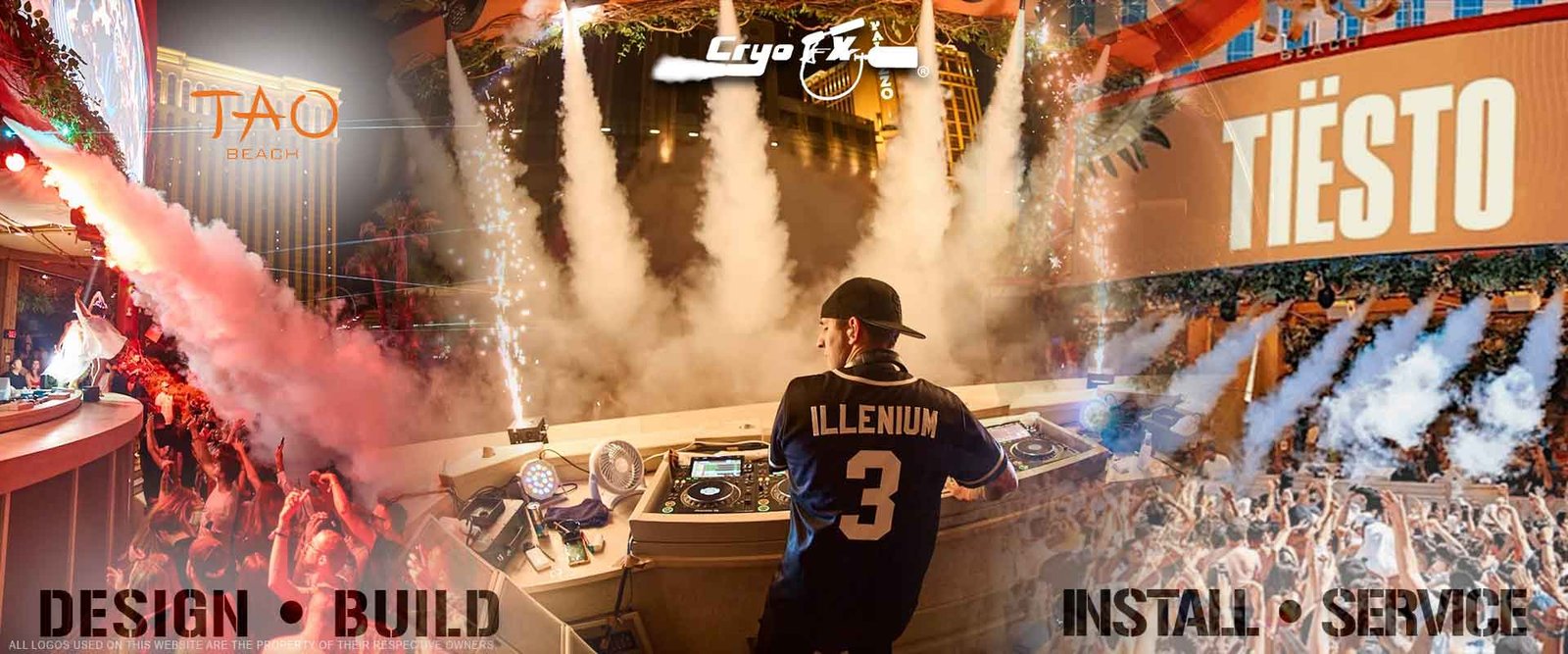
With recent Vegas projects such as TAO Beach Dayclub at The Venetian. LIV Nightclub and LIV Beach at Fontainebleau. The Silver Knights Arena. These aren’t venues that tolerate a system that looks good in testing and underperforms on a packed Saturday night, let alone allow anything less than a full expertise when such high risk is involved.
The most visible recent project was Fontainebleau Las Vegas, a nearly $4 billion resort that opened carrying some of the highest expectations the city had seen in years. The effects environment CryoFX built for the nightclub (and dayclub) went well past what most nightclub productions attempt. Massive truss circles suspended overhead created what guests kept reaching for the same word to describe: otherworldly. CO2 systems fired on precise musical cues. Lighting didn’t fill the room so much as respond to it, shifting the atmosphere in ways that made the space feel different from one hour to the next, all visible by atmospheric design.
The system wasn’t decoration. It was the experience.
Where the engineering actually lives
The visible output is, counterintuitively, the easier part of the project. The harder work happens in the months before anyone fires a single co2 jet.
These systems are about hooking up a few co2 cannons on a stage with some tanks off to the side. They consist of thousands of pounds of high pressure co2 or nitrogen in large tanks, piped through hundreds of feet of engineered stainless steel piping, with control systems that not only control the outputs, but monitor flow rates, levels, and report back to fire command safety systems to ensure parameters stay within permitted limits. It’s the kind of detail that completely disappears from the conversation when a vendor is primarily interested in moving equipment, and what separates the two types of companies.
Tank placement introduces its own set of constraints. CO2 and liquid nitrogen storage can’t simply go wherever it’s convenient. Both gases displace oxygen, CO2 at a significantly higher rate than liquid nitrogen, which means storage areas require dedicated air quality monitoring, evacuation systems capable of clearing gas accumulation in a malfunction scenario, and a serious look at whether the venue’s HVAC system can actually handle the load.
That last point is where a lot of installations run into trouble. A club can be running substantial AC capacity and still fall short on the airflow-in versus airflow-out equation once you factor in full occupancy. That gap doesn’t show up until you’re doing environmental testing at system capacity, which is exactly why that testing has to happen before the venue opens to the public, not after.

Two systems, very different design requirements
The choice between CO2 and liquid nitrogen isn’t about preference. It’s an engineering and regulatory decision with real downstream consequences.
CO2 displaces oxygen more aggressively, which drives stricter monitoring thresholds and tighter integration requirements with the venue’s safety infrastructure. In some jurisdictions, systems above certain capacity thresholds are required to interface directly with the fire panel, so a gas level exceedance triggers automatic evacuation. Others operate on independent monitoring with manual protocols. Which path applies depends entirely on the jurisdiction and what the authority having jurisdiction determines during plan review. Getting that determination wrong early means redesigning mid-installation.
Humidity drives the visual output question. CO2 effects depend heavily on ambient moisture to develop the dense, visible plume that reads well in a venue. In a low-humidity market like Las Vegas, that’s a real challenge. Liquid nitrogen often produces a better visual result in those conditions. High-humidity markets like Florida or coastal Southern California shift that calculus the other direction. The same system specification produces a meaningfully different result depending on geography, which is why system design can’t be separated from site conditions.
Outside installations add wind, direct sun exposure on lines and equipment, and temperature management for tank storage. Each variable requires deliberate accommodation. Ignore them and the system works in controlled conditions and degrades in operation.
The compliance layer most clients never see
CO2 and liquid nitrogen are classified hazardous materials. Full stop. That classification triggers a permitting path through the fire prevention department, a hazardous materials management plan, environmental testing at baseline, full operating capacity, and simulated malfunction, and ongoing monitoring integration requirements that vary by venue and jurisdiction. In some instances a full atmospheric testing report is required to be part of the plans.
On major installations, particularly theme parks, the monitoring and evacuation infrastructure routinely matches or exceeds the cost of the effects hardware itself. That ratio surprises people who haven’t been through a large-scale build before. It shouldn’t. It’s what doing this correctly at scale actually costs.
The fire department inspects. Permits get issued. Evacuation plans cover both people and gas clearance. Oxygen monitoring runs continuously during operation. Some systems tie into the fire alarm panel. Some run parallel and independent. All of it has to be designed, documented, and approved before a single effect fires in front of a paying audience.
The audience sees none of it. That’s the job.
The design philosophy
Kris Mullins, CryoFX’s CEO, doesn’t approach projects from the equipment side first. He also runs a series of other companies outside this industry. One specifically, Black Swan Agency, his marketing agency where he operates as a cognitive behavioral marketing scientist due to his extensive training in behavior, psychology, NLP and marketing which services his high end clients, like Tony Robbins and other Fortune 500’s, with more sophisticated, emotional, and advanced areas of marketing. He applies that framework directly to how effects environments get designed. The question isn’t where the jets go. The question is what emotional state the guest should be in at that specific moment, and what it takes to produce it.
“Designing these ‘experiences’ is a gift and blessing,” he said. “Touching on the senses in person while adding the 6th element of emotion into the mix, we’re elevating the experience to a totally new level which complements, in some instances, my work as a marketer. This is what a true 6D Immersive Storyteller does in live environments, while keeping true to psychology-driven storytelling in my other roles with my marketing agency. Whether on screen or in person, emotion is what people remember and what drives actions, including recommendations!”
Working backward from the desired emotional response changes what gets specified and where. A vendor focused on hardware asks where you want things mounted. A company thinking about the guest experience asks what the room needs to feel like, then figures out the hardware required to produce that feeling reliably, night after night, under real operating conditions.
The distinction sounds conceptual. In practice it shows up in the output.
“Think about how uneventful nightclubs would be without any special effects?” Mullins said. “No haze, no cold sparks, nothing on the drops. Yeah, pretty lame I agree. They literally make the night what it is!”
DMX integration lets CO2 jets fire on exact musical cues, hundreds of times per night, without a mistimed discharge that kills the moment or wastes product. Haze systems require their own fluid management and nozzle positioning to distribute evenly through a space rather than pool in dead zones. Handheld cryoguns operated by a DJ introduce a human variable that fixed systems don’t have, with its own protocols around discharge direction and safe operating range. Every one of these systems carries a safety layer that has to be engineered as carefully as the effect itself.
Venues have always competed on talent and aesthetics. What’s shifted is the weight audiences now place on the moments that can’t be replicated anywhere else. The thing that happens at exactly the right second and makes a room full of strangers react as one.
Someone has to build that. And build the permits, the monitoring, the evacuation infrastructure, and the operational reliability that lets it happen the same way the ten-thousandth time as it did the first.
The crowd remembers fifteen seconds. Everything else, years and thousands of hours, is what made those fifteen seconds possible.