
AI in customer service is changing the way businesses communicate with customers, manage enquiries, and respond to complaints. As customer expectations continue to increase, customer service organisations need to respond quickly and resolve customer issues promptly. Traditional customer service relies heavily on human employees, and when businesses receive large numbers of enquiries, it can become difficult to manage every request efficiently, especially during busy periods. AI offers additional ways to address these responsibilities by automating certain tasks, analysing information, and supporting communication systems.
AI chatbots and virtual assistants, automated ticket routing, sentiment analysis, and multilingual support are aiding businesses in enhancing customer service. These technologies can provide responses to typical questions, schedule complaints and assist employees in resolving customer issues. But AI is not always flawless, either, as there are instances of incorrect answers and privacy concerns that it poses, and it’s unable to tackle complex enquiries. It is crucial to understand its use, benefits and issues to ensure that the introduction of automation doesn’t exclude the assistance of humans that may be needed by the customer.
What is AI in Customer Service?
Artificial Intelligence in customer service involves the application of AI tools and technology to handle customer interactions, provide answers to enquiries and help resolve issues. These technologies leverage machine learning and natural language processing, which enables them to interpret messages, detect patterns, and respond appropriately.
AI enables repetitive inquiries to be automated, support enquiries to be organised and employees to be helped to find information. Whilst these systems increase efficiency, they are not capable of coping with all scenarios on their own. Nevertheless, a high level of complexity and delicate issues may still necessitate human appraisal and help.
12 Ways AI is used in Customer Service.
1. AI Chatbots
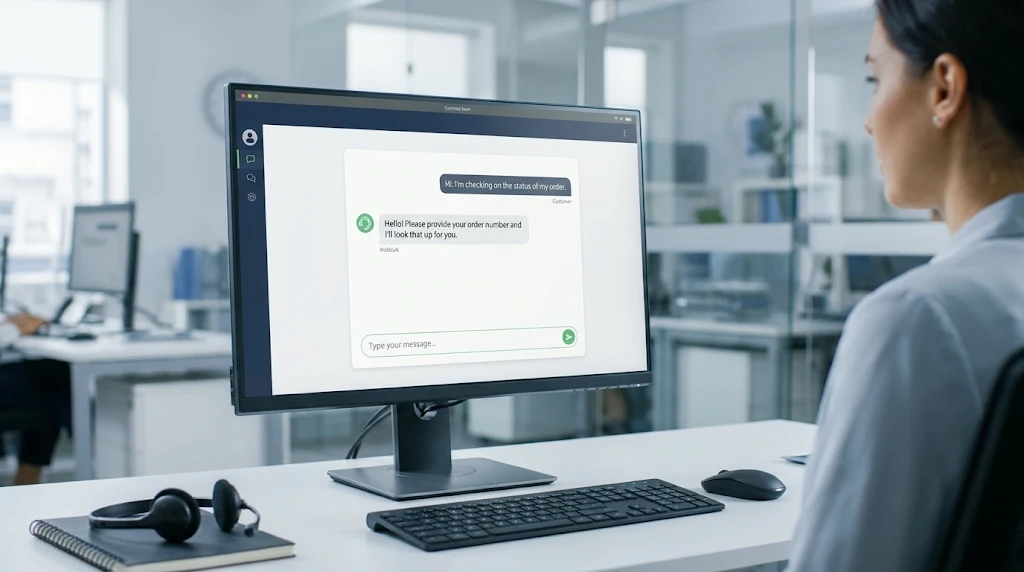
They engage with customers via AI chatbots on websites, mobile apps, and messaging platforms, powered by AI. They respond to frequently asked questions, give information about products and help with simple requests. Chatbots can cut down the time devoted to handling repetitive queries.
They may also be able to provide help outside of the business hours. They may have difficulties answering complex questions or with unusual complaints, though. There should be a way for businesses to have human staff available for customers when they need it.
2. AI-Powered Virtual Assistants
Virtual Assistant assists customers to get information, know the services and finish basic tasks. Telecommunications companies, for instance, can use them to explain bills, retailers can offer help with product queries and information on orders.
These types of assistants make customer support a lot easier and provide data faster to users. But firms must make sure to feel competent to offer precise responses and be attentive to the secret of the customers’ awareness.
3. Automated Ticket Routing
The AI-powered ticket routing systems are designed to sift through incoming customer enquiries and route them to the correct departments. It is able to determine if the call’s about billing, technical support, delivery or account access.
This cuts down on manual effort and enables staff to efficiently handle requests. But false classified enquiries can still go to the wrong department that may need human processing to receive the proper department.
4. Sentiment Analysis
Sentiment analysis involves analyzing the consumer message through the help of AI to discover feelings of pleasure, frustration or dissatisfaction. Businesses can incorporate customer complaints, views and interactions to learn about customer experience.
This can enable managers to see and act on common issues and focus on negative feedback. But AI can miss the tone, nuance, or cultural context in sarcasm, jokes, and other nuances, underscoring the need for review by humans.
5. Multilingual Customer Support
Businesses can use AI translation technologies to effectively communicate with customers from different language backgrounds. It makes customer services more accessible to people from other countries, with the ability to translate enquiries and come up with answers.
But automated translation might get the technical meanings and regions wrong. Human review of important communication to assure accuracy.
6. Intelligent Knowledge Bases
An Intelligent Knowledge base enhances the ability of customers and employees to locate information in product manuals, policies and frequently asked questions by means and AI algorithms.
Customers have the ability to talk about the problem in everyday speech and obtain pertinent information. It is important for businesses to regularly refresh these resources so as not to provide old or incorrect answers.
7. AI-Assisted Customer Service Agents
AI helps staff by providing suggestions on which answers to apply, by finding the relevant details and by summarising conversations with customers. This can be beneficial to agents when dealing with enquiries.
AI in customer service works best when intelligent technology is supported by employees who understand how to communicate effectively with customers. Although AI tools can suggest responses, summarise conversations and provide useful information, employees still need strong customer service skills to understand customer concerns, demonstrate empathy and resolve complicated complaints. Combining AI assistance with effective communication helps businesses provide more reliable and personalised customer experiences.
8. Predictive Customer Support
Predictive AI technology looks back on previous mentions and ticket content to discover any recognisable trends which could depict future issues. Example: if stress-related problems have a tendency to recur in the business, they can be identified and solutions are developed in advance of receiving complaints.
This allows organisations to tackle any issues earlier. But forecasts are not infallible, and should be examined—even before major decisions are taken.
9. Voice Recognition and Voice Assistants
With AI-based voice recognition, customers can interact with automated support systems through their voice. Users can know the information of the account, check services or know the answers for the common questions.
This means convenience, but may not work well with background noise, various accents, and/or mispronunciations. It is necessary to keep a business with human telephone support.A business needs to have human telephone support.
10. Customer Interaction Summarisation
AI summarisation tools provide shorter descriptions of conversations with customers, identifying key points and actions that have already taken place. Such summaries can be utilized by employees to have insight into queries without looking via lengthy conversations.
This enhances communication as requests cut through departments. But, in some cases, important information may be omitted from a summary, so it is important that employees review the summaries.
11. Customer Feedback Analysis
By reviewing customer feedback, such as online ratings, surveys, grievances, and social media posts, AI tools can pinpoint patterns indicating common customer pain points. This information could be used to, for instance, uncover the fact that a retailer is seeing lots of new customers’ complaints about return protocols.
This information can be used to enhance and refine products, services and policies. Human checks need to be in place to ensure automated analysis is a proper reflection of customer opinions.
12. Personalised Customer Support
When it comes to providing relevant assistance, AI can take data from the authorised customer and past engagements to offer more relevant support. For instance, if your Web retailer has an online customer call center, he or she can direct them to the backlog of orders. Your software company could suggest that a particular customer find appropriate troubleshooting suggestions.
Personalisation offers enhanced convenience and less repetition of questions. But those businesses need to secure customers’ data and also use personal data properly.
Advantages of AI in Customer Service:
- Faster Response Times
These chatbots and virtual assistants powered by AI can handle basic queries quickly, cutting down on customer wait time. Such automated systems also enable rapid routing of requests to the correct departments.
Facilitating the convenience but businesses should make sure that faster responses are accurate and valuable.
- Improved Employee Productivity
AI completes repetitive tasks, like answering repetitive questions, categorising tickets, and summarising chats. The staff thereby can focus on complicated complaints and deal with customer relations.
- Greater Availability
Use AI systems to help provide basic customer support during non-business hours. This enables customers to receive information when employees are away such as during the weekend, holidays or similar.
- Increased Awareness of Customer Complaints and Issues
AI can review a vast amount of customer interactions and flag common issues. It is possible for businesses to leverage on these findings to make improvements to products, services and internal processes.
- Improved Scalability
AI streamlines customer enquiries, even as they grow, without helping to get your manual administrative tasks to scale accordingly. But as long as organisations have sufficient, trained personnel to manage complicated requests.
Challenges in using AI for Customer Service
- Answers not successfully dealing with complex enquiries.
AI will usually provide a quicker response time than humans to routine questions, rather than dealing with complex complaints. Special circumstances may warrant investigation, flexibility and human judgment.
Difficult inquiries should be referred to skilled staff in a business and clear procedures should be established in the business.
- Customer Frustration
For some, it can be beneficial to call through to agents. Automatic responses may result in repetitive responses and often it’s hard for employees to reach the person and this can cause frustration and may lead to a decrease in customer satisfaction.
Whenever automated support is not enough, businesses should be able to avail their human help right at their fingertips.
- Inaccurate Responses
AI can occasionally provide us with fabricated data that isn’t accurate. This can lead to issues where the customer expects an automatic response to a question concerning how to pay, refunds or company rules and regulations.
Organisations need to rely on trusted information sources, routinely assess its network, and incorporate the use of a human review when required.
- Data Privacy & Security
AI systems can be used to analyze personal data, such as contacts, account information, and purchase history. It is important for businesses to safeguard against the misuse of and unauthorised access to this information.
AI in customer service often involves processing customer details, account information, communication records and purchase histories. Businesses must therefore establish effective customer data protection practices to prevent unauthorised access, misuse and potential privacy breaches. This includes using secure systems, limiting access to sensitive information, maintaining transparent privacy policies and following responsible data management procedures. Protecting customer information helps businesses maintain trust while using AI technologies to improve their support services.
- Implementation Costs
There may be costs of investing in software, technical integration, employee training, and even maintenance when incorporating AI. Smaller companies should go with inexpensive applications first to start solving the most salient customer service issues.
- Overdependence on Automation
Relying too heavily on AI can make it difficult for customers to receive personal assistance. Human workers are still valuable in situations where knowledge is required, complex enquiries and sensitive complaints are required to be dealt with.
Five Ways Businesses Can Use AI Effectively.
- Recognise Customer Service Requirements
To fix issues like, for example, long waiting times, repeated enquiries, and inefficient tickets management, companies should initially see what issues they may be facing. This empowers managers to choose the right AI solutions for their operations.
- Maintain Human Assistance
Organisations need to figure out what queries are suitable for automation and what are suitable for human employees. It is essential that customers are able to ask for assistance of a personal nature.
- Protect Customer Information
The key aspect here is that businesses should set up the corresponding security measures, limit access to confidential paperwork and manage customer info responsibly.
- Train Employees
Service staff should be aware of how the artificial intelligence tools are functioning, be used to their limitations and cross-check their recommendations with customers. The technology is able to be used well, but not exclusively, over the course of training and education.
- Monitor Performance
It is extremely vital that businesses can review response times, resolution rates, customer satisfaction, as well as ticket accuracy frequently. Response from the public can reveal whether AI can actually be enhancing the service quality.
The Future of Customer Service.
As chatbots, virtual assistants and automated workflows become smarter, AI will only get more and more relevant in the field of customer service. Adopting more sophisticated systems can enable businesses to comprehend customer needs, locate data, and schedule assistance tasks.
But there will always need to be accuracy, privacy and oversight by humans. Businesses should also ensure that automation does not cause any hurdles but enhances the current customer experience. The integration of AI tools and human effort will continue to be a key ingredient in successful customer service.
Conclusion

Customer service is undergoing an AI transformation through chatbots, virtual assistants, automated ticket routing, sentiment analysis, multilingual support and more. Such innovations enable companies to react quickly, boost employee productivity and recall frequent customer complaints.
But, difficulties with wrong answers, privacy, customer frustration with hard-to-answer questions prove that not all human assistance can be replaced by automation. It is crucial for businesses to incorporate AI selectively, maintain secure customer data, and retain easily accessible human support.
The bottom line is that taking the approach of an AI system combined with human expertise does the best job! AI can handle repetitive tasks and offer rapid information, but employees are still crucial in dealing with more intricate issues or scenarios that demand more personalised attention. This equilibrium will help companies optimize supply chain performance with no compromise on customer satisfaction and customer trust.