Introduction
Advanced Driver Assistance Systems (ADAS) is a term for the new technology developed to support drivers behind the wheel, which in turn improves awareness, reduces work behind the wheel, and also helps to either prevent or at least reduce the severity of some accidents. In today’s cars, you will find cameras, radar, ultrasonic sensors, and computer software which are used to see the road and what is going on around the vehicle. At present, there are many popular ADAS features which include automatic emergency braking, adaptive cruise control, lane-keeping assistance, blind-spot monitoring, traffic-sign recognition, parking assist, and forward-collision warning. While each of these systems has a different job to do, as a whole they are focused on improving safety in the vehicle and also to help drivers to react better to what is happening on the road.
ADAS is a growing feature in today’s cars, which in turn means that drivers must get to know what these systems do and don’t do. The systems can provide useful alerts, help out with braking and steering, and they also make some driving tasks which were once difficult now easy. At the same time, what we see is that ADAS does not equal full autonomy. Drivers still have to pay attention to the road, follow traffic laws, and also be prepared to take over at any time. Out of this knowledge comes safer and more effective use of the driver-assistance technology.
What Is ADAS and What Does It Do?
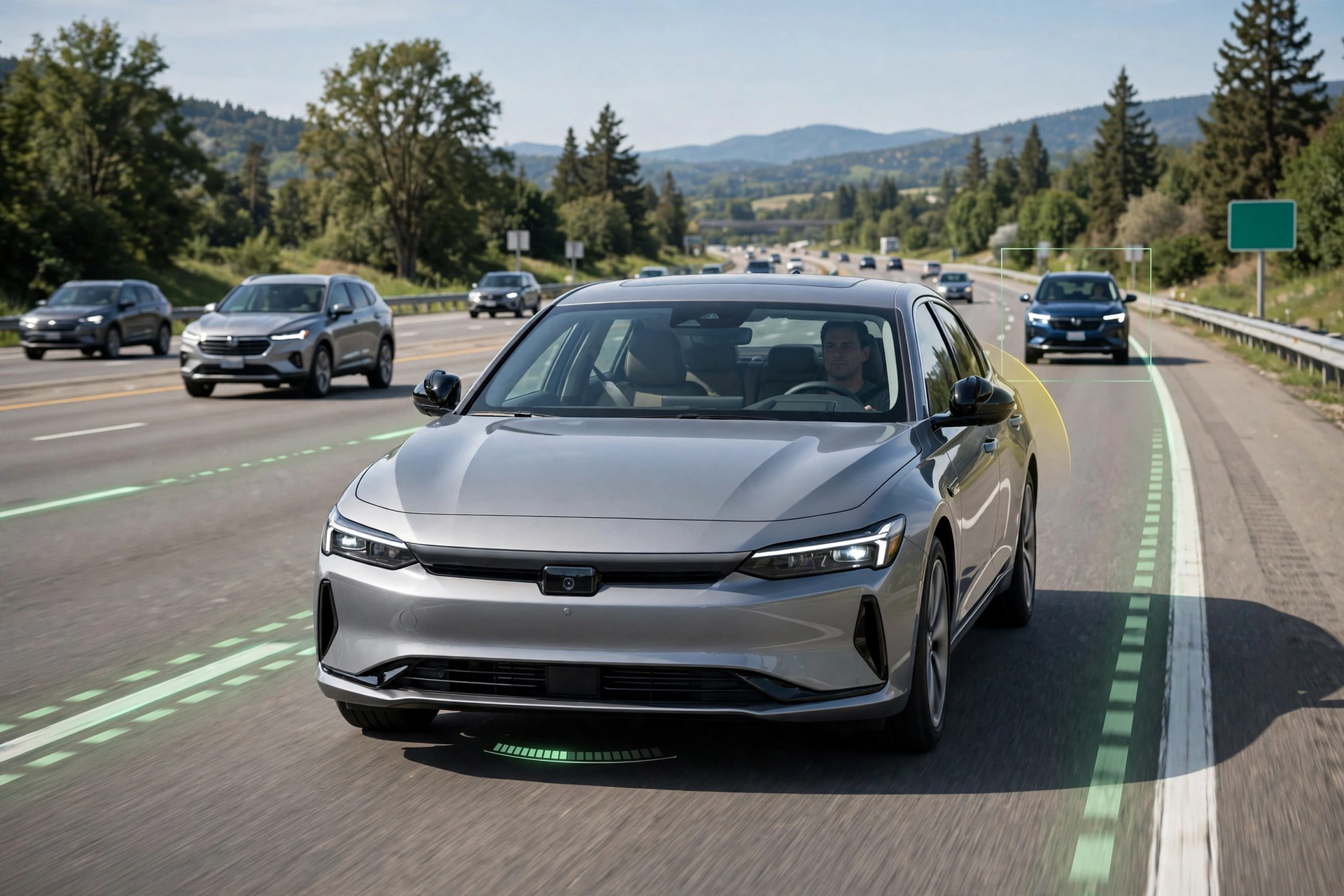
ADAS technologies which has a suite of sensors that it uses to gather information on the car’s environment. Cameras in this setup identify lane marks, other cars, pedestrians, and traffic signs, while radar measures the distance and motion of objects. Also very common are ultrasonic sensors which we use for short-range detection like in parking. The car’s computer then looks at this information to either issue a warning or take over brake, steer, or speed control.
In different vehicles and between manufacturers, the technology used varies. Some systems are based mainly on cameras; in others, we see a combination of cameras and radar which improves performance. Also, sensor performance may be affected by dirt, rain, fog, when components are damaged, road markings are poor, or in other environmental conditions. Also, it is also important to note that Advanced Driver Assistance Systems do have their limits and that at no time should they be put forward as the only source of information for the driver.
Automatic Emergency Braking and Forward-Collision Warning
Automatic emergency braking is designed to reduce the risk or severity of front-end accidents. The system pays attention to what is happening ahead and will alert the driver of a potential crash. If the driver doesn’t react in time and the system determines that a collision is going to happen, it will step in to apply the brakes. Also, it is very useful in heavy traffic when stop-and-go action is the norm or when a car crosses into your lane.
Forward-collision warning will alert you when a possible crash has been detected on the front. Cameras and, in some cases, radar are used for this also. Also, unlike AEB, a warning’s main job is just to get your notice to which your action may be necessary. Although both of these technologies are meant to be of great help to you, do not think that they can warn you about everything.
Adaptive Cruise Control

Adaptive cruise control, which is an upgrade from the standard cruise control, does so by its ability to change the car’s speed at any time in response to traffic in front. Radars and cameras which are a part of the system do the job of watching the space between your car and the car in front. If a forward vehicle breaks speed, the adaptive cruise control will slow your car to what you have set as your desired following distance. When traffic dies down, the system will get you back up to the speed you have chosen.
This feature does perform to reduce some of the repetitive elements in highway and stop-and-go traffic. At the same time, though, drivers must pay attention to the road, as at present adaptive cruise control doesn’t react properly to all situations. We see that in the case of sudden obstacles, other cars which merge into your lane, sharp turns, or bad weather which is to prompt driver intervention.
Lane-Keeping Assistance
Apart from lane-keep assistance, which also reduces unexpected lane changes, we have road sensors that identify the lane boundaries and determine the vehicle’s location. If the car begins to drift toward a lane mark, the system may alert the driver or take over steerage to put the vehicle back in the lane.
The feature does best when lane markings are clear and visible. In poorly constructed zones, with faded markings, during heavy rain, snow, and in atypical road layouts, the feature’s performance goes down. It is important to note that lane keeping technology should not be treated as an adaptive driving system, which is what many think. You still must do some steering and pay attention to the road.
Blind-Spot Monitoring and Traffic-Sign Recognition
Blind-spot detection systems which support drivers in the identification of cars which may be out of view using traditional mirrors. We have sensors which are usually based out of radar which look at areas which are beside and behind the car. If the sensor sees another car in that area, a warning light will come on in the side mirror or in some cars other parts of the dash will also alert the driver. Also, in some vehicles, this can include a warning when you try to switch lanes.
Traffic cameras and software-based systems are used for the identification of road signs which include speed-limit signs. The information then appears on the vehicle’s dash or head-up display. This may keep the driver informed of important road information, but at the same time the system may not identify all the signs accurately. Drivers should still pay attention to the natural road environment and visible signs instead of the in-car displays which are not always reliable.
Parking Assistance
Parking aids which do low-speed detection of nearby obstacles. Ultrasonics which measure the distance to objects around the car and which may present audio or visual warnings. Also, some of the better systems use cameras to give a wider field of view of the car’s surroundings; also, in some vehicles which are very advanced, they will do the steering for you during certain parking actions.
These features improve your parking in tight spaces. But some sensors may not see very small or out-of-the-way objects; also, camera views may be limited. It is up to the driver to check the environment and control the car. Don’t assume that the parking system will catch everything.
Benefits of ADAS
One big benefit of ADAS is that it improves what the driver is aware of. We see in collision warnings which bring to the driver’s attention that there is a developing hazard, in blind-spot monitoring which reports on nearby vehicles, and in automatic emergency braking which steps in when a collision is about to happen. Also, we have adaptive cruise control and lane-keeping assistance which in turn reduces the monotony of the task of driving on the highway.
ADAS also introduces ease in day-to-day drive. We see in parking assistance which makes tight spaces a better-managed issue and in traffic-sign recognition which is a help for keeping track of certain road signs. But these benefits are contingent upon proper use. As users become over-reliant on ADAS, they may put less attention to the road, which is the opposite of what the technology is meant for in terms of safety.
Why Driverless Does Not Replace the Driver
ADAS is out to support drivers’ actions, not to take over. Also, it is important to know that in certain conditions, the technology exhibits some limitations. A camera may fail to see a road mark, radar may not react as we expect to a certain size of object, or weather may play a role to impair sensor performance. Also, at times the technology may be working fine, but we put it to a situation which is out of its design to react to.
Drivers must pay put full attention on the road and be ready to brake, steer, or take over at any time. Also, they should clean sensors and cameras as required and pay attention to what the car is warning them of regarding system availability. Also, good driving practices which include checking mirrors, maintaining safe distances, and following traffic signs still goes without which even when you have very advanced vehicle features.
Conclusion

In today’s vehicles, we see the growth of Advanced Driver-Assistance Systems which are key safety features. Automatic emergency braking, adaptive cruise control, lane-keeping assistance, blind-spot monitoring, traffic-sign recognition, parking assistance, and front-crash warning are some of the many features which do well in different driving scenarios. Through use of cameras, radar, ultrasonic sensors, and computer software, these systems also help drivers out by increasing their awareness of what is going on and which in turn reduces some of the work that goes into driving.
Also, in that regard, which is the best way to put it — ADAS is to be used as an addition to human attention rather than a replacement. Car users still are responsible for the road and aware of traffic conditions and to take over when needed. By learning what these systems do and also knowing their limits, car owners may use ADAS more safely and get the most out of today’s vehicle technology.