Introduction
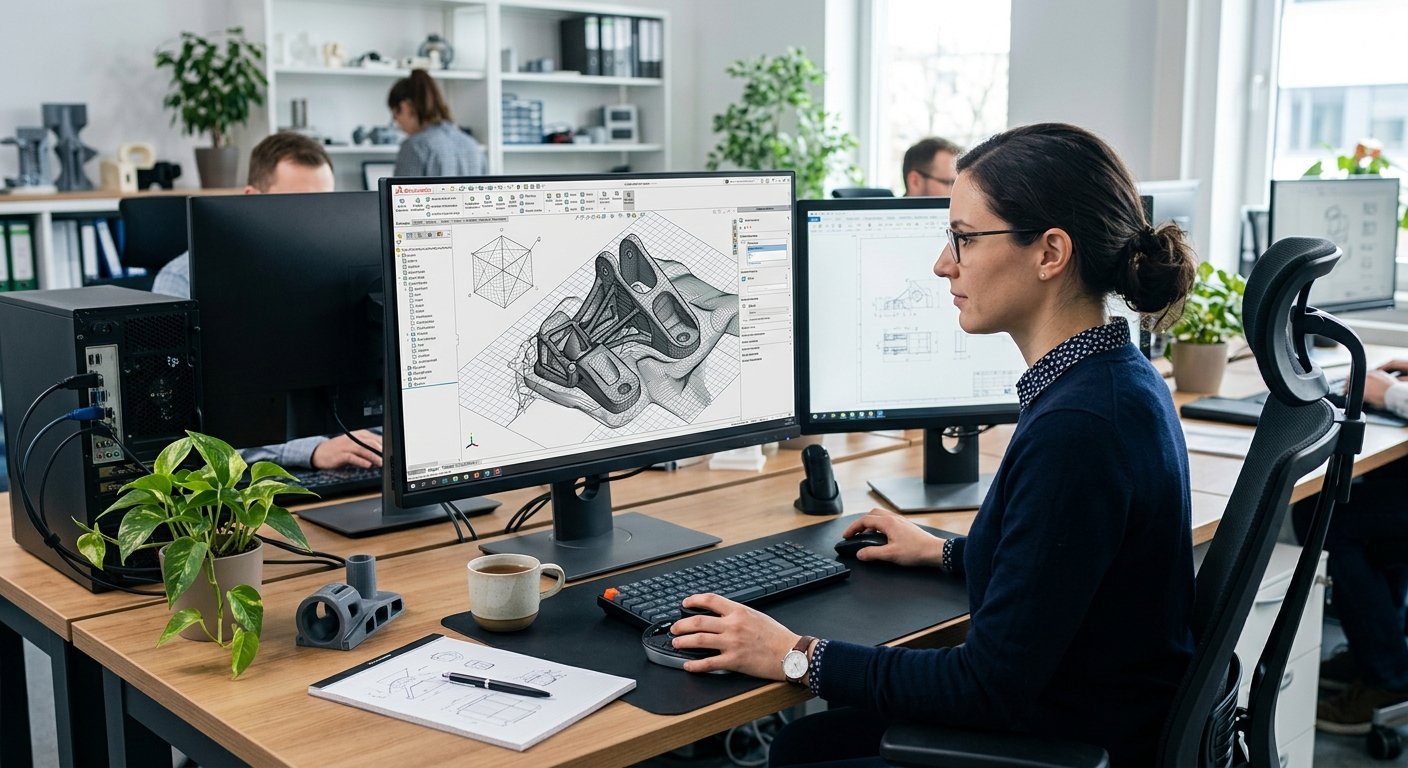
Artificial intelligence is changing the way engineers, architects, designers and technology professionals create, analyse and edit 3D models. Traditionally, computational geometry has relied on mathematical equations, geometric algorithms and manual modeling. Although these are fundamental processes, there is a need for faster, smart and more automated solutions. This is being addressed by adding machine learning, generative models and multimodal systems to allow for the interpretation of design instructions, creation of 3D models, identification of geometric patterns, optimisation of meshes and automation of repetitive CAD tasks.
Overall, there is an increase in AI in Computational Geometry as it is increasing the traditional mathematical methods by introducing intelligent methods to allow for advanced geometric modelling.
Computational Geometry and 3D Modelling
Computational geometry is a field of computer science and mathematics which involves the development of algorithms to solve problems involving geometric objects including points, lines, curved lines, surfaces, polygons and 3D models. It allows for many technologies to be developed such as computer graphics, robotics, geographic information systems, engineering and computer aided design. Traditional geometric modelling involves using pre-existing algorithms to calculate distances, intersections, angles, surface area, volumes and spatial relations between objects. For example, an engineer may use geometric modelling to calculate if parts of a machine will fit together. Architectural modelling can be used to create accurate models of a building. While these methods can provide predictable results, complex models can take a long time to create manually and will involve many calculations.
Traditional 3D modelling involves using various methods to create models. These include polygon modelling, solid modelling, surface modelling and parametric modelling. Polygon modelling involves creating models using connected vertices, edges and faces. This can be useful for creating detailed models for animation, gaming and visualisation. Solid modelling creates complete 3D models with defined boundaries. This can be very helpful in engineering. Surface modelling focuses on generating complex curved surfaces. This can be very useful in automotive, aircraft and product design. Parametric modelling allows for dimensions and features to be defined. When dimensions are changed, the relevant parts of the model will automatically change. While these methods can provide powerful results, complex models can involve many processes and repetitive changes. AI can provide an opportunity to automate certain processes.
How AI is Influencing Computational Geometry
Introducing AI into computational geometry allows computer systems to recognise patterns, learn from previous geometric data and make predictions. Instead of having to write instructions manually, AI driven applications can analyse thousands of geometric examples. This allows for relationships to be found which may not have been easy to find using traditional coding methods. Machine learning can allow for shapes to be classified, structural features to be identified, properties to be predicted and suggestions made for suitable changes. This can be very useful when creating complex models with many surfaces, curves and connected parts. For example, an AI system can analyse a part of a mechanical product and identify repeating geometric features. This doesn’t mean that traditional geometric algorithms aren’t needed, however it provides an extra level of intelligence to help automate decisions.
AI can also be combined with mathematical geometry algorithms. While traditional algorithms provide accurate results, they can sometimes require very specific inputs and complex coding. AI can help by interpreting unstructured data, identifying likely intentions for a design and suggesting suitable changes. This can allow for more complex modelling to be performed using the modelling software. For example, a machine learning model can be used to identify a suitable change to a surface and then the traditional geometry engine can be used to implement this. It is important that this is done as many times geometric modelling will require precise measurements and predictable results.
Generative AI for Automating 3D Modelling
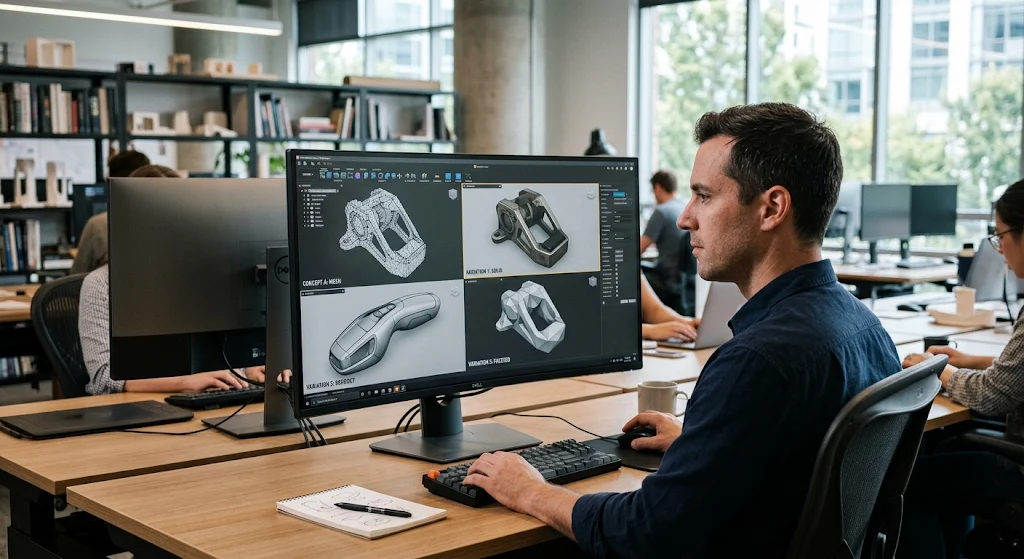
One of the biggest developments in 3D modelling is the use of Generative AI. Instead of manually creating models using traditional modelling applications, generative AI can create designs based on descriptions, images, sketches and other inputs. A designer could describe what they want for a particular object, along with estimated dimensions and any additional requirements. An AI driven application could be used to create an initial 3D model. This can provide multiple design variations. This can be very useful when trying to create a new product as you can quickly see different variations.
Generative AI can be used to create models in different ways. Some will create polygon meshes, while others will create point clouds, voxel models and neural implicit models. A polygon mesh will consist of connected vertices, edges and faces. A point cloud will use points to represent a shape. A neural implicit model will use learned mathematical functions to identify boundaries and surfaces. Each of these can be advantageous depending on what is required. However, just because a good looking 3D model has been created doesn’t mean it will be suitable for use by professionals. The designer may still need to check the dimensions, surface continuity, structure and compatibility with the modelling software.
Machine Learning in Geometric Design
Machine learning can provide improvements to geometric design by analysing existing models. Machine learning can be trained to recognise patterns in a collection of geometric data. Once trained, the machine learning algorithms can identify similar patterns in new models and suggest suitable changes. For example, if a machine learning model has been trained on mechanical components, it can identify holes, slots, cylindrical features and connecting surfaces in a new uploaded design. This can help with classifying features or identifying areas which need more attention. This can save professionals time analysing complex models. Machine learning is being looked into for suggesting designs, classifying shapes, reconstructing geometry and predicting manufacturing properties.
Design optimization can also be completed using machine learning. Engineers often need to balance many factors such as materials, weight, strength, cost and limitations during design. Traditional methods can involve many simulations and calculations to find a suitable design. AI models can help speed this up by learning relationships between design parameters. For example, an engineer creating a light weight part could use AI to help optimize their design. They could look at different structural variations while considering strength and material requirements. The system may suggest a few different variations to try. These can then be tested using traditional engineering simulation methods. While machine learning can reduce the amount of variation in design, the suggestions still need to be checked to ensure they follow physical principles, engineering standards and requirements of the final component.
AI for Generating and Optimising Meshes
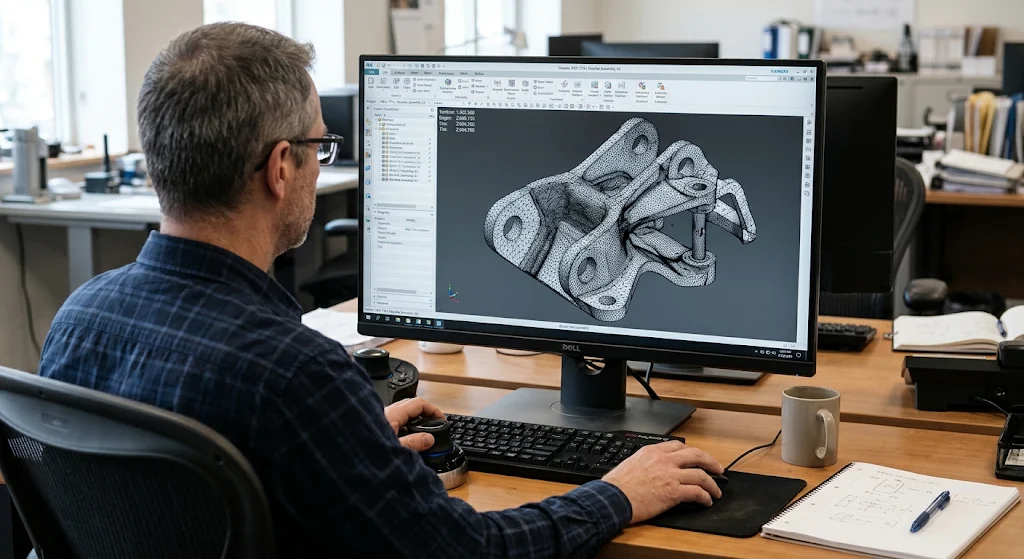
Meshing is an important part of computational geometry and 3D modelling. It involves taking complex surfaces or volumes and breaking them down into small sections for the computer to process. A mesh will usually consist of vertices, edges and faces. Meshes are used in engineering simulations to analyse properties such as stress, deformation, temperature and fluid flow. Creating a suitable mesh can be challenging as some areas may need more detail than others. Areas such as sharp corners, curved surfaces, small features and complex intersections often need more careful consideration when creating a mesh. AI can help improve this process by using machine learning to predict mesh quality, identify complex geometry and suggest suitable changes.
Optimising meshes using AI can help identify poor quality elements, excess detail and areas which could be improved. For example, a machine learning system can analyse an existing mesh and predict which areas are likely to cause issues during an engineering simulation. It could suggest increasing the mesh density in key areas. AI can also help with preparing the geometry. It can identify small features which may not be required for the analysis. These can be removed, commonly known as defeaturing, to reduce the complexity of models. However, the mesh quality will still depend on mathematical and numerical requirements. The suggestions from AI should be analysed using traditional geometric measurements and simulation validation.
Multimodal AI for Spatial Reasoning
Multimodal AI is increasing the ways users can interact with geometric modelling applications. These can include written descriptions, images, technical drawings, sketches, diagrams and existing 3D models. This means the user doesn’t need to describe every feature using specific modelling commands. For example, an architect could provide a sketch of a building along with written descriptions of dimensions and requirements. An AI driven application could analyse this information and help create an initial geometric model. A product designer could upload an image of an existing object and request changes to be made to alter the proportions or surfaces. Using multiple inputs can provide greater flexibility when modelling and can reduce some of the issues with traditional CAD software.
Spatial reasoning is an important part of this process. To successfully create a 3D model, the modelling system needs to understand the spatial relationship between objects. This includes knowing the position, orientation, distance, scale, depth and alignment. For example, when designing a mechanical assembly the system needs to know how the components fit together and if there are any unwanted intersections caused by movement or positioning. Multimodal AI systems are being developed to help identify these spatial relationships. However, sometimes the AI won’t be completely accurate. The depth could be misunderstood, a technical drawing could be misinterpreted or a shape could be created with incorrect proportions. Reliable geometric calculations will still be needed along with human input to ensure the models are accurate.
Automated CAD
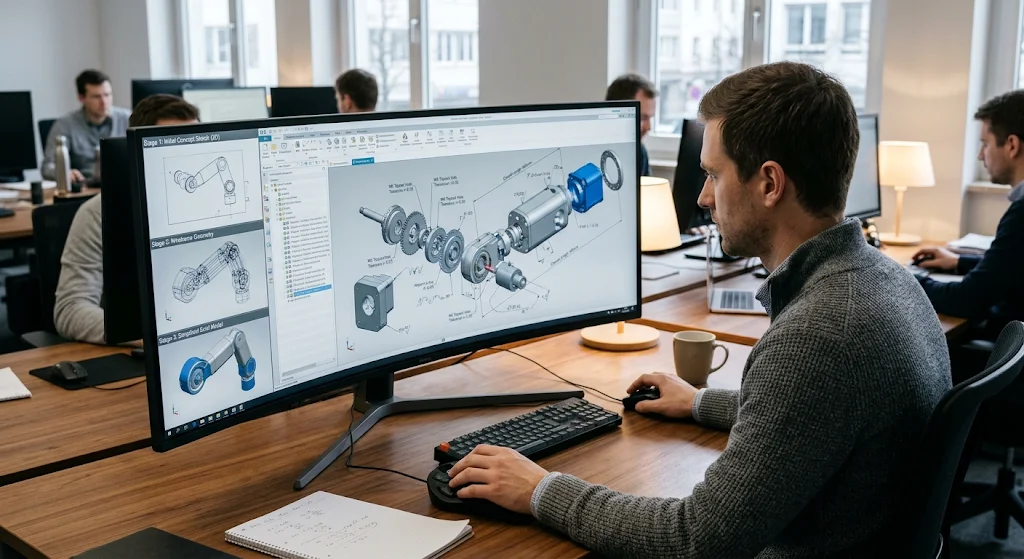
Computer aided design software is commonly used by engineers, architects, manufacturers and product designers to create accurate digital models. Traditional CAD involves choosing modelling tools, setting the dimensions, creating sketches, setting constraints and making changes. While this gives great control, it can become time consuming for complex assemblies or when many changes need to be made. AI can help automate some processes by using natural language, intelligent suggestions, automatic feature recognition and AI driven scripts. A designer could describe a simple geometric task using everyday language and an AI assistant could convert this into a series of CAD commands or a script. This can make advanced modelling applications easier to use and help experienced professionals with repetitive tasks.
AI driven CAD can also help identify design issues. For example, when creating a new household appliance a product designer may need to consider many factors such as dimensions, internal components, materials and manufacturing limitations. An AI design assistant could help organise these requirements, suggest possible setups and create initial geometric models. In engineering environments AI can help identify repeating features, create documentation and prepare geometry for simulation. Some new systems are combining large language models with geometry software to allow users to describe what they want to do in a conversational manner. However, complex design intentions can cause issues with automated CAD. The features may have ongoing relationships and editable parametric models may not be preserved. The most useful applications will combine intelligent assistance with traditional CAD and human input.
Applications in Different Industries
1. Engineering and Manufacturing
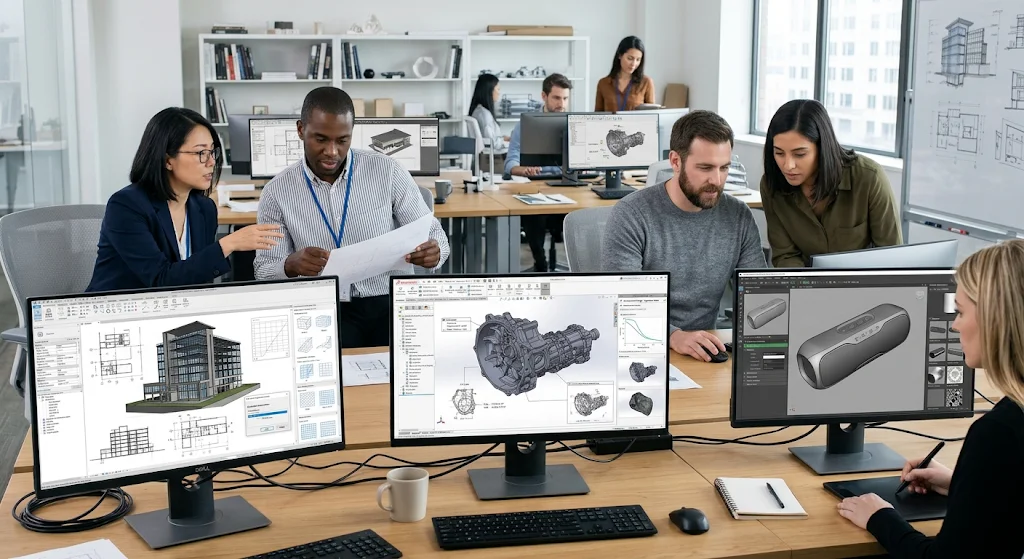
Engineering and manufacturing are some of the main industries benefiting from AI driven computational geometry. Engineers can use AI driven modelling to create component designs, identify features, optimise materials and prepare models for engineering simulation. For example, an automotive engineer could use generative design to look at different structural variations for a component considering weight, strength and manufacturing requirements.
Machine learning can also help predict how well the design will perform based on previous simulation results. This can save time looking at different design variations. However, engineering models will have strict requirements and the AI generated geometry will still need to be tested, measured and validated.
2. Architecture and Construction
Architects and construction professionals can use AI driven geometric modelling to create building layouts, look at different structural variations and visualise complex ideas. Generative design applications can be used to create different building variations considering the space available, environmental factors, lighting requirements and other design factors. AI can also help interpret architectural sketches, create initial 3D models and make changes to building components.
For example, an architect could look at different rooms, corridors, windows and structural variations when designing a commercial building. Intelligent modelling can help speed up the early stages of design by providing different variations. However, the designs will need to follow building regulations, accessibility requirements, structural engineering principles and local standards. Professional architects and engineers will need to review the final designs.
3. Gaming and Animation
Gaming and animation rely heavily on 3D modelling. AI can help create initial 3D assets, create variations of existing objects and automate some geometric editing. For example, a game developer could use AI driven tools to create different variations of environmental objects such as buildings, furniture, rocks and ornamental features.
Machine learning can also help with automatic retopology, texturing and organising complex digital assets. This can be very useful when creating large amounts of consistent objects. However, the models may contain excess polygons, inconsistent topology and unsuitable surface details. The assets will need to be optimised and reviewed.
4. Product Design
Product designers use computational geometry to create digital prototypes of everyday products, electronic products, furniture, appliances and industrial equipment. AI driven modelling can help designers look at different shapes, dimensions and variations. For example, a designer could provide reference images, dimensions and requirements for a new electronic product.
The AI could help create an initial design. This can then be refined using traditional CAD to ensure the components fit together and meet production requirements. AI can also help with exploring materials, ergonomic design and potential manufacturing issues. By combining generative design with precise geometry, product development teams can look at more design variations.
Advantages of Combining AI with Computational Geometry
One of the most important advantages of combining AI with computational geometry is increased productivity. Traditional modelling can often involve repetitive tasks, manually identifying geometric features and making many changes to complex models. AI driven applications can help automate some of these tasks to allow the user to focus on more important design decisions. Generative systems can also provide multiple design variations in a shorter time frame. Another advantage is increased accessibility. Using natural language and visual inputs can help some people who may not be very experienced with using specific CAD commands. This can help technical professionals work with other team members.
AI can also provide better optimisation. Large amounts of geometric data can be analysed using machine learning models to identify repeating patterns and suggest changes which could improve the design. In engineering this can help look at lighter structures, less material use and efficient component layouts. In computer graphics AI driven mesh optimisation can help manage complex models. Automatic geometric analysis can also help identify potential design issues earlier. This can be very useful in industries where products are becoming more complex and multiple requirements need to be considered in a short time frame.
Technical Hurdles
Whilst using artificial intelligence can have many benefits, there can also be some technical issues with using it for automated geometric modelling. Firstly, there can be issues with accuracy. Whilst it can seem like your model is accurate and realistic the dimensions of the model may be incorrect, there can be overlaps, some features may be missing or there may be disconnected parts. These issues may not be immediately apparent when looking at your model on screen however can cause issues with engineering, animation and manufacture. In addition, if the machine learning doesn’t have a variety of training examples to learn from it can cause issues. If the training examples do not show a variety of design styles or there is not enough accurate geometrical information it can cause issues.
There can also be issues with the computational power required to create detailed 3D objects. This is due to needing a lot of resources to create and process these models. There can also be issues with some AI applications not being compatible with other CAD software. There can be issues with retaining design intent. The object may look correct however it may not have any editable parameters or accurate feature history. Finally, there can be issues with recommendations not being consistent. Overall, automated modelling shouldn’t be solely based on AI recommendations. To ensure accurate models are created you will need accurate geometric algorithms, good software validation and professional input.
Importance of Combining AI and Accurate Geometric Algorithms
Whilst using AI can open up new opportunities within computational geometry, traditional mathematical algorithms are essential for creating accurate models. Using traditional geometric algorithms ensures that intersections can be calculated, distance measured, surfaces validated, object boundaries can be checked and spatial relationships maintained. Often this requires very accurate results which cannot be ensured with statistical predictions. For example, whilst an AI may suggest changes to a component, a geometric kernel is required to ensure that the surfaces will form a solid. Similarly, when creating an architectural model using AI, it is important that the dimensions, connections and spatial relationships meet the correct design requirements. By combining AI with traditional algorithms you can create a more reliable modelling process. The intelligent systems can help with interpretation and recommendations whilst the mathematical algorithms will ensure accuracy.
By using a combination of both, AI can be implemented into current professional processes. Rather than expecting the AI model to do everything on its own, the AI can be used for feature recognition, recommendations, mesh quality predictions and scripts. The traditional geometric engine will then carry out the suggested actions and ensure the models meet the set requirements. Humans can also be used to make important decisions and fix any issues that the automated systems may have missed. This increases transparency as you can see what has been done by the software. As research and development continues hybrid modelling systems are likely to become more important.
Future Opportunities
In the future, AI is likely to create more intelligent modelling applications. With improvements in multimodal AI, designers can easily switch between sketching, photographs, written descriptions and editable 3D models. Generative systems are likely to improve to retain accurate geometrical constraints, relationships and manufacturing requirements. Finally, AI is likely to be combined with simulation software to improve efficiency when evaluating design proposals. For example, an engineering team could create multiple designs for a component and evaluate how well they would perform using the simulation tools. This could help create a more efficient advanced geometric modelling process and increase experimentation within engineering, architecture, manufacturing and digital content creation.
AI agents are also likely to become more popular. This would allow the modelling software to carry out a series of related actions. This may mean that the AI can understand the design goal, create an initial model, find issues and give recommendations. Research is currently being carried out on language driven automation for CAD and AI aiding the preparation of geometry. This shows how much interest there is in combining intelligent systems with traditional modelling and engineering software. However, to create a reliable automated process there will need to be improvements made to training data, spatial awareness, geometric validation and software integration. Whilst it may not replace humans in the design process, AI is likely to become an important aid.
Conclusion
Overall, AI is having a huge impact on computational geometry and automated 3D modelling. Generative AI allows preliminary 3D designs to be created from descriptions and visuals. Machine learning can help with feature recognition, geometric categorisation, design optimisation and mesh quality predictions. Multimodal AI is improving how modelling applications interpret different information. Automated CAD systems are helping professionals carry out repetitive design actions. This creates amazing opportunities for Engineers, Architects, Game Developers, Manufacturers and Product Designers to work with increasingly complex geometry.
However, there can be issues with inaccuracies, compatibility and structural issues with AI designed models. Therefore, the most reliable way is to combine AI with traditional geometric algorithms, validation and human input. As technology progresses AI aided computational geometry is likely to become an increasingly important aspect of modern digital design and engineering.