
Introduction
With the increase in online payments, it has become an essential part of our modern society. They can be used to pay for goods, send money, pay bills and offer various other financial services. However, there are many opportunities for criminals to exploit vulnerabilities within online payment systems. Many issues can occur due to online payments such as card fraud, account takeover, identity theft, unauthorized payments and suspicious payments. Traditional ways of detecting fraud can often use static rules and manually set security requirements. This can make it difficult to detect any sophisticated fraud which regularly changes. Machine learning has become an important aspect of detecting fraud. By analyzing transaction data, detect anomalies and predicting potential threats, it can help banks, payment service providers and financial platforms identify any suspicious activity.
Understanding Machine Learning and Online Payment Fraud
Machine learning is a type of artificial intelligence that allows computer systems to identify patterns in data. It uses past experiences to improve itself and can make predictions without having to be programmed for every possible scenario. Within Online Payment Fraud Detection, machine learning algorithms look at vast amounts of transaction data to identify if a customer is being genuine or if they are trying to commit fraud. This takes into account various factors such as transaction value, where they paid, how often they purchased, device information, customer history and any suspicious account activity. This can help identify any activity that needs extra security checks. Financial institutions use this to improve fraud detection, reduce manual work and speed up authorizations. If you want to understand more about machine learning and how it can be used to detect fraud, you can look into machine learning fraud detection.
Identifying Fraudulent Transactions using Supervised and Unsupervised Learning
A popular method used within machine learning fraud detection is supervised learning. This is when algorithms are trained using past transaction data that has already been identified as either genuine or fraudulent. This helps give the system an understanding of what different transactions may look like. For example, if an algorithm identifies that there are multiple payments from an unknown device, unusual withdrawal amounts or payments from locations that are not typical for the customer, this can be a sign of fraud. Once this has been learnt, the model can identify if new transactions are likely to be genuine or suspicious. This can use classification algorithms such as decision trees, random forest and logistic regression. However, supervised learning can be limited as it relies heavily on accurate historical data. If there is incomplete or outdated data, it can make this less effective. As criminals can use new ways to commit fraud, this can cause issues.
Unsupervised learning can also be used to detect fraud. This does not rely on historical fraud data but looks at transaction data to see what typical customer activity looks like. Any activity that stands out can be flagged up. For example, if a customer usually makes small payments within one country but suddenly makes multiple high value payments from different international locations, this can be seen as an anomaly. Even if this has not been seen before, an unsupervised learning model may identify this as an anomaly. This can help financial institutions identify any unusual behaviors using techniques such as clustering and anomaly detection. By using both supervised and unsupervised learning, this can create a more flexible detection system. This will help identify known fraud patterns but also any potential unknown threats.
Classifying Transactions
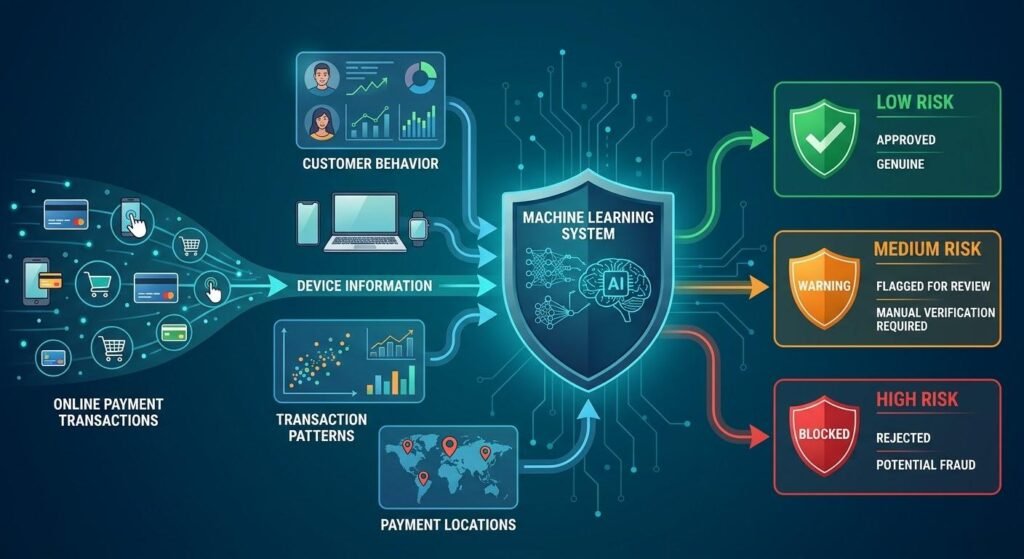
This can help financial institutions identify if payments are genuine, suspicious or fraudulent. A machine learning model looks at various factors of the transaction to identify what risk category it falls under. This can include transaction value, how often they have paid, merchant information, account history, device information and location. For example, if a payment fits with the usual spending pattern of the customer it may be classed as low risk, whereas if there is an unusually high payment from a new device, this may be flagged as a higher risk. This helps payment service providers categorize transactions based on their potential risk. This can help improve fraud detection as financial institutions will know to pay more attention to the transactions that have greater signs of potential fraud.
Identifying Payment Patterns
This helps algorithms understand how customers typically use their financial accounts. All customers will have some sort of payment pattern such as when they usually shop, how much they usually pay, what merchants they usually visit and where they usually pay. A machine learning system looks at this behavior and compares it to new activity. This can help identify any significant differences. For example, if there are multiple purchases in a short space of time, multiple failed payments or any sudden changes in spending, this can suggest that the account may have been compromised. This can also help identify any suspicious sequences of transactions. By looking at the relationship between different payments, financial institutions can identify any coordinated fraud.
Predictive Fraud Models
This uses historical transaction data and machine learning algorithms to predict the likelihood of a new payment being fraudulent. Rather than waiting for financial loss to occur, it can identify any signs that may suggest an attack is happening. This takes into account various factors such as past fraud, customer spending patterns, where the transaction was made, how often they are paying and device activity. This can help financial institutions identify what transactions need more attention. For example, if a payment has many similarities to payments that have had card fraud, this may be flagged as a high risk. This is a useful technique as it can help put preventative security measures in place. This means banks and payment platforms can investigate any suspicious activity.
Automated Risk Assessment
This takes the predictions from machine learning models and puts them into action. Each transaction can be given a risk rating based on the information. Low risk payments can be authorized automatically. Medium risk payments can require extra verification such as one time passwords or biometrics. High risk payments can be temporarily blocked. This can help financial institutions put the right security measures in place. This can also help reduce the workload of the fraud investigation team. However, clear risk levels need to be in place to ensure customers are not unfairly restricted.
Real Time Authorizations
One of the most important aspects of Using Machine Learning within digital financial services is real time authorization. Online payments often need to be authorized within seconds, so machine learning can help. This looks at transaction data and predicts the risk. When a customer tries to make a payment, the system can look at various factors such as transaction value, account history, device information, merchant information and other indicators. This can give a risk rating to help the payment processor or issuing bank decide whether to authorize, reject or ask for extra verification. This can help financial institutions quickly identify any suspicious activity.
The effectiveness of real time fraud prevention relies on how quickly financial institutions can gather, analyze and react to the data. Machine learning can look at multiple pieces of information so can be a good option for payments that may have thousands or millions of transactions in a short space of time. This can also be implemented into payment gateways, banking systems, card processing and digital wallets to help improve security. If any suspicious activity is identified, extra verification can be put in place automatically. This can reduce the opportunity for criminals to move stolen funds or make multiple unauthorized payments. However, financial institutions need to ensure their detection systems run efficiently. If authorizations are taking too long to process, this can impact customer satisfaction.
Improving from Past Fraud
One of the main benefits of Using Machine Learning is that it can improve from past fraud. Financial institutions will often come across new patterns, fraud attempts and suspicious activity. If these can be confirmed, this can be used to improve the training data. This can help algorithms recognize similar signs of fraud in the future. For example, if investigators discover a group of fraudulent payments were coming from compromised accounts and had certain device features; this can help improve the system. Getting feedback from fraud investigation teams can also help improve the accuracy. This can help improve the responsiveness of machine learning systems.
Customers can often change their behavior. This means fraud detection systems need to adapt. For example, if they move house, start shopping from new merchants, go abroad or start using a new device for online payments, this could be picked up as fraud if the detection model relies too much on past behavior. However, machine learning can help by looking at new transaction data. This is often referred to as retraining. However, care must be taken when updating. If the system is learning from inaccurate information or manipulated transaction data, this can cause issues. Financial institutions will need to regularly review their models to ensure they are not causing any extra security issues.
Challenges of Using Machine Learning
One of the main challenges of Using Machine Learning to detect fraud is handling large amounts of transaction data. Banks and payment platforms have vast amounts of data to process through various channels. This includes card payments, mobile banking systems, digital wallets and online payment gateways. This means a reliable computing system, efficient data handling and algorithms that can produce predictions quickly are needed. If the detection system cannot process the data in time for authorization, this can cause delays to payments. Financial institutions will need to invest in scalable technologies to ensure they can process larger amounts of data without impacting performance. They will also need efficient data handling.
Detecting new fraud techniques can be challenging. Criminals are always finding new ways to get around security. Some fraudulent payments can be very similar to genuine customer activity. Whilst unsupervised learning and anomaly detection can help identify new patterns, it does not guarantee that all new fraud techniques will be recognized. Machine learning can also produce false positives and false negatives. A false positive is when a genuine transaction is seen as fraudulent. A false negative is when a fraudulent payment is seen as genuine. This can cause issues for financial institutions. False positives can cause inconvenience for customers and false negatives can leave businesses and consumers exposed to financial loss.
Keeping models accurate can also be a challenge. Fraud patterns, payment methods and customer behavior are constantly changing. A model that works well now may not be as reliable in the future. This is sometimes referred to as model drift. Financial institutions will need to regularly review their models. They will need to update their training data, investigate inaccurate predictions and adjust detection levels when needed. Data quality can also be an issue. If there is incomplete, duplicate, outdated or inaccurate transaction data, this can impact the accuracy of the decisions made by algorithms. Financial institutions will also need to ensure sensitive customer data is protected. They will also need to ensure they are following relevant data protection and financial regulations. Even with advanced machine learning, without proper governance, this can cause unreliable results or introduce extra risks.
Ensuring Security without Causing Inconvenience
Whilst preventing financial fraud is a priority, financial institutions will want to ensure they are not causing unnecessary issues for customers. Customers expect online payments to be quick, easy and reliable. If there are too many security checks in place, this can cause frustration if genuine payments are constantly being rejected. Machine learning can help by implementing risk based authorizations. This means higher risk transactions will have extra security measures. This will help improve security whilst still allowing customers to make payments that have familiar and low risk features.
Financial institutions should implement machine learning alongside human oversight, good customer support and reliable verification. Fraud investigation teams can look at any unusual cases and suspicious patterns. This can help improve automated decisions. Customers should also have easy ways to verify genuine payments, report unauthorized activity and regain access to compromised accounts. Financial institutions should also be clear with customers when payments are being rejected or require extra verification. This will help build confidence and reduce the opportunity for criminals to exploit payments. A successful fraud prevention strategy should also consider how many fraudulent transactions are being blocked, how accurate genuine payments are and how well customers are protected.
The Future of Machine Learning and Online Payment Fraud Prevention
As digital financial services continue to grow, machine learning is likely to play a bigger role within online payment security. With new payment methods such as digital wallets, instant payments, contactless payments and mobile banking apps, this can create new opportunities for financial transactions. However, it can also create new security concerns. Advancements in artificial intelligence may mean fraud detection systems can look at more complex behavior patterns and identify relationships between suspicious accounts. Financial institutions may also use machine learning alongside technologies such as biometric verification, behavior analytics and advanced identity verification to improve security. However, investments will need to be made to ensure reliable infrastructure, responsible data handling, transparent models and good cyber security.
Conclusion
Machine learning has become an important tool to help detect and prevent fraud within online payments. It can help financial institutions analyze transaction data, recognize unusual behavior, predict potential threats and speed up authorizations. By using supervised and unsupervised learning, classifying transactions, identifying payment patterns, predictive fraud models and automated risk assessment, banks and payment service providers can identify suspicious activity before they cause significant financial loss. It can also help improve digital payment security by learning from past fraud and adapting to customer behavior. However, there are challenges to overcome such as large amounts of transaction data, new fraud techniques, keeping models accurate and not causing unnecessary issues with payments. By Using Machine Learning alongside human oversight, improving models and putting customer focused security in place; financial institutions can create a secure and reliable online payment environment.
Get more well researched information about Machine Learning Fraud Detection here.