
Introduction
Lending is an extremely important part of the banking industry, however, it can present many risks to financial institutions. Banks need to ensure that individuals are able (financially) and willing to pay back the amount they have borrowed. Traditionally, banks rely on credit history, income, collateral and manual checks to assess individuals. However, these can be improved by using predictive analytics. This helps financial institutions to use past and present financial information to predict future repayment scenarios. This helps banks to make more informed decisions by analyzing patterns in a customer’s financial transactions, income, spending behaviour and repayment habits. This can help reduce losses from lending and provide suitable credit opportunities to more customers.
1. Improved Credit Scoring
Using credit scoring helps banks to predict how likely an individual will repay their loan. This can be improved by using predictive analysis. This allows banks to look at multiple financial indicators. Banks can look at payment histories, debt, income, employment history and repayment history to give more detailed assessments. Statistical techniques and machine learning can help to identify any links between financial indicators and repayment history. This helps financial institutions to give customers a more accurate credit score. More accurate credit scoring can help lenders decide who is more risky to lend to. This helps to ensure they are making consistent decisions when approving loans and reduces the risk of approving loans to customers who may struggle to repay.
2. Analyze Credit History
Understanding an individual’s credit history can help banks to understand what they have done financially before. By using predictive analysis, banks can easily analyze patterns in customer’s credit history. If someone has been making payments in advance for multiple loans, credit cards and other financial obligations it can show they are more likely to pay on time. However, predictive analysis can take into consideration how recent these issues have been and whether they have improved their repayment habits. This can help banks to understand more about their credit worthiness. This can help lenders to understand whether they were just facing temporary financial issues.
3. Understand Income Patterns
Having a consistent income is very important when trying to determine if someone can comfortably repay a loan. However, sometimes it can be difficult to determine how consistent their income is by looking at just one payslip or bank statement. Predictive analysis can help financial institutions to understand income patterns. This can look at salary, income from business, commission and other legitimate sources of income. This can help banks to determine if they have a consistent income, seasonal income, increasing/decreasing income. For example, self-employed individuals may not have a consistent income each month. However they may have enough income over the year to repay their loan. This can help to provide a more realistic view of how stable their income is.
4. Analyze Transaction History
Transaction history can help banks to understand how customers are managing their day to day finances. Predictive analysis can help banks to look at deposits, withdrawals, transfers, regular payments and spending behaviors. This can help banks to understand how much money they regularly have in their accounts, frequently going into overdraft and how much they are spending on financial obligations. For example, 2 people may have a similar salary but one person may have less monthly costs and debts. This can help banks to understand how much spare income they have after essential costs. This can help them determine how much they can lend.
5. Predict Likelihood of Defaulting
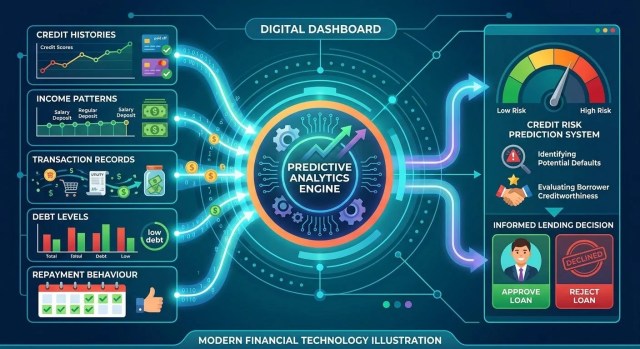
Defaulting on a loan means a customer has failed to meet their repayment obligations. Predictive analysis can help banks to predict how likely someone is to default. This can help banks to understand patterns that are common with defaulting. This can include increasing debt, inconsistent income, missed payments, excessive borrowing and decreasing account balances. Using machine learning banks can analyze past lending data to see what factors can indicate someone is more likely to have repayment issues. This can help banks decide if they need to carry out more checks, apply stricter lending criteria or decline the application. This can help financial institutions to manage their lending risks by identifying potential defaults early. This can help banks to base their decisions on actual financial data rather than assumptions.
6. Use Alternative Credit Data
Traditional methods may put people at a disadvantage if they don’t have much borrowing history or have never had credit. However, predictive analysis can help to improve this. Where possible, banks can use additional financial data to help assess applicants. This can include rental payments, bills, verified mobile money transactions and more. An individual may not have a credit card history but may be showing consistency in their finances by paying their rent and electricity regularly. Predictive analysis can look at these patterns to predict how reliable they will be with their repayments. This can help banks to provide credit opportunities to young adults, small business owners and those who may not have had much credit.
7. Automate Application Decisions
Manually assessing loan applications can be time-consuming. Predictive analysis can help automate this process. Computer systems can look at financial data, calculate risk scores and identify if an application meets the lending criteria. Once an applicant has provided the relevant documentation and given permission for relevant checks, the system can assess their financial status. Simple applications may be approved quicker whereas more complex applications can be passed onto credit officers. This can help reduce the admin burden. However, there should be clear lending criteria in place and appropriate checks should be in place for any unusual cases.
8. More Accurate Debt to Income Ratios
The debt to income ratio shows how much of an individual’s income is being used to repay current debt. This is an important factor to see if they can afford to borrow more. Predictive analysis can help to provide a more accurate assessment. This can look at current loan repayments, regular financial commitments, fluctuating income and how much they will be paying back. This can help banks to understand more about their financial responsibilities by using authorized financial data. For example, someone may have a reasonable salary but may have multiple loans which are taking up most of their income each month. This can help lenders to understand how much they can borrow comfortably.
9. Decide on Risk Based Lending
Banks need to ensure they are getting the right amount of interest from their loans whilst also ensuring they don’t lose out financially. Predictive analysis can help financial institutions to understand how risky each application is. This can help them to decide on suitable lending terms. Those with a good repayment history and stable financial status may receive more favorable interest rates. Those with higher risk may require extra precautions. This can help lenders to make decisions based on their risk management policies. However, there should be appropriate consumer and lending regulations in place. Banks should ensure they aren’t using any biased factors to determine interest rates.
10. Monitor Borrowers
Once a customer has been approved for a loan and received the funds, credit risk should still be considered. People can go through financial issues such as losing their job, having less income from their business, unexpected costs and increasing debt. Predictive analysis can help banks to monitor relevant account activity and repayments. This can help banks to compare current financial activity to past patterns. If they notice any red flags such as frequent missed payments, decreasing balances or unusual income fluctuations they can identify they may be having financial issues. They can then contact the borrower to discuss repayment options.
11. Manage Loan Portfolio Risk
A loan portfolio shows the variety of loans and credit facilities a financial institution has provided. It is important to manage the risk involved. Using predictive analysis, banks can identify how well their portfolio is performing. This can look at different categories of borrowers, types of loans, repayment patterns, industries and geographical markets. Financial institutions can identify which groups of loans are becoming more risky. They can also predict how potential changes in the economy could impact repayments. For example, a downturn in an industry could increase the risk of defaulting for customers whose income relies on this industry. This can help banks to make changes to their lending and diversify their portfolio.
12. Identify Early Warning Signs
Many borrowers will have financial issues before missing payments on their loan. Predictive analysis can help banks to identify early warning signs. This can look at changes in customer’s financial activity. This can include less salary being deposited, frequently going into overdraft, increasing credit card balances, inconsistent business income and unusual withdrawals. These may not indicate repayment issues individually but if there are multiple changes they may be indicating increasing financial pressure. Predictive analysis can identify these and notify the credit management team that an account needs attention. This can help banks to get in touch with the customer sooner and provide them with advice and suitable repayment options. This can help reduce default rates.
13. Use Machine Learning
Machine learning can improve predictive analysis by allowing computer systems to identify complex patterns in large sets of financial data. Banks can use different techniques such as logistic regression, decision trees, random forests and neural networks to predict how likely they are to repay the loan. This learns from past lending data. The models can be analyzed and updated with new information. For example, a model may identify that people with inconsistent income, high debt and previous late payments are more likely to default. This can help financial institutions to improve their assessments. However, these models should be tested regularly. If they contain old data, incorrect assumptions or economic changes they can become less reliable.
14. Ensure Fair Lending
Whilst predictive analysis can improve credit decisions, financial institutions should ensure they are applying their systems fairly. If models aren’t designed properly they can cause historical discrimination. This can cause issues for individuals as they may be disadvantaged for reasons that aren’t related to their ability to repay. For example, using specific geographical or demographic indicators without proper precautions can cause unfairness for certain customers. Banks should regularly check their models for bias. Use relevant financial data and have clear decision making processes. If required, applicants should be given the correct reasons. Responsible lending should be carried out. This means using predictive analysis to make decisions based on real financial risk rather than just automatically rejecting people. There should be human oversight, fair testing and clear accountability.
15. Secure Customer Data
Predictive analysis uses reliable financial data. It is important to ensure this data is accurate, secure and private. If there is incorrect income data, duplicate transactions, old credit data or missing data it can cause misleading predictions. This can cause incorrect lending decisions. Banks should have good data management processes in place. This can help to ensure data is accurate, clean, organized and regularly updated. They should also ensure customer data is secure. Customers should understand how their financial data is being collected. Regularly checking models can also help. Financial behaviors and economic changes can occur so it is important to ensure data is accurate. This can help banks to make reliable predictions.
Conclusion
Predictive analysis is transforming the way banks assess credit risk. By looking at credit history, income patterns, transaction history, repayment behaviors and alternative financial data, financial institutions can gain a more complete understanding of borrowers. It can help to improve credit scoring, predict defaults, automate decisions, monitor current loans and manage loan portfolio risk. This can help reduce losses from lending, improve efficiency and provide suitable credit opportunities. However, banks should ensure they have accurate data, secure customer data, fair decisions, clear decision making and responsible lending practices. As financial technologies continue to develop predictive analysis will continue to be an important tool to help lenders make informed decisions. It can help create more accessible and sustainable financial services.
Get more well researched information Predictive Analytics in Credit Risk Assessment here.