Introduction
Big data is revolutionizing what financial institutions do at the time of evaluation of borrowers, determination of creditworthiness, and loan approval. In the past banks turned to credit scores, payment history, job stability and preexisting financial relationship to determine if an applicant is a good risk for repayment. Also it excluded groups which had thin credit history, irregular income, or were not part of the traditional banking system. Today banks, microfinance companies, and digital lenders are able to look at large sets of financial and behavioral data which in turn gives them a more in depth picture of the borrower. Using complex analytics and predictive risk models, lenders are able to put together a better picture of a person’s ability to pay back the loan as well as identify those at high risk that may default, thus they are able to make better lending choices. While data based lending brings about the chance for better performance and wider financial inclusion its also dependent on responsible data collection practices, that the analysis is accurate, that is fair, and also that the decision making processes are transparent.
Big Data in Credit Scoring
Big data is a term we use for very large sets of information which we collect from many different sources and we analyze them to see what trends and connections we can find. In the field of credit scoring we see that these data sets help lenders to do a better job of evaluating a person’s financial history beyond what is reported in a typical credit report. What we look at may include things like income deposits, account balances, bill pay history, outstanding debts, business transactions, past loan repayments. Also digital lenders may look at what is made available to them from mobile banking apps and electronic payment systems. When we put all this info together we get a more complete picture of a person’s financial health and their ability to pay back a loan. Instead of looking at just one factor we look at many. But the value in big data is also in its accuracy, relevance, and fullness. If the info is wrong, out of date or misleading we get bad results out of our analysis which in turn leads to poor lending decisions.
Traditional Credit Scores and Repayment Histories
Traditional credit scoring is still a main component in which lenders make their decisions. What we see in credit scores is a compilation of a person’s past borrowing and repayment actions which in turn is used by lenders to determine the chance of that person having issues with payment in the future. Reports which are put out there include past loans, present balance, payment delays, defaults and the term of a person’s credit history. Those that have steady payment records are looked at as lower risk as opposed to those with a record of default or too much debt. Also we see big data improve this process by which institutions are able to look at payment trends over many accounts and over long period of time. For instance a lender may see if a person pays what they are due on time, has a history of not having enough money for payments, or has recently taken on more debt. That information in turn supports more precise determinations, but it is important to note that credit scores are not a full picture of financial responsibility. A person that does not have a credit history may in fact be a good risk for a new loan.
Using Income Records and Transaction Patterns
Income reports and transaction trends also play a role in determining a borrower’s ability to pay back a loan. Banks look at salary deposits, account balances, regular outgoings, present debt repayment habits, and the incoming funds are consistent. For the self-employed and small business owners which formal salary info is not available, transaction histories do put into picture commercial activity. At the microfinance level we see that lenders use the same info to evaluate traders, artisans and other business people whose income is very variable. For e.g. a market trader will get many small scale payments as opposed to a steady monthly salary. We see that they look at that transaction data to determine average income, to note any seasonal changes, and to get a better picture of the applicant’s finances. Also it is important to note that transaction volume by itself is not a sure sign of credit worthiness. Big deposits may be from loans or from transfers between accounts rather than actual income. Lenders have to look at this info very carefully and to look at the income stability also what is left over after core expenses.
Alternative Information and Borrowers of Thin Credit Files
Alternative data is a great asset for those which have not used traditional credit products. In many a developing economy which includes Nigeria users may earn income from informal business, freelance work, agriculture, and what not which do not put together standard employment records. Such borrowers may have a hard time getting into loans because credit bureaus do not have info on them. Where it is allowed by law and makes sense, lenders may use alternative info which includes consistent utility payments, verified business transactions, rental payment records, and digital payment history to present a more complete picture. These may put forth reliability which may not be present in traditional credit reports. For instance a small scale business owner who regularly gets customer payments and does well with expenses may have proof of repayment which a bank loan does not. Also that which is alternative data must be related to the lending decision, collected lawfully, and reported fairly. Personal past time or out of the blue digital behavior should not be a measure of financial dependability.
Predictive Analytics and Automated Loan Decisions
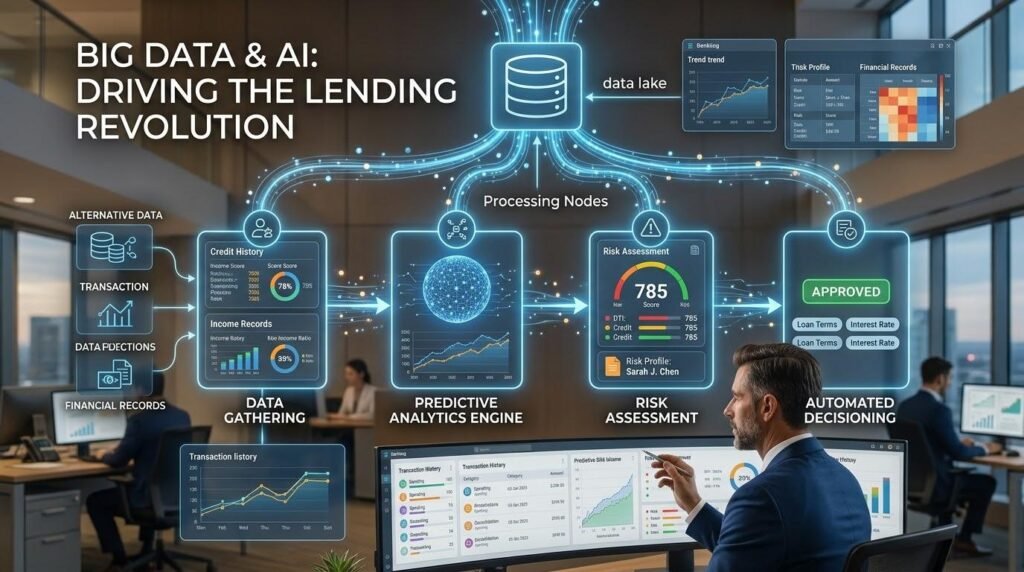
Predict in large banks and financial institutions are used to recognize in past and present data the trends which may play out in terms of customer repayment behavior. Machine learning we use to study the relationships between income stability, debt levels, payment history, purchase trends, and past loan performance. That which we find out from these relationships allows us to put forward estimates of default and to determine what the terms of the loan should be. Also we have the automated systems which play a role in the decision of which applications to approve or reject, what the interest rate should be, the payback period, and the amount which may be borrowed. For example a person which has stable income, which reports manageable debt, and which has a good history of payment may be given a larger loan than one which we see as a greater risk to default. Also we have the models which flag up applications which may require more in depth look by a person. But also it must be said that predictive models do not have a guaranteed accuracy. Their performance is a function of the quality of the data used to train them, the variables which are put in, and also of the models’ regular testing. Also financial institutions have to be ever watchful of their models as economic changes may make past reliable predictions less so.
How Data Speeds up Loan Approval.
One large benefit of data driven lending is we are able to see processing times for loan applications drop. In the past we had in depth paper work, manual document check off, repeat customer visits, and very long internal reviews. With big data we are able to automate many of those issues out. We can pull in authorized financial info, check out application details, do an affordability analysis, and identify issues. Digital lenders are using these features to get pre-approved applicants processed within minutes or hours which depend on the complexity of the loan and the quality of the available info. We see this as a benefit to people with urgent needs and small businesses that are in need of working capital to buy inventory or weather a short term cash storm. Also we see a reduction in admin costs and the staff that used to do the admin can now focuses on the hard cases. That said speed should not take over careful evaluation. We still have to do in depth looks at income which is iffy, transactions that look fishy, incomplete docs, or anything that may be an issue of discrimination which will require more time before we can make a responsible decision.
Benefits of Big Data to Banks, Microfinance Institutions and Digital Lenders
Big data brings to the table a range of benefits which vary by which financial institution you are talking about. Commercial banks use it to improve risk management, do better customer segmentation, and do more consistent application evaluation. Microfinance institutions can do a better job of getting to know their customers which run small businesses or have irregular income. Digital lenders are able to process large numbers of applications without almost totally relying on manual reviews. Across the board we see that better info may help to identify good borrowers, do early detection of default, and change loan terms to fit individual situations. Also we see that which data driven assessments do is support financial inclusion which in turn helps lenders to tell the difference between applicants that truly present high repayment risks and those which just don’t have traditional credit reports. But in the other hand we must balance expansion of credit access with affordability. We see that which is to say extending credit to people who can’t really afford to pay it back increases debt and financial distress. Thus responsible lending requires institutions to look at repayment ability, to put forward borrowing costs clearly, and to not push customers into taking on which may be inappropriate financial products.
Algorithmic Bias and Financial Exclusion
Despite what big data’s got to offer, it also has the tendency to reproduce present inequalities when we see models which are based on biased or incomplete info. Past lending histories may include past cases of discrimination, unequal access to bank services, or economic disadvantages which some communities had to bear. If a model is trained on this info without proper protections in place, it may well continue to put out decisions which do in fact penalize applicants from underserved areas. Also people which don’t use digital payment systems a whole lot may be seen as less financially reliable just because there is a lack of data on them. That in turn creates a cycle in which persons excluded from formal finance still can’t get the digital history they need in order to get credit. Also certain variables may put in play what in fact are red flags for personal characteristics which aren’t even included in the model at all. Therefore financial institutions should be doing regular checks for fairness, testing results across different customer groups, and where appropriate put in alternative assessment processes. Human review and open appeal processes can also play a role in the issue of an applicant which is served up what they think is an unfair or incorrect decision.
Data Privacy, Security, and Transparency
Credit evaluation systems need robust protective measures as financial data includes very private info. Unauthorized access, over collection of data, or poor data storage may put customers at risk of identity theft, fraud, and other financial issues. Institutions should only get what is required for the lending which is to be done, tell how it will be used, and get consent or determine another legal base as required. Also they must put in place proper security measures, control what employees have access to, and follow data protection laws which include Nigeria’s. Also in terms of transparency which is very key. Applicants should be given easy to understand info on what went into a go or no go decision instead of being told a black box algorithm made it. Also lenders should keep a record of the automatic go through processes, give out ways to correct in accurate info and have in place for human input when needed. These actions improve account ability and customer confidence also help institutions to catch errors before they lead to large scale financial issues.
Conclusion
Big data is transforming credit scoring and loan approval as it sees to it that financial institutions put together traditional credit reports with income info, transaction histories, alternative data, and predictive analytics. We see that these are improving risk assessment, speeding up application processing, and that which in turn helps lenders look at customers that have had little or no past credit history. Banks, microfinance companies, and digital lenders are using this info to make better decisions and also to which in turn supports wider access to what we may term responsible financial products. But tech alone does not ensure fair play or accuracy. We see issues like algorithmic bias, digital exclusion, privacy violations and lack of transparency which in turn can null out the benefits of data driven lending. What we thus see is that financial institutions have to run on quality data, to put in place regular testing of predictive models, secure personal info, and report back on major lending decisions. When used in combination with human input and responsible lending practices big data can put in place a more efficient, inclusive and accountable credit system.
Get more well researched information about Big Data in Credit Scoring here.