
Introduction
Individuals voice their opinions, emotions and experiences with online reviews, social media posts, customer feedback forms, and business conversations daily. A customer may say a good thing about a new phone, say something bad about a slow delivery, or say something bad about a restaurant. These comments provide helpful information, but it can be tedious and challenging to read and analyze thousands of comments. This is where artificial intelligence (AI) can help. Sentiment analysis is a type of Natural Language Processing (NLP) that uses computers to analyze written text and determine sentiment or emotion within a text. It can give businesses a clear idea of what their customers are thinking about their products, services, and brands without having to read each comment.
The sentiment analysis has become an important tool for organisations that want to know what their customers are feeling about them, how to better their products and make informed decisions. For instance, an online retailer may determine whether the average customer is satisfied with the goods they’ve received, whereas a telecommunications firm could examine the comments on social media and generate insights into common complaints about network services. The technology can be used to determine the positive or negative character of the opinion, or in more advanced applications, determine emotions including happiness, frustration, disappointment and excitement. Sentiment analysis is a valuable primer in the relationship between Artificial Intelligence, human language and business intelligence.
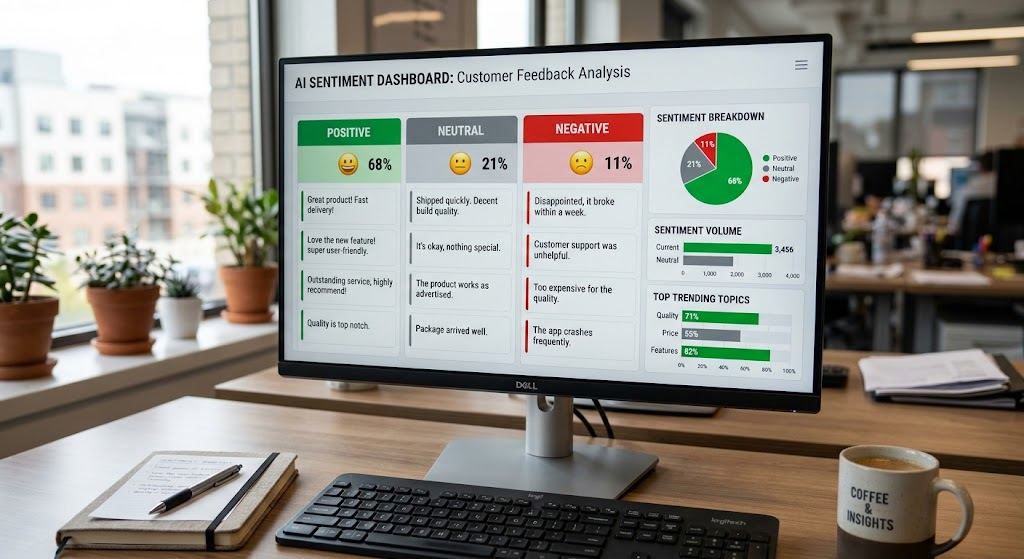
What is Sentiment Analysis
Sentiment analysis is the way of employing computer systems to determine and categorize the emotional color or opinion included in written language. It can also be referred to as opinion mining, as useful information about people’s attitudes towards a specific topic can be extracted from it. It can be a product, company, public service, political problem or experience. Instead of just recognizing the words in a sentence, a sentiment analysis system tries to interpret whether the sentence expresses a positive, negative or neutral sentiment. This is distinct from simple text processing, which may identify topics or count words, but not decipher the intent of the text.
An example of a sentence may be “The delivery was quick and the item is perfect.” This is a positive statement and would be classified by a sentiment analysis system as such, as the writer seems to be very happy with the delivery and the product. The sentence below on the other hand would get a bad classification: ‘The delivery was late and the product did not function after two days’. The statement “The package arrived on Tuesday” may be considered neutral, as it does not necessarily make a judgement. Here are some examples to illustrate the working of the basic sentiment analysis. The system processes language, recognizes patterns, and generates a classification for the language that can be used to help a person or organisation understand language.
How NLP can benefit from Sentiment Analysis
NLP sentiment analysis can be used to interpret written opinions using language processing techniques, rules, statistics or trained artificial intelligence models. Natural Language Processing (NLP) enables computers to interact with human language, such as words, sentences, and relationships inherent in the context of messages. If a sentiment analysis system is given a piece of text from a customer review or social media comment, the system analyzes the text and applies patterns it learned from language data or from predefined rules to make an estimation of the sentiment. The process can include the identification of significant words, analysis of sentence structure, negation recognition and the examination of the relationship between various parts of a message, depending on the system. More advanced systems can also take into account context, which will allow them to understand expressions that are not necessarily understood.
The first step in a typical sentiment analysis process is to gather text from various sources, like customer reviews, online surveys, social media, or support interactions. The system then formats the text for analysis, possibly stripping out some formatting, fixing some inconsistencies and breaking sentences into smaller pieces. A rule-based program or trained model then analyzes the language and labels/scores it with a sentiment. These results can then be arranged to make reports, charts or dashboards that display the overall attitude of the clients over time. For example, a company may find that its positive comments rose with the launch of a quicker delivery service. Sentiment analysis integrates the written sentiment information with language analysis and empowers organisations to gain insights from large amounts of written opinions to make better business decisions.
For a more general overview, refer to sentiment analysis, which discusses the methods and uses of computational language analysis.
Three Main Sentiment Categories
- Positive Sentiment
Positive sentiment is defined as language that conveys satisfaction, approval, enjoyment or appreciation. Popular comments include “the customer service was fantastic,” “I really like the quality of this product” and “this app is really easy to use. This sentiment analysis system recognises these sentences as positive, since they are conveying positive feelings about what they are talking about. Positive sentiment information can help businesses identify their customers’ top strengths, which can help them tweak their offerings to produce even better results.
If numerous customers are calling out that a company has a fast turnaround time, for instance, management could see the company’s customer service strength and continue to build on that. Positive sentiment also can be used to gauge the results of a new product, ad campaign or a service enhancement. But a positive classification doesn’t necessarily equate to a complete satisfaction with all aspects of a customer’s experience. The results should be assessed in the context of the product being discussed. For instance, a person might like the design of a product, but not the performance of it.
- Negative Sentiment
Negative sentiment is language that conveys a negative opinion, dissatisfaction, criticism, frustration or disappointment. Some examples might be: The application keeps crashing, The food comes cold, or The company doesn’t resolve my complaint. Sentiment analysis systems can detect these types of words and enable businesses to become conscious of the problems that need to be addressed. For example, an online retailer might notice that more customers are reporting problems with their orders being delayed, items being damaged in the order, or issues with receiving a refund.
Employees can view automatically generated summaries to see if there are recurring issues, rather than having to read through them all. Negative sentiment analysis is especially valuable in the context of organisations that must track customer experiences on multiple platforms. However, don’t always assume that negative sentiment is a sign that a product or service is not working. Certain comments might be frustrated at a point or contain constructive criticism or mention a single incident. Before making a decision on what action to take, businesses should review the context and supporting evidence.
- Neutral Sentiment
Neutral sentiment is the text which does not express either a positive or negative attitude. Examples involve things like “The shop is opening at nine in the morning”, “My order consists of 3 items”, and “The company has released a new version of its app”. These statements primarily are fact statements, rather than statements of approval or disapproval. Neutral classification is the ability to separate opinions from other statements without a strong emotional tone, like descriptions, announcements, etc.The neutral classification helps sentiment analysis systems differentiate between opinions and other statements that have little or no emotional tone.
This distinction is crucial as not all product or company references are customer references. A user may refer to a brand of a particular smartphone while talking about a technology event, and not comment on the manufacturer’s capabilities in any way. Neutral statements may not contain as much information about customer satisfaction as more direct statements, but can still be helpful in conjunction with other data. They can assist businesses in comprehending what’s on the mind of the public, recognize significant moments, and determine if the comments are factual or true statements.
Types of Sentiment Analysis
There is a variety of levels of sentiment analysis that can be done depending on the information that an organisation wishes to receive. Perhaps the easiest method is to look at the whole document or message and give it one sentiment score. This type of sentiment analysis is called document-level sentiment analysis and is valuable for categorizing full product feedback or longer sentiments provided in response to a question. However, sentence-level sentiment analysis looks at individual sentences and a system can detect opinion changes in the same review. For instance, one customer may say, “The product’s looks are nice, but the battery life is not. Sentence level analysis can assist in determining the positive opinion towards appearance and the negative opinion towards battery performance. The different approaches are helpful since a general classification may conceal important details within a longer message.
Another significant type is aspect-based sentiment analysis, which detects opinions in relation to particular attributes or aspects of a product, service or experience. This is not as much a positive or negative review technique as it is about finding out which parts of the review the customer is extolling or decrying. In the review, The phone has an excellent camera, but the battery drains quickly, there is positive sentiment towards the camera and negative sentiment towards the battery. An aspect based system can be used to distinguish these opinions and enable a manufacturer to find out what features are effective and what is not. More sophisticated systems also can detect emotions such as anger, happiness, sadness, fear, or excitement. These abilities offer a better insight into written communication, but their accuracy is dependent on the model, the data used to train the model, and context of the message.

Rule-Based Sentiment Analysis
Sentiment analysis based on rules requires a set of rules and a sentiment dictionary to categorize written material. A sentiment dictionary will be a list of words or phrases with positive or negative sentiments. For instance, the words “excellent” and “wonderful” might be assigned positive scores, while the words “terrible”, “broken”, and “disappointed” might be assigned negative scores. A rule-based system looks through the text, finds these expressions and sums their scores to determine the overall sentiment. There are other rules which can be incorporated to deal with some aspects of the language, such as negation. For instance, the word “good” by itself might be interpreted differently than the word “not good. The fusion of sentiment dictionaries and grammatical rules can help implement relatively simple systems for analyzing some of the more common expressions.
One upside to rule-based sentiment analysis is that it may be simpler to comprehend and apply than some of the machine learning options. Developers can view the dictionary and rules to see why the system gave a specific label. This could be appropriate for small-scale projects, specific application or when labelled training data is scarce. While the rule-based systems have weaknesses, however. They often miss the tone and intent behind sarcasm, quirky or not so common language, technical jargon and context-sensitive phrases. You can have a positive word in a statement but it’s also indicating that you’re frustrated. For instance, in the statement “Great, another network outage”, the word great is a positive word but it is also indicating that you are frustrated. A basic dictionary approach could mistake it as positive, unless it takes into consideration the context. It can take time and effort to keep dictionaries and rules up to date for various languages and communication styles.
Sentiment Analysis Using Machine Learning Techniques
Machine learning is a new technology that enables computers to learn from examples instead of having to follow all rules manually. In sentiment analysis, the developers usually train a model on already classified text that is positive, negative or neutral. The model looks at the relationship between the language and the assigned labels and learning patterns which can be used to classify new messages. The text can be represented in one of three ways: word counts; term frequency statistics; or numerical features that contain information about the words. Logistic regression, support vector machines and Naive Bayes are commonly applied algorithms in text classification. The model is then trained and can analyse new customer reviews, predicting the sentiment behind each one.
Machine learning methods can be more flexible than the traditionally rule-based methods, since they learn from the examples of actual communication between humans. An algorithm that was trained on thousands of product reviews could suggest that combinations of words often signal dissatisfaction, even if there isn’t a clear indicator in any single word. But the quality and relevance of the training data is critical to the model’s performance. A system that is trained primarily on restaurant reviews may not be able to understand and analyse financial service complaints, which have a different vocabulary and context. There could be biases or lack of examples within training data for certain expressions, languages, or customer groups. Businesses need to therefore use appropriate test data to assess their business models and track their performance as language and customer behaviour evolve. Machine learning will make it easier to avoid writing each rule by hand, but it doesn’t mean that careful design and evaluation is not required.
Deep Learning and Modern Sentiment Analysis Models
Deep learning is a part of machine learning which utilizes neural networks to capture complex patterns in data. Complicated sentences can be represented in a language that can be processed by deep learning models which can take advantage of the relationships between words and phrases to recognise sentiment in the sentence. Previous neural methods such as recurrent neural networks (RNN) and long short-term memory networks (LSTM) were created to process sequences of words and to account for the evolution of information over a sentence. When sentiment is based on the order of the words, these models can be helpful. For instance, “I expected the service to be bad, but it was actually very good” has a meaning shift that would not be captured simply by the number of positive and negative words.
Transformer-based language models are used increasingly in modern sentiment analysis to represent the word in relation to the context of the text. Transformer-based models are capable of learning the contextual relationships and are able to perform a wide range of language tasks, such as text classification and emotion detection. A transformer model can also make a distinction between “This film is sick” being an expression of approval in one context and a statement about illness in another context. But every contextual model is not perfect as it comes to understanding all expressions. Even with the language being ambiguous, the lack of training examples, domain differences, and cultural variations can affect their predictions. They can also be more resource intensive than basic rule-based systems. The best solution for businesses will depend on the complexity of the task, the amount of text, the budget, languages, and accuracy required.
Application of Sentiment Analysis as a Practical Tool.
Customer reviews and feedback
One of the most prevalent sets of data used for sentiment analysis are the ones provided in customer reviews. Customers leave written feedback about their experiences on online marketplaces, travel sites, restaurants and services.There is a ton of written feedback about customers’ experiences on online marketplaces, travel sites, restaurants and service providers. It can be challenging to go through every review manually, particularly for companies that have thousands of customers.
Sentiment analysis can be used to classify this information into positive and negative sentiment and detect common themes. For instance, a hotel may find that people often comment on how well-located it is, but how slow it takes to check in. These findings can help management keep the strengths of the hotel and resolve the related issues in service. Likewise, an internet retailer can investigate product reviews for typical complaints regarding the durability, packaging, or product description. These insights can be used in conjunction with direct customer feedback and operational data to identify areas for improvement.
Social Media Monitoring
Customers can voice their reviews about companies, products and public events in social media in an instant. Such conversations can be quickly developed, and businesses can find it challenging to track public response manually. Sentiment analysis can be used to analyse vast amounts of posts and comments, and determine whether conversations are positive, negative or neutral. For instance, a telecommunications company can listen to what consumers are saying about its network reliability and customer service and discover the issues that could be causing customer dissatisfaction.
A business that is introducing a new product can also track reactions to see what aspects are catching some attention and what concerns the customer frequently brings up. But there are abbreviations, emojis, humor, slang, and sarcasm to deal with in social media language. Businesses must, therefore, not take automated sentiment classification for granted, and review key points before making major decisions.

The development and improvement of products.
Sentiment analysis can assist business in discovering characteristics of a product which customers like and issues which manufacturers ought to address. In customer reviews, there may be some practical aspects that do not show up in the formal surveys. For instance, a software firm may find very easy design is favored by users, but they are baffled by its way of communication. Battery life, camera quality, and software updates could be constant concerns for a smartphone company.
These opinions can be categorised by aspect-based sentiment analysis, which aids product teams in prioritisation. As time passes, organisations can track the sentiment trends before and after the changes, to determine if the sentiment of customers is improving. The results of these findings should be taken into account together with product testing, sales data, support requests, and other data. Sentiment analysis can point to possible priorities, but cannot identify all technical issues that may cause a problem.
Protecting a brand’s image and presence online
How customers, employees, partners and the general public talk about a company’s activities has an impact on its reputation. Organisations can use sentiment analysis to track these discussions and determine shifts in sentiment. For instance, if a business experiences any disruptions in delivery, poor customer service or a controversial announcement, they might see more negative comments after the event. These changes may be identified early, however, to help the organisation to investigate the issues and respond appropriately.
The positive trends in the sentiment could indicate successful campaigns, popular services, or enhancements that users value. When a brand is talked about in various websites and social media, brand monitoring will help a lot. However, caution must be used in interpreting the sentiment scores as the number of mentions may not be the number of customers who have views. A drastic uptick in negative comments could be because of a particular event that caused the shift in sentiment, rather than a change in overall sentiment.
Difficulties and drawbacks of sentiment analysis.
Sarcasm and Irony
Sarcasm: Language which conveys a meaning different than, or contrary to, what is expressed literally. For example, a customer might write, “Wonderful service! I had to wait 3 hours for a delivery. The word ‘wonderful’ is used with a positive connotation, but the overall statement is negative. Simple sentiment analysis systems can fail to accurately classify such messages as they tend to rely on the individual words instead of the context and relationship between the words and the situation.
Many times it takes context, tone, background and intent on the part of the writer to understand sarcasm. Even though advanced language models can be correct in their interpretation of ironic comments, they still tend to get it wrong. For companies that rely on sentiment data for their business, they should therefore review ambiguous classifications, include sarcastic language in their training data if it is relevant to their business, and shouldn’t use individual words as a sole indicator of sentiment.
The use of slang, abbreviations, and evolving language
Informal language is often employed in online communication. This app is fire, that service was mid, or the update is sick might not translate to the words, meaning, or intent that the user intended to convey. Abbreviations, misspelling, emojis and slang can also be problematic when analyzing text. If a model is trained using formal documents, it may not perform as well in social media interactions since the vocabulary and writing style will be different.
Moreover, not only do expressions evolve over the course of time, but a positive expression in one community can mean something different in another. These challenges can be overcome by training with language data that matches the target language(s), periodically re-training models, and testing models on realistic examples. These steps will help to enhance classification, but new expressions and quickly evolving slang will continue to be liable for mistakes.
Mixed Opinions and Context
There are many messages that are written with both positive and negative opinions. The customer may say, “The food was great, but it was too long for the delivery.” It would be inappropriate to classify the whole sentence as negative, as it would miss out on the customer’s satisfaction with the food, but it would also be inappropriate to classify the whole sentence as positive as it would miss out on the delivery complaint. One advantage of aspect-based sentiment analysis over labeling an entire review is it can be more informative.
When words take on different meanings in various contexts it is important to understand them in that context. For instance, a film can be considered ‘unpredictable’ as a positive attribute or a software could be considered ‘unpredictable’ as a fault. In a sentiment analysis system, it is important to take into account what is being said and how the words relate to the subject discussed. Sentiment analysis can overcome these constraints by showing businesses sentiment at the sentence or aspect level and allowing them to view significant sentiment trends in connection with the original documents.
Action Learning for Cultural and Linguistic Differences
Different languages, cultures, communities, say different things as sentiment. Some express their discontent in an explicit way, others imply it or try to be tactful about their criticism. Words that mean something different in one culture than in another, and ones that are seen as very positive in one country can be very negative in another. The challenge of translation can add other complications since expressions, humor, and emotional significance don’t necessarily cross the language barrier. Such models trained primarily on English language data can thus be poor in the analysis of comments written in languages and language varieties other than English such as Nigerian Pidgin, Hausa, Yoruba, Igbo, etc. without being adequately trained or adapted.
A sentiment analysis system should be tested with data reflecting actual audiences for businesses that cater to diverse populations. They should also understand that sentiment scores are not exact indicators of human sentiments and be mindful of the fact that every customer may not have the same way of expressing opinions.
How Businesses Can Implement Sentiment Analysis
Implementing sentiment analysis successfully begins with identifying a clear business objective. An organisation should determine whether it wants to measure customer satisfaction, monitor brand reputation, analyse product reviews, or identify recurring service complaints. The objective influences the type of data required, the appropriate analysis method, and the way results will be evaluated. A small business analysing a few hundred reviews may find a simple sentiment analysis tool sufficient, while a large organisation monitoring millions of messages may require a more advanced machine learning or deep learning system. Businesses should also consider where their data comes from, whether they have permission to use it, how personal information will be protected, and which languages the system must support. Establishing these requirements early helps organisations choose a solution that addresses a real need rather than adopting AI technology without a clear purpose.
The next step is to collect representative text data and evaluate the chosen system before relying on its results. If a business trains its own model, it will need examples labelled with suitable sentiment categories and a separate dataset for testing performance. If it uses an existing sentiment analysis service, it should still test the service with examples from its industry and customer base. Performance measures such as accuracy, precision, recall, and the F1 score can help determine how reliably a model classifies different sentiment categories. The organisation should also establish a process for reviewing uncertain or important results and correcting recurring errors. Finally, sentiment findings should be connected to practical decisions, such as improving customer support, investigating product complaints, or monitoring the effects of a new service. Regular evaluation helps ensure that the system continues to provide useful information as products, customers, and language patterns evolve.
The Future of Sentiment Analysis
Sentiment analysis is likely to become more capable as language models improve their ability to interpret context, identify relationships between ideas, and process different forms of communication. Modern systems can already support more detailed analysis than simple positive, negative, and neutral classification. For example, businesses may use advanced models to identify opinions about individual product features, recognise certain emotional expressions, summarise recurring customer concerns, and compare reactions across different periods. Systems that combine text with other permitted forms of information may also help organisations develop a broader understanding of customer experiences. However, more sophisticated technology does not guarantee perfect interpretation. Models can still misread sarcasm, overlook cultural context, or generate inaccurate classifications. Human oversight, appropriate testing, and responsible data handling will therefore remain important as sentiment analysis becomes more widely adopted.
Another important development is the increasing use of sentiment analysis in decision-making processes. Businesses may combine sentiment trends with customer service records, product performance information, and sales data to investigate relationships between customer opinions and real-world outcomes. For instance, a retailer could compare recurring complaints about delivery times with its logistics records to determine whether the concerns reflect an operational problem. A software company could examine user sentiment before and after a major update to identify areas requiring further investigation. These applications demonstrate that sentiment analysis is most valuable when it supports a wider process of understanding and solving problems. Rather than replacing human judgement, the technology can help people identify patterns, prioritise issues, and ask better questions about the experiences of their customers.
Conclusion
Sentiment analysis is an important application of Natural Language Processing that helps computers identify opinions, attitudes, and emotional expressions in written language. By classifying text as positive, negative, or neutral, it enables businesses to examine large amounts of customer feedback more efficiently. More advanced approaches can identify specific emotions and separate opinions about individual product features, providing greater detail than a single overall sentiment label. Its practical applications include analysing customer reviews, monitoring social media conversations, improving products, and tracking brand reputation. These capabilities can help organisations understand what customers appreciate, recognise recurring problems, and make better-informed decisions.
However, sentiment analysis has limitations that businesses must understand before relying on its results. Sarcasm, slang, mixed opinions, contextual ambiguity, and cultural differences can all affect classification accuracy. Rule-based systems offer a straightforward approach for certain tasks, while machine learning and deep learning models can identify more complex language patterns when suitable data and resources are available. No method guarantees that every opinion will be interpreted correctly. The most effective approach combines an appropriate technology with representative data, regular evaluation, and human judgement. As AI continues to develop, sentiment analysis will remain a valuable tool for transforming written opinions into useful insights, helping businesses respond more effectively to customer needs and improve the experiences they provide.