Introduction
Algorithmic trading involves the use of computer-based programs to interpret and trade on financial market data based on a predetermined algorithm, or set of rules. Rather than humans having to watch the market and make orders manually, algorithmic systems have the ability to react to market conditions in milliseconds or even less depending on the infrastructure and design. They are widely used in all stock markets, foreign exchange, futures, bonds, and other financial markets. They can use the information on price movements, trading volume, historical trends, and more to look for opportunities. For instance, a trader can implement volume-based execution, which helps them decide the distribution of orders in the course of a trading session based on volume. While algorithmic trading can enhance efficiency and consistency, its performance relies on the effectiveness of the trading algorithm, data quality and accuracy, as well as market conditions. Financial risk will remain even if a transaction is automated and there will be no guarantee of profit.
What is Algorithmic Trading and How Does It Work?
Algorithmic trading is the process of developing a set of rules that instruct the computer when to buy or sell, when to exit a position and when to modify an order. These instructions can be offered based on any price threshold, technical indicator, statistical relationship, trading volume and other measurable factors. After the market data is entered into the system, it considers the information in relation to the rules the system is programmed with and make a decision as to whether an action should be taken or not. So, if all the conditions are met, the algorithm passes an order to the respective market via a broker or any other authorized trading link. The order can be carried out right away, partially, or not performed in all depending upon liquidity, price limitations and market conditions. Some of the algorithms are dedicated to finding profitable opportunities, and others are dedicated to making efficient large-scale orders. Human traders and developers still play a significant role in the system, as they can make decisions, set risk levels, track the performance of the system, and make adjustments when necessary.
Stages of an Algorithmic Trade
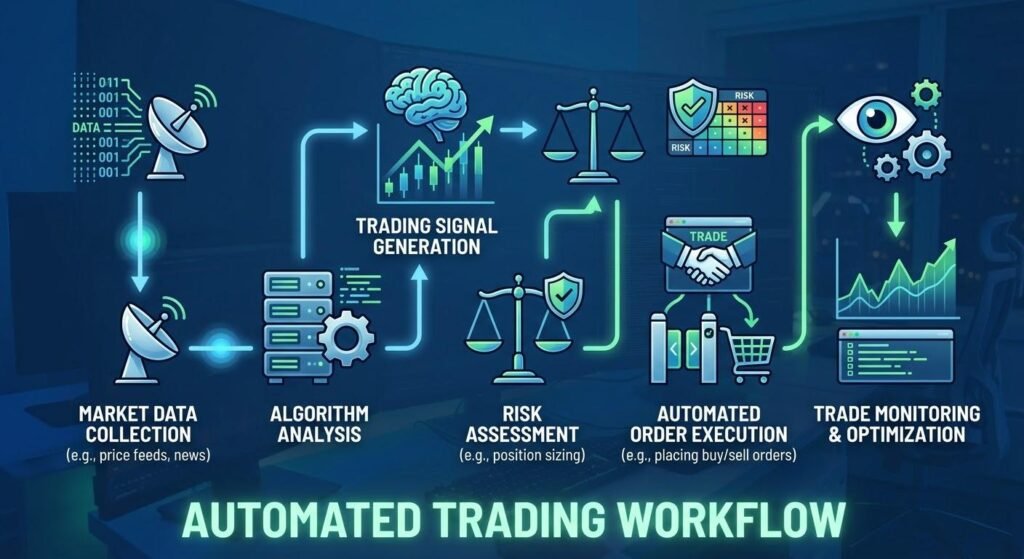
The basic steps of an algorithmic trading process typically involve data collection. Data and information that is fed into the system include current prices, bid and ask quotations, volume of trades, and historical records. Then it analyzes this one according to certain rules or statistical models in order to decide if there is a trading signal. Position limits, available funds, and order size restrictions, among other checks, are used to perform risk checks in the next stage of the process. If the proposed trade meets these conditions, the algorithm creates an order and sends it via a brokerage application programming interface (API) or exchange connection. The broker/trading venue executes the order based on the trading rules, available liquidity and matching processes of the broker/trading venue. Then, the system gets execution reports, updates its records and modifies its position information. It can be a very fast sequence, but not necessarily a good one regarding the execution price and/or success of a trade.
Common Strategies are used in Algorithmic Trading.
1. Trend Following
Trend following algorithms make an effort to determine if the price of an asset is trending up or downward. They might employ moving averages, momentum indicators or price breakouts to help them decide the direction of a potential trend. For example, one strategy could be an MA that is short term moving up and crossing over a long term MA, with one more qualification. A downward signal could result in a selling or a reduction in an existing position. These systems are created to be involved in extended price movements instead of forecast every brief change in price. When prices go up, down, or sideways, however, they can be having trouble and give false signals, resulting in repeated signals and losses and transaction costs. Developers should then try this trend following rules on various market conditions and set up exit criteria, trading levels and stop loss strategies as needed. Past success does not guarantee future success or that a trend will repeat itself or that a strategy will work in the same way.
2. Arbitrage Trading
Arbitrage algorithms are looking for arbitrage opportunities between similar assets, markets or exchange venues. A system can try and purchase an asset at a lower price and sell it at a higher price, if the same asset is temporarily offered at different prices. Other techniques involve consideration of other securities or other futures contracts whose futures price is likely to have a specific relationship. One of the best uses of any computer program is for these strategies where price differences can vanish in a matter of seconds as other participants react. But while there may be apparent possibilities, they can be too small to cover the costs of moving or financing a position, exchange costs, taxes, and broker fees. Whenever a trade is being made, this may occur before either side of the trade happens, or the trader would be subject to the market risk that they didn’t want. Thus, the ability to accurately price, connect, calculate costs and control are essential to arbitrage success. Not all price disparities are good and when execution is delayed, a gain can become a loss.
3. Market-Making Algorithms
Market making algorithms offer the potential to generate quotes for buying and selling financial instruments, with the goal being to make it easier for trades to take place and possibly to make a profit from the price difference between the bid and ask. A market maker can offer a price to purchase an asset, and a percentage higher to sell an asset. If both sides play under the proper conditions, the gap can have an impact on revenue. As the market prices and trading volume change, as well as when there is more or less stock available on the market and when there is a higher or lower chance of a bad price movement, algorithms will constantly adjust quotations. This can help to keep the market liquid, especially during periods of high trading volume. But when the price of an asset turns against a market maker’s guess or he/she ends up with a large quantity of an asset during a bad market, then he/she could be in trouble. They also need to factor in the competition and transaction costs, as well as any dramatic shifts in supply and demand. Market making is thus a specialized function that calls for discipline in inventory control, and constant surveillance.
4. Volume-Based Execution
Volume based execution strategies are designed to execute trades based on volume, rather than executing the entire trade at once. These algorithms are especially helpful when investors must make large-scale transactions without causing any significant price fluctuations. The volume weighted average price (VWAP) strategy is one that tries to buy and sell at prices more favorable than the average price weighted by trading volume during a given time frame. Some strategies might make trades in varying sizes based on the percentage of trading volume that can be expected or seen throughout the trading session. The spread-out nature of the transactions can lessen the visibility and market impact of a large transaction. But quality of execution relies on the liquidity, volatility of the market, and the volume estimation’s accuracy. The algorithm might change its schedule and/or execution price if trading activity does not match the expectations. These techniques focus on execution efficiency, rather than assured investment returns.
The Technology behind Algorithmic Trading
Historical Data and Market Indicators
Historical data is useful for the developers to know how a trading strategy would have worked in past market conditions. Quotes, volume, bid/ask quotations, corporate actions and economic information are examples of what records may contain. This information is used by traders to test algorithms, find weaknesses in an algorithm, estimate transaction costs, and compare other algorithm rules. A program can translate raw data into signals using a number of different technical indicators such as moving averages, readings on the relative strength index, and measures of volatility. But when it comes to historical testing, there needs to be a realistic estimation of the costs of implementation and limitations of data. Look-ahead bias is a situation that can arise in a strategy, where the information used is not available during the actual trading. Another worry, overfitting, is that developers can fine-tune a model to fit past observations and end up with a model that fails to perform well on new data. These weaknesses can be minimized, if not eliminated, through testing at various times and through performance monitoring following the deployment.
Programming Languages and Trading Infrastructure.
Programming languages like Python, C++, Java, etc., are used to create algorithmic trading systems, depending on their technical needs. For data analysis, strategy development and testing, Python is often used while languages and architectures with the goal of minimizing processing delay can be used for performance-critical systems. Other elements of trading infrastructure comprise market data feeds, servers, network connections, broker APIs, order-management software and monitoring tools. Others high frequency trading companies desire to have their servers placed near to the exchange infrastructure, by using colocation providers, which can help minimize communication delays. This is called “low latency trading infrastructure” and it can be relevant if there are slight differences in timing that can impact the execution. But it is the more advanced gear that can be costly, and it is a bad strategy that will not be lucrative. Reliable systems also have to be able to manage network interruptions, orders that are out of order, duplicate messages, out-of-date prices, and unexpected software failures. A secure trading environment is critical and must include security controls, access limitations, backups, and comprehensive transaction logs.
Benefits of Algorithmic Trading
An advantage of algorithmic trading is that it speeds up the process. A computer can analyze a vast amount of information in the market and place orders quicker than a person placing orders manually. Consistency is also achieved by automation; when the automation system is designed properly, it acts according to pre-programmed rules and it is not distracted by fear, excitement or fatigue. They can be used across different assets and different markets, and provide the trader with the ability to watch more opportunities to trade than he or she could do on his or her own. They can also be used to split large orders into smaller ones, set risk limits and make notes for subsequent analysis. In institutional context, automated execution can mitigate some of the inefficiencies of operation and facilitate the quantification of the execution quality with respect to the benchmarks. However, with the advantages come challenges of good design, correct data, reliable infrastructure and effective supervision. Algorithms can also do the wrong thing over and over again and overtrading can add to costs. When deciding to use automation, it should be considered as a way to process a trading process, not as a way to eliminate common sense from trading.
Risks and Challenges in Automated Trading.
Programming Errors and Unintended Behavior
An algorithm might send wrong prices, calculate inaccurate quantities of orders, or place the same order over and over again if a condition is not handled correctly, due to a programming error. If a rule has a tiny little error in it, then it can cost you a lot of money when the system is performing transactions quickly and not having to review that at the moment. Software components can also interact in unexpected ways, creating results which the developers didn’t expect. These risks are mitigated through code reviews, test trading, automated testing, order limits and emergency shutdown protocols. Any strategy must be applied to pre-game scenarios (including orders being rejected, data being delayed and connection being severed) before being used with real funds. Any monitoring tool should then raise the alarm for operators if any activity is out of tune. Despite these protection measures, none of the testing processes can foresee all market events. However, human intervention is still required to detect abnormal activity, delve into failures and stop a system from operating when actions are deemed unsafe.
Market Volatility and Systemic Risk
Algorithmic strategies may not work as effectively when there are sudden price movements, as past relationships could shift and liquidity may be lost. With volatile markets, multiple algorithms can act on the same signals and drive up the activity and activity noise of the short term market. If the risk controls don’t respond to the risk in a suitable manner, poorly designed systems can lead to quick sell or quick buy. One worry is that cascading effects could occur when there are market linkages and the automated strategies interact. The risks are addressed by exchanges and regulators in a variety of ways, including the implementation of trading halts, price limits, order controls and surveillance systems, with some markets being more protected than others. Individual traders are also advised to set up their own position sizes, loss limits and how to halt automatic trading. What works well in normal market conditions can fall short in a crisis scenario, so it is crucial to conduct stress testing and risk assessments as part of algorithmic trading.
The Future of Algorithmic Trading
The use of algorithms in trading is likely to continue to evolve as technology advances, with the introduction of new tools and strategies. As technology continues to evolve, algorithmic trading is expected to continue to grow and develop, with new tools and strategies being introduced. The application of machine learning models may not be able to adequately capture intricate patterns, predict execution prices, and adapt to changing market conditions. However, such models can be difficult to comprehend and can be erratic if they encounter information they have not been exposed to. While cloud services can enhance access to computing services, there are a number of factors to keep in mind, such as latency, cybersecurity, service interruptions, and regulatory requirements. Automated trading practices, integrity and operational resiliency of markets will be closely supervised by regulators and exchanges in the meanwhile. In the Future, it’s not all about speed! As trading systems increasingly evolve, transparent controls, strong testing, accurate data and transparent accountability will continue to be critical. New tools should be viewed individually, rather than as the new being better than the old and assessed in terms of the potential benefits that they can provide and the harm that they may cause.
Conclusion
Algorithmic trading has revolutionized the financial world by allowing computer algorithms to process data, find trading opportunities, and make trades based on pre-established criteria. Different strategies can be used trend following, arbitrage, market making, volume based executions, etc. Their performance is based on historical data, good programming, appropriate infrastructure, realistic tests and continuous risk management. Although there are advantages with the automation of trading, particularly the speed, reliability and speediness of operations, there are also risks, including software errors, volatility, liquidity, and unintended trading behaviors. It has to be noted that algorithmic trading is not an infallible means to making profits. Its best use is when coupled with a well-defined and disciplined strategy design, a focused supervision and with the conviction that markets are not devoid of uncertainty.
Get more well researched information about Algorithmic Trading here.