Introduction
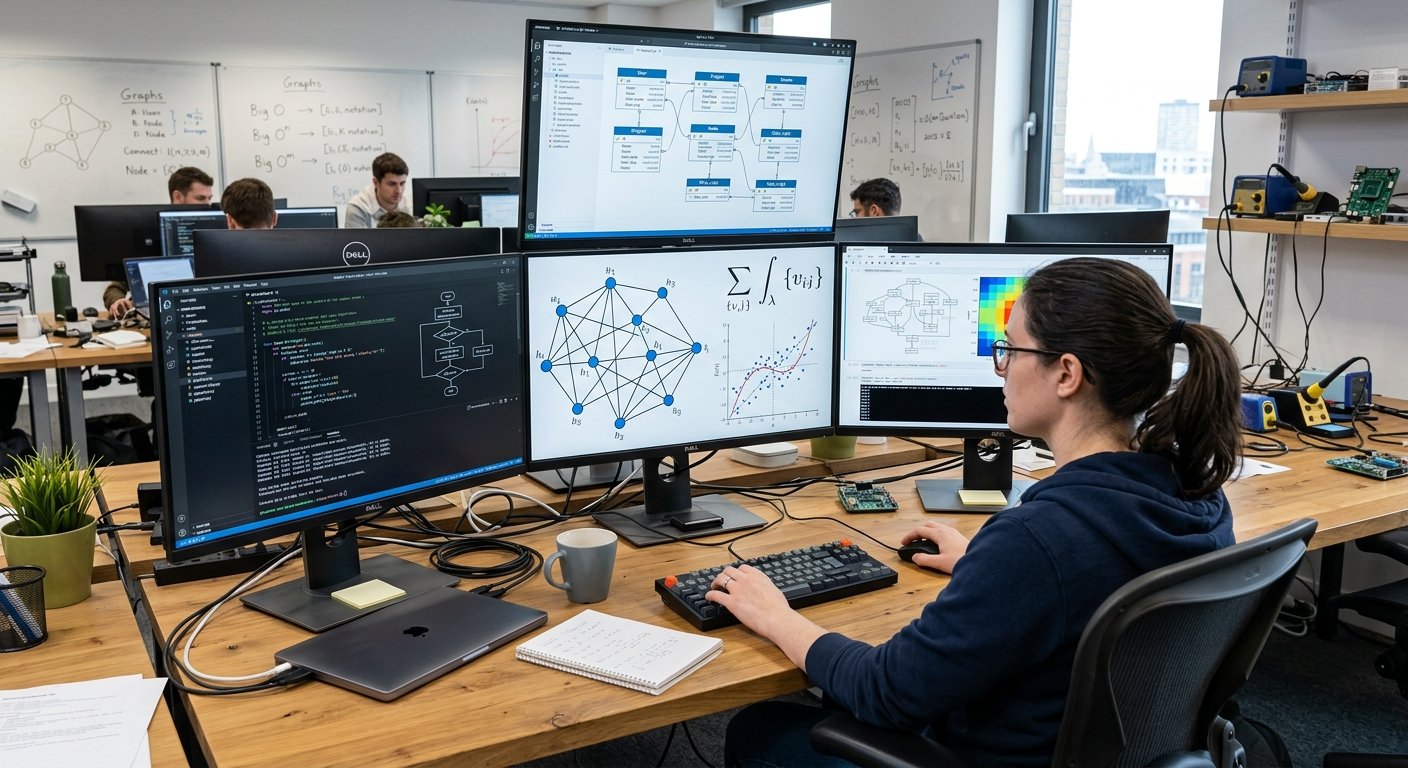
While programming languages, software applications, artificial intelligence, websites, mobile applications, and super-charged computer hardware are often the focus of computer science, the work is underpinned by a mathematical foundation which enables the computer to represent information, follow instructions, solve problems and make reliable decisions. One of the most significant components of this foundation in discrete mathematics, which deals with discrete and countable entities, is not continuously varying. Computer scientists use concepts like sets, logic, relations, functions, combinatorics, graph theory, Boolean algebra, recurrence relations and probability to precisely describe data and design solutions to problems.
The following concepts may be used by a programmer without the need to use mathematical notation, but they are there in databases, algorithms, programming structures, computer networks, cybersecurity systems, and software design. Discrete mathematics is then not only a source of mathematical knowledge for the beginner but also develops his/her structured thinking, which is essential to understanding the operation and effectiveness of certain computer solutions.
What is Discrete Mathematics?
Discrete mathematics is the study of mathematics that focuses on objects which can be counted, separated, and identified individually. Whereas calculus is often concerned with continuous change, discrete mathematics is concerned with structures like integers, finite sets, logical statements, graphs, combinations, sequences, and networks. This aspect is very useful in computer science where the digital computer works with discrete units of information. Data is represented in a computer by individual bits, instructions are carried out by programs, identifiable records of information are stored in a database, and networks are made up of individual devices communicating via some means.
The structures can be accurately described in a language of discrete mathematics, and their behavior can be reasoned about. It also introduces techniques for verifying the correctness of a solution and for measuring the efficiency of an algorithm and for discovering connections between various pieces of information. Discrete mathematics for beginners is learning to solve computer problems in a systematic manner, rather than by trial and error and intuition.
Sets and its Role in Computer Science
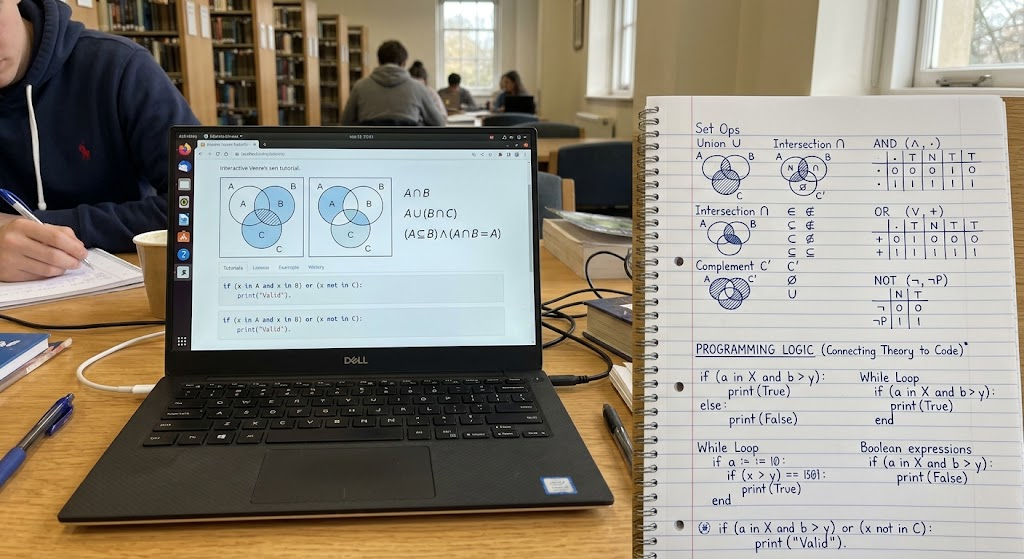
A set is a collection of objects that have been grouped together as a set and set theory is one of the simplest methods of structuring mathematical information. Numbers, words, objects, database records, users, programming variables or anything else that can be identified are elements of a set. For instance, a computer science student could decide their programming languages were the set {Python, Java, C++, JavaScript}. Union, intersection, difference and complement are important operations performed on sets, used to describe the relationship between sets of information.
These operations can also be directly used in databases when a query can require to join records from multiple groups or to find records where multiple conditions are satisfied. Concepts of set also come into use in programming, for example, in the use of lists, dictionaries, and sets, and in the way operating systems and data management systems manage resources. Students learn sets through sets, and begin to sense first, how computers organize, store, compare, and classify sets of information.
Logical Reasoning and Computation.
Logic is important to computer science because computers have to make decisions based on well established rules. Mathematical logic provides ways to construct and evaluate statements that can be either true or false. Logical operators like AND, OR, and NOT can be used together and combined. In programming, these properties are used in conditional statements like if, else if and else, which cause the program to execute different code depending on whether the specified conditions are met or not. Programming is also important because the programmer has to design algorithms which make correct decisions at each step of execution.
In addition to programming, logical reasoning is used in formal verification, artificial intelligence, database queries and cyber-security. For instance, a security system can allow access to a space if multiple conditions are met, and a database query can return a set of records that satisfy a series of conditions. The study of logic is thus to provide the beginning student with an understanding of how computational systems evaluate information and make decisions based on precise rules.
Relations and Functions
Relations are associations between elements, while functions are a relation in which each element in the domain corresponds to exactly one element in the range. These ideas are particularly relevant as computer systems process relationships between information all the time. For instance, a customer might be related to an order, a student to a course, or an employee to a department in a database. The principles of mathematical relations are similar to those employed in designing databases, both in terms of organizing tables and creating relationships between records.
The importance of functions in programming cannot be underestimated since many programs can be considered processes that take input, do operations, and generate output. A function may accept information from a user, perform some calculation, and return the result to another section of the program. Mathematical functions can aid students in their ability to identify the rules, inputs, and outputs in a function. The following are other applications of these ideas that are important for designing algorithms, data transformation, software testing and mathematical modeling in computer applications.
Combinatorics and Counting Problems.
Combinatorics is the branch of mathematics that investigates the counting of arrangements, selections and possible configurations. While counting can seem straightforward at first, computer science often comes up with scenarios where there are lots of options. There are mathematical tools called combinatorics that can be used to compute the number of possibilities without enumerating them all. For instance, if a system has to deal with various configurations of data, routes through a network, or combinations of selected items, then combinations formulas can be used to estimate the size of the problem. In the context of cyber security, the number of potential user credentials or security settings that an adversary might be able to figure out is an important consideration in security systems.
Combinatorics is also useful in algorithm analysis, scheduling, optimization, artificial intelligence and probability. The concepts of permutations and combinations enable the programmer to see that certain problems take longer and longer to run as the size of the input grows. It also helps students to think about the fact that there may be multiple solutions, and that finding one solution is only a small part of the space of all solutions.
Graph Theory and Networks
Graph theory deals with structures made up of the vertices, or nodes, and the edges that link the vertices together. Graphs are often used in computing to model systems that have relationships and connections, either visually or structurally. Computers (or network devices) in a computer network can be modeled as nodes of a graph, with communication links between computers as edges of the graph. Likewise, a social network could be modeled as a graph of users (nodes) and links between users (edges). Graphs can also be used to model maps, transportation systems, website links, recommendations and dependency structures in software.
Graph theory is heavily used in algorithms to find efficient routes or to explore connected structures, such as shortest-path algorithms and traversal algorithms. Graph-based reasoning is used in search engines, navigation systems and network-management software. Students in computer science gain an important skill by understanding how to use graph theory, which allows them to think about how systems are connected together; by designing algorithms that can easily navigate relationships between many separate elements.

Boolean Algebra and Digital Computers.
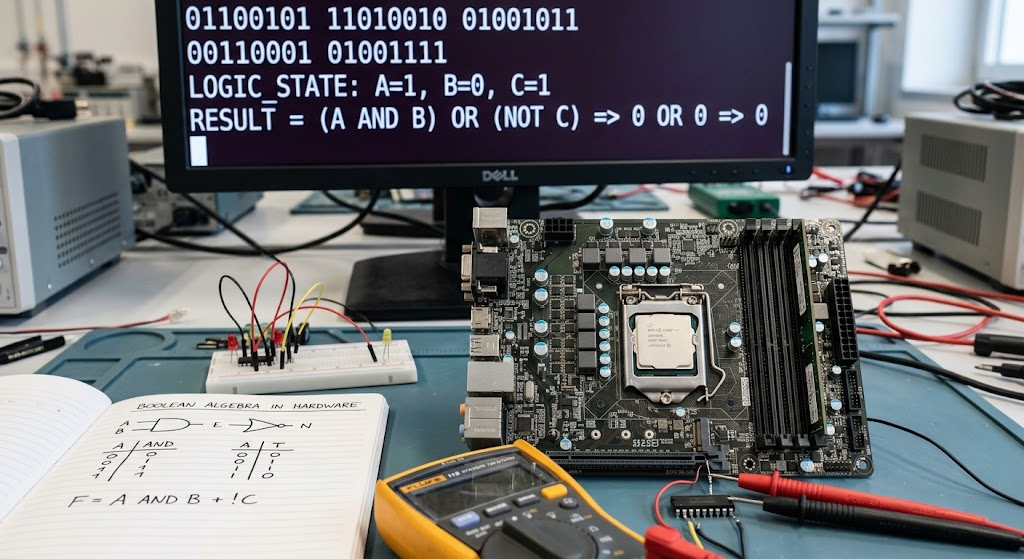
Boolean algebra is a mathematical expression in which each variable can take on the value of either True or False, or on and off, 1 or 0. It is the basis of computer systems since digital electronics work by the binary state. Boolean operations, including AND, OR, and NOT, can be used in combination to make logical expressions, which can control the behavior of digital circuits. Boolean expressions are used in conditions, search, validation rules and decision making structures at the software level. Logical gates are used to create circuits at the hardware level, which are used in processors, memory devices, and other devices with digital components.
Boolean algebra provides a bridge between mathematical logic, programming and the workings of computer hardware. For instance, if he’s creating a condition that must include two conditions, he’s using the same basic logical logic as the AND operation. The importance of boolean algebra is thus that it is a link between abstract mathematical thought and the physical working of a digital computer.
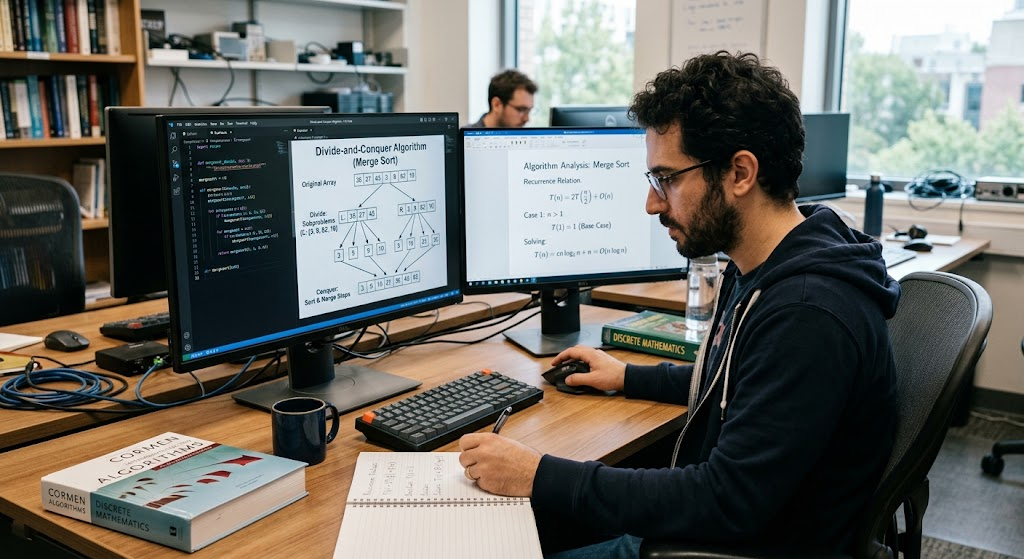
Recurrence relations are used to describe a sequence or process by using a term to relate it to one or more of the previous terms. They are very handy in computer science as a lot of algorithms break down a problem repeatedly into smaller ones. A recurrence relation can be used to specify how much work is required to perform the computation as the size of the input increases or decreases. This is especially important when analyzing recursive algorithms and determining their efficiency.
For instance, divide and conquer algorithms will typically break a large task into smaller sub-tasks, solve them, and then merge the solutions. Computer scientists can use recurrence relations to make estimates on the amount of work needed at each level of this process. Making sense of these relationships will guide programmers to compare algorithms and find solutions that will be useful as data sets increase in size. Recurrence relations can thus be related to actual problems concerning algorithm scalability, recursion, computational complexity, and program performance.
Discrete Probability and Computer Science
Probability is relevant in any computer system that needs to reason on uncertainty, possible outcomes or unpredictable events. Discrete probability is similar to continuous, but rather than dealing with continuous outcomes, it deals with those that can be counted individually, especially relevant to many computational problems where the possibilities are finite or countable. The idea may be introduced at the beginning with situations like calculating a probability of a specific item occurring from a set of a finite number of items, etc. The same logic is extended in computing, where probability can be used for randomized algorithms, artificial intelligence, network analysis, simulations, and cybersecurity.
The concept of probability is also useful to computer scientists in order to gauge risks and make decisions under uncertainty. Discrete probability is a helpful introduction to the concept of discrete probability and the discrete distributions. Students become familiar with the way probabilities are assigned to outcomes, and end up with a mathematical structure that allows them to represent uncertainty rather than assume that it represents ignorance.
Programming and Algorithms Applications
Discrete mathematics directly affects programming because software is a collection of precise operations carried out, following rules. Data is stored in sets, logic is used to make decisions based on conditionals, operations are easily re-used in functions, and Boolean algebra is used to perform binary decisions. Graphs can model relationships between things, and combinatorics can help the developers determine the number of possible inputs and/or configurations an application might be presented with. Recurrence relations and other mathematical methods help to analyze recursive algorithms and computational complexity.
They are especially significant when programmers are no longer just writing simple programs and start to develop efficient solutions to large problems. A program that correctly answers the question but uses an unreasonable amount of time or memory may not be of much use in practice. Discrete mathematics enables programmers to reason about correctness, efficiency, structure, and scalability, and help them design software based on principles, rather than constantly trying something until it seems to work.
Applications in Databases
Mathematical concepts play a crucial role in databases as these are used to store, organize, retrieve and accurately connect large amounts of information. In relational databases, information is structured under the relational model in tables of records and attributes, with which relationships are created. Database queries can be combined or filtered using set operations, and individual records can be selected according to their value using logic. Functions and mappings can also be used to describe transformations between data structures and values.
Think of a University with students, courses, lecturers, departments and registrations, and relationships between them; all as structured collections in a database. The information in these interrelated collections is then selectively accessed with queries by database management systems. By learning about the discrete mathematical concepts such operations embody, students gain insight into why certain databases are structured in a certain manner, and how query systems can hold large numbers of records in a consistent, accurate, and meaningful relationship.
Applications in Cybersecurity
Cybersecurity depends on mathematical reasoning because digital systems must protect information while operating in environments where unauthorized access, errors, and unexpected behavior are possible. Discrete mathematics contributes to security through logic, combinatorics, probability, graph theory, and related areas. Combinatorial reasoning helps security professionals understand the enormous number of possible configurations or credentials that may need to be considered when evaluating security strength. Probability can help analysts reason about risks and uncertain events, while graph theory can model relationships between devices, accounts, systems, and potential attack paths.
Boolean logic is also important in access-control rules, authentication systems, and security policies because systems frequently need to determine whether several conditions are satisfied before granting access. Although cybersecurity involves many specialized technologies and mathematical fields, a strong foundation in discrete mathematics helps students develop the structured reasoning necessary to analyze threats, evaluate security rules, and understand why carefully designed systems are more resistant to unexpected or unauthorized behavior.
Applications in Software Engineering
Software engineering involves much more than writing code because developers must design systems that are reliable, maintainable, testable, and capable of handling changing requirements. Discrete mathematics supports this process by providing precise methods for describing relationships, conditions, structures, and computational processes. Logic can help developers specify requirements and evaluate whether a system behaves as expected. Sets and relations can support the modeling of data and system components, while functions provide a useful way to describe transformations and interfaces.
Graphs can represent dependencies among software modules, workflows, and states within an application. Mathematical reasoning is also valuable during software testing because developers need to consider different input conditions and possible system behaviors. By applying discrete mathematical thinking, software engineers can reduce ambiguity and reason more systematically about complex applications. The result is not simply code that works in one situation, but software designed with clearer structures and more predictable behavior.
Discrete Mathematics in Computer Systems
Computer systems combine hardware and software components that must operate together according to precise rules. Discrete mathematics helps explain many of these operations, from binary representation and digital logic to memory organization, instruction processing, communication networks, and system dependencies. Boolean algebra explains how digital circuits process binary values, while graph theory can represent connections among hardware components and network devices. Logic helps define conditions under which system operations occur, and functions provide ways of understanding how inputs are transformed into outputs.
Probability can also be useful when computer systems must account for uncertain events or evaluate reliability. These mathematical ideas may operate beneath the visible interface of a computer, but they influence how processors execute instructions, how networks communicate, and how software interacts with hardware. Learning discrete mathematics therefore allows computer science students to look beyond the surface of applications and understand the underlying structures that make digital systems possible.

Why Discrete Mathematics Matters for Computer Science Students
Studying discrete mathematics is important because computer science is fundamentally concerned with structures, information, relationships, decisions, and processes that can often be described using discrete models. A student who understands these concepts can approach programming and algorithmic problems with stronger analytical skills. Instead of memorizing programming techniques without understanding their purpose, students can recognize the mathematical principles behind data structures, algorithms, database queries, digital circuits, and security systems. Discrete mathematics also develops precision because mathematical definitions require concepts to be stated clearly and reasoning to follow logically.
This skill transfers directly to programming, where small ambiguities can produce incorrect results. Furthermore, the subject teaches students to break complex problems into manageable components, identify relationships, count possible outcomes, and evaluate whether a proposed solution is correct or efficient. These abilities remain valuable across almost every major area of computer science, making discrete mathematics an essential part of a strong computing education.
Conclusion
Discrete mathematics provides one of the clearest mathematical foundations for understanding computer science because it focuses on structures and processes that closely resemble the way digital systems operate. Sets help organize collections of information, logic supports computational decisions, relations describe connections, and functions explain transformations between inputs and outputs. Combinatorics helps computer scientists count possibilities, graph theory models networks and relationships, and Boolean algebra explains both programming conditions and digital circuits.
Recurrence relations support the analysis of recursive algorithms, while discrete probability provides tools for reasoning about uncertain outcomes. These concepts are not isolated mathematical topics; they appear throughout programming, algorithms, databases, cybersecurity, software engineering, computer networks, and hardware design. For beginners, mastering discrete mathematics can therefore make computer science easier to understand because it reveals the principles behind many technologies that otherwise seem unrelated. Rather than being mathematics studied separately from computing, discrete mathematics is a practical language for describing, analyzing, and improving the systems that make modern computing possible.