Introduction
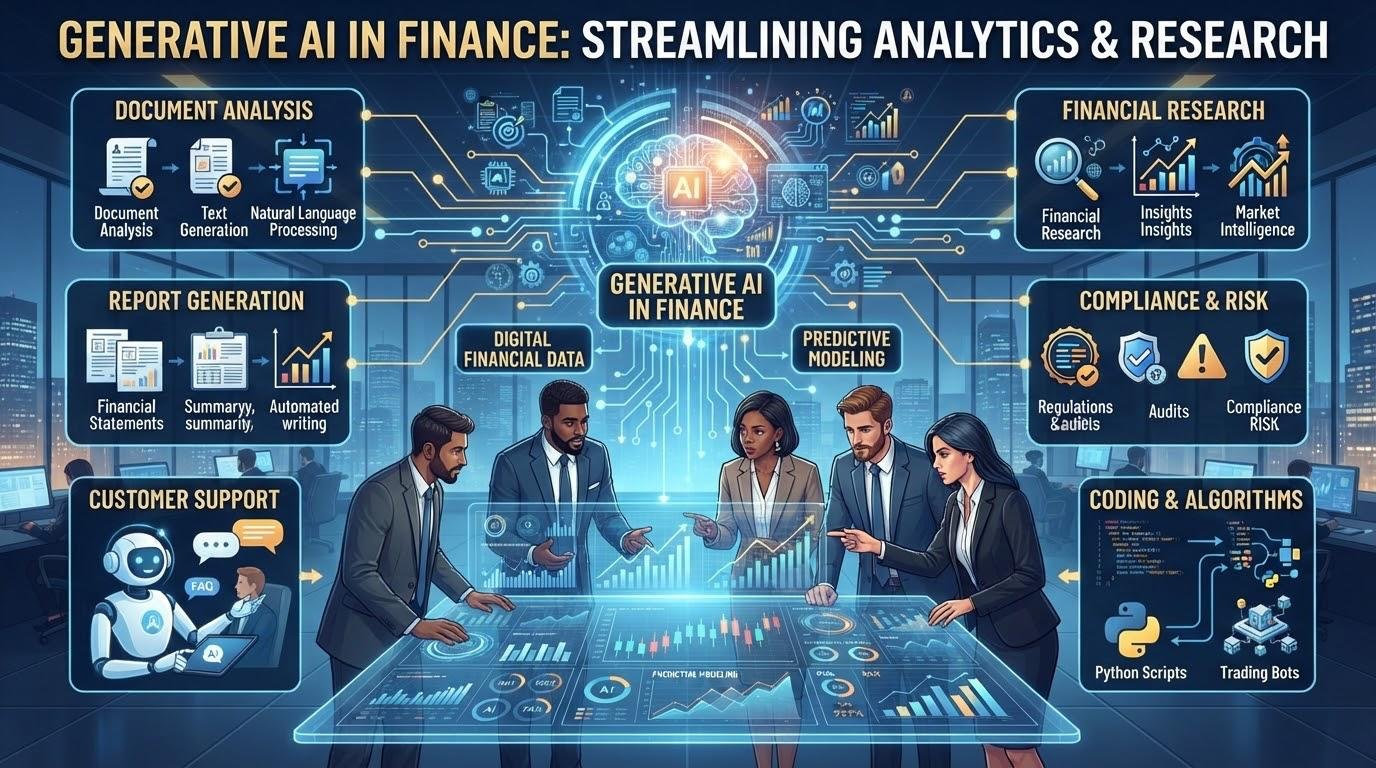
With the ability to create new messages, summaries, explanations, code, reports and more from a vast amount of information, generative AI is proving to be a valuable resource in the financial industry. Unlike the more linear interaction that has been typical to financial technologies that were created to perform a particular action, Generative AI agents can interact and converse with information more flexibly. Some financial institutions, such as banks, insurers, asset managers, fintechs and others are considering such features for their employees and customers. It’s part of a broader initiative to integrate traditional financial AI systems and new generative models that are used by financial institutions. Understanding that large language models are not just another type of financial AI models, which are typically used for specific analysis, prediction, classification or decision support.
Financial institutions have a ton of documents, communications, research, policies, transactions and regulatory information to handle – it’s a very attractive fit for Generative AI. The large language models can be fed with natural language input and produce natural language output that is more easily interpretable than data or technical reports. For instance, a financial analyst might request a system to extract this long report of earnings, and then summarize the report and compare two or more reports, or organize a series of information to present as a briefing. It can be used by a team of customer service representatives, to write responses, or by an internal technology team to create and/or document software code. But, if you do your best to make convincing material does not mean you make right content. The financial institutions should then take a step back and consider generative AI as an assistive technology and enforce controls, validation, security and human supervision over that technology.
Generative AI vs. Traditional Financial AI
Typical financial AI systems are built with predefined goals and targets. The machine learning model could predict the credit risk, identify fraudulent transactions, categorize customers, predict customer demand, etc. These are often very effective as the inputs and outputs of the system are typically known and the boundaries and criteria for evaluating it are also known. The way generative AI operates is different. LLMs are designed to identify patterns in language and respond to a prompt and the information that is given to them. They are able to carry out some of the language-related activities without having to create a model for each of the small activities. They are helpful in meeting the flexibility of cross-departmental needs, but can create further questions as the information and answers generated may sound authoritative and correct when it is not, or is incomplete, or mistaken, or simply incorrect.
Document Analysis & Financial Research
One of the most obvious uses of generative AI in the finance industry is document analysis. Annual Reports, Contracts, Loan documents, Policy manuals, Research reports, Regulatory notices, Meeting records and customer communication are processed by financial institutions. Staffs are spending a considerable amount of time finding information, making comparisons and summarizing. Generative AI can help with summarizing for human review, identifying differences between versions, providing information organization, and extracting key points. A model can be used for financial research to structure public filings, earnings announcements, industry reports or any other agreed upon sources into a briefing. The technology can thus minimize manual reading time needed for basic information processing tasks and focus more time on analyzing the evidence and making own judgments.
Care needs to be taken in designing the document analysis though, as the model could miss out on the context in the document, important details, or have a wrong summary of the information in the document. Technical language, numerical tables, legal qualifications, footnotes and conditions may frequently be found in financial documents and are not suitable to be reduced to a straightforward paragraph without careful examination of the original document. The summary of a contract might fail to capture an exception that is material to the meaning of the contract, and a research assistant might mix up historical information with current information. Therefore, a summary made should be interpreted as a working document and not as a document that is authoritative. When important conclusions may impact any investment decision, lending decision, contractual commitments or regulatory reporting, they should be tested against the underlying documents.
Customer Support and Financial Communication
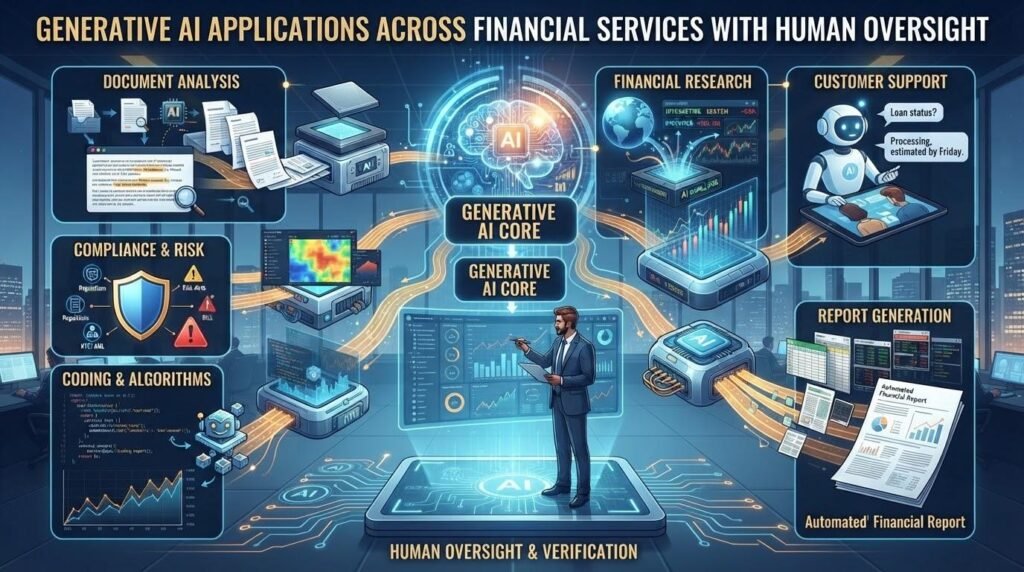
Another space where generative AI could be very helpful for customer support is in identifying areas for improvement. Strong volume of inquiries relating to account features, transaction processes, cards, payment, applications, fees, documentation and financial services in general are received by financial institutions. AI can assist customers with finding information, explaining how to perform the procedure and routing complex cases to human resources. The same technology can work on the inside to gain quicker access to relevant policies and compose responses. Generative AI can also customize explanations according to the familiarity of the audiences; this can help make financial communication more accessible, but also without having to start writing each answer from scratch. But for financial communication, there are definite safeguards that must be in place as misstatements can have serious consequences. A generated answer should NOT create the fees, account rules, qualifications, returns on investment, or regulations. Organizations should have specific escalation procedures that ensure issues of complex investments, suspected fraud, a complaint, and legally sensitive issues are brought to the attention of trained personnel. Using approved information sources, monitoring and regular testing can help minimize the potential for misleading customer responses.
Generate reports, Share knowledge and code.
AI can also enhance in-house processes that are dependent on text. Finance teams create management reports, meeting summaries, operational updates, risk briefings, presentations, and more that demand information is gathered and presented in a particular manner. A language model can perform the preliminary work of generating a first draft based on approved data and instructions, which lets employees concentrate on checking out figures, interpreting results and enriching with appropriate context. An intriguing other application is internal knowledge management. Staff would no longer have to trawl through many policy documents or documents that have been stored up in the archives in order to find answers to queries in natural language; they would simply be able to ask the question and get an answer based on authorized, internal information.
Generative AI is also having an impact on software development. Financial institutions have huge technology environments with applications, APIs, databases, testing systems and legacy code. The AI coding assistants will provide developers with assistance in generating repetitive code, understanding unfamiliar functions, writing test cases, identifying potential errors or documenting software. These features can help developers be more efficient, but the generated code will still need to be reviewed and tested for security. A model can replicate insecure patterns, misunderstand business rules, have defects or produce code that is incompatible with an organization’s architecture. This also holds true for creating automated reports and internal knowledge resources – the quicker they get created, the more valuable they are as long as the information they present and the information itself is accurate, secure, and suitable for the intended purpose.
Compliance Assistance & Risk Management
Generative AI can aid compliance teams in activities like policy review, regulatory organization, cross-checking of processes with regulatory, draft documentation, and summarizing changes to be communicated to staff. The technology can also be used to more rapidly find rules and internal guidance in large collections of rules. In this context, generative AI can be considered a tool to assist with compliance, not a compliance enforcer. Regulations can be complex, jurisdiction-specific and might change, and a language model might generate a valid interpretation that is not accurate to the applicable regulation. The human expert is thus still needed to interpret obligations, approve decisions, document judgments and make decisions on the application of the obligations to specific situations.
The danger can be particularly great when generated information is employed in the high impact monetary processes. Hallucinations are when a model is able to generate information that is credible, but has no supporting information or is incorrect. A false regulation, financial number, a detail of a transaction, a fact about a company or an investment statement, in the financial field can have serious consequences. One worry is the wrong or out-of-date economic details. A general purpose model may not be the most up-to-date model with market data, proprietary data, or the latest regulations. These risks can be mitigated by institutions retrieving information from reputable sources, implementing access controls, testing the model, validating outputs, setting up audit trails, and having well-defined approval processes. Numbers that are outputted should also be double checked, not just taken as they’re presented as being professionally written. These controls are not only crucial when an answer generated is applied outside the organization, but also when it is incorporated into a formal business process.
Confidential Data, Cybersecurity and Intellectual Property Risks
Financial organizations face a significant challenge when it comes to the deployment of generative AI, with confidentiality being one of the key factors to consider. The financial institutions contain personal data of customers, transaction records, business plans, authentication data, proprietary research, etc. Failure to adequately safeguard the information you send to an AI system could lead to privacy, security, or contractual issues. To prevent ambiguity, the organizations should establish guidelines on what information employees are allowed to feed into the AI systems, where the information is processed, how it will be stored, and who will be able to see the information that is generated by the AI. Technical protections can cover encryption, identity and access management, data-loss prevention (DLP) controls, monitoring, secure integration techniques and secure environments for sensitive workloads. Access to these technologies should also be restricted by role so that the AI assistant does not access or display information that would not be otherwise authorized for it to be accessed securely by the employee.
Data protection is not the only type of cyber risk. The attacker could try to exploit the prompt to get the information they want, exploit the weakness in the system that uses the language model, misuse AI-enabled apps, or exploit weak links in the system. Financial institutions have to take security of the model and its application into account. Intellectual property questions are also important as AI-generated content can be seen as giving rise to IP concerns including the ownership of the content, any planned licensing on the source material used, confidentiality issues and the use of protected content in the generation of training or outputs. These concerns are dependent on the technology, contract and jurisdiction and use case and therefore organizations should have legal and governance processes, not simply taking it for granted that AI-generated content is free of restrictions.
Regulatory Concerns and Need for Human Verification
Another essential component to the responsible use of generative AI is the regulatory expectations. Financial institutions work and communicate in a world with consumer protection, privacy, record keeping, risk management, cyber security, discrimination, transparency and accountability requirements. These responsibilities remain the same when using generative AI. Institutions should grasp the purpose of using AI, how it is being utilized in the process, what information is feeding into its outputs, and who is responsible for the output. Governance programs can contain approved use cases, model and system inventories, risk assessments, employee training, documentation standards, testing procedures, incident reporting and controls for human approval.
It is particularly critical to have human verification when an AI-generated output might impact a customer, financial decision, regulatory submission or material business action. Not all AI responses require manual rewriting – verification can be done in different ways. Rather, the level of review may be commensurate with the impact of the task. Certain drafts, such as low-risk, may only need a basic check, whereas other drafts like investment research, compliance interpretation, customer decision making or sensitive communications may need to be reviewed by professionals. This is because fluent language does not equal accuracy – this will not be the case with generative AI, as it is designed to boost productivity. The key is that the responsibility for the content lies with the institution and its authorized users and not with the model that created the content.
Conclusion
Financial institutions can expand the scope of tasks they can assist with using Artificial Intelligence with Generative AI. It’s also great for document analysis, financial research, customer support, generating reports, internal knowledge management, coding, compliance and financial communication, thanks to its natural language understanding and generation capabilities. It has at the same time captured the advantage of being flexible, which has its own risks compared to analytical systems which are very tightly designed. Without checks, AI-generated content can be a real issue with regard to hallucinations, misinformation, sharing of confidential data, cybersecurity concerns, intellectual property matters, and regulatory concerns. The best way to do this is to integrate generative AI with trusted data sources, security precautions, governance structures, specialized financial systems, and human verification. In this context, generative AI can be a productivity information-support tool and financial institutions stay in control of decisions and communications that are relevant.
Get more well researched information about Generative AI in finance here.