Introduction
Maize is one of the most profitable crop sector activities to be undertaken, both by smallholder and large-scale farmers, particularly in maize-farming areas where maize serves as a major food item as well as animal feed. A successful maize enterprise requires a thorough consideration of the entire maize production process including a series of well coordinated activities from preparation of the land through to harvest of the crop and post harvest handling of the crop. Farmers employing structured production systems have increased chances of higher production and lower production cost while becoming more competitive in the market. Maize is prone to poor agronomic practices, and errors made at any stage can result in a drop in yield potential, for example poor planting depth and/or poor fertilizer application.
It offers a valuable resource to farmers who want a step-by-step approach to better maize production, as well as an explanation of each stage of maize production, including scientifically proven practices that boost productivity and profitability. Once farmers are familiar with these necessary steps, they can build up a sustainable and profitable agribusiness that will be productive and reliable in different seasons and weather.
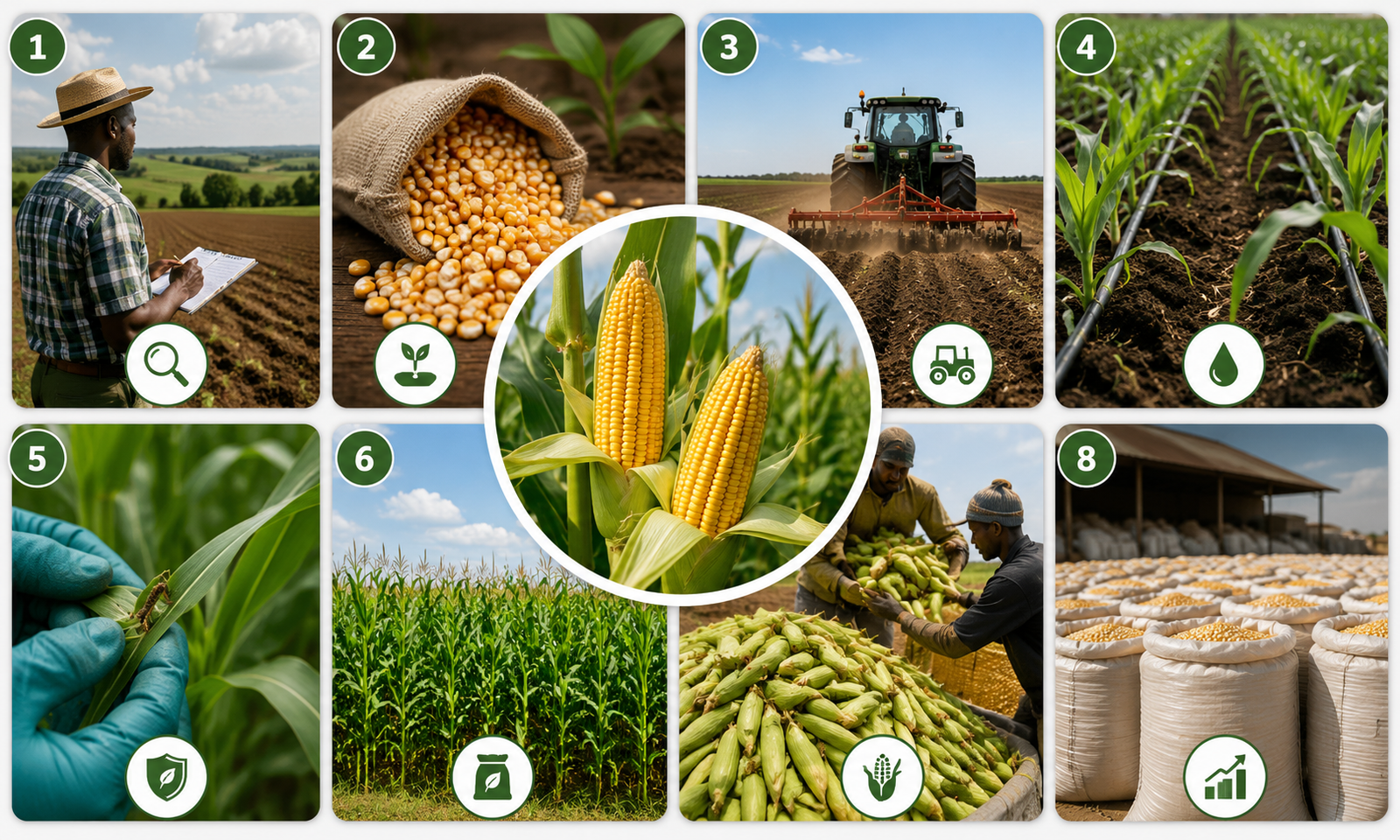
Step 1 – Selecting the land appropriate for the field and sufficient preparation.
Land selection and proper land preparation for cultivation is the first and most important factor to consider in maize production. Maize grows best in a well-drained loamy soil with a good organic matter content and pH that is conducive to accessing nutrients. The farmers are advised to refrain from any moist spots as excess watering may result in root rot and decrease in germination rates. Prior to land preparation, the vegetation is cleared and unwanted debris is removed from the field; the field should never contain weed vegetation which may be perennial and interfere with maize’s ability to absorb nutrients. Similarly, good tillage practices are necessary because they help to aerate soils, aid rooting and to promote uniform crop establishment.
Once the soil has cleared, it should next be ploughed and harrowed to get a fine tilth for seed to be easily placed and germinates well. Mechanised farming systems use a tractor to plough, and manual or animal-powered tools are used by smallholder farmers. During land preparation, the incorporation of natural manure will promote soil fertility and porosity and will be very useful in the early growth of the crops. A well prepared field will enhance good seedling emergence along with lowering weed pressure and provide a vast array of growing season water holding capacity and opportunities for fertilizer applications.
Step 2: Select high quality maize seeds
The choice of seed is a key factor in the success of maize growing as it is related to yield potential, disease resistance and maturity term. Improved hybrid varieties and/or open-pollinated varieties well-suited to local climatic conditions should be selected for farmers. Highly recommended are use of certified seed from reliable agricultural suppliers which have been tested for germination rate and purity. The poor seed quality can lead to uneven germination, poor plant establishment and productivity, thus impacting farm profitability.
Farmers should take factors into account like: drought tolerance, resistance against common pests and diseases as well as demand for certain maize varieties in the market. Hybrid seeds tend to yield higher, but their use demands more careful management while with open pollinated seeds the farmer is able to save seeds for further sowing. Appropriate fungicide or insecticide treatment of seed is also a key factor to ensure resistance to soil-borne diseases and first pest attacks. The acquisition of seeds of good quality is a good seed.It is good to invest in seeds of good quality so that the farming season will be fruitful if farmers do it.
Step 3: Good planting methods and spacing practices
Maize planting is a highly sensitive time of maize production and when planting is imprecise, it leads to non-uniform crop establishment, thus affecting yield producing potential. Spontaneous areas need to be planted at the start of the rainy season while irrigation can be provided during the dry season. Seed should be sown at an appropriate soil depth of between 3 to 5cm, depending upon soil moisture and texture. Too deep of planting can result in delayed germination, too shallow and the seeds may be vulnerable to pests and exposure.
The importance of spacing in plant population and effective resource use cannot be ignored. The spacing depends on the variety of maize but 75 cm between rows, and 25 cm between plants, are recommended to start with. Spacing helps to ensure that every plant gets sufficient sunlight, nutrients and water, whilst minimising competition and promoting even plant growth. There are two choices available to farmers: manual planting system or mechanized seed drill (for larger sized farms). Good planting practices play an important role in getting good yields as they help to plant the crops efficiently and reduce the losses of seeds during early stages of crop growth.
Step 4: Fertilise and manage soil nutrients.
Fertilization is an important stage of maize production as maize could be a nutrient demanding crop that needs good nitrogen, phosphorus and potassium for good production. Before seeding, soil analysis to supply information on deficiencies to help planning fertiliser applications. From the soil test report, the farmers can grow the crop with the most suitable dosages of organic and inorganic fertilizers so as to make the soil fertile and help the crop to grow better. Chemical fertilizers are used to provide soil with the nutrients that are required for quick vegetative growth, and organic manures, like compost or poultry manure, are used for improving the soil structure.
One of the more commonly used fertilization programmes is to use a basal fertiliser application with a high phosphorus content at planting, to promote root growth and to use a top-dressing with nitrogen applied during the vegetative growth phase to promote leaf and stalk development. Knowing when and how to apply the right nutrients and/or fertilizers is key to preventing nutrient loss and fertilizer burn. Only minimum rates of nitrogen ratings should be used, since excess nutrients can result in excessive vegetative growth and depressed yields. The key benefits of balanced fertilization of maize are good cob yield, good yield of cobs, better cob quality and good maize stem.
Step 5: Weed Management for Healthy Crop Growth
Weeds are a threat to the crop in maize production as they compete with crops for nutrients, water and light particularly during the early growth stages. Weeds can severely reduce maize production if not managed appropriately as well as add expenses to production. Good weed control starts right after planting and ceases throughout crop life. A combination of manual and mechanical and chemical methods can be cultivated across various farms depending on the farm size and resources in the farm. Apart from the first 3 – 6 weeks after planting, TMY is particularly sensitive in this window for maize development; that’s why early weeding is crucial.
Weed control is a very effective means of control and best achieved when applied in accordance with recommended standards not to harm the crop. Pre-emergence herbicides can be used to prevent weed emergence and post-emergence are used to kill weeds. Another effective mulching method to prevent soil water loss and weed growth. Maize plants need to compete fairly for essential resources, leading to healthy growth and superior performance in germination and emergence that last throughout the farming season when proper weed management is implemented.
Step 6: Pest and disease control
Proper handling of pests and disease management is critical in maize cultivation since in extreme cases, the attack could destroy the crop and result in low output in maize production. Typical insect pests are fall armyworm, stem borer, aphid, among others, and maize streak virus and leaf blight are disease causes that can cause plant health and productivity issues. Minimal crop damage can be achieved only by early detection and intervention. Through regular field inspection, farmers are able to detect the symptoms early and then take the proper control strategy before the infestation can spread further.
Integrated Pest Management (IPM) is strongly recommended and involves the use of all three control methods, biology, chemistry and culture, in an integrated approach to minimize pest populations while keeping them at a manageable level. Biological control methods consist of natural predators and chemical control means careful application of approved pesticides. Finding regions where the use of crop rotation and field sanitation practices also help interrupt pest life cycles and reduce disease build up in the soil is also beneficial. Avoidance of infestations to severe levels is achieved by further use of resistant maize varieties. Good pest and disease management help assure successful development and production of viable grain at harvest.
Step 7: Water management
Water management is very important to maize production particularly under erratic rainfall conditions. Maize strongly needs uniform moisture during its growth period especially during the germination stage, flowering stage and grain filling stage. Scarcity of water at these stages will result in retarded growth and yield formation. The use of proper irrigation practices like furrow, sprinkler or drip irrigation should be encouraged based on resources and farm size. The efficient management of water is carried out in such a way that crops get sufficient water without creating water-logged situations.
Aside from irrigation, other management practices for crop growth include thinning, staking (when needed) and plant health checks. Thinning can be used to control the optimal plant population and remove weak seedlings, and monitoring in the field can be used to check early for stress factors, e.g. nutrient deficiencies or attacks by pests. With balanced soil moisture it also promotes nutrient uptake and otherwise promotes crop health. Maize plants grow well from sustainable irrigation and management of the crop, producing quality grains for domestic use and the markets.
Step 8:Crop Protection Management Series
As a final stage in maize production, harvest is one of the major critical factors that affects the final product quality and profitability. When maize is at a stage of physiological maturity, grains should be harvested when the husks begin to dry and ear tips are hardened. Early harvesting may lead to low market value and poor grain quality, and late harvesting can lead to mold, pests and damage from adverse weather conditions. Harvesting – farm operations are done by hand or by using mechanised harvesters, depending on resources available for farmers.
Once the harvest is made it is important that grain is handled appropriately to avoid loss and impact on grain quality. This consists of drying maize to safe moisture level to prevent fungal growth; careful shelling of grains and storing in clean dry and well aerated storage bins. Grains can be stored in airtight bags or silos to help prevent insect and rat damage. Forex, when proper post harvest management is put in place, farmers benefit from minimising losses and maximising profits, whilst ensuring market demand and long term storage of quality products.
Conclusion
Setting up a profitable maize farming enterprise is not an easy task; it requires planning, strict adherence to the steps and monitoring. From preparing land to selling the product, each of these steps could make a crucial impact on the overall yield and profit.
These eight key steps and use of modern agronomic practices will allow farmers to greatly enhance their productivity while minimizing production risk. Knowledge and application of the entire maize production chain not only boost the productivity but also make maize agriculture sustainable and profitable in the long-term.
Maize production has the potential to be a stable and sustainable agribusiness for smallholder and commercial farmers if done correctly.