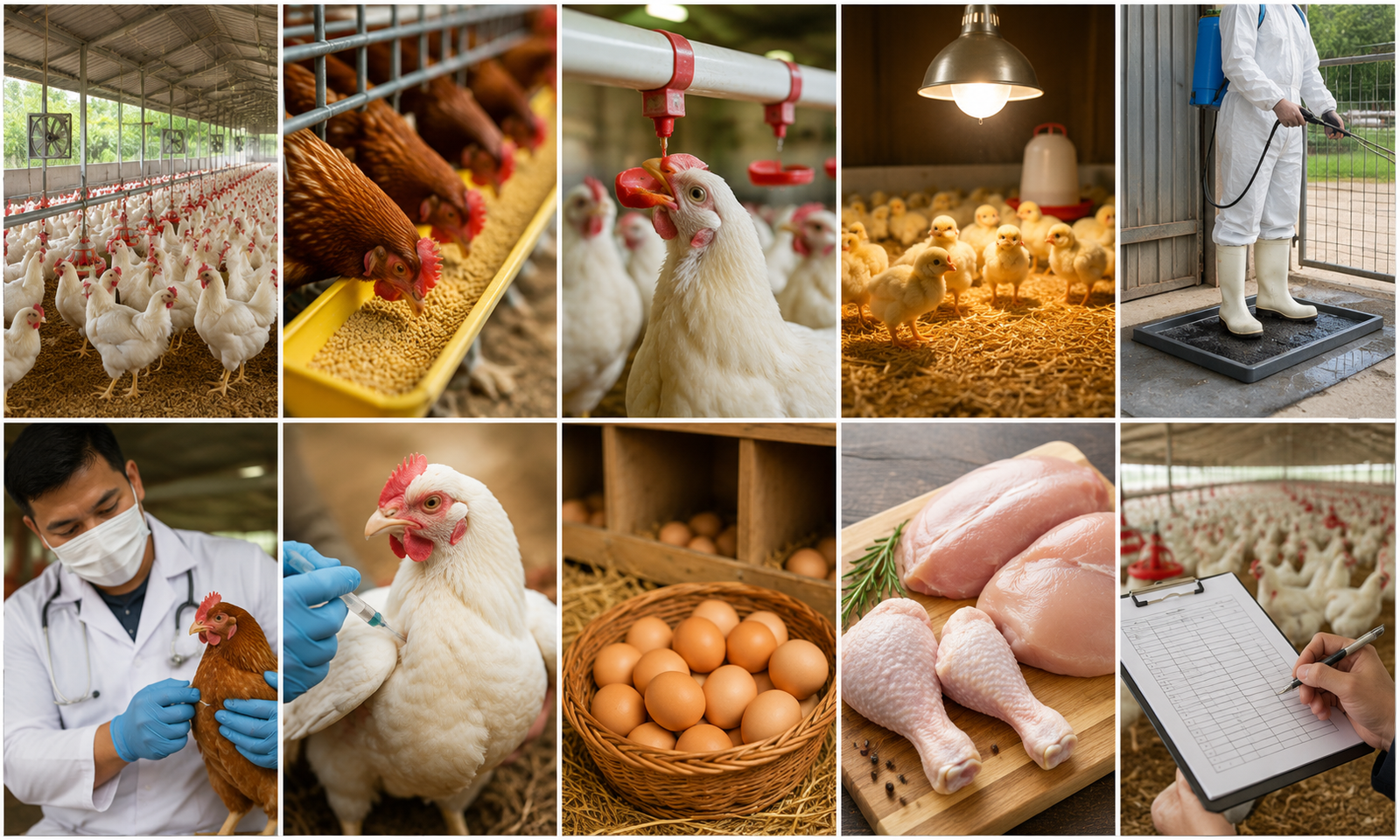
Poultry farming continues to be one of the most lucrative agricultural industries globally, because of its ability to generate income for farmers with high demand for eggs and meat commercialised through it. But flock size isn’t the only aspect of successful poultry operations. The key factors in achieving success involve the use of sound, productive poultry management practices which minimize disease outbreaks, help lower mortality and optimize feed use efficiency. Adopting effective management systems can help farmers to improve egg production, growth rate, and profitability in the market.
For any poultry producer, whether they have a small backyard flock or a large commercial operation, knowing and practicing management practices that have been demonstrated to be successful is important. Whether it’s the breed you choose or the biosecurity measures you take, all aspects of poultry production can impact on the flock’s performance. In this article, we look at 10 profitable poultry farming practices that can help poultry farmers boost their poultry output, to ensure good poultry animal welfare and to successfully run a poultry business.
1. Choose the high-performing poultry breeds.
Breed selection is the first step to a successful poultry project. There are various types of poultry breeds that are used for different purposes like laying eggs, meat production, or for both purposes. Breds are chosen to match the production interest of the farmer, thus higher farmer returns on investment.
Commercial layers like Isa Brown, Hy-Line Brown, and Lohmann Brown are blessed with their remarkable laying ability and feed conversion ratio. These breeds will have a capacity to lay in excess of 300 eggs a year when under proper management. Meat production broilers are commonly referred to as broiler breeds and are typically top genetic influences when it comes to rapid growth rate and feed efficiency. The Cobb 500 and Ross 308 are popular choices.
Farmers need to take into account if the chick is suited to the climate, resistance to diseases, availability of feed and consumer demand before buying the chicks. Expensive initially but definitely worthwhile in the long-term is the acquisition of a good flock of quality chicks bred by good breeders, as they mean to cut future losses from poor genetic lines and poor performance.
2. Develop Stylish and Inviting Homes
The role of housing in the productivity of poultry is very important. Suitable conditions of housing can cause stress, disease outbreaks, affect growth and decrease egg production. The proper design of a poultry house should afford protection against predators, severe weather and disease causing organisms as well as comfort to the birds.
The following are reasons why good ventilation is especially important in poultry units as they produce a lot of heat and moisture. If proper flow of air does not take place, ammonia may rise that may result in respiratory issues and may lower the immunity of the birds. Poults should also have adequate natural light sources in the poultry houses along with control on both rising and falling temperatures.
These floor space requirements should be of great interest to avoid overcrowding. The high stocking rates mean there is a greater competition for water and feed, more aggression among the animals and disease is easier to transmit. Clean litter materials such as wood shavings also contribute to a healthy bird environment, minimizing stress amongst the birds.
3. Develop Balanced feeding programs
In most cases, feed expenses can make up to 70% of poultry production costs. Hence, it is essential to have a well thought-out feeding program for profitability. Balanced dry feed mixtures with appropriate protein, carbohydrate, fat, vitamin, mineral and clean water requirements are provided for the birds.
Layer edges need foods that are high in calcium for egg production and good egg shell production. On the other hand, broilers require higher protein level based diets that allows for both accelerated weight gain and accelerated muscle development. There is also the need to consider the birds’ age and stage of development in their feeding.
Avoid feeding sudden feed changes to the farm as it may lead to disturbance in digestion and lower the production. Feed storage is also crucial. Feed that’s improperly stored can be infested with molds, rodents, or moisture, which can reduce feed quality and cause health problems. Improper feed selection and quality during a feeding strategy can result in reduced flocks performance, reduced feed conversion efficiencies and can also have a major impact on the overall profitability of the operation.
This complete poultry management resource offers more information on how to increase flock productivity using good poultry management practices.
4. Preserving Continuous Access to Clean Water.
Water is one of the most important nutrients for poultry, yet is not always treated as such. Birds need clean and fresh water at all times to facilitate digestion, absorption of nutrients and to help regulate body temperature and maintain good health. A few days without water will have a negative effect on growth rate and egg laying.
There is a difference between water consumed by different feeder types, breeds and temperatures, as well as with age. Birds can drink a lot more water during hot weather to help keep cool. Drinkers should be inspected on a regular basis, so that farmers can keep them clean and in working order.
Diseases can be spread in a flock through contaminated water. So it’s important to clean water lines, water tanks and water drinkers often. Water treatment chemicals can also be added to the water to enhance the water quality and to minimize the microbial contamination in some instances. Good water access will promote good flock performance and allow stable production levels.
5. Take note of appropriate vaccination schedules
Disease outbreaks can have a profound impact on a poultry operation in a matter of days that can cause significant economic losses. One of the best methods to keep flocks healthy and prevent common poultry diseases is through vaccination. A detailed vaccination plan should be formulated according to disease status in the area and veterinary expert advice.
Some of the most prevalent poultry ailments that require vaccination include Newcastle disease, Gumboro disease, Marek’s disease, fowl pox and infectious bronchitis. Depending on the vaccine and disease, vaccines can be given by drinking water, eye drops, injection, or spray.
Having a good record of vaccinations will enable farmers to determine when vaccines have been administered and can make an early measure of flock health. It is important that vaccines are stored and handled properly to ensure they are effective. Vaccination programmes can help to produce substantial reductions in mortality and a higher overall productivity.
6. Strengthen Farm Biosecurity Measures
Biosecurity is the management of activities to stop the importation and dissemination of disease-causing organisms within the poultry farm. One of the most critical poultry management practices with a low cost of treatment is effective biosecurity.
Visitors should not have unrestricted access to poultry houses and all people working in production areas must wear dedicated clothing and footwear. Any footbaths to be used with disinfectants should be provided at the critical points of entry and regularly used.
Newly purchased birds should also be isolated from flocks before purchase. All equipment, vehicles and feed delivery systems should be sanitised to exclude contamination. Rodent and wild bird control programmes are also essential as these can potentially introduce disease pathogens onto the farm. Bio-security protocols minimise disease risks and help farm enterprises to be profitable.
7. Promote Feeding and Watering of Birds
Ornamentalists can catch the bad news early by routinely checking their flocks. Close monitoring on a daily basis allows early detection of disease, nutrient deficiencies, environmental stress and/or injuries and can provide timely corrective measures.
A healthy bird will be active, alert and eat and drink normal amounts. Signs to look for include lethargy, coughing, sneezing, diarrhea, unusual droppings, feather loss and a decrease in egg production. Anything of abnormal behavior should be investigated immediately.
Having accurate health records makes it easy to recognise problems and facilitate effective management decisions. Early diagnosis and treatment not only saves birds but also prevents losses in production and expenses on the farm. Opt-in health monitoring is a simple method that is very cost-effective for managing health.
8. Practice good litter management.
Management of litter has a great impact on poultry health and housing situation. Soiled or damp litter can harbor potentially harmful bacteria, parasites and mold. Not only can these be a hygiene issue but they can also result in weak footpads, respiratory issues, and higher ammonia.
Monitor moisture content of litter at the farms; change wet regions promptly. Good ventilation maintains dryness of litter by minimizing the moisture in poultry houses. For effective moisture absorption the litter depth should be kept at an appropriate level.
Good litter management can improve litter performance in broiler operations, improving growth performance and carcass quality. For layers it facilitates a less dirty environment which helps maintain a more consistent egg production. Good litter management is beneficial for the birds and limits losses due to disease.
9. Keep up to Date Farm Records
The successful poultry farmer regards his enterprise as a business – not just a project for raising birds. Good record keeping provides information to: evaluate performance, determine inefficiencies and make decisions about managing.
Material records include medications administered, egg counts, weight gains, transactions, feed intake and mortality. Such records help farmers accurately check the profitability of their operations and calculate the cost of production.
Farm records can be analyzed to see trends and to keep track of flock performance and make necessary adjustments through management. Plus, record keeping helps keep regulatory requirements and helps to communicate with business partners, veterinarians, and lenders. The value of good record management is that it helps increase productivity and profitability.
10. Formulate efficient marketing and/or sales strategies.
No matter how successful the poultry farm is, marketing is essential for its success. Prior to optimal yield, farmers should know their target market and have a secure sales system. Good marketing helps to maintain a steady stream of cash flows and to minimize the risk of having products that will not be sold.
Home, stores, restaurants, hotels and food companies can purchase from egg producers. The meat producers can target the live markets, the supermarket providing, processors or the final consumers. Keeps prices more stable and demand more predictable if building a long term buyer relationship.
Potential opportunities for additional value addition also exist, and can improve profitability. This can happen in the form of attractive packaging schemes, provision of ‘dressed’ poultry products, or the manufacture of special lines of products like organic or free-range eggs. Strategic marketing enables the farmer to optimize income and be competitive in the market.
Conclusion
It takes more than raising birds to be successful with poultry farming. All successful poultry operations rely at least in part on the adoption of management practices that have been proven to increase productivity, improve health and minimize losses. Strategies for profitable production begin with selecting superior breeds, offering good housing, balanced nutrition, clean water and adherence to vaccinating schedules.
Also, it’s important to implement strict biosecurity measures, practise daily health checks, manage litter properly, maintain comprehensive records and market the herd. Consistent implementation of these practices enables farmers to see better egg production results, faster growth rates, reduced mortalities and improved financial outcomes. These ten profitable poultry farming practice examples focus on those that allow producers to create viable poultry business concepts that will be successful in a more competitive agricultural arena.