Introduction
One of the most fundamental pillars in modern dentistry, restorative dentistry also constitutes an important part of every dental student’s curriculum and centers on effective restoration of damaged teeth. Dental composite, dental amalgam and other materials have been discussed during the training and have become two of the most clinically interesting and discussed materials. It is important for operative dentistry students to know the properties, indications, advantages and limitations of these materials, as they will differ and affect treatment outcomes.
For over 50 years ledged by their durability and long-term success, amalgam restorations were considered the standard treatment for posterior restorations. The use of composite resin materials has been greatly enhanced with the development of adhesive dentistry and the growing demand for esthetic solutions from patients. Today’s dental students should be knowledgeable with both restorative systems due to the fact that they might need to see them in future clinical practice and because treatment planning relies on selection of appropriate material for patient-specific restorative treatment.
In the composite vs amalgam debate, aesthetics are but one consideration. Mechanical resistance, moisture control, technique sensitivity, cost, durability, tooth conservation, and patient’s preferences are all taken into account. Both materials are used in dental schools as education can not be denied to its practical value in dentistry. Having an understanding of the strengths and weaknesses of restorative materials gives students the information they need to make sound clinical choices and provide effective patient-centered restoration.
Fundamentals of composite resin restorations.
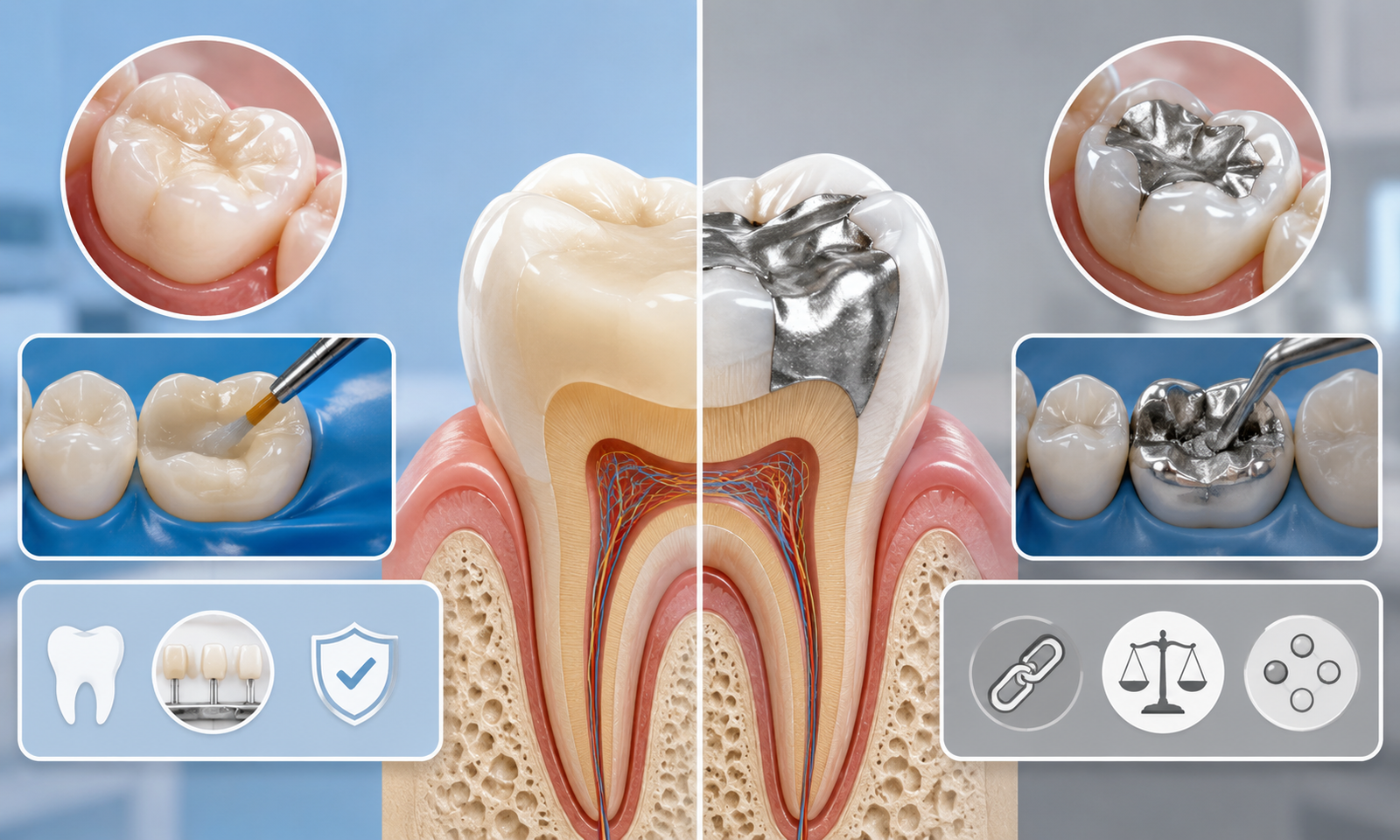
Composite resin is a tooth-coloring restoration that is made up of a matrix of resin, filler particles, coupling agents and initiators that enable the composite to set when it is cured by the UV-light. Over the years, the composite genus has changed a great deal—gaining in strength, esthetic (appearance) and versatility. Anterior and posterior tooth restorations are commonly made from modern composites since they closely resemble the appearance of a natural tooth surface.
One of the big factors that make composite resin popular these days is its aesthetic benefit. Patients often like where restorations fit into the tooth structure, natural blends when adjacent to tooth structures, particularly when the restoration is in view during talking and smiling. Because of its ability to be shade-matched to natural teeth, it is the ideal option for restorations on anterior teeth and cosmetically sensitive areas. So, shade-matching, multi-layering, contouring and polishing techniques are taught to dental students to provide very esthetic results.
The combination of the other important features of composite resin is its adhesive property. Adhesive systems are used to bond the composite to enamel and dentin and this process differs from that of amalgam in that it is not primarily mechanical. This helps the dentist to preserve a greater portion of health in the treatment of cavities. A new principle in restorative education is the proper emphasis upon conservative cavity designs to enhance long-term tooth survival and to follow the guidelines of minimally invasive dentistry.
While there are benefits, composite resin restorations have their drawbacks, too. It’s quite technique sensitive; that is, it really does depend on the correctness of the isolation and techniques used to layer the curing and finishing processes. Moisture can affect bond strength and failure of the restoration can be disastrous. Getting placement of a rubber dam and using the right adhesives is a very important step, and students usually put in a good amount of time to ensure they get it right, when using composite with a dental student.
The other limitation of composite resin is the polymerization shrinkage. This contraction of the material, during the curing process can cause stresses, gaps near the margins or postoperative sensitivity when improperly managed. Learners are taught incremental placement to minimise shrinkage stress and minimise adaptation to cavity walls. These concepts need to be understood to make a long-term and stable restoration.
Understanding Amalgam Restorations
Dental amalgam is a filling material primarily made of the metals silver, tin, copper and mercury. Aimed at esthetic and environmental issues, its use has been reduced in many areas, but amalgam is still one of the most proven and long-lasting restorative materials used in dentistry. Dental students keep learning about amalgam because there are many amalgam restorations in the mouths of patients that need maintenance, repair, replacement, etc.
The strength of amalgam is one its best features. Amalgam restorations can tolerate high biting forces and may last many years particularly in the back teeth where heavy chewing forces are applied. In the past, amalgam has proved to be very durable in large restorations where strength and wear resistance are significant. This preservation is perhaps the reason for the widespread use of amalgam in posterior restorations for decades.
Another excellent merit of Amalgam is simplicity of placement which is easier than composite resin. The rest of the procedure is performed correctly, but it is less critical to keep amalgam dry when placing it. This property is beneficial when it is not possible to have absolute isolation. During their dental studies, students are aware of the requirement of moisture control still with amalgam, but composite resin may be more RA significant in less ideal clinical scenarios.
Amalgam has cost benefits in certain clinical situations, too. The material is typically less costly than composite resin and in some cases, the placement procedures can occupy less chair time. Ameralgam might also have a more practical and useful place in public health settings or areas of limited resources due to its cost and reliability.
A few drawbacks of amalgam, however, have made this material less popular. There is poor aesthetics down and the most obvious is this. Amalgam is not as attractive for a visible restoration, as it appears silver-gray. So, the demand for cosmetic dentistry has grown and people are more drawn to tooth-colored options.
Amalgams also have an increased requirement to remove healthy tooth structure as they must be mechanically retained. The retention of the tooth or teeth in the composite is accomplished by making undercuts and cavity shapes that a dentist is only able to do from the inside out.Only a dentist can make undercuts and cavity shapes necessary to retain the composite. Conservative treatment is a focus of modern dentistry and thus, in many situations, adhesive composite restorations are more appealing options.
The fear of the effects of mercury has also played a role in people’s attitudes toward amalgam. Most patients do not require a different treatment, and for this reason dental amalgam is generally regarded as safe by scientific bodies; however, some countries have seen dwindling use of the material due to environmental concerns and to patient anxiety. It’s important for dental students to be familiar with the evidence as well as patient concerns when it comes to discussing the patient’s restoration options.
Longevity and Clinical Performance Comparison.
In composite resin versus amalgam comparisons, dental students will be aware that no single restoration is consistently (in all situations) better. The type of material to be used will be determined by several considerations such as cavity size, cavity location, patient behavior and habits, cavity moisture control, esthetic requirements, and caries risk.
Amalgam has proven itself to be very successful in long-term posterior large restorations. They are exceptionally durable to wear and fracture, thus are very resistant to large occlusal force. Abraded/braced amalgams can at times serve better as a restorative than comps, in patients with bruxism or high biting forces. In a restorative dentistry program students will see that adequate case selection is still an essential component to successful restoration.
However, composite resin restorations have greater aesthetic qualities and conservative preparation designs. The improvements in filler technology and bonding systems have greatly enhanced the mechanical strength of materials now made up of composites. Today many posterior composites have been successfully introduced in clinical application in the right way. But, there is a bigger part for operator skill in the long term success of composites, as it is more technique-sensitive.
These are generally the terms used for the failures of both materials, with the exception of marginal leakage, which is rarely a failure of the restoration; it refers to failure of the margins.You would find marginal leakage is a failure rarely associated with the restoration, and saying restoration fracture is the same as margin failure is true for both materials, but the failure occurs differently in both cases. This is frequently coupled with bonding failure or polymerization stress and/or poor isolation. Amalgam failures can be a fracture failure of the tooth structure or a failure due to daily wear and tear of the margins of the teeth. It is, therefore, important that dental students are able to comprehend and assess not only their own ability to ‘manage’ restorations for the sake of placement, but also value and manage them over recall visits.
Strategies for clinical applications in 21st-century dentistry.
The composite restorations are generally used in anterior and posterior teeth due to their esthetic characteristics, adhesive strength. Very commonly used for any cavity of small to medium size, to correct cosmetic concerns, close diastema, veneers and minimally invasive restorations. Since the finished contour and polish is the most important in determining patient satisfaction, students are taught a large number of contouring and polishing techniques.
Amalgam are commonly used for posterior restorations where aesthetics is not really a factor and durability is of utmost importance. Amalgam can be challenging for students, but is something that they will undoubtedly continue to come across in clinical practice, despite its decline in use. The fact that there are numerous amalgam restorations in need of evaluation or replacement is still helpful to learn how to manipulate, carve, and finish amalgams to improve their longevity.Many old amalgam restorations are in need of assessment or replacement and learning the correct methods for manipulation, carving, and finishing amalgams to maximize their longevity remains useful.
Evidence-based treatment planning is also a focus in looking at what materials to use, especially at dental schools. There are many factors to evaluate in determining any restorative option for a patient, such as patient expectations, oral hygiene, caries activity, financial constraints and occlusal considerations. Knowing these overall clinical issues will enhance students’ decision making abilities and increase confidence.
Some students ask questions about the rationale for teaching amalgam established in a very dominated field by the composite resin. It boils down to holistic clinical teaching. Dentists need to know about the indications, contraindications and maintenance issues of all the restorative materials that might be held within their practice.
During the learning of amalgam, students will be taught the principles of cavity preparation, resistance form, retention form and occlusal anatomy. In modern Adhesive Dentistry these principles still hold true. Meanwhile, Composite Resin training has fine motor skill training, adhesive techniques, shade matching skills, and esthetic awareness training. Both materials offer an extensive, educational basis for restorative dentistry.
Students also will gain an appreciation of the history of restorative materials. As new biomaterials are created and introduced, dental professionals must continue to keep up their skills and remain flexible. Such material fundamental training can be achieved by having students study both the amalgam and the composite resin.For students to acquire the material fundamental knowledge, they could be made to study both the amalgam and the composite resin.
Conclusion
Both composite resin and amalgam are important tools for teaching restorative dentistry. The advantages of esthetic, conservative preparation designs and the adhesive properties in line with the principles of modern M.I.D., make composite resin an ideal material choice. On the other hand, amalgam is still recognized as reliable and durable for posterior tooth restorations.
The objective for dental students is to know more than just the differences between materials and to grasp the concept that the material selection affects outcome. There needs to be a balance between the various goals of clinical dentistry—such as esthetics, function, durability, patient expectations, and biological preservation. An understanding of both composite resin and amalgam provides students with the information they need to make educated decisions; to offer high quality restorative services in clinical practice.
Modifications of restorative materials will be progressive, following advances made in dentistry. The underlying principles imparted via composite and amalgam training, however, play an integral part in the skill acquisition, accuracy, and self-assurance of future dentists.


