Introduction
This career involves a sequence of learning, skill development and subsequent hands-on experience starting way before an individual even meets a patient. The primary principles of restorative dentistry are the conservation, replacement, and repair of natural teeth with the use of fillings, crowns, inlays/onlays and rehabilitative procedures. What is not fully understood is that these more complex clinical techniques can’t be mastered in the clinic. Rather, they are meticulously formed early on in their training in simulation-based surroundings, in which students undergo instruction on anatomy, materials science, hand skills, and procedural sequencing. This foundation will enable students to be technically ready for the day of clinical practice and also clinically aware of decision making principles that focus on lifelong oral health and patient-focused treatment options.
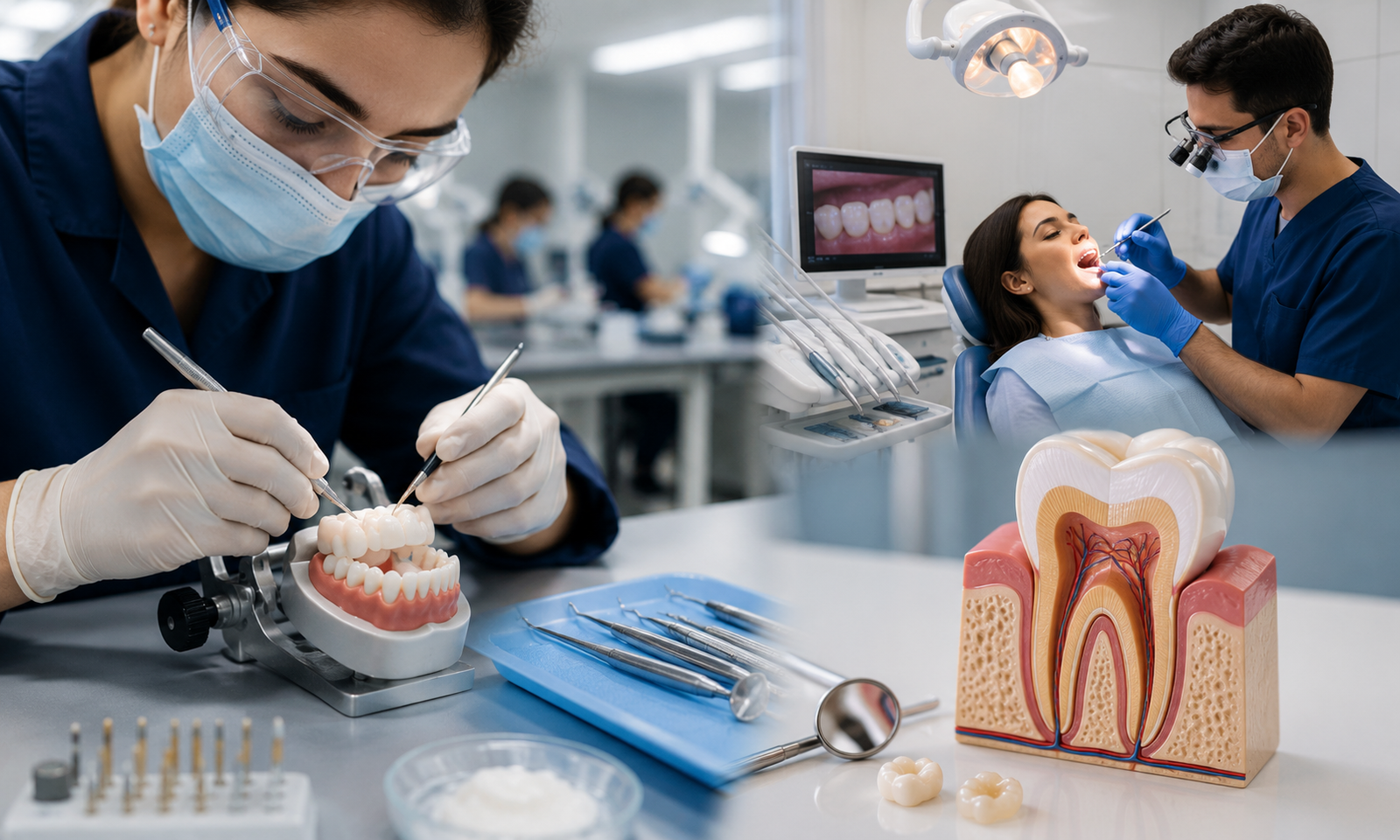
Pre-Clinical training of operative dentistry is an interface between theory and practice. Some of the technical and learning aspects of the course, like simulating procedures in models and typodonts, happen during this period. Basis is on learning cavity preparation including handling the instruments, placement of restorative material and understanding the principles of cavity preservation. This is not rote learning. It is about the way precision, ergonomics, and procedure can be understood and applied to create clinical excellence. A systematic study of academic materials for this foundational phase can be accomplished via pre-clinical operative dentistry, which encompasses the academic framework that will help promote a competency in restorative procedures in the long run. As students explore these early experiences at a deeper level, they develop an appreciation of the importance of accuracy, consistency, procedure, and several other important concepts that will assist them in the process of achieving success in restorative dentistry.
Skills developed during the Pre-clinical Training Programme.
Of paramount importance following pre-clinical operative dentistry is development of basic psychomotor skills which serve as the foundation for all the restoratory procedures. Students develop control techniques for rotary instruments, hand tool skills and precision use of restorative materials in simulated settings that simulate a clinical challenge. These skills are not natural or innate and need to be structured for repeated practice, feedback and gradual improvement. In addition to being tactile, which is very important for having good manual dexterity, students also gain visual-spatial awareness to grasp the tooth morphology and natural contours to be restored. As important, however, is the development of discipline in maintaining infection control procedures and maintaining correct posture, which prevents fatigue and the development of long term problems with the muscles, tendons and joints. In the early competencies, that learning ensures that student performance and decision making are not challenged or overwhelmed when students move into clinical situations where time pressure and patient comfort are factors.
Role of tooth preservation principles in skill development.
One of the core philosophies of contemporary restorative dentistry is minimal intervention – to maintain as much of the natural tooth structure as-possible whilst effectively managing the disease/damage. This philosophy is deeply embedded through the pre-clinical training to teach students how to integrate restoration needs with biological conservation. Students learn how to make cavity preparations through simulated exercises in such a way that only the diseased tissues are removed and the prepared cavity is still structurally sound. This involves a detailed knowledge of the dental anatomy, caries progression as well as material behaviour under load. These exercises continue to foster clinical judgment skills so that dentists will be more capable of making the right decisions for long-term survival of their teeth instead of just making short fixes. The attitude is particularly crucial in restorative dentistry where the beauty of the restoration is also judged in terms of durability and biological tolerance.
Making the leap from Simulation to Clinical Practice
One of the most important steps in every dental student’s education is the final one that is moving from pre-clinical operative dentistry onto a real patient in actual clinical practice. Simulation labs offer the benefit of a controlled setting for learning, but clinical practice offers the real-life consequences of uncertainty to face, from patient anatomy to behaviour, and oral conditions. But a student who has been academically prepared during his pre-clinical years is better prepared to face such challenges as he already has in his academic mind some organization of flow of the procedure. They know a range of step-by-step restorative procedures, the characteristics of materials handled and the demands of accuracy in time constraints. More importantly, they have learnt to critically evaluate their work and this is crucial when finding techniques to suit the patient’s individual needs. It is a transition period that is designed not to present new concepts but to bring to the fore already known skills in more complex and dynamic situations that require the ability not so much to be technically correct as correct “with flexibility.
Promoting confidence and clinical decision making skills.
Trust in restorative dentistry only comes after seeing more simulated cases, receiving positive feedback, and continuously improving skills. The focus of pre-clinical training environments is to warm the students to this confidence incrementally, ensuring that whatever mistakes students may make in the training do not have real-world impact on their lives, while they learn to correct them appropriately. Through this process students not only learn how to perform procedures correctly but also why certain procedures are used in particular situations, rather than others. This enhances the students’ clinical decision making skills. As the years pass, they are able to consider the options for restoration that could restore tooth vitality, structure lost to disease, occlusal demands and aesthetic requirements. This analytical thinking is also invaluable in clinical practice, where dentists need to make quick, yet informed decisions and decisions that significantly impact patient outcomes and treatment success.
Career Pathways in Restorative and Operative Dentistry.
Pre-clinical experience in operative dentistry is a platform to the development of many career paths in restorative and operative dentistry. A few graduates choose to work as general dental practitioners, carrying out basic restorative dentistry, such as fillings, crowns and preventative work. Some specialize in other areas, such as restorative dentistry or prosthodontics, or conservative dentistry, dealing with intricate cases that involve multiple disciplines and high technical skills. In an educational and research environment, faculty members play an important role in the development of new materials, techniques, and clinical protocols within the field that continues to advance. Also some dentists have a teaching and training scale which teaches the next generation of practitioners in pre-clinical and clinical settings. Whether a person selects the path of operational duty or other fields of service, a basic set of skills gained as an early operator will always be of great importance for career success and progress.
Why Continuous Skill Development?
The learning journey is never ending and even after going to clinical practice. Continuous professional development is vital to ensure the dentist can keep up with new developments in materials and research leading to new methods in digitally supported treatment concepts and minimally invasive techniques. Those dentists with a sound pre-clinical background will be better equipped to adjust to these changes as they will have a better understanding of the concepts involved in restorative procedures. This adaptability enables them to include new technology within their restorations like CAD/CAM systems, adhesive innovations and biomimetic restorative materials. In addition, the continuous development of manual skills guarantees clinical results that continually improve over time and cement the value of continuous education as an integral part of professionalism in dentistry.
Conclusion
Pre-clinical operative dentistry is not just a course – it is the building blocks that enable you to build a successful career in restorative dentistry. Much like in other fields of medicine, students will find themselves exposed to the complexities of actual dental practice with the assistance of technical skill, clinical reasoning and knowledge of principles relevant to the principle of tooth preservation up front in their training. The change from simulation to care in the clinical environment is smoother, confidence builds gradually, and decision making is increasingly sophisticated. But, discipline and competence acquired during this developmental process shape every consequential dental practice—from simple restorations to advanced rehabilitations. The importance of a solid pre-clinical foundation is constant, as dentistry continues to progress as a field and restorative and operative pre-clinical foundations always remain the starting point for the successful career in the field.