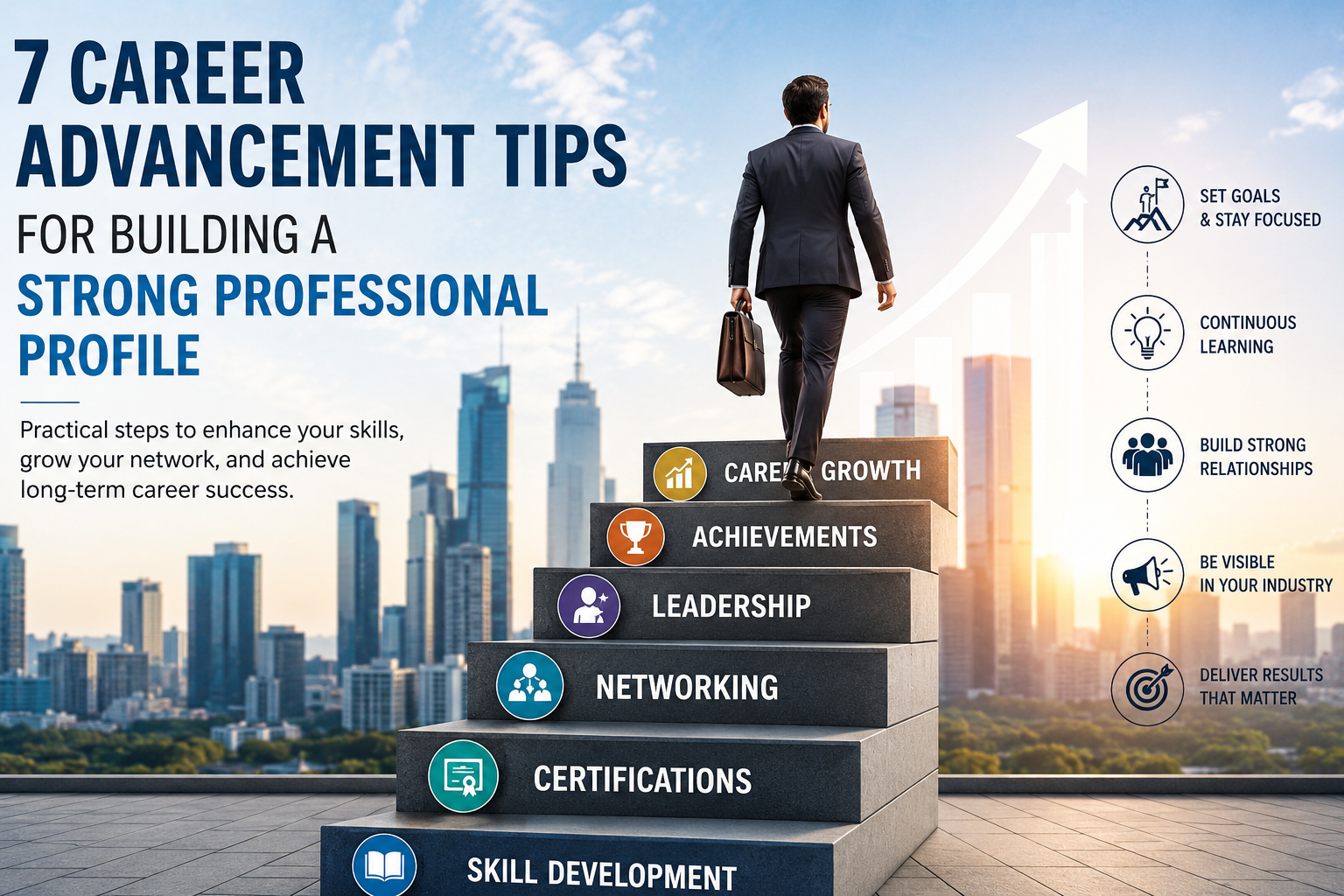
Today, with the competitive job market, job qualifications are no longer sufficient to ensure career advancement. Employers are increasingly looking for professionals who constantly strive to better themselves, adapt to change, have leadership qualities, and are viewed as being professional. Creating a professional profile can greatly enhance job prospects, particularly when looking for a promotion, a career change, or better opportunities.
A professional profile isn’t simply a list of job titles and responsibilities. It demonstrates your expertise, successes, reputation and worth in your industry. You can make yourself a formidable player for future opportunities by deliberately building your skills, improving your network, acquiring the right qualifications and establishing a recognizable professional personal branding.
This tip sheet discusses seven practical career advancement tips that can help professionals enhance their profiles and make sure that their achievements are clearly reflected on their CVs.
Why a Strong Professional Profile Matters
Your professional profile provides the basis and foundation of your career. It enables recruiters, hiring managers, co-workers, and industry leaders to gain an understanding of your expertise and the value that you can add to an organization. Many career opportunities are available even before an application process is advertised. Workplace networks, social media, referrals, conferences, and past achievements are among the common ways that employers scout for new hires.
Those who make a conscious effort to enhance their professional skills are more likely to be successful. A well-established profile can result in promotions, leadership roles, speaking engagements, consulting projects, and better employment opportunities. It also offers a sense of job security, as your reputation and expertise are valuable beyond your current employer.
7 Career Advancement Tips
1. Continuously Develop Relevant Skills
Continuous skill development is one of the best ways to make your career climb up the ladder. Technological progress, fluctuations in demand, and new business practices drive the evolution of industries quickly. Those who have the ability to keep abreast of changes are competitive and flexible.
The first step is to determine the skills that are most needed in your industry. They can be technical skills, leadership capabilities, communication skills, project management experience, data analysis skills, or knowledge of the industry. Prioritize learning skills based on career aspirations, not all courses and opportunities.
Skill development can take place in an online course, workshop, webinar, professional training program, or self-directed learning. A growth mindset is shown through consistent effort and investment in education and skills, which is the kind of attitude that is highly sought after by employers. Record measurable results as you gain new skills that demonstrate the impact of skills on business.
When creating your CV, don’t just put a string of skills. Rather, link them to particular accomplishments. If you have project management skills, instead of saying so, you can explain how you were able to lead a project that enhanced efficiency or cut costs.
2. Earn Industry-Recognized Certifications
Certifications are tangible proof of skills and dedication to professional development. They are a great way to confirm your expertise and demonstrate your value to prospective employers with otherwise identical experience and education.
A certificate is often a quick way for employers to know that a professional has demonstrated competence in a specific subject or task, as it has been shown that the individual holds a standard. Certifications are often used as a quick indicator of competence because they help employers know that a professional has demonstrated competence in a specific subject or task. Certifications can be related to the project management field, information technology, finance, marketing, human resources, healthcare, cybersecurity, and other specialized areas, depending on the field.
The worth of a certification will rely on its pertinence to your career goals. Before enrolling in a certification program, consider how recognized, credible, and expected by employers it is. A strategic certification can enhance your qualifications, bolster your income-earning potential, and boost your likelihood of getting leadership roles.
Certifications should be included in a section of your CV and, if relevant, mentioned in your professional experience. Talk about project results to show practical application if the certification had a direct impact on improved performance or project results.
3. Build a Strong Professional Network
Networking is a proven way to advance one’s career. Professional relationships create many career opportunities, not just applying for a job. A robust network can provide industry knowledge, mentorship, references, and professional assistance.
Networking is more than just collecting contacts. It is characterized by the establishment of meaningful relationships of value and professional respect. Go to industry events, join professional organizations, join online forums, and follow professionals with the same interests and/or career paths.
Relationships are also critical to sustaining. Over time, building professional relationships can be enhanced through regular communication, thoughtful engagement, and helping others. Experts who are always willing to give back to their communities are always ready to be helped and given opportunities when it matters most.
For any networking success, include it as a line item on your CV, such as speaking engagements, committee involvement, involvement in industry groups, and collaborative projects. These experiences show interest and impact in your industry.
4. Develop Your Personal Brand
Effective personal branding goes hand-in-hand with a strong professional profile. Personal branding is the “image, expertise, and professional identity” that people equate with you. It impacts the way your colleagues, bosses, clients, and peers see your skills and worth.
The first step in developing a personal brand is to determine what you are good at, what you know, your professional values, and the difference you make in your field. Think about the type of person you want to be known as in the business world and act accordingly. This could involve sharing knowledge, creating publications, speaking at events, engaging in professional dialogue, or sharing the achievements of projects.
There is great importance in consistency in personal branding. The image you want to project in the professional world should be reflected in your online presence, professional communications, social media, and interactions in the workplace. As time goes on, a genuine and trustworthy brand can boost your visibility and credibility with decision-makers.
Your CV should demonstrate your brand by highlighting achievements that reinforce your professional persona. Employ a strong professional summary to emphasize your skills, abilities, and accomplishments relevant to the career path you select.
5. Seek Leadership Opportunities
Leadership experience is highly valued in every industry, even outside of a management position. Employers look for people who are able to be proactive, influence others, solve problems, and help organizations achieve goals.
Leadership opportunities can be found in various settings. You might be part of a project leadership team, mentor colleagues, coordinate cross-functional teams, lead initiatives, volunteer to serve on committees, or manage process improvements. These experiences show responsibility, accountability, and leadership in helping others reach their objectives.
Leadership skills also come with communication, decision-making, conflict-resolution, and strategic-thinking skills. These skills are important to have for a long career path and help people reach higher positions.
When writing about leadership experience in a CV, highlight and cite measurable achievements. Emphasize the team size managed, the results of your projects, revenue generated, efficiencies gained, or problems solved while leading the team.
6. Build a Record of Measurable Achievements
Career progression is not just a matter of what you do, but what you achieve. Employers are becoming more interested in measurable achievements as they are clear evidence of impact and effectiveness.
Learn to keep a record of your accomplishments throughout your career. Monitor key indicators like revenue growth, cost reductions, productivity gains, customer satisfaction, project completion, or process improvements. These measurable goals help you build up your professional profile and make your contributions measurable.
Measurable accomplishments serve as strong proof during performance evaluations, promotion conversations, job interviews, and salary negotiations. They help you stand out from professionals who talk about responsibilities but don’t show results.
Focus on achievements, not day-to-day work. For instance, rather than saying you handled marketing campaigns, explain how your campaigns drove more traffic to the website, more leads, or better conversion rates. Specific results make a bigger impact and have more credibility.
7. Stay Visible and Active Within Your Industry
The visibility of an individual can be a huge factor in their career prospects. Professionals who participate and volunteer in their industry are more likely to be known for their expertise and may be considered for new opportunities, partnerships, leadership roles, or job opportunities.
There are several ways to increase industry visibility, such as writing articles, joining professional conversations, attending conferences or webinars, joining professional associations, mentoring others, or speaking at events. These activities signal to others that you care about your profession and that you are a part of the industry.
Being visible is also important to keep you up to date on trends, challenges, and opportunities that are on the horizon. Engaging on a regular basis will help you grow your knowledge, as well as build your professional reputation.
How to Showcase Career Growth on Your CV
Creating a professional profile is just part of the equation. Just as crucial as this is, however, is how you communicate your achievements on a CV. By organizing your CV in a comprehensive and clear manner, you can make it easier for your potential employers to identify your skills and accomplishments.
Start with a solid professional summary showcasing your skills, experience, strengths, and achievements. This section should immediately convey your value proposition and career direction.
Have bullet points throughout your work experience section that are achievement-based. Use metrics and measurable outcomes whenever possible to show impact. General statements about responsibilities are not as convincing as quantifiable results.
Add separate sections for certifications, professional memberships, awards, publications, and leadership activities. These sections strengthen your dedication to growth and professional development and serve as additional credibility.
Make sure your CV is up to date. Update it regularly with newly learned skills, certifications, projects, and achievements. Deferring the process until you start looking for work can mean missing out on things you’ve achieved and don’t have on your CV up to this point.
Conclusion
Rarely do people get promoted into a better position by chance. It’s the outcome of careful consideration, ongoing refinement, relationship development, and dedication to professional excellence. Building the right skills, securing certifications, expanding your network, polishing your personal brand, seeking leadership opportunities, tracking measurable results, and staying visible in the industry will help you establish a professional profile that will lead to long-term success.