There’s a standard walk-through that experienced restaurant operators do before service starts, and most of it involves the kitchen. Line setup, prep mise en place, temperature checks on the reach-ins. The dining room gets a pass with a damp cloth on the tables and whatever someone ran over the floors last night. The booths get wiped down. And that’s usually where it stops — until a health inspector walks in or a booth cushion starts to smell in a way that reaches the adjacent table.
The booth problem in Seattle restaurants is consistent across a range of concepts, from the Capitol Hill neighborhood spots to the suburban family chains in Northgate and Lynnwood. The upholstery gets cleaned on the same schedule as the tablecloths: when it looks dirty. Which means it usually isn’t being cleaned until it’s already costing something — customer complaints, failed inspections, or the particular situation where a booth that’s held thousands of diners over three years finally becomes irreplaceable rather than restorable.
What Actually Accumulates in Restaurant Booth Fabric
Restaurant booth upholstery operates in a different contamination environment than residential furniture. The inputs are more varied, more frequent, and more chemically aggressive. A residential sofa absorbs body oils, pet dander, and the occasional spill. A restaurant booth in a busy service absorbs grease aerosolization from the kitchen on every service, food and beverage contact from several hundred diners per week, cleaning product residue from daily surface wipes, and the body oils and clothing residue from every person who sits in it.
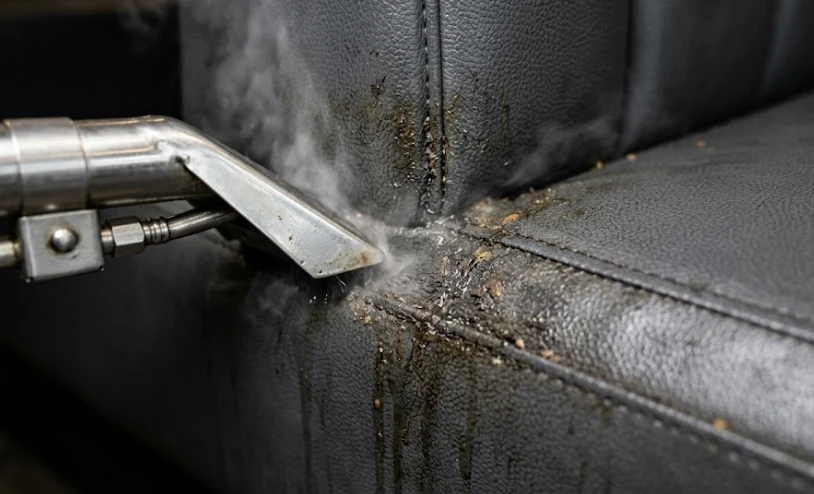
Grease is the category that matters most. In any restaurant with a grill, fryer, or open cooking station, grease particles travel through the dining room in the air. They’re invisible individually and settle on every surface — walls, light fixtures, chairs, and booth upholstery. Over the course of a month, the surface of a booth cushion that’s never been professionally extracted accumulates a thin layer of polymerized cooking grease that standard wipe-down can’t remove. This is the base layer onto which everything else adheres. It’s also what gives a restaurant booth its characteristic odor after a year without professional cleaning — not the smell of any single meal, but the accumulated ghost of all of them.
The second significant input is beverage contact. Water, coffee, and soft drinks are the most common and the least damaging because they’re mostly water and sugar. Wine and craft beer — significant categories in Seattle’s dining market — leave tannin and hop compounds in vinyl and fabric that surface cleaning doesn’t address. Tomato-based sauces, which have high acidity and red pigment, penetrate upholstery finish in ways that are difficult to reverse after more than a few hours.
Third is cleaning product buildup. Most restaurant front-of-house staff wipe booths with quaternary ammonium sanitizers — the standard food service sanitizers required by most health codes for food-contact surfaces. These compounds leave residue that attracts particulates and, when they interact with food proteins over time, can create surface films that look like soiling but are actually chemical buildup. This is why restaurant booths that have been “cleaned every day” for two years sometimes look worse than residential furniture that was never touched — the daily wipe-down deposits as well as removes.
The Health Code Reality in King County
The Washington State Retail Food Code and King County Public Health’s enforcement guidelines don’t specify a cleaning frequency for upholstered booth seating the way they specify temperature controls for protein storage. What they do require is that all surfaces in the dining area be “clean to sight and touch” — which is a standard that professional upholstery cleaning is occasionally called in to meet after an inspection reveals that daily wiping isn’t producing clean-to-sight results on booths that have accumulated months of grease and beverage residue.
The more immediate regulatory issue is odor. An inspector who notes a persistent odor in the dining area as coming from booth upholstery can document it as a cleanliness finding, which generates a corrective action requirement. Operators who’ve been through this situation consistently report the same sequence: the inspector identifies an odor source, they clean the booths with whatever staff and products they have on hand, it doesn’t fully resolve the issue, and the follow-up inspection either closes the finding or generates further documentation. Professional extraction between inspection cycles is the standard way to prevent the issue from reaching that stage.
Beyond the regulatory dimension, there’s the liability consideration that comes with fabric booth seating specifically. Upholstered booth seating that has visible staining, tears in the surface material, or odor that reaches adjacent tables creates a sanitation impression — accurate or not — that affects the overall inspection experience. Clean-to-sight fabric seating reads as a managed environment; visibly compromised fabric seating reads as a management attention problem even when every other area is in order.
Vinyl vs. Fabric Booths — The Cleaning Difference
Most commercial restaurant booth seating in Seattle uses vinyl or vinyl-blend upholstery rather than fabric. Vinyl is more durable, easier to surface-clean, and more resistant to beverage penetration. The distinction matters for professional cleaning because the methods and chemistry are different.
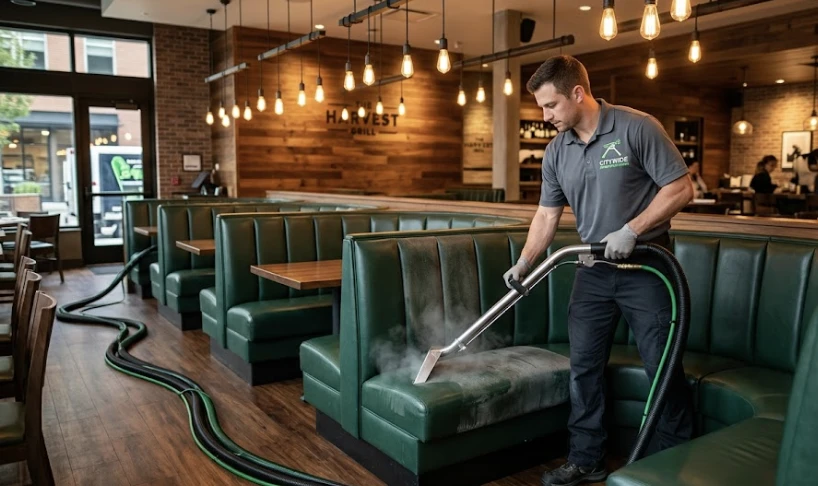
Vinyl booth seating can be cleaned with a hot water extraction process adapted for non-porous surfaces — the primary goal is removing the grease film from the surface and the accumulated sanitizer residue from the seams and tuck areas where the vinyl folds into the frame. These seam areas are where contamination concentrates most heavily, because daily wiping doesn’t reach them effectively and the seam gap traps organic material that then becomes an odor source. A professional extraction pass on vinyl seating that reaches into seams and tuck areas is meaningfully different from a surface wipe, even an aggressive one.
Fabric booth seating — more common in higher-end Seattle dining rooms where the aesthetic is warmer and more residential — requires full hot water extraction at temperature ranges and vacuum pressure similar to residential upholstery, but with pretreatment chemistry appropriate for the restaurant contamination profile. Grease pretreatment is mandatory before extraction; fabric that has accumulated cooking grease without grease-specific pretreatment applied before the extraction water hits it will move the grease deeper into the fiber rather than releasing it. This is the most common reason fabric booth cleaning done with general-purpose upholstery equipment produces disappointing results — the extraction process without grease pretreatment redistributes rather than removes.
What the Cleaning Schedule Actually Looks Like
The professional cleaning frequency that makes sense for Seattle restaurant booth seating depends on service volume and concept type. These are the general benchmarks that most commercial upholstery cleaning services in the Seattle area work from, with the understanding that individual restaurants will vary based on their specific conditions:
High-volume concepts — anything turning 150 or more covers per service, full bar programs, lunch and dinner service — are typically looking at quarterly professional cleaning for vinyl seating and every two months for fabric seating. At this service volume, the grease accumulation rate is fast enough that quarterly extraction is the minimum to prevent buildup from polymerizing into a condition that requires significantly more aggressive treatment.
Mid-volume concepts — 75 to 150 covers per service, primarily dinner, moderate kitchen intensity — are generally in the twice-yearly range for vinyl and quarterly for fabric. Many Seattle neighborhood spots fall into this category, and twice-yearly professional cleaning combined with proper daily maintenance is usually sufficient to keep seating in presentable condition.
Lower-volume concepts, cafes, and brunch-focused operations with limited cooking intensity can often maintain vinyl seating on an annual professional cleaning schedule with good daily maintenance. Fabric seating in any commercial context is still typically twice yearly minimum because the fiber construction holds contamination even at lower volume levels.
The daily maintenance protocol between professional cleanings matters considerably. Quaternary ammonium sanitizers applied to vinyl seating after each table turn are standard and appropriate. What makes a meaningful difference is wiping the seam areas specifically, not just the seat surface, and removing visible food debris before applying sanitizer rather than wiping it into the fabric or seams.
The Customer Perception Economics
Seattle diners are attentive to restaurant environments in a particular way. The city has a high concentration of food-educated consumers, a competitive dining market with significant choice at every price point, and a review culture where Google and Yelp comments specifically mention booth cleanliness with notable frequency in one-star and two-star reviews. The upholstery connection to review outcomes is something that operators who track their review content over time consistently see: cleanliness mentions cluster around booth seating, bathroom fixtures, and kitchen visibility.
The economics of a professional cleaning for booth seating — a commercial booth cleaning service Seattle typically prices restaurant seating by the linear foot of booth, with a full dining room of standard six-seat booths usually running $300 to $600 for vinyl extraction and $400 to $700 for fabric — is straightforwardly favorable when measured against the cost of a single negative review cycle. A dining room with twelve booths that gets professionally cleaned twice yearly at $500 per cleaning is spending $1,000 annually on seating maintenance. The revenue impact of a sustained two-star rating on a platform with significant local search visibility in Seattle exceeds that cost quickly.
The other economics calculation is longevity. Restaurant booth seating at commercial quality costs $600 to $1,200 per booth installed, depending on the construction, fabric specification, and vendor. A dining room with twelve booths has $7,200 to $14,400 in seating investment. Professional cleaning at twice-yearly frequency demonstrably extends booth life — seating that accumulates grease and beverage contamination without extraction typically develops surface cracking, seam separation, and structural foam breakdown faster than seating that’s been regularly extracted. The cleaning cost over five years is a fraction of early replacement cost.
Finding the Right Service for Commercial Work
Not every upholstery cleaning service that handles residential furniture is set up for commercial booth work. The differences are meaningful: commercial work requires commercial-grade chemistry appropriate for food service environments, NSF-compliant products that don’t leave residues that could contact food surfaces, and scheduling flexibility for off-hours work that doesn’t interrupt service. Most Seattle-area restaurants that schedule booth cleaning do it on Monday mornings when many concepts are closed, or at split shifts that allow booths to dry completely before the next service.
A commercial upholstery service operating in the restaurant sector should be able to discuss grease pretreatment specifically, describe their drying time protocols, confirm that their cleaning products are appropriate for food-service environments, and provide documentation if the operator needs records for health department purposes. The residential-focused services that don’t work in commercial environments regularly won’t typically have the commercial-grade pretreatment chemistry or the scheduling infrastructure that restaurant work requires.
Seattle has enough of a restaurant density — particularly in neighborhoods like South Lake Union, Fremont, and Bellevue’s growing restaurant corridor — that commercial upholstery cleaning is a service with established providers who understand the operational requirements. Getting the cleaning scheduled at the right interval, with the right pretreatment chemistry, by a service that understands food-service environments is what separates booth maintenance that works from booth maintenance that generates the inspection findings and review comments that prompted the question in the first place.