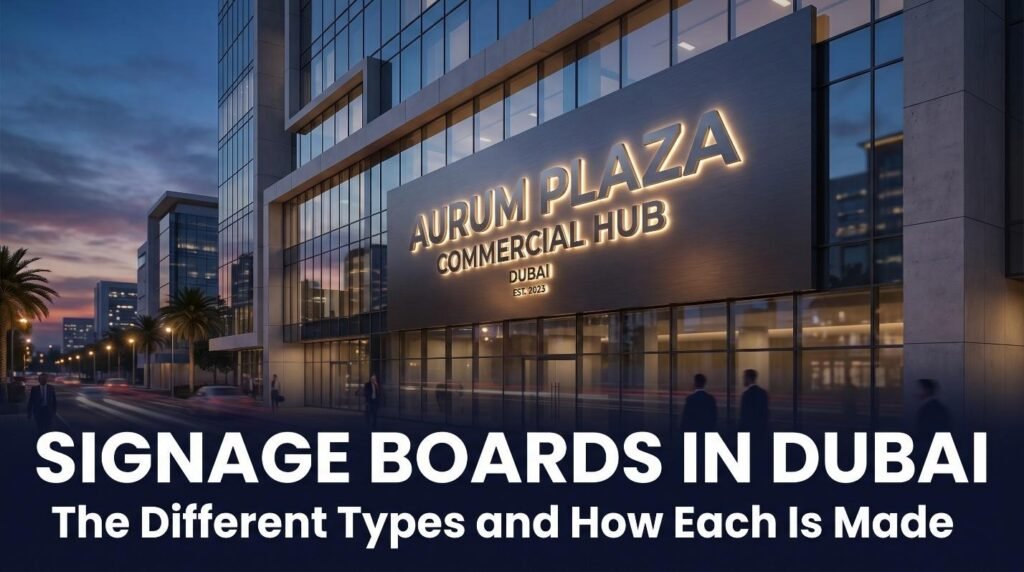
Dubai’s commercial environment, above all, runs on signage. Consequently, every retail unit, office tower, hotel, and restaurant carries some form of it. The correct type depends on the position, the message, and how long the board needs to last in Dubai’s climate.
Furthermore, understanding the different types helps businesses in Dubai brief their signage company correctly — and avoid the common mistake of specifying the wrong type for the position, only discovering the problem after installation.
What Are the Main Types of Signage Board in Dubai?
Fascia Signage Boards
Specifically, a fascia board mounts directly to the front face of a building or shopfront. Moreover, it is the most widely used type across Dubai’s retail, hospitality, and corporate environments. Furthermore, it is what most people picture when they think of a business sign — a flat panel with a logo and business name, positioned above the entrance or along the building facade.
Fascia boards in Dubai typically use aluminium composite panel (ACP) as the substrate. PVDF-coated ACP handles Dubai’s outdoor UV conditions significantly better than polyester-coated alternatives. Therefore, signage industries in Dubai have moved to PVDF as the outdoor standard — PVDF holds its finish for 8 to 12 years in direct sun. Polyester coating in the same position shows visible degradation within 3 to 4 years.
Dimensional Letter Boards
Dimensional letter boards use individually fabricated letters or logos mounted directly to a building facade. Each letter stands proud of the wall surface. Consequently, this creates depth and shadow that flat printed panels cannot replicate. Consequently, dimensional lettering communicates a premium brand positioning that fascia-mounted graphics alone do not achieve.
Moreover, stainless steel, acrylic, and aluminium are the most common materials in Dubai’s signage fabrication market. Grade 316 stainless steel is the correct specification for coastal positions — Marine-adjacent areas in Dubai’s Creek, Marina, and JBR zones where chloride-rich air attacks standard grade 304 over time.
Illuminated Signage Boards
Illuminated signage boards integrate LED lighting into the board structure. Front-lit, back-lit, and halo-lit configurations serve different visual objectives and building facade types. Moreover, illuminated boards are the standard specification for any Dubai business that operates beyond daylight hours — which, in this market, covers most retail and hospitality environments.
However, LED systems for outdoor illuminated signage in Dubai need specifying for Gulf ambient temperatures. Consumer-grade LED drivers in sealed cabinets under direct Dubai summer sun operate above their rated temperature range. Consequently, Gulf-rated drivers — designed for sustained operation at Gulf temperatures — resolve this at a modest additional cost.
Outdoor Signage Boards and Hoardings
Outdoor signage covers building wraps, site hoardings, roadside boards, and any signage positioned in a fully exposed outdoor environment. This category is one of the highest-volume applications across Dubai’s active construction and development market.
Consequently, material specification for outdoor signage in Dubai is more demanding than for sheltered or indoor positions. Sandstorm abrasion, UV radiation at Gulf intensity, and coastal humidity all work on unprotected materials continuously. Furthermore, cast vinyl with UV-rated overlaminate is the correct graphic media for outdoor signage in Dubai — calendered vinyl without overlaminate shows visible fading within 2 to 3 years in the same outdoor conditions.
Pylon and Totem Boards
Pylon and totem boards are freestanding signage structures — positioned at the road boundary of a commercial property rather than on the building facade itself. They appear across Dubai’s petrol stations, shopping centres, and hotel developments where the building sits back from the road.
Specifically, the function of a pylon board is roadside visibility — communicating the brand to drivers approaching at speed, from a distance where a facade-mounted sign would not be legible. Therefore, pylon boards are designed for a completely different viewing context than building-mounted signage. Letter height, contrast ratio, and illumination all reflect this roadside viewing condition. A fascia board serves a completely different context.
Wayfinding and Directory Boards
Wayfinding signage directs people through complex commercial environments — office towers, retail centres, hotel campuses, and mixed-use developments. In Dubai’s large-scale commercial environment, wayfinding is a discipline in its own right within the signage industry.
Moreover, a well-designed wayfinding system is largely invisible — visitors move through the space without needing to stop and think about where they are going. However, a poorly designed system creates friction at every decision point throughout the building’s operational life. Specifically, the problem with most wayfinding failures in Dubai is not the quality of the signs themselves — it is that the information architecture was resolved after the building design was finalised rather than as part of it.
Large Format Printing and Graphic Displays
Large format printing covers printed graphic applications that communicate brand visuals at scale — window graphics, wall murals, vehicle wraps, exhibition graphics, and retail display prints. Additionally, a branding company in Dubai uses large format printing as part of the full brand environment — printed graphics on walls, floors, and surfaces working alongside fabricated signage to create a cohesive brand experience.
Furthermore, large format printing in Dubai’s signage industry operates at print widths up to 5 metres on specialist wide-format printers. The graphic media — the material the print goes onto — determines how long the output lasts. UV-stable substrates and UV-overlaminated print outputs perform correctly in Dubai’s outdoor and high-UV interior environments. Standard indoor media in direct sun positions degrades visibly within months.
Exhibition Display Stands
Exhibition display stands are a specialist category — temporary branded structures used at trade shows, product launches, and brand activations across Dubai’s major venues. The Dubai World Trade Centre and Expo City host significant volumes of regional and international exhibitions annually. Therefore, exhibition display stands represent a high-volume category within the signage industry Dubai-wide.
Exhibition stands differ from permanent signage in one critical way — they assemble, perform at the event, and dismantle without damage, ready for the next activation. Furthermore, the fabrication standards for exhibition display stands balance visual quality with the requirements of repeated assembly and transport.
What Does a Signage Company in Dubai Handle?
A full-service signage company in Dubai manages every stage — site survey, design, signage fabrication, and installation. The distinction between a supplier and a full-service signage fabricator matters in Dubai’s commercial market. However, a supplier sells a product off the shelf. A fabricator designs and builds the specific solution for the specific position and brief.
Signage industries that handle the full process in-house carry accountability from design intent through to installed result. Nevertheless, those that separate design, fabrication, and installation between different parties create gaps — and gaps in signage projects typically surface at installation, when the deadline has no flexibility.