Introduction
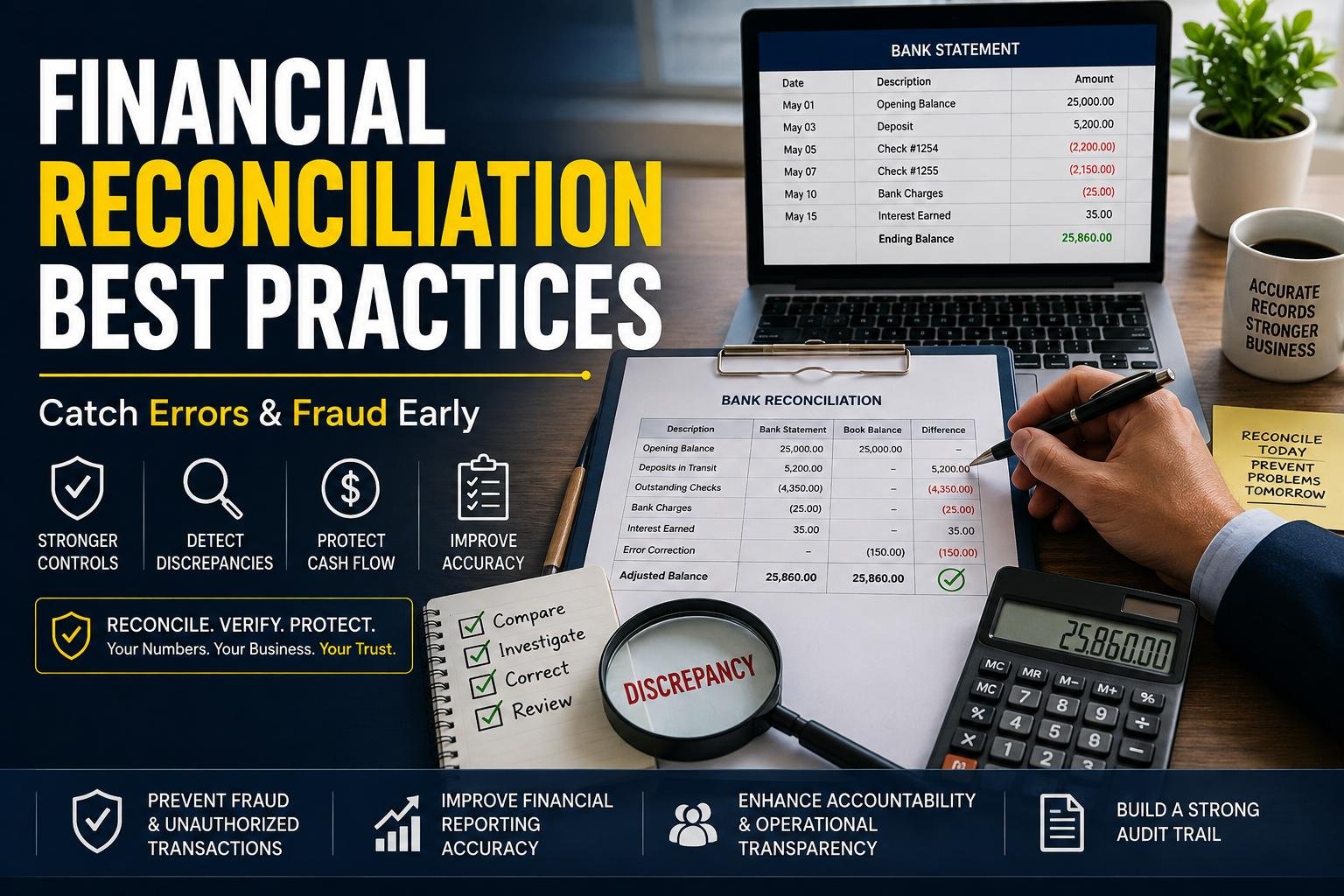
One of the most vital detective controls in an organization’s financial and accounting management system is financial reconciliation. It includes comparing the financial records of the various sources, drawing out discrepancies from the records, finding out what causes them, and making the necessary adjustments to the financial records so that the books of the organization are accurate and complete. By doing this regularly, finance teams can ensure a safe cash flow, catch accounting mistakes, stay on top of unauthorized transactions, and notice suspicious activity in time so it doesn’t become a major financial burden. Bank reconciliation, vendor reconciliation and general ledger reconciliation are some of the most critical procedures. In this way, for instance, an organization can grasp how the activity in their bank accounts should match the accounting records by following existing guidelines for bank reconciliations. Management should not consider reconciliation as a normal bookkeeping process but an integral part of the control aspect, which gives an independent source of information on whether the financial information that is recorded can be relied upon.
Financial Reconciliation
Financial reconciliation is the systematic effort to compare two (or more) series of financial data to establish that they are in agreement. One source can be an organization’s accounting records while the other can be a bank statement, vendor statement, subsidiary ledger or supporting schedule. If the balances or transactions do not match, the finance team will trace the discrepancy to identify any timing issues, accounting mistakes, missing transactions, incorrect amounts, unauthorized transactions or other valid causes. The goal is to not only match two numbers, but to show that the organization’s financial statements are based on credible evidence. Reconciliation is thus based on a comparison, investigation, documentation, correction and review. If these activities are repeated on regular basis, discrepancies will be detected at a relatively early stage of the transactions and thus the risk of errors or fraudulent transactions will be minimized if these differences are identified at this stage.
Importance of Reconciliation for the Financial Control
Regular reconciliation adds to the control of finance as it provides a detective control over accounting processes. While preventive controls can be a great way to prevent unwanted transactions, it is not possible to completely eliminate the risk of error and fraud with effective approvals and access controls. Reconciliation is the second defense, which involves comparing recorded transactions with evidence that is independent of or kept separately from the recorded transactions. When an employee makes a mistake in a payment, fails to make a record of an entry, makes a duplicate invoice or tries to hide an unauthorized transfer, the error or omission might be seen during the process of reconciling. This process can also help safeguard cash flow by helping you determine if any withdrawals have been made for which you were not expecting, if any deposits have not been received, if double payments have been made, or if the bank has made some errors in its charges. Continuous reconciliation will make the financial statements more reliable over time, aid in decision making by management and establish an audit trail of financial information being monitored and not just accepted.
1. Bank Reconciliations
How to Reconcile Bank Statements?
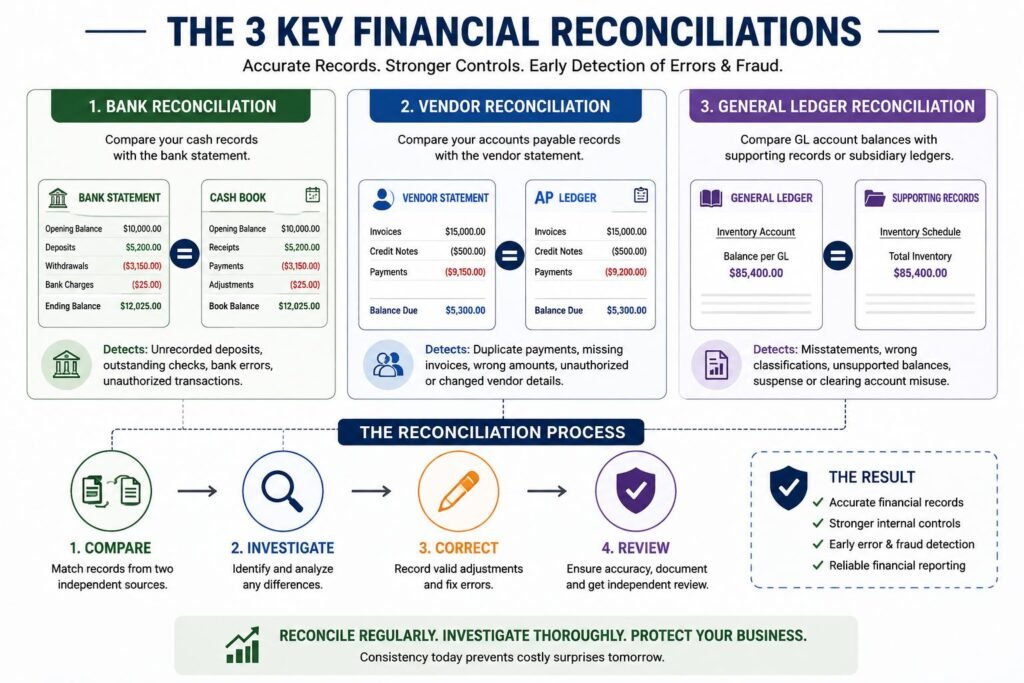
Bank reconciliation involves comparing the balance in an organization’s cash/bank ledger to the bank statement. Temporary differences can occur when the two balances are different due to the time of recording of transactions. For instance, a business could book a deposit on their books as soon as the money is deposited, but the bank doesn’t process the deposit until a later date. Likewise, there is a possibility that there are outstanding checks that were recorded by the organization, but not presented to the bank. Bank statements may also show bank fees, interest earned, direct debits, electronic transfers and more, prior to posting to the organization’s accounting records. A proper reconciliation will show these differences, identify the legitimate timing differences and what needs accounting adjustments and finally determine the reconciled cash balance. This is especially beneficial as it presents an outside record that can assist monetary groups recognize transactions that might otherwise go undetected.
Step-by-Step Bank Reconciliation Procedure
The first step towards bank reconciliation is to get the bank statement and cash ledger of the organization for the same period. The finance professional should review the opening balance, deposits, withdrawals, transfers, checks, electronic payments and other transactions on both records to verify that they are equal. If there is an agreement, then these transactions should be matched and cleared, if not then they should be added to a reconciliation list for investigation. Afterwards, it is necessary to look for valid timing discrepancies, like outstanding checks or deposits in transit. The next step is for the accountant to find bank charges, interest, direct debits or any other things that are on the bank statement but do not appear in the accounting system. The necessary journal entries should be made and approved prior to updating the accounting records. Lastly, the adjusted book balance should match the adjusted bank balance, and the reconciliation should be signed and/or observed by an appropriate supervisor.
Why Bank Reconciliations are important in detecting Errors and Fraud
There are a number of clues that can be spotted in bank reconciliations that could be due to accounting mistakes or fraud. If one is withdrawing money, transferring money electronically to a place no one has heard of, making a duplicate payment, making a check payment but one is missing, or an odd payment, it needs to be investigated promptly. For instance, if a payment is recorded on the accounting books to a familiar supplier, but the banking transaction is recorded in a foreign account, then this could be an unauthorized payment. A deposit that appears on the books but not the bank statement could be a timing error, but might warrant a special investigation if it has been outstanding for an unusual amount of time. Recurring unexplained adjustments, transactions in close proximity to reporting deadlines, unusual reversals and manual journal entries to cash accounts are some adjustments that should be monitored by finance teams. Reconciliation alone is not an infallible tool to detect fraud, however it does provide a chance to detect an anomaly in good time for investigation by management.
How often do Bank Reconciliation Need to be done?
The frequency of the rescheduling of the reconciliation may vary based on the volume of transactions, cash exposure, risk and financial reporting requirements of the organization. Formal bank reconciliations usually occur at least monthly for an organization with substantial cash flow transactions, many bank accounts, or a greater vulnerability to fraud. For smaller organizations with relatively small numbers of transactions, monthly might be sufficient as long as the level of risk is properly managed. It might be difficult to conduct investigations if a bank account is not reconciled for several months as employees might forget transactions and available documentation may not be easily found. Generally, high-risk accounts should be the ones to be paid more attention than low activity accounts. Management should therefore set up a documented reconciliation schedule according to risk and not schedule the same frequency for each account without taking into account the volume of transactions and financial exposure.
2. Vendor Reconciliations
What is Vendor Reconciliation?
Vendor reconciliation is a comparison of an organization’s AP records to the statement or transaction records from a vendor. To establish whether the accuracy and completeness of recording of the following: Invoices, credit notes, payments, outstanding balances and other transactions. In cases of accounts payable errors, there is a chance that the duplicate payments may be made, the invoice may go missing, the total amount payable may be wrong, the supplier may become upset, and cash flow can be stressed. This is why Vendor Reconciliations are so important. Finance personnel reconcile the supplier’s statement with the finance’s accounts payable ledger and supporting documents in the reconciliation. The differences may be due to an invoice not being recorded, a payment that did not appear on the supplier’s records, a credit note that was not included or a transaction that was incorrectly posted. When examining these disparities prior to closing the accounting period, organizations can keep up more exact liability balances and limit the danger of paying the incorrect quantity or paying the identical liability twice.
The Step-by-Step Vendor Reconciliation Procedure
Finally, the vendor reconciliation process should start with a vendor statement to get up to date information and then compare it to the organization’s accounts payable system. An invoice should be cross-referenced with the appropriate purchase order, receiving document and accounting entry (where applicable). Payments that are entered into the entity should then be matched to payments that are accepted by the vendor and credit notes and adjustments should also be checked. Any invoice that is on the vendor statement, but does not show up in the accounting system should be looked at and either verified as received or determine if it should have been accrued or recorded. Likewise, if there are payments that are documented on the organization’s records but are not on the vendor statement, they could be due to timing issues, or the vendor may need to be confirmed. When discrepancies are found, the finance team should record why each discrepancy occurred, determine if it is an approved correction and make those corrections; however, it is best to not leave items “nagged” without explanation as they may lead to other discrepancies.
How Vendor Reconciliations Can Help Stop Fraud
Vendor reconciliation can be valuable when conducting a procurement and payment fraud investigation. Fraudulent activity can be through using fake vendors, inflated invoices, duplicate invoices, unauthorized payments, changed supplier bank accounts or collusion between employees and suppliers. Unusual transactions can be identified through comparing the vendor statements with the transactions that have been recorded internally. For instance, two invoices that are showing slightly different invoice numbers could be a result of an administrative error or an effort to get two payments for the same product or service. If there is a discrepancy in the vendor balance due to supporting paperwork and payment history, it should also be investigated. Organizations should enhance the process by not relying on their suppliers to confirm changes to their bank accounts, by reviewing unusual credit notes, by tracking for duplicate payments, and by separating the creation of vendor accounts from the authorizing of payments. Reconciliation is most effective if it is supported by segregation of duties, proper approvals and any unusual discrepancies are subject to an independent review.
Vendor Reconciliation be Performed at least once a Month.
The frequency of vendor reconciliations should be proportional to the number and value of transactions, and the reliance on specific vendors. Strategic suppliers, those that pay significant amounts to vendors and those with high volumes may need more frequent monitoring or monthly reconciliation. Lower volume suppliers might be reconciled on a quarterly basis but important balances should be checked prior to the financial statement closing. It’s also advisable that organizations reconcile their vendors before the significant reporting dates and explore and settle on outstanding balances that haven’t been settled for some time if they haven’t. Unresolved vendor differences can result in duplicate payments, unrecorded liabilities or vendor balances being incorrect. Creating an aging schedule of any reconciliation differences can aid management determine products that have not been settled for an abnormally lengthy period. The goal should be to make sure that payables balances are backed with a true and valid need and that cash in the organization is utilized just for sanctioned and accurately documented business purposes.
3. General Ledger Reconciliations
Understand the concept of General Ledger Reconciliation.
A General Ledger Reconciliation is the process of reconciling the balances in the GL with the supporting documentation or subsidiary records that are reliable. General ledger accounts can be cash, accounts receivable, accounts payable, inventory, fixed assets, loans, payroll liabilities, taxes, accrued expenses, prepaid expenses, or equity accounts. For each important balance, there should be some evidence that shows how the balance was calculated and that the balance is appropriate. For instance, a fixed asset account could be compared to an asset register and a loan could compare to a lender statement and repayment schedule. Payroll reports and payroll records can be compared with a payroll liability account. Reconciliation process ensures the completeness, accuracy, proper classification and support of account balances. If not addressed, these accounting errors can become a part of the general ledger and impact management reporting and financial statements later in the process.
Step-by-Step General Ledger Reconciliation
The initial step in the process is to determine which general ledger account is being reconciled and then getting the ending balance from that account for the desired period. The finance team should then collect the supporting records needed to support that balance and reconcile each of the components to the general ledger. Differences should be classified based on the cause of the difference, such as: timing, missing items, incorrect classification, duplicate transactions, calculation, or unsupported balances. Significant differences should be looked into individually don’t just adjust to “make up” the difference. If a correction is required, an appropriate journal entry must be made, documented and authorized as per the authorization procedures of the organization. Once corrections are posted, the account should then be reconciled again to ensure that the account is now “Supported”. Completed reconciliation shall contain signature of preparer, date of preparation, supporting evidence, reconciling items, and evidence that reconciliation has been independent reviewed.
Understanding how General Ledger Reconciliations Aid Fraud Detection.
With general ledger reconciliations, manipulation that might not be found through transaction investigations can be uncovered. A fraudster can try to hide unauthorized transactions on a suspense account or other accounts that are not checked frequently, such as a miscellaneous expenses account or a clearing account. An abnormal or unexplained balance can thus be a key warning indicator. Significant manual journal entries, frequent adjustments, reconciling items that are not current and unusual account activity or movements near the end of an accounting period should be examined. Reconciliation can also reveal cases where transactions have been made in the wrong accounts to conceal the real nature of the transactions. For instance, a wrong expense could be booked in the assets account, or a payment may be made by someone who is not authorized and posted to a clearing account for a short time. Such practices are more difficult to hide when supporting documentation is reviewed regularly and such a review reminds employees of their accountability for financial reporting.
Setting up an Effective Reconciliation Schedule
A good reconciliation programme should clearly specify who should prepare each reconciliation, at what frequency each reconciliation should be prepared, what supporting documents should be required for each reconciliation, and who should do the independent review. Sample tasks may be monitoring of cash activity on a daily basis, bank reconciliation on a monthly basis, major vendor accounts monthly, and general ledger accounts monthly for significant accounts on the balance sheet. Generally, low-risk accounts can be reviewed quarterly, and high-risk accounts reviewed more often. Individual employees who are not assigned to the same process should not initiate transactions, hold records, perform transactions reconciliations and sign off on transactions adjustments without any oversight as there is an increased opportunity for fraud if a single employee has too much control. The segregation of duties of ownership and clear ownership means the reconciliation process is more reliable and discrepancies are investigated, not ignored.
Best Practices for Stronger Financial Reconciliation
There are a number of practices that can greatly enhance the effectiveness of the reconciliation processes. Firstly, it’s important to reconcile accounts on time, not letting the differences build up. Second, all reconciling item explanations and supporting evidence should be clear. Thirdly, unresolved differences should be preserved in an “aging” process so that old items are treated more. Fourth, the transactions that are being reconciled should not be under the exclusive control of the preparer of the reconciliation. Fifth, completed reconciliations should be checked by supervisor or other independent individuals and unusual explanations should be challenged. Sixthly, there needs to be a procedure for significant or suspicious differences to be escalated. Technology can also enhance it by automating the transaction matching, detecting duplicate transactions, flagging for abnormal transactions and keeping electronic audit trails. Automation, though, must complement, not supplant, the exercise of professional judgment. Two records do not match, and human experts in finance still need to discover the cause of the discrepancy and whether it is a simple timing error, an accounting error or a potential violation.
Some Common Reconciliation Errors
Most often the mistake is to view reconciliation as a mechanical process where discrepancies are closed out to get the balances to match. This can be risky as there could be a big mistake in the accounting records or even a fraudulent transaction that has gone undocumented. A common error is not reconciling old reconciling items and then assuming that they were just not cleared up by the General Ledger accountant. Organizations should also not use a verbal explanation alone as this may be difficult to substantiate in internal or external audits. Reconciliations must be done as soon as they should be, not months after transactions have been made, especially if they are big cash transactions. In addition, management should not approve an Unexplained Adjustment without independent review by management. Reconciliation is not just about matching the number at the bottom of a spreadsheet; it’s about understanding and validating differences.
Conclusion
The process of financial reconciliation is essential for the proper financial control as it helps in determining that the accounting records are accurate, complete and have supporting evidence. Bank reconciliations support organizations in tracking cash, identifying unauthorized or unusual transactions, and vendor reconciliations support organizations in its verification of liabilities, in order to prevent duplicate payments and inconsistencies between the supplier and the internal records. General ledger reconciliations offer a more general level of assurance over the completeness and accuracy of significant balances in the financial statements. If these procedures are followed at the right time, kept in writing and independently reviewed, they can be a formidable deterrent to error and fraud. Consistency is key the more, the greater the benefit, and discrepancies, any discrepancies, should be investigated as soon as possible, corrected appropriately, and the items not resolved left unappealed with the next reporting period. Reconciliation can be part of the daily financial management process, helping to safeguard cash flow, enhance accountability, boost reporting accuracy, and uncover financial issues early on to prevent bigger losses impacting the business.
Get more well researched information about Financial Reconciliation Best Practices here.