Introduction
Computers have taken root in all aspects of modern life which includes industry, communication, health care, education, and entertainment. It is true that we picture laptops and smartphones first when we think of computers, but the field of IT is much wider than that. We have many types of systems which are designed for specific purposes and by understanding the different Types of Computers we see how technology is applied to a variety of fields.
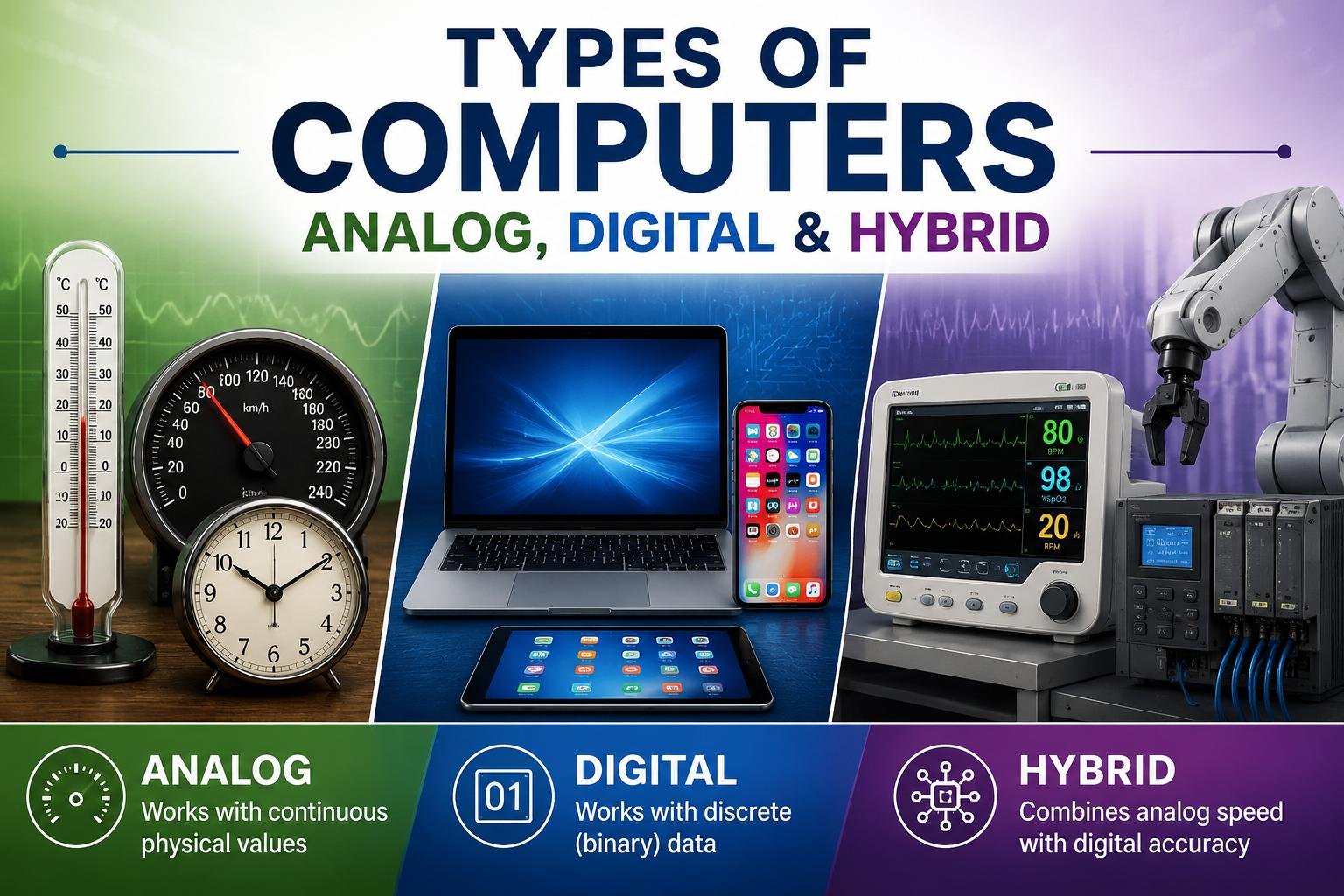
Analog computers, digital computers and hybrid computers. We see that each type is different, they process data in unique ways, and which they are designed for different uses. Analog systems work with continuous data, digital systems deal in discrete binary info, and hybrid systems put together the best of both.
In this article we will go in depth into these three categories, compare their features out, look at their pros and cons, and talk about what roles they play in today’s tech landscape.
Understanding the Different Types of Computers
The category of Types of Computers is a classification of how info is processed which in turn helps users out with what each system does and how they are designed.
The three main categories include:
- Analog Computers
- Digital Computer Systems.
- Hybrid Computers
Each category operates in different ways and has distinct applications.
Analog Computers
What Are Analog Computers?
Analog computers present a different design to what we see in today’s computers which are what you may call digital. They do not use numbers or binary digits for processing as we see in modern computers which do everything from adding a number in a word document to that in a spreadsheet at the same time. Instead analog computers work with physical variables which may be represented by temperature, pressure, voltage, speed or motion.
These computers use continuous variation of physical properties to represent data. For instance a thermometer which is a very basic analog device does so by measuring temperature in a continuous range instead of at fixed numbers.
Analog computers did until recent past have a greater use. Although they are less so today, which is to say that their use is more limited, they still do well in very specific scientific and industrial settings.
Characteristics of Analog Computers
Analog computers have several defining features:
- Ongoing Data Processing: They work with continuous value changes rather than distinct numbers.
- Present Time Computation: An analog systems present info instantly by directly measuring physical quantities.
- Speed for Certain Tasks: They are very quick in the solution of problems related to physical systems.
- Low resolution: Analog computers’ output is a result of physical measurements which in turn may have more error than what digital computers present.
- Custom Design: Most analog computers are for a specific task which is different from general purpose computing.
Advantages of Analog Computers
- Fast Processing: Analog systems do calculations in real time without transforming data to binary.
- Effective for Simulations: They do very well at modeling physical systems which include weather patterns or mechanical movements.
- Efficient with Continuous Data: They report on variables such as temperature, pressure, and electrical signals.
Disadvantages of Analog Computers
- Lower Accuracy: Results may include some error due to signal variation or measurement issues.
- Limited Storage: An in large scale analog systems data storage is not a strong point.
- Difficult to Reprogram: Most analog computers are for special tasks which do not change.
- Obsolete in Many Areas: Digital systems have taken over analog in most fields.
Examples of Analog Computers
Some common examples include:
- Speedometers
- Thermometers
- Analog clocks
- Flight simulators
- Old industrial control systems
Uses of Analog Computers
Analog computers are still employed in fields that require continuous data processing.
- Scientific Research: Researchers use analog models in physical processes.
- Engineering: Engineers use analog devices for machinery monitoring and control.
- Medical Equipment: Some medical devices use analog principles in signal monitoring.
- Aviation: Flight simulators use analog computing for the most realistic control models.
Digital Computers
What Are Digital Computers?
Digital computers are what we see the most of today. They process info in what is basically a 0 or 1 which we also term as bits.
Unlike in analog systems which are continuous in nature, digital computers work with discrete data and also use programmed instructions for processing. Also these computers are very accurate, flexible and are able to store large amounts of information.
Examples are of smartphones, desktop computers, laptops, tablets, calculators and servers.
Characteristics of Digital Computers
- Digital Processing: Digital computers use base 2 codes for information processing and storage.
- Great Accuracy: They are very accurate.
- Storage of data: Digital we have the ability to store large volumes of info which we can use in the future.
- Programmational ability: Users can install a variety of software for different tasks.
- Variety: Digital computers do many tasks in various industries.
Advantages of Digital Computers
- Accuracy: Digital systems produce very dependable and consistent results.
- Easy Data Storage: They are able to save, retrieve, and organize large volumes of info.
- Flexibility: Digital computers support a wide range of applications from game to scientific research.
- Automation: They perform repetitive tasks and increase productivity.
- Connectivity: Today’s digital computers enable the internet and computer networks.
Disadvantages of Digital Computers
- Dependence on Electricity: They need a constant power supply.
- Cybersecurity Risks: Digital systems are at risk of hacking, malware, and data breaches.
- Complexity: Advanced systems may require technical skill to use or repair.
- Electronic Waste: Frequent updates which in turn cause environmental issues related to e-waste.
Examples of Digital Computers
Examples include:
- Desktop computers
- Laptops
- Smartphones
- Tablets
- ATMs
- Gaming consoles
- Smart TVs
Uses of Digital Computers
Digital computers have taken over almost all areas of modern life.
- Education: Students that which they do for learning, research and communication.
- Business: Companies use digital platforms for accounting, management, and marketing.
- Healthcare: Hospitals use digital computers for health records and diagnosis.
- Banking: Banks perform secure transactions via digital computing systems.
- Entertainment: Digital technology is what supports streaming services, gaming platforms, and social media.
Hybrid Computers
What Are Hybrid Computers?
Hybrid computers are which of analog and digital computers. They work with continuous as well as discrete data which in turn enables them to do complex tasks very efficiently.
These systems have analog elements for speed and real time measurement and at the same time use digital components for accuracy and storage.
Hybrid computers are found in special environments that require precision and speed.
Characteristics of Hybrid Computers
- Blend of Analog and Digital Elements: They combine the benefits of both computing methods.
- Dynamic Data Processing: Hybrid systems handle continuous inputs quickly.
- Very Precise: Digital elements improve the accuracy of results.
- Specialized Applications: Hybrid computers are used in science and industry.
- Advanced Features: They are able to solve very complex issues with great efficiency.
Advantages of Hybrid Computers
- Speed and Accuracy: Hybrid systems present analog speed and digital precision.
- Efficient Data Handling: At the same time they process continuous and discrete data.
- Useful for Complex Applications: They are perfect for simulations, medical devices, and industrial control.
- Reliable Performance: Hybrid systems report stable results in tough environments.
Disadvantages of Hybrid Computers
- High Cost: They are expensive to create and keep up.
- Complexity: Hybrid systems’ operation requires.
- Limited Availability: They don’t usually see use in personal computing.
- Maintenance Challenges: Repairing hybrid systems is a job for experts.
Examples of Hybrid Computers
For example:
- Intensive care monitoring systems
- Petrol pump measurement systems
- Weather forecasting systems
- Scientific laboratory equipment
- Industrial process control systems
Uses of Hybrid Computers
- Healthcare: Hospitals that which use hybrid systems for patient care and diagnosis.
- Aerospace: Aircraft and space vehicles use hybrid computing for navigation and simulations.
- Weather Forecasting: Meteorologists which are into the use of multiple models for better results apply hybrid systems which in turn are used for analysis of environmental data.
- Industrial Automation: Factories use hybrid computers for production processes.
- Scientific Research: Researchers which they use for in depth simulations and calculations.
Comparison between the Types
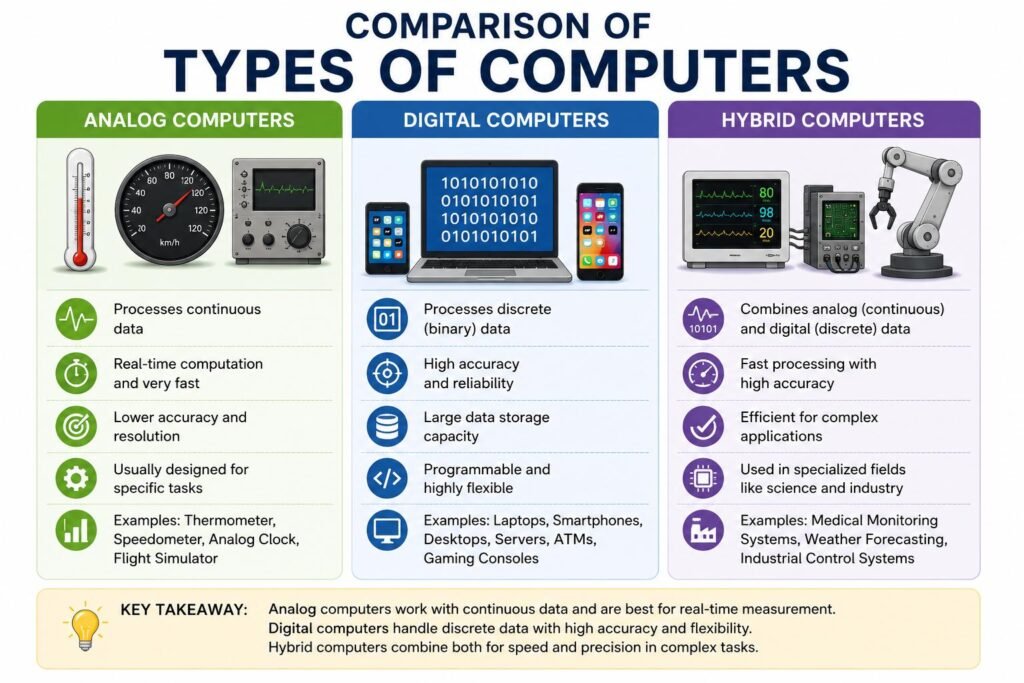
Analog, digital and hybrid computers also have key differences. Analog systems work on continuous data and therefore are ideal for real time measurement and simulation. While very fast for some tasks they also are not as accurate or flexible as other systems.
Digital computers also do this which is the opposite of what analog computers do. They are very precise, flexible and also store large volumes of info. These systems which we use today are preponderant in the field of computing they do a wide range of tasks from running the internet to performing AI functions.
Hybrid computers present a mix of analog and digital components. In them we see the speed of analog which is very fast also the accuracy and storage features of digital systems. These features make them a very good fit for specialized fields like health care, weather prediction, and industrial automation.
Today analog computers see less of a role in which we partake, digital computers do which is in everything we use daily. In certain industries that require advanced data analysis and real time results hybrid systems still which play very key roles.
Evolution of Computer Systems
Computer technology has revolutionized how we process info.
Early Analog Era
At first computers were analog machines which did scientific calculations and did measurements. We had mechanical and electrical devices that assisted scientists and engineers with complex equations.
Rise of Digital Computing
Digital computers took over because they provided greater accuracy, programmability and storage. The invention of transistors, microprocessors and integrated circuits turn brought about this change.
Emergence of Hybrid Systems
As in the push for better performance and efficiency we saw the development of hybrid systems which combined analog and digital technologies for special purposes.
Role of the Different Types of Computers
Learning out about Different Computer Types is essential, it helps people to see how technology works in many fields.
Better Technology Awareness
People see what each system does best and which it falls short in.
Career Opportunities
Computer systems knowledge is applied in fields like engineering, health care, information technology, and data science.
Improved Decision-Making
Businesses and Organizations may choose the right systems for their particular needs.
Enhanced Learning
Students’ base in computer science and info tech concepts is strengthened.
Present Day Relevance of Analog, Digital, and Hybrid Computers
In spite of the fact that digital systems are the preponderance in modern computing analog and hybrid technologies still play.
- Analog Systems Today: Analog techniques still play a role in sensor technology, signal processing, and control systems.
- Digital Dominance: Digital computers are the base for the internet, artificial intelligence, cloud computing, and modern communication systems.
- Hybrid Innovation: Hybrid systems are used in scientific research, health care equipment, and industrial automation.
Future Trends in Computer Systems
In the years to come we will see the development of what is beyond present hybrid technology
Artificial Intelligence Integration
AI at present is seeing great use of hybrid processing models.
Quantum Computing
Quantum computers may present new forms of computation which do not exist in today’s analog and digital systems.
Internet of Things (IoT)
IoT devices incorporate sensors and digital processing that is a result of hybrid computing.
Advanced Automation
Industries will see an increase in the use of specialized computing systems for robotics and intelligent manufacturing.
Conclusion
In the fields of computer science we see that which types of computers are covered is a very valuable topic. Analog computers do very well with continuous data and real time measurement, digital computers we see to rule in everyday computing for their accuracy and flexibility, and also we have hybrid computers which put the two together for advanced applications.
The types of computers are used for different purposes in many industries which include health care, engineering, education, manufacturing, and science. Although digital computers are the primary types used today analog and hybrid systems still have large roles to play in specific environments.
As technology advances, the relationship between analog, digital and hybrid systems will continue to play a role in the development of new innovations and the direction of computing.
Get more well researched information about the types of computers here.