Introduction
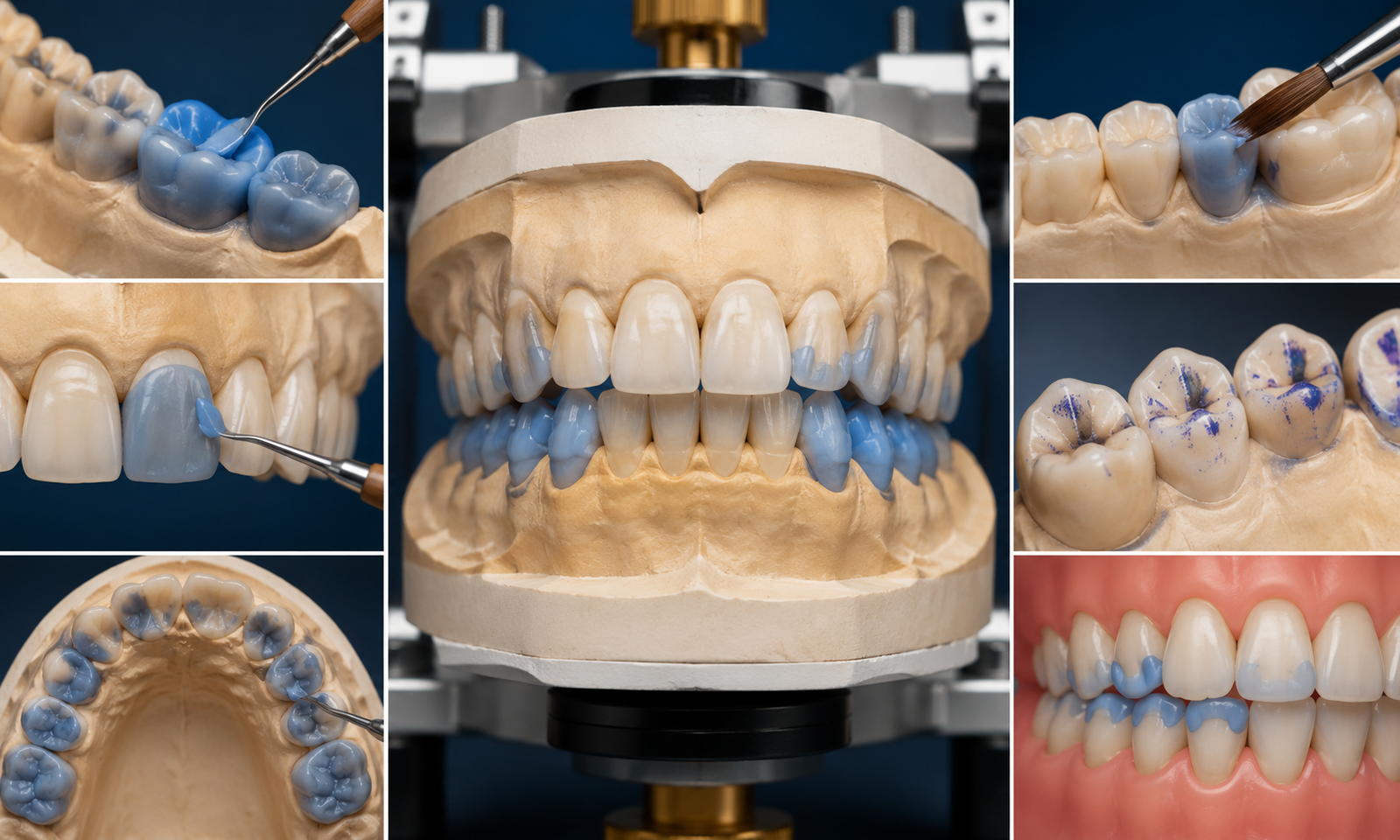
Dental waxing is among the most basic tasks of learning the morphology and occlusion of teeth in preclinical dental training. The process sees the creation of tooth structures in wax, to replicate real-world procedures of restorative treatment. Waxing is not a mere manual activity as it is highly structured and a learner gains precision, a sense of space, and a critical insight into the essence of occlusal harmony.
Dental waxing represents an intermediate between theoretical knowledge and clinical practice. The recreation of the natural contours, cusps, grooves and contact points of teeth helps students to understand how the restorations need to work in the oral environment. The process conditions the hands and mind together so that future clinicians can condition themselves at the same time to produce restorations that are anatomically accurate, as well as functionally efficient.
Understanding Ideal Occlusion
What Is Ideal Occlusion?
Ideal occlusion is an optimal contact and alignment of upper (maxillary) and lower (mandibular) teeth. It guarantees effective mastications, adequate loading of forces, and long-term oral health conditions. In this state:
- There is even contact between teeth during closure.
- The distribution of forces is along the lengthy axis of teeth.
- Tooth, muscle and temporomandibular joints are in harmony.
It is essential to balance restoration in restorative dentistry. The possibility of any deviation may result in tooth wear, fractures, or temporarily mandibular disorders.
Why Waxing is Important in Occlusion.
Dental waxing enables the students to replicate these perfect relationships under a regulated setting. They are taught the interaction of occlusal surfaces during function by modeling the wax in anatomically correct forms through teeth. This includes:
- Centric contacts
- Excursive movements (lateral and protrusive)
- Functional cusp relationships
Waxing, by repetition, creates an intuitive awareness of how even slight morphological alterations can cause an occlusion change.
Dental Waxing Role in Skill Development.
Enhancing Manual Dexterity
The hand control and precision needed during dental procedures are remarkable. The waxing exercises teach the students:
- Adequately play small instruments with precision.
- Apply controlled pressure
- Learn to make consistent hand movements.
These are the same skills that can be directly translated to clinical procedures like cavity preparation, placing of crowns, and adjustments of prosthetic teeth.
Improving Anatomical Accuracy
The morphologies of each tooth are different. Waxing aids students to internalize:
- Cusp heights and inclines.
- Groove designs and fossae.
- Contact areas and marginal ridges.
The recurring building up of these features enable students to create a mental map of tooth structure which is necessary to produce restorations that look natural.
Building Spatial Awareness
It is essential to understand how the teeth fit in three dimensional nature. Waxing teaches:
- Interarch relationships
- Occlusal plane orientation
- Contact point positioning
This space consciousness can guarantee that restorations will not interfere with the normal jaw movements.
Materials/Instruments used in Waxing.
Types of Dental Wax
Depending on the stage and intent of the exercise; different waxes are used:
- Inlay wax: The wax is normally applied in detail owing to its smooth flow.
- Baseplate wax: It can be employed to accumulate in bulk.
- Sticky wax: Aids in the stabilization of parts.
Essential Instruments
A number of tools are used by students to create and perfect wax:
- Wax carvers (e.g., PKT tools)
- Spatulas
- Bunsen burner or electric wax heater.
- Articulators
All the tools have a certain purpose to bring precision and detail.
Step-by-Step Wax-Up Procedure
The Making the Die or Model.
It starts with a natural tooth model or die. This is the tooth which has to be restored. The model must be:
- Clean and dry
- Properly trimmed
- Attached to an articulator in case of studying occlusion.
2. Die Spacer.
Die spacer is put to form some space where the final restorative material is going to be. This guarantees the appropriate fit and cementation in clinical cases.
3. Initial Wax Buildup
The general shape of the tooth is established by applying a base layer of wax. At this stage:
- Emphasis is on larger than smaller.
- The form of outline is produced.
- Correct height is achieved.
4. Establishing Occlusal Anatomy
This is the most crucial phase. Pupils start to cut:
- Cusps (functional and non-functional)
- Fossae and grooves
- Marginal ridges
Particular emphasis is also put on upholding optimal cusp height and inclination because these dictate the cusp contacts.
5. Refinement of Morphology
Detailed work is done to add the effect of realism:
- Secondary grooves
- Developmental depressions
- Smooth surface transitions
Harmony and accuracy of the anatomy are taken into serious consideration at this stage.
6. Checking Occlusion
The wax-up is put to trial against the opposite arch:
- Identification of contacts can be applied to paper articulation to determine the points of contact.
- Tilting is done to remove untimed contacts.
- Balanced UGW is provided.
7. Final Polishing
To create a natural finish a planned and regular surface of the wax surface. The move will increase aestheticism and accuracy in functioning as well.
Etihad’s Principles of the Occlusal Contact in Waxing.
Centric Contacts
Centric occlusion The point at which the teeth meet in the greatest amount of intercuspation. In waxing:
- The opposing fossae should be contacted by functional cusps (e.g., mandibular buccal cusps).
- Contacts need to be well defined and well spaced out.
Excursive Movements
During jaw movements:
- During anterior guidance, the posterior teeth should be avoided.
- Interferences should be evaded.
Waxing enables the students to make simulations of such movements and how they affect the restorations.
Cusp-Fossa Relationships
Appropriate cusp-fossa associations are imperative towards effective mastication. Waxing teaches how:
- Cusps are inserted into opposite fossae.
- Forces flow in directions that are along tooth axes.
- Function is maintained in a stable state.
Most Dental waxing mistakes.
Overbuilding or Underbuilding
High occlusion may occur due to excess wax and a lack of contact may occur due to a lack of sufficient wax. The two have an impact on function and the need to correct it.
Incorrect Cusp Placement
The abnormal placement of cusps can cause occlusion to be destroyed and result in movement interferences.
Lack of Symmetry
The morphology of natural teeth is balanced. Unilateral waxing may put the aesthetics and functionality on the line.
Ignoring Occlusal Contacts
Lack of occlusion checking may lead to completion of restorations that restore normal jaw functionality.
Educational Value of Waxing in Dentistry.
Clinical Procedure simulation.
The Waxing simulates the real life processes of restoration like:
- Crown fabrication
- Bridge design
- Occlusal adjustments
This renders it a priceless training document prior to exposure to clinic.
Theoretical Knowledge Strengthening.
Students put into practice on lectures what they have learned like:
- Tooth morphology
- Occlusal schemes
- Functional dynamics
This incorporation increases retention and comprehension.
Critical thinking development.
Waxing involves a constant assessment and fine-tuning. Students learn to:
- Identify errors
- Analyze occlusal relationships
- Make precise corrections
Waxing as a Foundation to Restorative Dentistry.
Clinical Practice Transition.
The competencies that were acquired during the waxing have a direct impact on:
- Quality of restorations
- Patient comfort
- Longevity of dental work
By learning to master the art of waxing, the clinicians in question will be in a better position to design extensions that are functional and aesthetic at the same time.
Online Dentistry and Waxing.
Regardless of the growth of the CAD/CAM technology, waxing continues to be used. It provides:
- Basic knowledge of the design of the tooth.
- Understanding of digital processes.
- A foundation on which computer generated restorations should be assessed.
Conclusion
Dental waxing is much more than either an academic or an academic exercise–a foundation stone of dental education. By giving the student a mixture of manual skills and anatomical knowledge, it familiarizes them with the creation of the restorations that would result in optimal occlusion and durability of their functionality.
By using step by step procedures of wax-ups, students learn to re-create the morphology of the natural teeth, establish the appropriate occlusal contacts, and an understanding of the dynamic relationship within the oral cavity. Timely and technical competencies are crucial in providing quality restorative care.
Finally, dental waxing could also be one of the strongest simulation tools, being positioned at the intersection of theory and practice. It provides not only the accuracy, insight, and assurance in dentists of the future, but also in the harmonious interplay of the entire masticatory system.