Introduction
In the current digital age data is inputted, processed, stored and analyzed in seconds. Today’s computers do billions of calculations at a very fast and efficient rate which in turn makes it easy for businesses, governments, and organizations to handle large amounts of info. But before we had modern computer systems data processing there was early data processing tools. Early organizations used specialized machinery to record, sort, and put in order information by hand. Among the most important of these inventions were keypunch and sorter machines which played a basic but very important role in the development of today’s computing systems.
In the late 19th and 20th centuries we saw which machines changed how businesses handled records, statistics, payroll, census info, and inventory management. They put out better and faster ways to work with info which in turn we see play out in today’s computer input devices and automated systems. Looking at which of these early systems worked we can see into the history of computing and also how tech innovation grew through time.
The Historical Background of Early Data Processing Tools
Before the age of electronic computers, organizations kept information on paper records, in handwritten ledgers, and in filing systems. Large institutions like banks, insurance companies, railroads, and government agencies had trouble with the growth of their data. As populations grew and businesses expanded the demand for better info processing methods rose.
In the beginning of data handling we saw the introduction of the punched card system which proved very significant. This system used stiff cards which had holes punched out at certain points to represent data. The punched card method was a result of earlier inventions in the textile field which in turn inspired it, especially the Jacob’s loom which was developed in the early 1800’s. The loom used cards which in turn ran automatic weaves by use of encoded instructions which at the time was quite a novel idea.
Herman Hollerith developed the punched card concept which later was applied to data processing. In the 1890 census he designed machines for the US Census Bureau which ran his tabulating system. Hollerith’s invention which reduced time greatly in processing census data also proved that machines could effectively handle large amounts of info. From his innovations came International Business Machines which became one of the most influential tech companies in history.
Punched cards were a very common medium which in turn brought out the need for machines that would produce, structure, and interpret them. From this came the keypunch and the sort machines which became the main tools in data processing centers all around the world.
Understanding Keypunch Machines
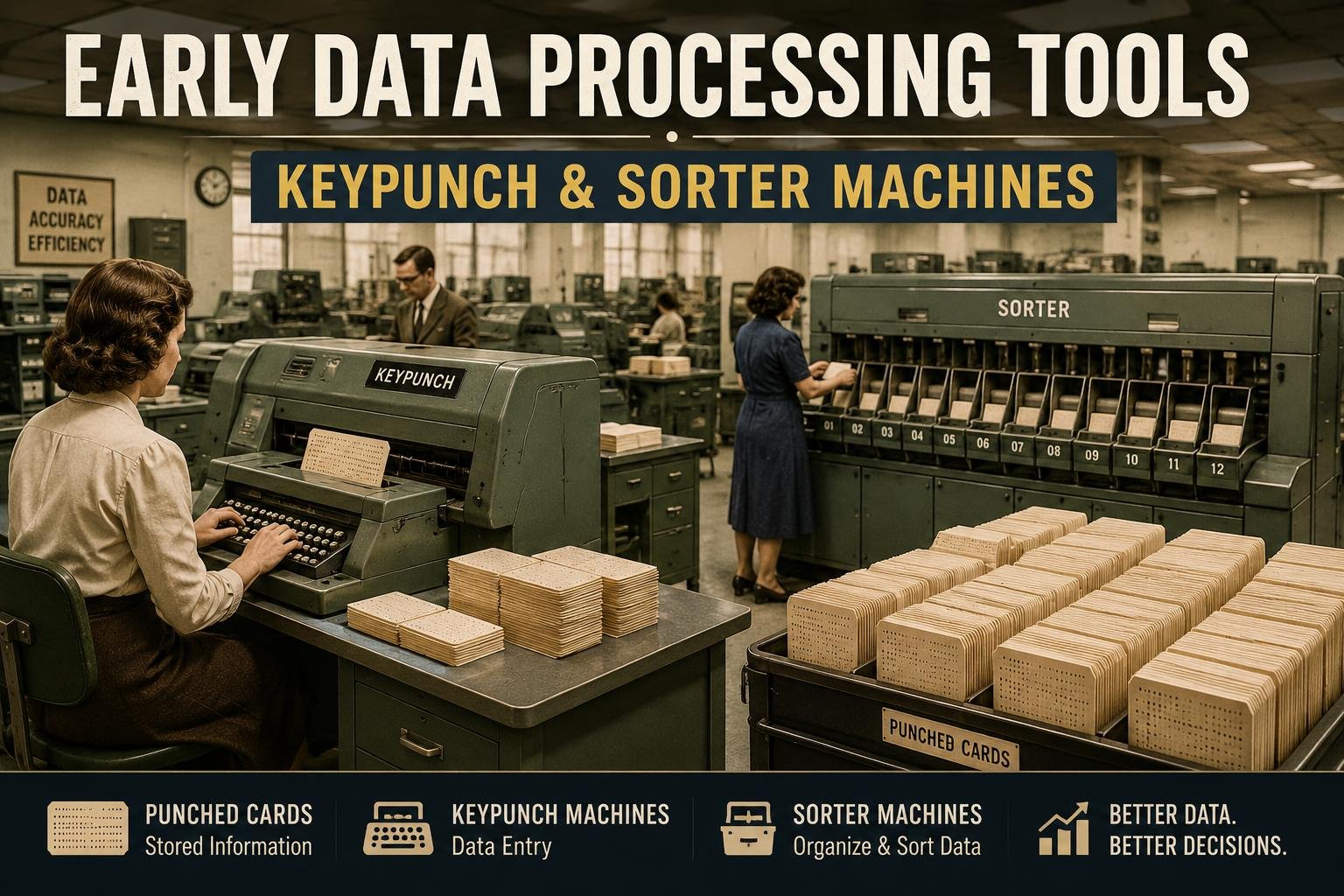
Keypunch machines which entered data into punch cards were used. We had operators which would type in the info into the machine which had a typewriter like keyboard. Instead of printing out on paper, the machine would put holes in designated places of a card. Each hole stood for certain info in a code.
The card which was punched out served as a physical representation of the stored data. Each card had a grid of rows and columns which in turn represented letters, numbers, and symbols. After data was put into the card it could be run through tabulators, sorters and other machines.
How Keypunch Machines Worked
Keypunch machines were operated by skilled professionals. An operator would put in a blank card and enter the data which was to go on that card. Each key press made a hole in the card in a pre-determined place.
In many cases what we saw was a pattern of holes which in fact represented information that machines were able to read. For example payrolls may have had in them employee numbers, salary info, and department codes. In the case of inventory we used punched cards to track stock levels and see also which products shipped out.
In some automated sorting and preparation machines which we put out we had what we called verification systems. In those we had a second operator that would use a verifier machine to go over the cards which had been punched to check for accuracy. We found that if we didn’t do this check errors in the cards would cause off target results or system failure which in turn affected data reliability greatly so we made sure to include this step.
Over the years keypunch technology improved. Later models which did away with the manual feed of cards reduced typing errors and improved info processing. While these did see improvements the machines still had human operators and a great deal of manual work.
The Importance of Sorter Machines
Once we had punched cards we had to come up with ways to organize and sort them. That is when the sorter machines came into play. Sorter machines would put the cards in order based on what data was put into the cards.
A sorting machine was able to quickly go through the cards and put them into various compartments. For example a company could sort employee cards by department number, salary range, or employee ID.
Sorters of data performed tasks that in the past required great deal of manual effort did see to great improvements in efficiency. Also large companies which dealt in the issue of millions of punched cards saw manual sorting to be a practical issue. Thus these machines which grew in use allowed for faster and more accurate data processing.
How Sorter Machines Operated
Sorters did that which of the punched cards they read in as they passed through the machine. As each card went in to the machine the sensors noted the pattern of the holes. By way of the chosen sort category the machine put the card in to the proper slot or bin.
Operators had the ability to sort cards in many ways. For example census data, first sorts by state, then by city, and finally by age group. This step by step approach to sorting was used by organizations to analyze large data collections in a systematic way.
Sorter machine speed at the time was very impressive. We had early models which processed hundreds of cards minute and later machines which handled even larger volumes. This ability greatly increased productivity in data centers.
Applications of Keypunch and Sorter Machines
Keypunch and sorting machine use grew by large margins in many fields during the 20th century. That they could handle great volume of data made them an essential tool in government offices, businesses, and scientific organizations.
Census and Government Records
Punched card systems at the very beginning were used for census processing. Governments required accurate population data for planning, taxation, and representation. Manual count methods were slow and inefficient as populations grew.
Keypunched and sorting machines enabled the Census to go through demographic info much faster than we did in the past. We see that age, occupation, gender, and location data was encoded into punch cards and put through a system of analysis.
Government also ran these systems which included tax records, social security management, military files, and public administration. We saw large scale improvement in government operation’s performance which was due to the efficiency in info organization and retrieval.
Banking and Financial Services
Banks and financial institutions used to greatly depend on punched card technology. We found that transactions, account balances, payroll records, and customer info were stored on those cards.
Sort of which machines which enabled banks to sort out their records by account numbers or transaction types, we saw better bookkeeping efficiency. In payroll departments we saw the use of keypunch machines for preparation of salary calculations and employee payment records.
Although present day standards have outgrown them, at that time these systems were a great step forward in financial data management.
Business and Inventory Management
Retailers, manufacturers, and transportation companies saw the value in punched card systems. In which they used keypunch machines to log into inventory data, shipment details, customer orders, and production schedules.
Sort which machines did which to get the job of sorting out the records done which in turn enabled managers to analyze stock levels and which also improved operational performance. Also this improved decision making and reduced admin delay.
Factories used to implement punched card systems for the tracking of production and employee attendance. Also these machines played a role in the growth of complex industrial processes which we see through the 20th century.
Scientific and Educational Institutions
In the early days of computing universities and research institutions took up punched card technology for statistical analysis and in science. Researchers used the cards to present experimental data in an organized way and also to do routine calculations.
Before the advent of electronic computers scientists used punched card systems which they ran for efficient data processing. This technology saw action in the fields of engineering, astronomy, and social sciences.
Educational institutions trained students on keypunch machines as they came to see the growing value of data processing skills in the workforce.

Man’s Role in the Early Data Processing Tools
Although computers did much of the work, keypunch and sorting machines still required great deal of manual labor. In large data processing centers teams of operators did the work of entering, checking, sorting and managing punched cards.
Keypunch operators went through special training for accuracy and speed. Many operators became very skilled at typing out large sets of info quickly which also included reducing errors.
In the 20th century women to a great extent were a part of the work force in data processing centers. At the times of industrial growth keypunch operation was a very important area of employment.
In data processing centers environment was a noisy one which came with the constant operation of machines. Staff worked with large sets of punched cards and followed in great detail procedures which prevented data loss and maintained order.
Human intervention was required as machines did not have the flexibility and intelligence of today’s computers. Operators had to watch over workflows, identify errors, and manually handle physical card collections.
Advantages of Keypunch and Sorter Machines
Although of which may have been issues, keypunch and sorter machines did transform information management.
Faster Data Processing
Compared to what was done before by hand, punched card systems saw great reductions in process time. Also we see that which the corporations were able to go through large amounts of info at a much greater speed as we did with the hand written methods.
Improved Accuracy
Verification tools reduced errors in data entry. Also machines which did away with manual calculation and sorting minimized mistakes.
Better Organization
Sort of which businesses did with government is that they developed systems for organization. Also this increased the efficiency in record keeping and data retrieval.
Scalability
As we see in the growth of organizations punched card systems handled greater amounts of info which in turn supported the expansion of industry and large scale admin processes.
Foundation for Automation
Keypunch and sorting machines brought out key concepts in automated data processing which in turn influenced the development of later computer technologies.
Limitations of Early Data Processing Tools
At the time very innovative, punched card systems also had large scale issues.
1. Physical Storage Challenges
Punched out cards took up a great deal of space. Large scale organizations stored millions of them in file cabinets and storage rooms. Careful organization was required for management of these collections.
2. Slow Compared to Modern Systems
Although we may have found an alternative to do things more quickly with the introduction of punched card systems which was indeed a step up from all out manual methods at the time we still had a long way to go in terms of speed by today’s standards. Also for large scale data sets we were still putting in a great deal of man hours.
3. Vulnerability to Damage
Punched cards also fell victim to moisture, bending, and tearing. Also they could not be put in the wrong place. What was put in them was data which when damaged would cause information loss.
4. Labor Intensive
The systems required a large human staff for data entry, verification, sorting and maintenance. We saw little reduction in labor costs at the introduction of automation.
5. Limited Flexibility
Changing out information, this at times meant to totally re-enter everything. Then we didn’t have the flexibility we do with today’s digital databases.
Transition to Electronic Computers
By the 1950s electronic computers began to replace punched card systems. With the advances in electronics which brought about faster and more efficient methods of data storage and processing.
Early computers still had punched cards as input devices which showed the legacy of keypunch technology. Programmers put in instructions via the cards which the computers then processed electronically.
Eventually computers saw the adoption of magnetic tape, disks for storage, key boards and digital interfaces which in time replaced punched card systems completely. These new technologies gave us speed, reliability and large scale storage.
Despite the decline Keypunch and sort machines served as important intermediaries between manual record keeping and the modern computing era. Also many of the ideas put forth in the early data processing tools which we see today in the design of advanced computer architecture and information systems.
The legacy of punch card and sorting machines
Keypunch and sorting machines’ role in history goes beyond that of their practical use. They put forth basic principles which still inform modern computing.
Influence on Data Encoding
The punch card system was a proof of how we may represent info via coded patterns. This idea later grew into what we have today in binary encoding and digital data representation in computers.
Early Automation Concepts
Sort of from the start sorters were what made the first forays into machine based automation of repeatable tasks. In manufacturing, logistics, and information technology today we see modern automation which in part has grown out of those early sorts of innovations.
Development of Information Processing Industries
The growth of the punched card systems’ market played a role in the rise of tech giants like IBM which later became the forerunners in computer development and digital innovation.
Workforce Transformation
Keypunch machines introduced a new set of technical jobs and we saw the growth of information management skills’ importance. This transition also served as a precursor to the modern info tech career fields.
Foundations of Modern Computing
Many early in the field of programming and computer science worked with punched cards. We still see today the basic principles of data input, storage, processing, and output in use.
Comparing Early Data Processing Tools to today’s systems.
Today at our disposal are electronic memory, cloud storage, artificial intelligence, and high speed processors which in turn enable the analysis of large data sets in real time. We also see the world as a global village which is made possible by the Internet.
In other words, what we see today in terms of electronic media for data storage early punched card systems used physical media and mechanical processes. We today which have near instant results had in the past teams of workers and large rooms full of machinery for what which are now millisecond tasks.
However we see that present day computing is a result of those early data processing tools. From punched cards to today’s advanced digital systems we see a trend of innovation which improves on past inventions.
Understanding that which has transpired helps folks to see the great work in info tech that we have today and also recognize the past work of former generations of engineers and inventors.
Conclusion
Keypunch and sorting machines’ role in the development of data processing is a key chapter which saw the transformation of how companies managed info at a time when hand written records could no longer keep up with growth.
Keypunch devices put out data in the form of punched cards which in turn were sorted by sort machines for analysis and processing. Together they improved efficiency, accuracy, and scale in fields like government, banking, manufacturing and scientific research.
Although we may see present day digital systems as having done away with the use of punched cards that were the mainstay of early computing equipment what in fact they did was to bring forward concepts which still today are very much a part of what we see in terms of computer science. They put forth the basic ideas of what automated data handling is all about, information coding, and the role of machines in processing which we still see played out in today’s electronic computing systems.
Through the study of keypunch and sorter machines we see how technology has transformed from mechanical to advanced digital systems. This is a reminder that modern computing did not appear out of thin air but which developed over decades through the efforts of experimental and creative thinkers.
Get more well researched information about early data processing tools here.