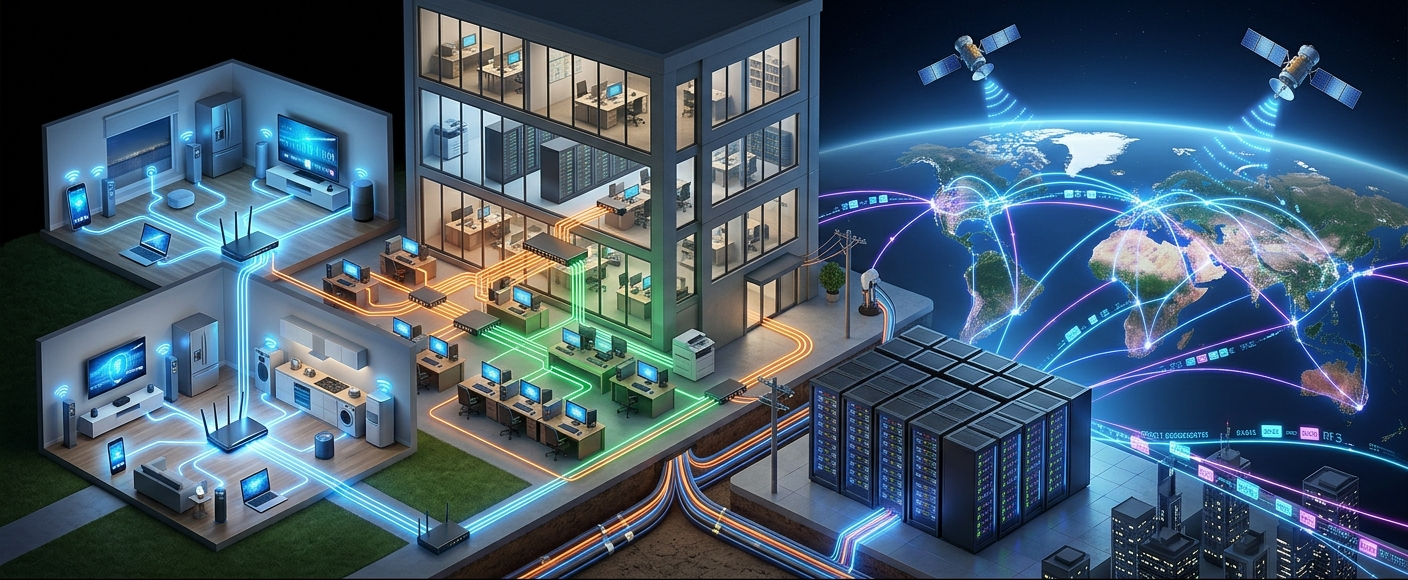
Computer networks can be categorized into various types based on their specific characteristics.There are different types of computer networks depending on the nature of the networks.
Computer networks play a vital role in the life of today. A person uses a computer network whenever they log in to the Internet, use cloud storage, send e-mail, play an online game, or connect a smartphone to Wi-fi. A network connects computers, mobile devices, servers, and other digital equipment together and enables them to communicate and share information. From the users’ point of view networks may seem easy, but they can range from small to large, intricate to simple, or for local to wide area use.
The primary distinction among computer networks is the size of the network and the distance over which the network is spread. A LAN within a house is not the same as a network of offices in various countries. This helps newbies get a good grasp of the ways in which technology relates to people and organizations. There are several types of networks commonly found, such as PAN, LAN, WLAN, MAN and WAN. They all have their own purpose, ranging from local friendships to global communication networks.
Computer networks are typically categorized by geographical range, number of devices and technology used to connect the devices. For instance, if you use Bluetooth on personal devices, you are operating within a smaller network; if you use enterprise networks that can stretch across continents you are depending on larger networks. A global WAN solution is required to connect employees, systems and data centers securely across the globe for a company with offices around the world. Knowing these network types will help to notice how everyday technologies are connected.
Definition of Computer Network
A computer network is an integrated system of two or more computers that share data and resources. These types of connected machines can be computers, mobile phones, printers, servers, routers, security cameras and smart home devices. Physical links (e.g., Ethernet cables) or wireless connectivity (e.g., Wi-Fi or Bluetooth) can be employed to enable devices to communicate.
The primary goal of a computer network is to facilitate communication and sharing of resources. In contrast, all computers are not working individually, but can also share files, share internet connections, share internet applications and services, etc. In a school setting, for instance, a network enables students and teachers to get access to online courses, interactive digital materials from various classrooms, and shared printers.
Networks also enhance efficiency, security, and collaboration. Networks are used in business to link employees, to manage databases, and to facilitate digital operations. Networks are used to securely share patient information among different departments in hospitals and to process transactions rapidly in financial institutions as well. All networks are created to enable communication between connected devices.
Types of Computer Networks Based on Size and Coverage
There are two types of computer networks based on size and coverage.
There are two types of computer networks based on size and coverage:
Personal Area Network (PAN)
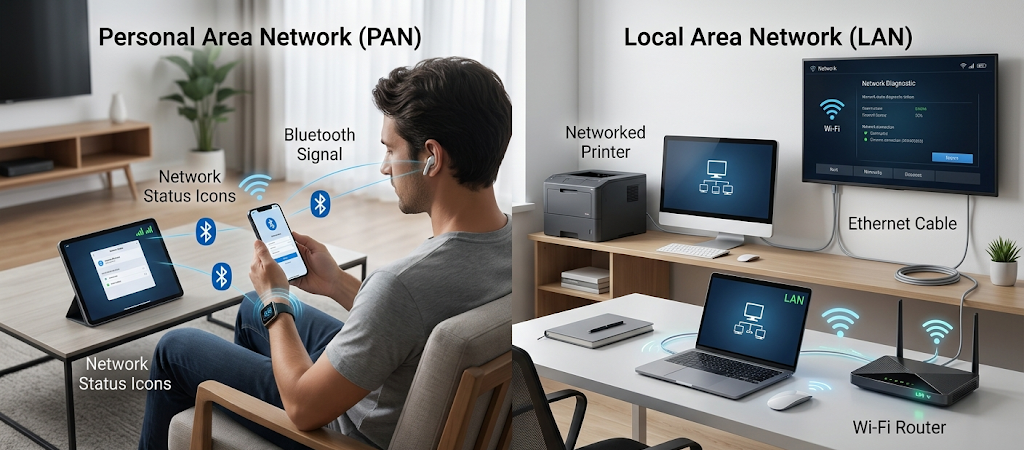
PAN stands for personal area network.Personal area network (PAN). A Personal Area Network (PAN) is the smallest type of computer network. It is used to link devices in a very short distance, typically one person. PANs are mainly applied to personal devices like smartwatches, wireless headphones, tablets and laptops. These networks are for convenience and can be set up without a significant infrastructure.
Bluetooth is one of the most common technologies available with PANs. For instance, if one user plugs in wireless earbuds to a smartphone, they are establishing a small personal network between two devices. Other devices that utilize PAN technology include Bluetooth keyboards, fitness trackers and smart speakers. Typically these connections are just about a few meters in length, as they are meant to be used for personal communications.
Wired connections are also possible for PANs, e.g. a smartphone can be connected via USB cable to a computer. PANS have a narrow spectrum of activity, but they are a significant part of a daily digital life. They enable users to interact with their personal technology, to transfer files and to control devices.
The key benefits of PANs are that they are low-cost, easy-to-setup and portable. They typically include only a few devices and are easier to manage than larger networks. Their range, however, is short and they are not appropriate for inter-building, inter-city or inter-country application.
Local Area Network (LAN)
One of the most popular computer networks is called a Local Area Network (LAN). It is used to connect devices in a limited geographical area, such as a home, school, an office building or a laboratory. The connected devices in LANs can share resources like the Internet, printers, files and applications.
A LAN is an example of a typical home network. A router links computers, smartphones, smart TVs and gaming consoles together, enabling them to communicate and to access the internet. A LAN can be used in a workplace to link together dozens or hundreds of computers, allowing workers to share information and utilize the company resources effectively.
LANs are typically characterized by their reliability and speed, since devices are relatively close together. Many LANs employ Ethernet connections as a relatively stable medium; however, LANs are increasingly using wireless technology. A wireless LAN is a WLAN, which performs the same functions as a cable LAN but does not need the cables.
LANs are often preferred by organizations for their enhanced control over data and security. Security tools like firewalls and encryption provide network administrators insights into what is connected, who can access it and how, and safeguard information. LANs, however, are restricted in scope, and if users are very far from each other, they cannot be directly connected to each other without using other network technologies.
Wireless Local Area Network (WLAN)
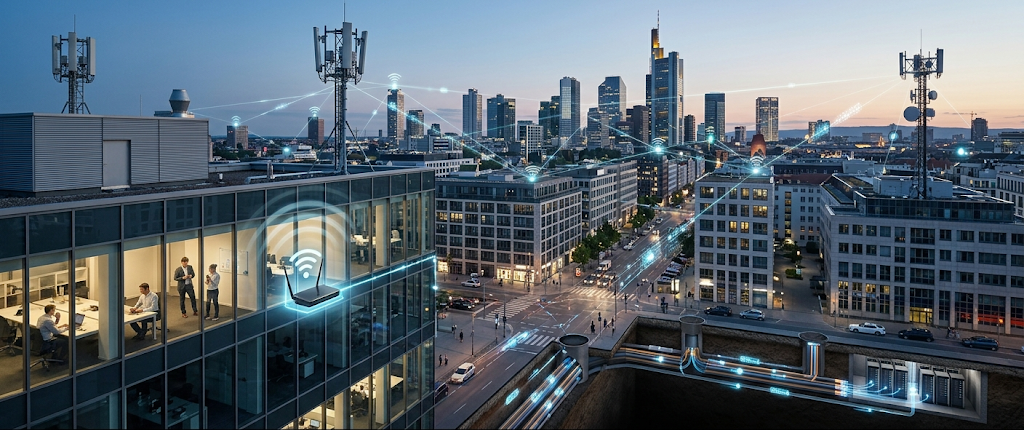
Wireless Local Area Network (WLAN): LAN in which communication is done via wireless rather than wired methods. WLANs are often equated with Wi-Fi, in which case devices can connect to a network without the help of Ethernet cables.
Examples of WLANs are the Wi-Fi networks found in homes, schools, restaurants and offices. A laptop or a smart phone can be plugged into a wireless router and then will be a part of a WLAN. The router can transfer radio signals to connected devices, which can be connected to the internet and communicate with each other.
WLANs have become popular due to flexibility and mobility. Users are able to roam within the area of network coverage and remain connected. This is particularly beneficial in workplaces where workplace staff use mobile devices, tablets, and laptops.
But WLANs need to be managed for security as well. Wireless signals can be transmitted through the air and if the network is not secured properly, unauthorized users might try to use it. Security risks are lessened with strong passwords, updated security protocols, and network monitoring.
WLANs have a much smaller number of cables required for installation as compared to wired LANs. They can be particularly beneficial in areas where the ability to establish a physical connection is hard to achieve or costly.
Metropolitan Area Network (MAN)
Metropolitan Area Networks (MANs) connect networks that span a greater distance than LANs and less than WANs. MANs are typically used to inter-connect networks within a city, town or across a large campus. They are commonly utilized by organizations that need to communicate between various places in the same metropolitan area.
It could be, for instance, a university with multiple sites in a city, where the buildings are connected by a MAN. MANs can also be employed to link offices situated across a city by government organisations, internet service providers and large companies.
A MAN is a network intended to offer quicker communications between sites than would separate independent networks. They enable organizations to pool resources, control information from a central location and enhance inter-branch collaboration.
MANs can use a range of technologies, including fiber optics, wireless connections, and advanced networking equipment. Since MANs have a longer range than LANs, they are more complex to plan, maintain and invest.
While LANs and WANs may get more attention than MANs, they play a vital role in inter-connecting communities, businesses and institutions within urban regions.
Wide Area Network (WAN)
WAN—Wide Area Network (WAN)
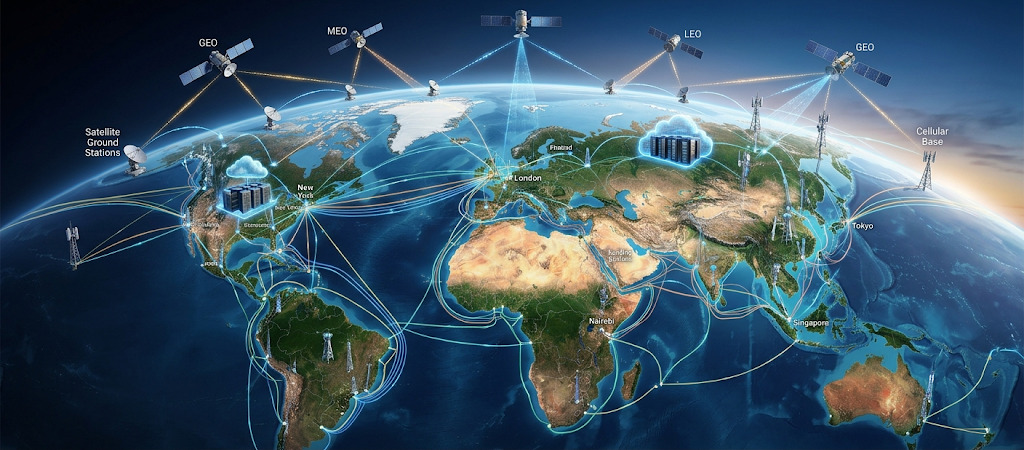
The largest network of computers is a Wide Area Network (WAN). It links devices and small networks over very large distances, continents, countries, etc. WANs can be used by organisations, governments, and individuals to communicate and share information over a long distance.
The most well-known WAN is the internet. It is a network of millions of smaller networks located around the world, and enables people to view websites, chat online, and utilize online services from anywhere in the world.
WAN technology is frequently used in businesses to link offices in various locations. To enable employees to access shared systems, databases and applications, a company with branches in several countries can use a secure WAN connection. Global WAN networks are solutions tailored for use across the globe, supporting businesses to stay connected and communicate among remote sites.
Typically, leased communication lines, satellites, fiber optic cables and virtual private networks (VPNs) are used to run a WAN. WANs are more complex, and costlier to operate than smaller networks, since the distances traversed are quite large.
WANs offer the greatest benefit of bringing people and systems together around the world. However, there will be greater delays for these than for LANs since the data must traverse much longer distances. Security is also a significant concern as there are advanced methods to ensuring security and that the system is not accessed by unauthorized individuals.
A Comparison of PAN, LAN, WLAN, MAN and WAN
All computer networks have the same basic function – to connect devices; however, they vary greatly in size, speed, and application.
A PAN is intended to be used for personal devices such as wireless accessories and a smartphone in the immediate vicinity of each other. LAN is a local area network that is used in a small community such as a home or office. A WLAN is similar to a LAN, but is wireless, primarily based on Wi-Fi. A MAN extends networking capabilities throughout a city or large campus. A WAN is used to communicate between countries and continents.
In general, smaller networks will be able to achieve faster speeds and have more manageable operations due to the fact that the devices are physically closer to each other. A larger network offers more connectivity but with more complicated equipment, security and maintenance.
These differences can be used to recognize what kind of network people are dealing with on a daily basis. A person with Bluetooth headphones is utilizing a PAN (Personal Area Network); one connected to a home WiFi is making use of a WLAN (Wireless Local Area Network), and one using an overseas website is depending upon WAN (Wide Area Network) technology.
Exploring the Role Networks Play in Everyday Life
Investigating the function of networks in daily life. Computer networks affect nearly all aspects of today’s society. Reliable networks are essential to education, healthcare, business, entertainment, transportation and communication. Without network connections, online classes, video conferences, digital banking, cloud applications and social media platforms would not work.
Homes can be equipped with networks, which are used for linking smart devices, spending time enjoying entertainment or sharing internet access. In a business, a network enhances collaboration among employees, facilitating communication and access to critical data. Advanced networks are the backbone of global operations in large organizations.
Networks are evolving to be faster, more secure and more intelligent as technology continues to evolve. The proliferation of cloud computing, artificial intelligence, and smart devices has led to the growing demand for efficient networking systems. Basic knowledge of different types of networks enables users to make informed decisions regarding technology and to understand digital systems.
Conclusion
The conclusion is that they have to understand the Network World.The end result is that they need to know the Network World. There are various types of computer networks that serve different functions and to different extent. The use of personal devices connects in personal area networks (PANs), LANs and WLANs connect locations within a home or workplace, MANs connect locations within a city, and WANs establish communication systems that can cover the globe.
These networks vary in scale and complexity but collaborate to provide the “world of connection” that people live in every day. Today, networks offer the backbone for the communication and information that supports the ways in which we manage our international business operations and send a message through a smartphone.
Knowing the differences between LAN, WAN, WLAN, MAN and PAN helps newcomers to the field to visualize how devices connect and how information flows from a small personal link to a global communication network. Computer networks will continue to be a significant part of the digital era as technology advances.