
Introduction
Running a business is a very engaging endeavor but also brings with it a vast array of duties. As business owners we see them wear many a hat which includes that of a manager, marketer, accountant, and customer service rep and decision maker all at once. While passion and determination are the fuel which powers business success poor time management will quickly lead to burn out, lost opportunities and a drop in productivity. Time management is not a nice to have but a must for the business owner which wants to see sustainable growth out of their company while at the same time maintaining a healthy personal life. By learning how to put things in order of priority, set realistic goals, pass off what you can and get rid of what drains your business, owners can do more without feeling over the top, also in to practical time management which gives a base for productive habits that in turn improve efficiency, reduce stress and make space for innovation. Instead of putting in longer hours, successful business people focus on working smarter, they make each hour count towards what is meaningful for the business and to long term success.
Why Time Management Matters for Entrepreneurs
Time is an asset which once gone is not brought back. As with money, inventory, or equipment which can be put towards a business’ benefit, each entrepreneur is given the same 24 hours per day. What we see between those business owners that do very well and those that do not is how they apply those hours. Poor time management see results in uncompleted projects, delayed customer communications, missed deadlines, falling employee morale, and upped stress. Over the time these issues add up to do damage to business performance as well as personal health. By way of effective time management entrepreneurs are able to direct their attention to what brings in income, better customer service, improved business processes, and opening the door for growth. Rather than react to every interruption which comes up, organized business owners choose where to put their energy. This in turn increases productivity and also the health of the work life balance. When entrepreneurs do a good job at scheduling they become more proactive, flexible, and sure footed in to deal with daily issues, thus putting their business in a position for long term success.
1. Setting out What you Want Before you manage your Time.
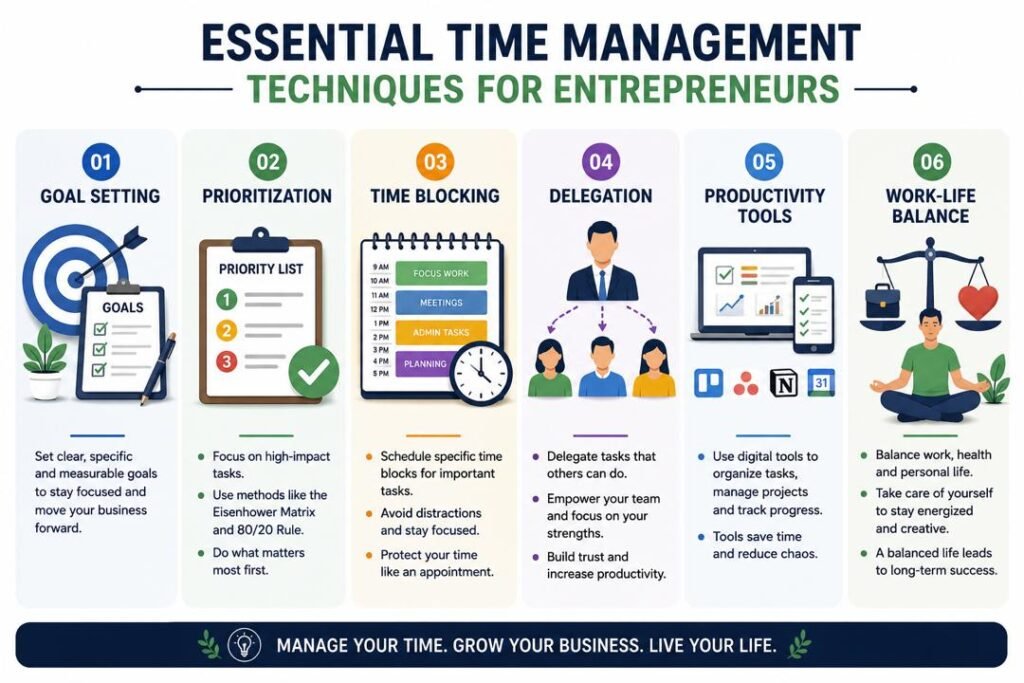
Effective in time management is to know exactly what it is you have to achieve. Many an entrepreneur which does not have clear goals spends their day reacting to the immediate instead of making progress towards important goals. By setting very specific, measurable, achievable, relevant, and time oriented goals you create a road map which in turn guides daily decisions. Long term business goals should be broken into monthly, weekly and daily priorities which in turn make large projects into manageable tasks. For example instead of a vague goal like to increase sales an entrepreneur may aim to get 20 new customers in within the next three (3) months by way of running in depth marketing campaigns and improving customer service. Also each day’s activities should support these large goals which in turn see to it that you are investing your time in tasks that will move the business forward. Reviewing goals at regular intervals also helps the entrepreneur to identify what the issues are, to change strategies as needed and to celebrate the milestones which in turn will fuel motivation. Clear goals give direction which in turn makes it easier to sort out what is important and what is not and thus avoid spending what should be productive time on things that do not in fact grow the business.
2. Prioritizing Tasks Using Proven Methods
Urgent and not urgent, this simple framework which also includes the concept of putting first things first for entrepreneurs to pay attention to what really matters while at the same time stepping away from the rest. Also a very useful approach is the 80/20 rule which we know as Pareto Principle, what which states that 80% of results come from 20% of effort. By identifying which 20% that brings in the 80% results the entrepreneur is able to put more time into that which brings in the most value and less time which have little impact. Prioritization turns large intimidating task lists into easy to manage action plans which in turn helps entrepreneurs do more with less stress and greater confidence.
3. Creating a Routine that Improves Productivity.
A productive routine does more than put in place a calendar of events; it also gives the structure which keeps entrepreneurs focused throughout the day. Also it is the practice of successful business people to start each morning by looking at what is most important for the day and then devoting bands of time to large tasks. What they do is set aside dedicated slots for certain actions which include replying to email, meeting with clients, and going over the finances, putting together marketing strategies, or working on large scale projects. By giving definite time frames to each task what they are doing is breaking the habit of putting things off and also sees to it that the day is not taken up with unimportant issues. Also very important is the inclusion of regular breaks in the schedule which they find out empirically plays a role in mental fatigue which in turn plays a role in reduced focus and decision making. Also they put in time for the unexpected which business does not always go as planned. And they finish each work day with a look back at what was achieved that day and a plan for the next which in turn lessens morning chaos and helps them to begin each day with more focus and purpose.
4. Using Productivity Tools to Stay Organized
Technology provides a wide range of solutions which improve time management and at the same time increase business efficiency. Digital calendars which are a part of the solution help entrepreneurs with their appointments, setting up reminders, and also in conducting meetings which are synchronized across many devices. We also have project management tools which teams use to put together projects, see when deadlines are and also to track the progress of said projects in a single easy to access place. Also we see task management apps which are very useful for entrepreneurs in maintaining organized to do lists which in turn helps them to put first things first based on how urgent and important they are. Also we have cloud storage which makes it easy to get to documents from anywhere thus reducing delays which come from misplacement of files or use of out dated versions. Also we have communication platforms which improve collaboration between employees, independent contractors, suppliers and customers; we see this in the reduction of unnecessary meetings and also of long email chains. Also in the automation space we see software which takes care of repetitive tasks like invoice issue, appointment setting, customer follow up and social media posting. To be sure productivity tools do not take the place of discipline and good planning but what they do is reduce admin burden which in turn allows entrepreneurs to put more time into strategic decision making, customer interaction and business growth which in the end fuels long term success.
5. Delegating Responsibilities Effectively
Many entrepreneurs have a hard time with delegation because they think no one else does a better job than they do. While that may sound like a strong work ethic, in fact it usually results in unneeded stress for the entrepreneur and also in which the business does not grow. Delegation allows entrepreneurs to focus on what only they can do which in turn sees employees grow into new roles and become more of an asset. Success in delegation starts with what tasks really do not require the owner’s hand in them which include admin work, inventory management, bookkeeping, customer support, or routine marketing activities. Also very important is that communication between the entrepreneur and the employee be clear so that the employee knows what is expected of them, when it is due, and what resources are at their disposal. Also entrepreneurs should put in place systems for to track progress without getting into the nitty gritty of everything. Trusting in that your team members’ abilities not only increases over all productivity but also grows employee confidence and engagement. As businesses grow, effective delegation becomes even more so a key element because the entrepreneur just can’t do it all.
6. Eliminating Time-Wasting Habits
Identifying out which habits are not productive is a key to improving time management. Things like constantly checking emails, scrolling through social media, going to meetings which don’t add value, multitasking, and putting off important decisions take up precious hours which do not see through to any great business achievement. Entrepreneurs should put in practice the habit of tracking what they do each day for a few days. This will bring to light unexpected use of time which contributes to what we waste. Also to put in place set times for email check ins, to reduce social media use during work hours, and to say no to meetings which don’t have a set goal. Also out with the practice of multi-tasking which only serves to decrease focus and increase mistakes. Instead do one large important task at a time. By developing awareness of what distracts you personally business owners may be able to create an environment that supports extended focus which in turn produces higher quality work in less time and with less stress.
Balancing Daily Operations with Long-Term Planning
Entrepreneur preoccupied with day to day issues which in turn leaves them little space to think of the future of their companies. Although it is of great importance to see to present issues, ignoring long term planning does not do the business any good. What we see in very successful entrepreneurs is they set out time aside for long term planning. They do this through scheduled planning sessions where in which they look at how the business is performing, what are the upcoming opportunities, what are the market trends, and also in what direction the business should head to. We see that weekly reports give a chance to report on progress towards set goals, but also those monthly or quarterly planning sessions which in turn bring out the bigger picture. In these sessions they look at financial performance, what the customers have to say, operational efficiency and competitive position to make informed decisions. Also it is a good idea for entrepreneurs to set aside that which is not interrupted planning time so as not to let the urgent over shadow the important in the strategic initiatives. Companies that are consistent in investing time in long term planning do better in that they are better prepared to adapt to market changes, to go after new opportunities and to get past unanticipated challenges all while growing steadily.
Managing Your Personal Affairs While Still Achieving in Your Career
Entrepreneurship must add value to life instead of take over everything. We see how it goes with family, health, friends, and self-care which in turn lead to burn out, reduced creativity, and drop in productivity. Also we note that which entrepreneurs pay attention to is that they put physical and mental health at the core of business performance. We suggest that which entrepreneurs do is to put personal commitments on par with business meetings which in turn set healthy work to personal life balance. Also regular exercise, proper sleep, healthy meals and play improve focus, emotional resilience and decision making. Family time and social connections we see as very important during tough business times. Also which I would say is to also unplug from work at times by way of taking leaves or having tech free even nights. Building a business which requires full time owner input at all times is a rare sustainable model. Instead what we see is that which by building systems and empowering team players which in the end the entrepreneur does professional success and also has that which fulfilling personal life which in turn leads to long term happiness and resilience.
Developing Consistent Time Management Habits
Effective time management does not come from sporadic bursts of productivity but from the development of daily routines which become a part of an entrepreneur’s fabric. Little changes that are made consistently often produce greater long term results than large scale but short term changes. Entrepreneurs may start out by introducing one or two new habits like to plan out their day at the start of each day, review what is most important each morning, or to do away with what is distracting. Once these have become second nature it is on to add in more productivity practices. Also out for regular review what is working and what is not. Entrepreneurs should be flexible in their approach as business needs change and so may the time management systems. Persistence is important as setbacks will happen especially during busy times. What is put in place should be sustainable, reduce decision fatigue and in the end will make an entrepreneur more productive even in the face of larger workloads or unanticipated challenges.
Conclusion
Time is of the essence in what an entrepreneur can do to better himself which in turn affects how productive he is, how profitable his business is, how well he makes decisions, and his overall well-being. By setting out what he wants to achieve, putting first what is most important, creating a routine, using tools at his disposal, passing off what he can to others, getting rid of what drains him, doing some strategic planning along with his day to day operations, and protecting his personal time out of the equation business owners can do more and at the same time see less stress. Effective time management is not about being tied to your desk 24/7 but about making deliberate choices that add the most value and which support the sustainable growth of the business. As entrepreneurs refine what works for them and they stay the course with organized planning they put themselves in a position to get over hurdles, to take on new opportunities and to build great businesses without at the same time wearing out there health or relationships. Each productive day is an investment in the long term success of the business which in turn proves that managing time well is about running your life and business with purpose, focus, and confidence.
Get more well researched information about Time Management Strategies for Busy Entrepreneurs here.