Introduction
Companies face various economic factors and must analyses and assess areas such as production, pricing and resource management in order to succeed. Regardless of a company’s area of specialism, be this consumer goods, farming or professional services, businesses must assess how to optimally deploy their resources. The Theory of the Firm is key to microeconomics, and is used to analyze how business’ structure and behavior can be affected by economic factors. Typical business goals include profit, cost efficiency, growth and continued business viability. Appreciating the underlying economics enables a company to assess which production techniques it should utilize, and to modify and adapt its business accordingly.
Theory of the Firm
This economic tool enables companies to analyze and assess their production, costs and revenue. It can be used to analyze why organizations arise, and how they are structured. Typically, it is assumed in economic theory that companies wish to operate in a way that allows them to generate the highest level of profits. Companies endeavor to do this by producing and supplying goods and services in a cost efficient manner and in line with consumer demand. Alongside profit, other common business goals may include market share growth, consumer satisfaction, business security and long-term growth. Utilizing the Theory of the Firm can therefore enable companies to better analyze these goals and to assess their business interactions with those in the market, together with customers, suppliers and competitors.
Production and Input / Output
Companies convert resources (often termed ‘inputs’) into goods and/or services so as to match consumer demand. Resources include land, labour, capital and enterprise. Land is used to refer to natural resources. Labour encompasses human labour and associated skills. Capital relates to physical resources such as tools, machinery and property. Enterprise includes both the structuring of a business and the ability to take on business related risks. Evaluating a company’s input and output is key so that it can optimally deploy its resources. For example, manufacturing firms supply goods by combining labour, energy, and machinery alongside raw materials. Likewise, farming enterprises grow produce by utilizing land, seed, fertilizer, tools and labour. Businesses will optimally combine resources so that they can produce a desired output in an economically efficient method and without unrequired waste.
Production Function
This summarizes the ‘technology’ involved and shows how the amount of input used by a business affects the maximum level of output that can be produced. It assists companies in analyzing the effect that different combinations of factors of production (such as labour and capital) can have on production. Within the short-run, at least one factor of production will be fixed and so a business will not be able to instantaneously alter all of its resources. For example, although a furniture company could increase the amount of labour it employs to run its machines, its factory size and machinery may stay constant. However, in the longer term, a firm can alter all of its factors of production; for example, by enlarging its premises, acquiring new tools and/or implementing enhanced technology. Analyzing a company’s production function can thereby assist in assessing business productivity and ascertaining any constraints. Furthermore, it can help to establish the optimal resource deployment.
Fixed and Variable Costs
A variety of costs are incurred by businesses in relation to their production. Economists typically categorize these as either fixed or variable. Fixed costs are those that are largely unaffected by the extent of a company’s production within a given timeframe. These may include rental, insurance and maintenance fees for business property together with salaries for select members of staff. Manufacturing businesses for example, continue to pay for their factory rental even if they are not currently producing. Variable costs fluctuate depending upon a company’s production. They can comprise for instance, the cost of raw materials and product packaging, labour expenses and energy bills specifically relating to a firm’s production. Generally, baking businesses will incur higher costs of flour, sugar and packaging for 500 loaves of bread than for 100 loaves. Analyzing fixed and variable costs allows a business to effectively construct budgets and to manage costs. It also enables a firm to recognize the impact that variations in production can have on its finances.
Total, Average and Marginal Costs
It is key for companies to appreciate how their costs behave at varying production levels. Total cost reflects the overall cost that a business incurs in producing a given level of goods and/or services. It can be calculated by summing both a firm’s fixed and variable costs. Average cost is the per-unit cost of production and is obtained by dividing a company’s total cost by its output. Marginal cost is the cost of producing an additional unit. Such metrics can be valuable in assessing a company’s production efficiency. For example, a clothes company may find that as it increases production volume, its average cost declines as fixed costs can then be spread over more units. Nevertheless, if there are issues such as machinery congestion and/or if staffs are required to work extra hours, then a firm’s marginal cost may increase. As a result, further production may become less appealing.

Total Revenue and Business Income
Revenue is the income that a business receives from the sale of its goods and/or services, prior to subtracting its production and running costs. It can be ascertained by multiplying a firm’s unit selling price by the number of units it has sold. If for instance, a farm sells 2000 bags of rice at ₦80,000 per bag, then its total revenue will equal ₦160 million. However, although a company may achieve substantial revenues, it is not guaranteed that it will be profitable. In addition to revenue, a business must also analyze its expenditure so as to calculate its profit. Therefore, businesses analyze product prices, sales data, consumer demand and running costs in order to assess their financial position. Moreover, market changes can have a major impact on a company’s revenue. If consumer demand for a business’s goods and/or services falls for example, it may need to cut its prices and/or production. Conversely, if demand increases, a company may seek to boost sales and so enhance its earnings.
Profit Maximization
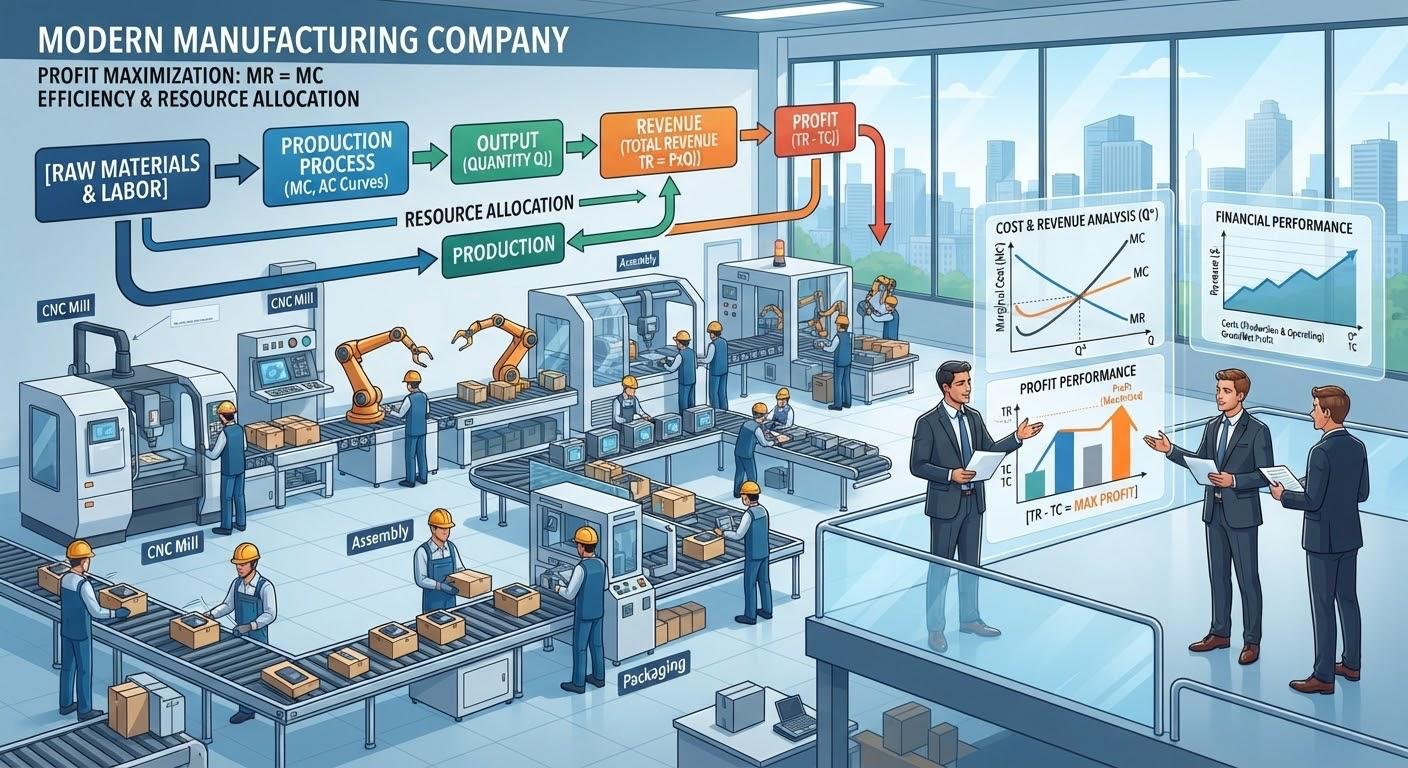
Profit maximization is a core topic within the theory of the firm. A company’s profit is derived by subtracting its total costs from its total revenue. Businesses maximize profit by identifying the production volume that enables them to realize the greatest profit differential. Typically, in economic theory, profit is maximized when marginal revenue is equivalent to marginal cost, subject to appropriate profit maximization criteria being fulfilled. Marginal revenue is the revenue obtained from selling an additional unit. For example, a drinks firm may boost production so long as the extra revenue attained from selling further units remains higher than the added production cost. However, once marginal cost outstrips marginal revenue, a company’s profit will fall as production is extended. Hence, this analysis can guide business’ decisions regarding whether to grow, sustain or curtail production.
Establishing Optimal Production Volume
Businesses need to establish what degree of production will best satisfy market demand, and also to manage their running costs. Under-producing can cause missed sales, unhappy customers and a decline in a company’s market share. Over-producing may cause stockpiling and additional storage costs. It can also result in product wastage, especially for farming businesses as many farm produce items are both time-sensitive and perishable. Companies analyze aspects such as production potential, consumer demand, resource availability, anticipated product selling prices and marginal costs in order to decide upon an optimal production volume. For instance, tomato farmers may analyze likely market demand and so determine how many hectares of land they should farm. Likewise, restaurants may analyze historical sales data and seasonal consumer trends to inform their procurement of ingredients. Businesses can thus avoid superfluous expenditure and correctly manage their stock. Furthermore, optimal production can be aligned to a business’ financial goals.
Market Competition
Market competition is significant in shaping a business’ production and pricing. Within a competitive market, companies must analyze not only the actions of competing businesses, but also consumer demand, product quality and current market pricing. Often in highly competitive markets, individual businesses will have limited autonomy to set their own pricing due to the ease with which customers can shift to substitute providers. Consequently, many businesses strive to lower their costs, to become more efficient and to enhance the value that they offer. Two food processing companies for instance, may seek to outperform each other by enhancing the quality of their products, developing appealing packaging and/or minimizing their distribution costs. Telecommunications businesses may endeavor to surpass their competitors by providing value for money subscription rates, dependable telecommunications and superior customer service. Effectively responding to competition can aid a business in sustaining its customer base, reinforcing its market position and continuing to realize profits.
Optimal Resource Deployment
Resources should be deployed in such a way as to maximize benefits and to economically efficiently manage expenditure. Given that companies have finite resources at their disposal, decision must be made regarding the extent to which labour, capital, materials and technology should be allocated to different business functions. Poor resource deployment can lead to heightened costs, sub-optimal staff performance and operational inefficiencies. Manufacturing enterprises may for example, implement automated technology in order to decrease reliance on labour, to expedite production and to limit material wastage. Farmers may utilize watering systems and contemporary tools so as to increase crop production and to lessen dependence on manual labour. Likewise, professional services businesses may incorporate computer based systems in order to more economically process client queries. Thus, optimally deploying resources can therefore facilitate greater business productivity, and can also help a company to economically efficiently manage its operations. In turn, this can further assist in the achievement of business goals.
Application in Various Industry Sectors
Manufacturing, farming and the service industry can all utilize the theory of the firm. Manufacturing organizations, for example, must analyze what labour, capital and material resources are needed in order to supply products in a manner that meets consumer demand and also efficiently manages costs. Businesses’ production capacity, automation and stock management will affect both their average costs and profitability. Farmers must analyze a range of elements including land availability, climatic conditions, fertilizer costs, labour and predicted product selling prices in order to determine how much to farm. Efficient planning is especially crucial within farming as produce can often be seasonal and also time sensitive. Furthermore, service businesses, such as banks, hospitals and telecommunications companies, also analyze and deploy people, technology, infrastructure and financial resources in a similar way. Despite the intangible nature of many service industry outputs, organizations still need to economically efficiently manage their costs and to effectively generate revenue. Services must also be efficiently supplied.
Conclusion
The theory of the firm is a valuable tool for analyzing how companies make business decisions in order to fulfill their economic goals. By analyzing elements such as input/output relationships, production functions and fixed/variable, average and marginal costs, together with total revenue, businesses can recognize ways in which they can enhance their efficiency. Profit maximization also enables companies to effectively analyze their production volume by assessing marginal revenue and marginal cost. Yet, in addition to seeking to lower expenditure and to enhance production volumes, businesses must also competently address market competition, analyze consumer demand and deploy suitable technology. Across all industry sectors, businesses that can effectively deploy economic theory are well placed to competently manage their operations, sustain market competitiveness and continue to successfully grow within evolving markets.
Get more well researched information about Theory of the Firm in Economics here.


