Introduction
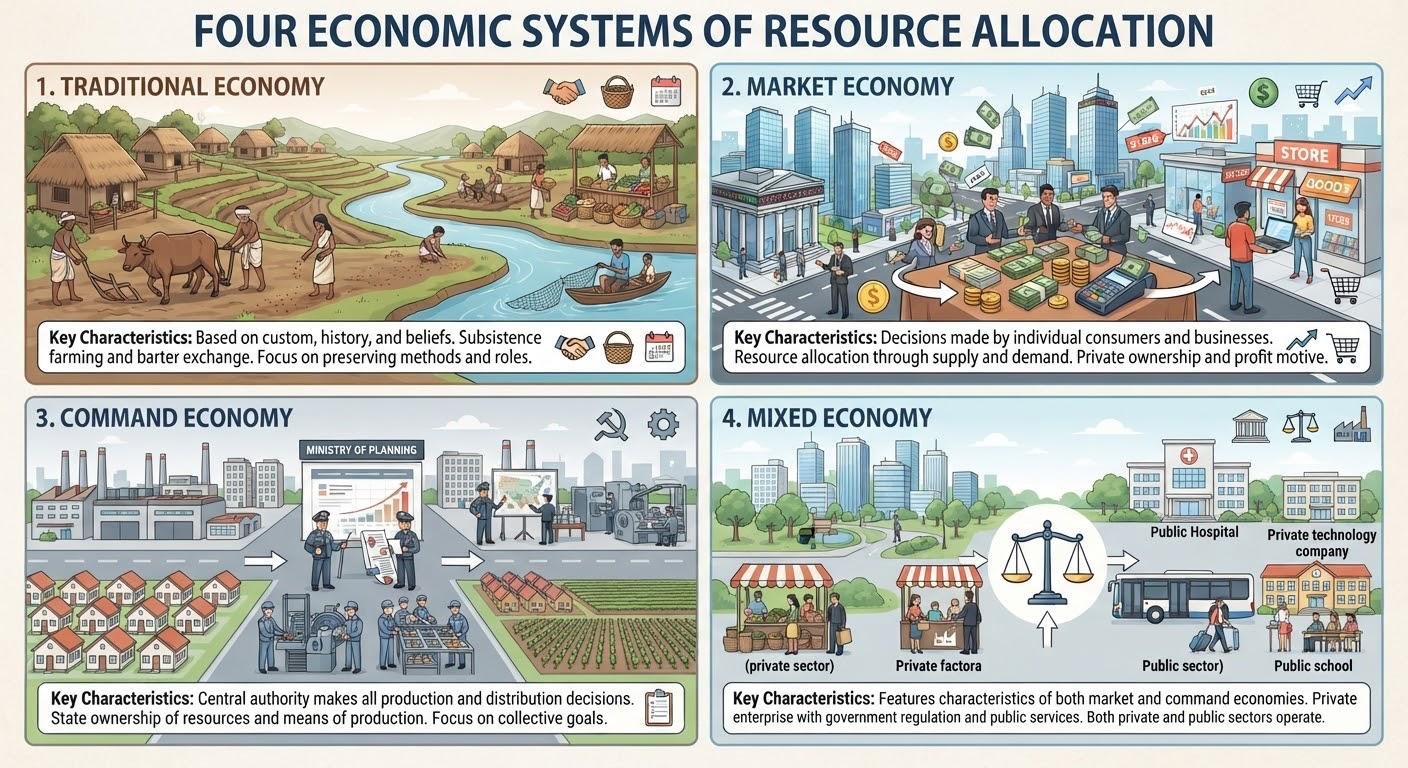
Economies must manage finite resources in order to fulfill the infinite requirements and desires of society. Individuals and firms must then determine how best to distribute and utilize the available range of resources (such as land, labour, capital and entrepreneurs). Economic systems are affected by these decisions and so will differ in the level of output, production processes and those who can access goods and services. There are various methods of resource allocation to suit different wants and needs. Economists typically recognize that there are four key economic systems – traditional, market, command and mixed. Each has distinctive features and benefits and drawbacks, especially in terms of private and government control, as well as competition and economic freedom. Recognizing these enables us to appreciate why different countries have different economic systems, and how this can affect output, consumption, employment and both distribution of income and a nation’s development.
Identifying the 3 Key Economic Issues
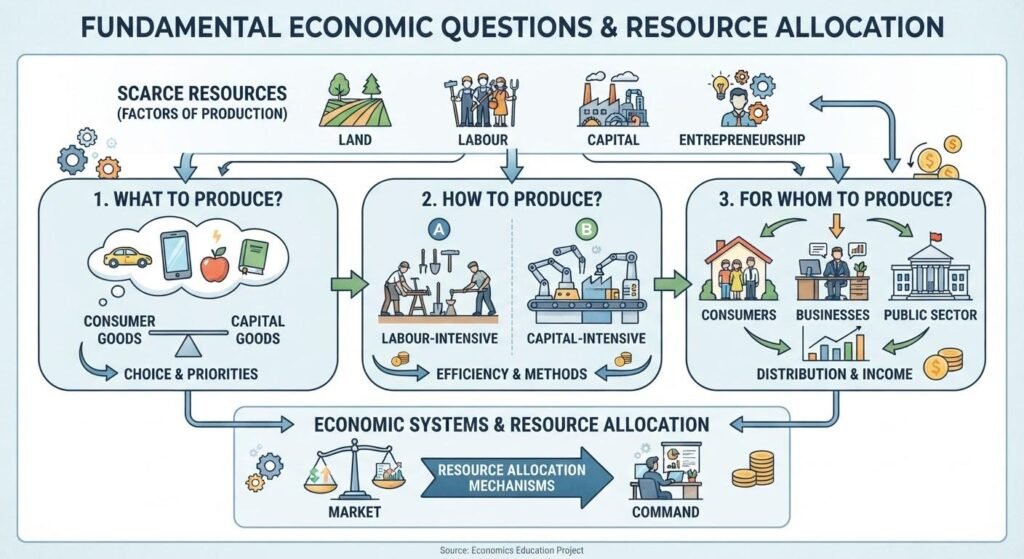
To begin analyzing each economic system, we need to firstly recognize the 3 key issues that all economies must resolve. Firstly, which goods and services should be produced? Societies must assess what their population requires, such as foodstuffs, health care, housing, education and manufactured items. Secondly, how should goods and services be produced? Businesses and governments must then decide whether to use labour intensive or capital and high technology production. Finally, for whom should goods and services be produced? Factors that can impact upon who gains access to outputs include; income levels, the community’s needs, government policy and culture. Each economic system deals with these issues in a different manner and so will result in varying resource distributions and development.
1. Traditional Economy
Within a traditional economy, economic activity is typically shaped by culture and customary behavior. Rather than being dictated by market forces or governmental policy, economic decisions tend to be affected by family and community norms. Communities often utilize traditional methods of work such as farming, fishing, hunting, animal husbandry and crafts. Usually, a community will produce those goods and services that are most suited to its basic needs and which are traditionally carried out within that area. Production is often conducted using time honored techniques. Members of a community frequently share out resources, alongside using family and social networks, and engage in barter. Even in contemporary times, traditional economies can exist within rural areas throughout Africa, Asia and Latin America. Agriculture and small scale trade are still often key to people’s means of earning a living in these regions. Although many of these communities have been influenced by modern economic systems, culture continues to affect the production and consumption behaviors of individuals.
Benefits and Drawbacks of Traditional Economies
Traditional economies facilitate the maintenance of culture, as well as community working and a sense of social duty. As economic behavior is often based upon tradition, many individuals are typically aware of and fulfill their community roles well. Traditional production can also foster environmentally friendly behavior as communities rely heavily upon their natural surroundings for survival. Yet, traditional economies suffer from various drawbacks. Output levels are often low and, furthermore, technology is generally not highly developed. Thus, it can be challenging to boost output and compete effectively with more modern industries. Cultural norms can also hinder creativity and so prevent people from pursuing alternative careers. Moreover, communities which place a high value on agriculture can be at risk from environmental issues such as natural disasters and drought. As societies continue to expand and diversify in terms of their needs, traditional economies can experience difficulty in supplying the required level of goods and services. Therefore, there is often a requirement to implement modern technologies and enhance economic processes.
2. Market Economy
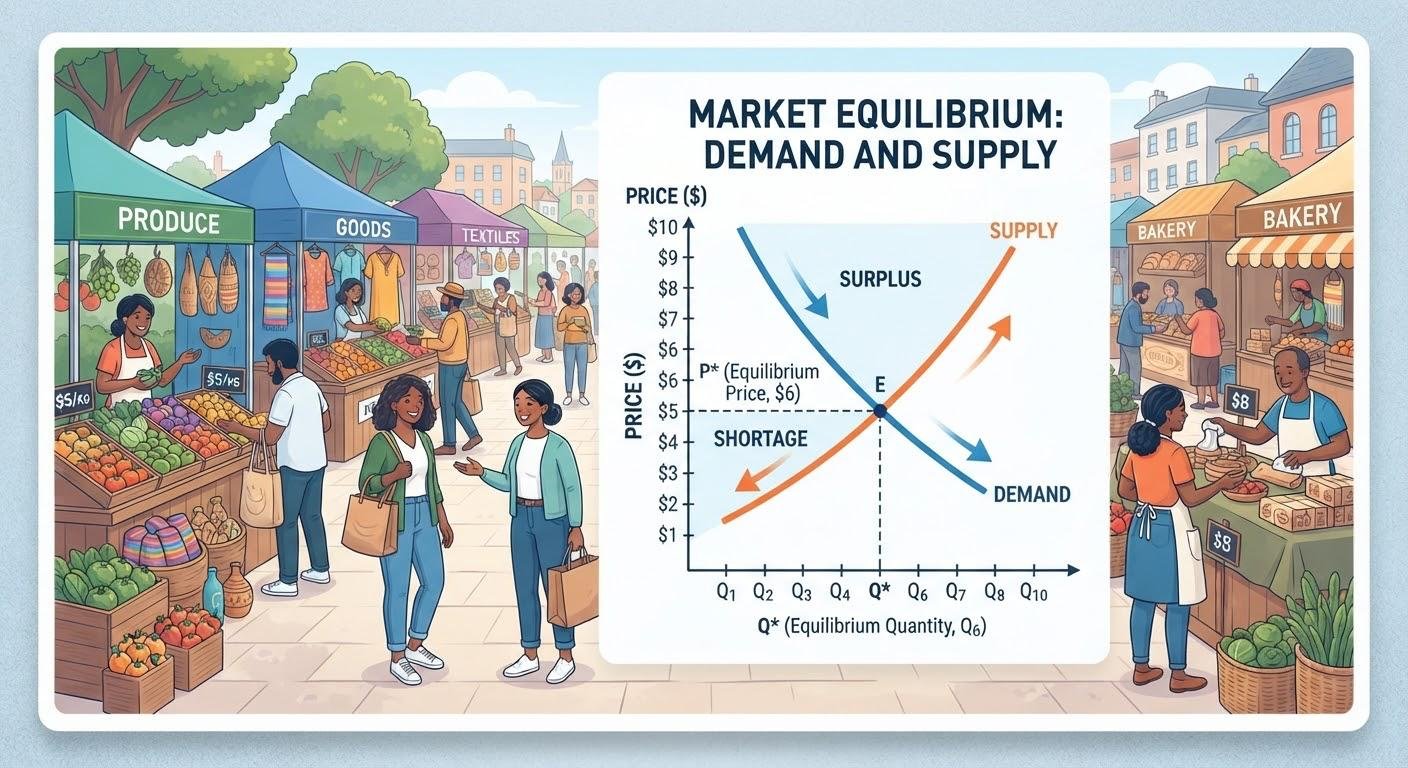
Within a market economy, demand and supply predominantly dictate the distribution of an economy’s resources. Generally, private individuals and firms hold control of the productive resources within the economy. People and firms are largely able to determine what is produced, how it is produced and who it is sold to. Price acts as an indicator for both consumer taste and the relative scarcity or abundance of products. Greater demand for a good or service can lead to higher prices and thus incentivize firms to boost output and attract extra resources into that industry. Conversely, if demand for particular items declines, firms may cut back on production in order to avoid incurring losses. Businesses will often strive to enhance the quality of their goods and services and to be innovative in order to gain a competitive edge within the market. As firms must adapt their outputs to match consumer demand if they wish to continue to generate profits, consumer behavior can therefore have a significant effect upon production. Although countries such as the United States are often associated with market economies, governments also impose regulation and deliver public services and social welfare.
Benefits and Drawbacks of Market Economies
Market economies can be highly effective at stimulating competition, innovation and both consumer and economic freedom. Privately owned businesses are motivated to invest, to increase output and to develop novel goods in order to successfully meet consumer demand. Businesses can also seek to lower their costs and become more efficient, again to stand out in the market and so benefit consumers. Nevertheless, market economies can give rise to unequal income distribution as those with greater financial resources and control over resources are often better placed to continue to generate extra income. Crucially, individuals may also find it difficult to access fundamental services, such as health care and education, if they lack the financial means to do so. Additionally, market economies can suffer from market failure. This is where market forces alone do not yield socially optimal results. Environmental degradation, monopolies and under-provision of public goods are all examples of market failure. Moreover, firms may place their own financial interests before wider societal wellbeing. Therefore, government regulation is often required in order to safeguard consumers, employees and the environment. Although market economies facilitate economic freedom, they are not always completely fair and do not always ensure equitable resource distribution.
3. Command Economy
Within a command (or centrally planned) economy, the government has significant control over an economy’s resources and is responsible for key economic decisions. Unlike within market economies, economic activity is not largely driven by private firms and market forces. Instead, a central authority formulates economic goals and distributes resources. The government determines what should be produced, using pre-ordained production processes and technology, and defines who should gain access to goods and services through its distribution policy and prioritization. The state exercises substantial control over key industries, such as energy, transport, manufacture and agriculture. Previously, the Soviet Union implemented central planning to a great extent in order to guide production and to allocate resources. North Korea is another country in which the government exerts wide-ranging control over economic affairs. Overall, economic planning is utilized within command economies to ensure that a nation’s resources are effectively managed and that outputs are focused on identified development aims.
Benefits and Drawbacks of Command Economies
As the government has substantial control over an economy, it can allocate resources to address key national issues independently of purely commercial considerations. It can place emphasis upon developing crucial areas including transport, public housing, education, health care and industry – even where private investors may not deem these to be economically viable. Central planning can also enable rapid resource reallocation in response to national crises. Moreover, the government can exert control over distribution and so help to alleviate specific types of economic inequality. Nonetheless, command economies frequently suffer from inefficiencies, and can be associated with high levels of bureaucracy. As economic decision making is undertaken at a central level, it can prove difficult for the government to fully comprehend the evolving demands and desires of a nation’s large population. This can in turn cause both under and over-supply of particular goods. In addition, a lack of competition can impede innovation, productivity and quality. Businesses may similarly fail to endeavor to reduce costs if they do not enjoy sufficient autonomy. Poorly coordinated and/or incorrectly informed government decision making can lead to wastage of scarce resources. This in turn can slow economic development and negatively affect the standard of living.
4. Mixed Economy
A mixed economy is a hybrid economic system which incorporates aspects of both market and command systems. Within this structure, private individuals and firms retain economic ownership and control. Simultaneously, the government becomes involved in the economy via regulation, public sector ownership, taxation and the delivery of social services. Although market competition and private ownership are recognized as important, it is also recognized that, at times, government involvement is essential to resolve economic issues and to look after the public interest. Typically, businesses in a mixed economy define what is produced in response to consumer demand. They then select appropriate technology and production processes and identifies target consumers according to people’s purchasing power. However, the government affects these decisions through economic policy, regulation, expenditure and the provision of key services. Mixed economies exist in countries such as Nigeria, the UK and Canada. Nevertheless, the degree to which governments become involved will differ. For instance in Nigeria, the private sector operates within diverse areas of the economy, for example, banking, telecommunications, agriculture and manufacture. Meanwhile, the government provides public infrastructure and regulates industries. It also contributes to the supply of vital social services.
Benefits and Drawbacks of Mixed Economies
Mixed economies successfully integrate market freedom with governmental duties. As previously noted, the private sector can stimulate competition, innovation and investment as well as promoting employment. Governments can work to tackle inequality, and can also provide services which may otherwise not be accessible to those from disadvantaged groups. They can regulate monopolies and establish environmental guidelines. Governments can also invest in infrastructure in order to further economic development. Yet, mixed economies are not without issues. Over-involvement by governments can act as a disincentive for private sector investment. It can also inflate bureaucracy and place unwarranted constraints on business. Conversely, inadequate government regulation can enable dominant firms to unfairly control markets, to exploit staff and/or to behave unethically. Governments may also struggle to strike the correct balance between their expenditure and the autonomy of the private sector. Moreover, political manipulation, corruption and inefficient governmental bodies can hinder resource distribution. Therefore, the efficacy of a mixed economy will largely depend upon the quality of economic policy, the integrity of institutions and transparent regulation. Good collaboration between governmental bodies and the private sector is also key.
Analysis of the 4 Resource Distribution Methods
Whilst all 4 economic systems endeavor to distribute resources, they differ greatly in relation to how economic decisions are reached and executed. Traditional economies are largely influenced by culture and custom and so community norms will typically dictate both production and distribution. Market economies are predominantly governed by demand, supply, private sector ownership and competition and so individuals and firms enjoy considerable economic freedom. Command economies are largely controlled by the government, which formulates economic strategy and determines how and for whom resources are distributed. Mixed economies incorporate both private and government involvement so as to simultaneously ensure economic efficiency and social care. These distinctions can affect the supply of goods and services, employment prospects, income equality, technological development and personal freedom. Whereas market economies may promote innovation through competition, command economies can focus resources on particular national development aims. Mixed economies endeavor to amalgamate the benefits of both of these systems. Traditional economies emphasize cultural preservation together with community interaction. No one method of resource distribution is foolproof. All economic systems can encounter economic, political and social issues.
The Impact of Government Control and Private Sector Ownership
Both government control and private sector ownership can impact upon resource distribution. Within market economies, private sector ownership enables individuals and firms to manage resources, to invest and to profit. Competition prompts businesses to adapt to consumer demand and to strive for operational efficiency. Nevertheless, governments are still integral as they legislate, monitor business conduct and protect property rights. Moreover, they can rectify market failures. Within command economies, the government both owns and utilizes central planning to largely dictate production. It can therefore distribute resources to emphasize particular areas of focus. Traditional economies are more influenced by community ownership, family duties and custom. Mixed economies utilize both of these elements, enabling private sector ownership alongside government control or involvement in specific sectors. Alongside identifying whether government or the private sector should lead resource distribution, it is also crucial to ensure that institutions are of a high standard, that economic policy is sound and that appropriate information is available. Responsibly managing resources also necessitates the capacity to address an evolving population’s requirements.
The Impact of Economic Systems on a Nation’s Development
The resource distribution mechanism followed by an economy can directly affect a nation’s development and the living standards of its population. Efficient resource distribution can enhance output, facilitate employment and promote investment. Furthermore, market competition can help to drive technological development and entrepreneurship so that firms can successfully tailor their offerings to customer demand. Governments can also plan to construct major infrastructure and can target investment at industries which they consider to be especially pertinent to a nation’s development. Traditional economies can aid the continuation of local knowledge and can sustain rural areas and community production. Mixed economies can draw upon these benefits, as well as utilize government policy to both tackle inequality and to address infrastructure issues. Particularly for developing nations such as Nigeria, it is highly important that resources are distributed effectively. Given that these countries generally have restricted financial resources, governments must effectively manage these so that they can be appropriately allocated to a variety of areas, for example, education, health care, agriculture, electricity, transport and industry. Indeed, it is not merely about adding to a nation’s resources, but also about ensuring that resources are both effectively managed and distributed in a responsible manner so as to further sustainable economic development.
Conclusion
Traditional, market, command and mixed economic systems are all distinct ways of resolving the issue of economic scarcity and distributing resources. Traditional economies are influenced by culture and community behavior. Market economies are predominately influenced by demand, supply, private sector ownership and competition. Command economies are largely controlled by central planning and government. Mixed economies blend private sector and government involvement in order to optimally balance economic efficiency and social care. Although each economic system has benefits, they can also each encounter issues which can in turn affect output, consumption, economic freedom and a nation’s development. The efficacy of an economic system is largely dependent upon its capacity to appropriately address the requirements of a nation’s population, to effectively manage resources, to stimulate productivity and to resolve economic issues. Sound decision making, strong integrity within institutions, innovation and suitable economic policy can all contribute to both positive economic development and enhanced living standards.
Get more well researched information about Methods of Resource Allocation in an Economy here.