Introduction
In present day’s competitive business setting managers are to make informed financial decisions which improve efficiency, reduce waste, and increase profitability. To which in managerial accounting we have very useful tool in Break-even analysis. What the analysis does is that it enables companies to compare actual performance with what was planned or budgeted which in turn identifies strengths, weaknesses and areas which require improvement.
Although we see variance analysis and break even analysis as separate accounting terms, they do in fact have a relationship in terms of cost management and decision making. Break even analysis that which is a component of marginal costing is what businesses use to figure out the lowest level of sales that will cover all their costs and prevent loss. By understanding both of these topics managers are able to make better operational and financial decisions.
This article looks at the fundamentals of variance analysis which also we go into in depth with break-even analysis including in the report are its formulas, calculations, practical examples, pros, cons and how it is used in a management setting.
What Is Variance Analysis?
Variance analysis is a tool which businesses use to put their present performance in the past which they have already budgeted for into an economic balance. Also known as a variance which is a term used for the gap between what had been projected to have happened in a certain business area, than what actually went on.
For instance if a company budgeted production costs at 12,000 the variance is $2,000 unfavorable which is a result of the company spending over what was planned.
Variance analysis allows managers to answer questions such as:
- Why did costs increase?
- Sales fell short of expectations.
- Which department is underperforming?
- Are business operations efficient?
Managers apply variance analysis to improve budgeting, control costs, and to increase profitability.
Types of Variances
Variance analysis includes a wide range of business performance. Which also include:
1. Sales Variance
Sales performance variation which is the difference between what we sold and what we planned to sell.
Formula:
Sales Variance= Actual Sales – Budgeted Sales.
A positive variance is when sales outperform what was expected, a negative variance is when they fall short of the target.
2. Cost Variance.
Cost variance is a comparison of actual production or operational costs to what were expected.
Formula:
Cost Variance= Standard Cost – Actual Cost.
If actual results exceed the standard we have an unfavorable variance.
3. Material Variance
Material variance in terms of use and cost of raw materials in production
4. Labor Variance
Labor variance is the difference between what we expected for labor costs and what we got.
5. Overhead Variance
Over which is reported the actual overhead costs versus budgeted overhead expenses. These differences which managers use to see how the operations are performing and to implement corrective measures as required.
Importance of Variance Analysis
Variance analysis is a key tool in which we see value in many ways which include:
Improved Cost Control
Managers which see spending go beyond what is in the budget should put in place actions to reduce what is non-essential.
Better Decision-Making
Variance analysis reports which we present to you are very accurate and they in turn help our managers in the strategic business decisions.
Performance Evaluation
Businesses may look at departments, employees, or production units by performance.
Budgeting Accuracy
Reviewing past performance enables organizations to develop better budgets going forward.
Increased Profitability
When issues of inefficiency are brought to light and fixed, companies see growth in profit and operational performance.
Understanding Break-Even Analysis
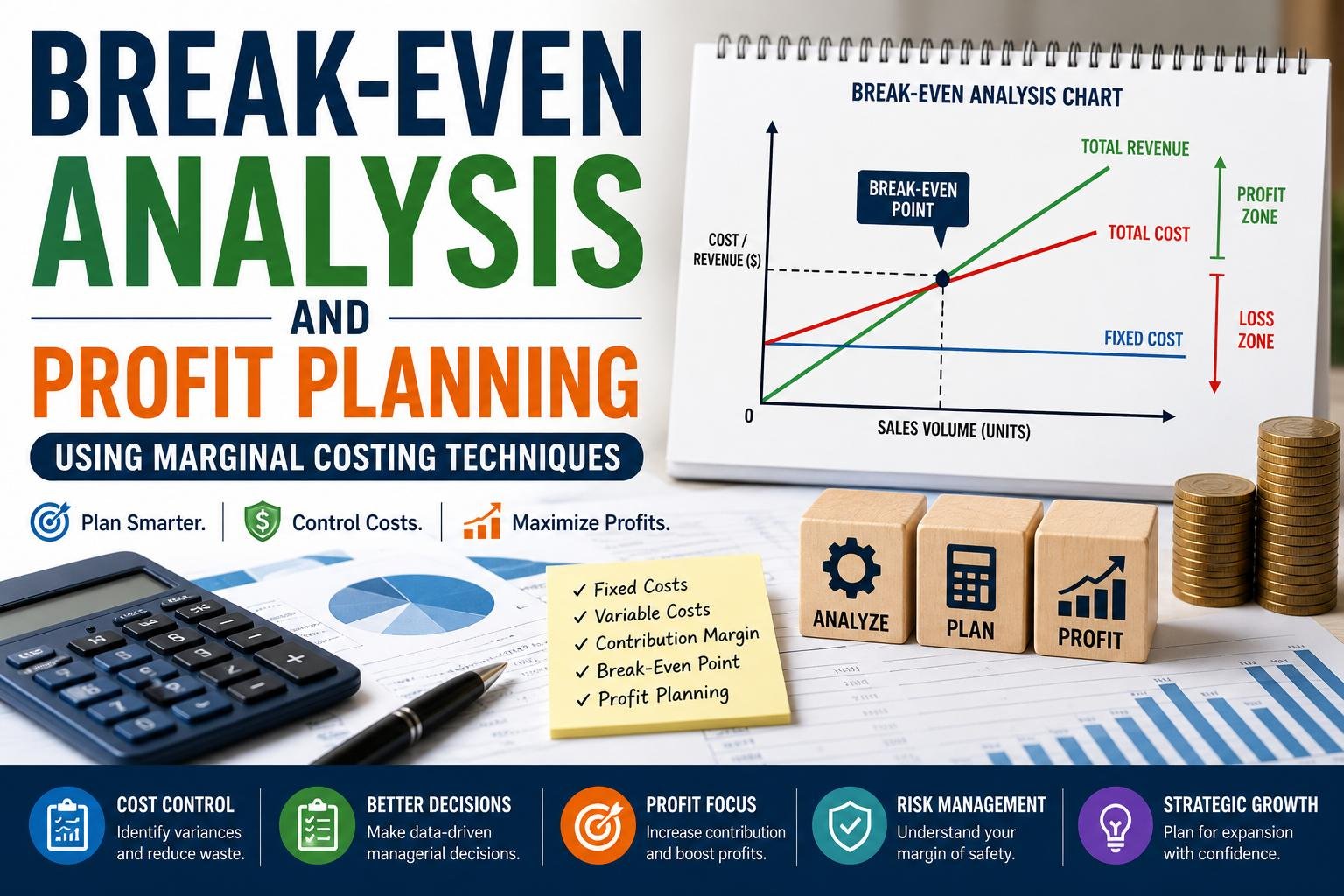
One in which marginal costing is applied is break even analysis. Break even analysis determines the sales volume which is required to cover all fixed and variable costs. At the break-even point a business does not make a profit or a loss. Beyond this point sales increase profit.
Break in even analysis is at large in financial planning, pricing decisions, budgeting, and business forecasting.
What Is Marginal Costing?
In marginal costing fixed costs are put aside separately and only variable costs are accounted for in production.
In the case of marginal costing:
- Variable production costs fluctuate.
- Fixed costs do not change with output.
This approach is for managers to see into contribution margin and profitability.
Contribution Margin
Contribution from variable costs is subtracted out of sales.
Formula:
Contribution = Sales – Variable Costs
Contribution is essential as it covers fixed costs and generates profit.
Components of Break-Even Analysis
Managers to do well in break-even analysis must know its key elements.
Fixed Costs
Fixed costs are constant.
Examples include:
- Rent
- Insurance
- Salaries
- Depreciation
Variable Costs
Variable expenses vary in direct proportion to production volume.
Examples include:
- Raw materials
- Packaging
- Direct labor
- Sales commissions
Selling Price
The price at which we sell to customers is Contribution per Unit
Contribution per unit is calculated as:
Contribution per Unit= Selling Price -Variable Cost per Unit.
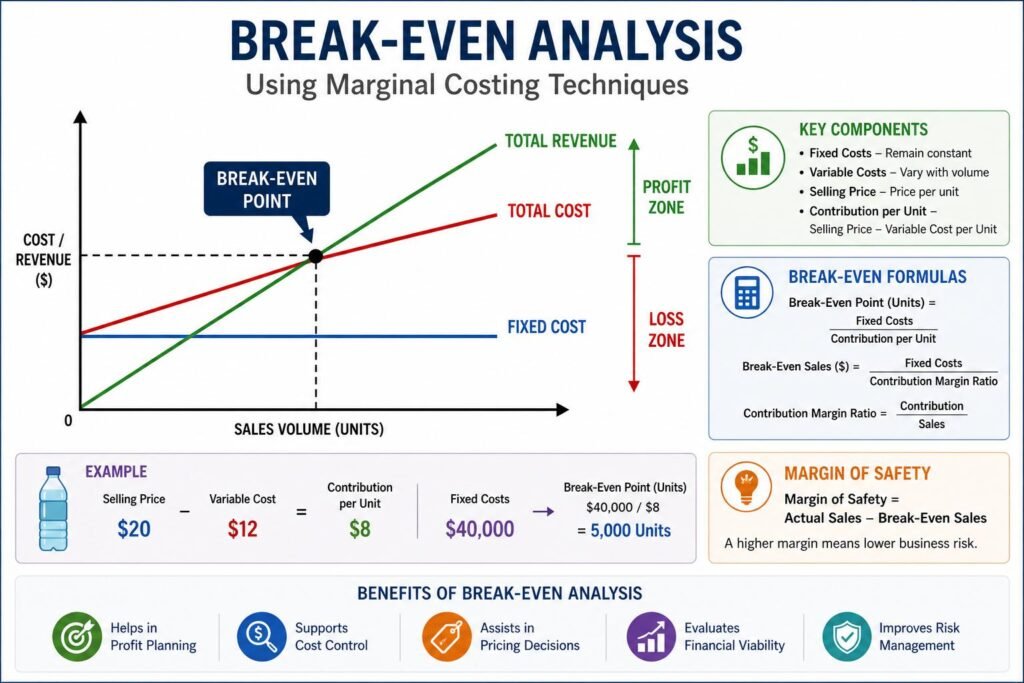
Break-Even Formula
At the point of break-even units sold or sales value are determined.
Break-Even Point in Units
Break Even Point = Fixed Costs /Unit Contribution.
Break-Even Point in Sales Revenue
Break Even Sales= Fixed Costs /Contribution Margin Ratio.
Where:
Contribution Margin Ratio =Contribution/Sales
Practical Example of Break-Even Analysis
Let’s take a look at a company that produces water bottles.
Given Information
- Selling price of each bottle is $20.
- Variable price per bottle $12.
- Fixed costs = $40,000
Step 1: Compute Contribution Per Unit.
Contribution of 20-12 which= 8.
The contribution per unit is $8.
Step 2: Determine Break-Even Point.
Break-Even Point = 40,000/8= 5,000 units.
This means that which they will have to sell 5,000 bottles to break even.
Step 3: Determine profitability past break-even point.
If the company sells 6,000 bottles:
Profit = (6,000ˣ8) – 40,000.
Profit = 48,000 – 40,000
Profit = 8,000
Once past the break-even point the company sees profit from additional sales.
Graphical Representation of Break-Even Analysis
Break even analysis is presented via break even charts.
The chart typically includes:
- Total cost line
- Total revenue line
- Fixed cost line
- Break-even point
At the intersection of total revenue and total cost lines is the break-even point. Below break-even point business is losing money. Above it the business is profitable.
Margin of Safety
The safety margin is the amount by which actual sales outperform break even sales.
Formula:
Margin of Safety= Actual Sales-Break Even Sales.
A wide safety margin is a sign of low business risk.
Example
If at actual sales of 8,000 units and break even sales of 5,000 units:.
Margin of Safety= 8,000-5,000= 3,000 units.
This means that sales may fall by 3,000 units before we see the business go into the red.
Applications of Break-Even Analysis
Break through analysis is very much so used in business management.
- Pricing Decisions: Managers use break-even analysis which determines sale prices.
- Profit Planning: Firms may determine what sales volume is required to reach target profits.
- Cost Control: Managers may determine which of variable or fixed costs issues for profitability are.
- Investment Decisions: Before releasing new products companies study break even points which is a measure of financial viability.
- Business Expansion: Companies which are looking to grow may use break even analysis to assess financial risk.
Real-World Example of Break-Even Analysis
Think of a small bakery which is to introduce a new cupcake line.
Estimated Costs
- Monthly fixed costs = $5,000
- Variable price per cupcake= $2.
- Selling price of a cupcake= $5.
Contribution per Cupcake
5 – 2 = 3
Break-Even Point
5,000/3 = 1,667 cupcakes
The bakery has to sell around 1,667 cupcakes per month to break even. If we go over those number sales wise, the bakery sees profit. If we don’t go past that level the bakery incurs losses. This data helps the bakery determine if the new product will do well from a financial perspective.
Relationship between Variance Analysis and Break-Even Analysis
Variance and break-even analyses are related, they both look at cost management and profit.
- Variance Analysis Helps Monitor Actual Performance
Managers compare what is the actual performance to what was expected.
- Break-Even Analysis Helps Predict Profitability
Managers’ report that which sales are needed to break even.
Together, these tools help businesses:
- Improve financial planning
- Monitor operational efficiency
- Reduce losses
- Increase profits
- Make strategic decisions
Advantages of Break-Even Analysis
Break through analysis provides many benefits to businesses.
- Simple and Easy to Understand: Calculations are simple and they apply to small as well as large businesses.
- Supports Financial Planning: Managers can gauge required levels of sales and plan for that.
- Helps in Decision-Making: Firms can assess pricing, production, and expansion strategies.
- Assists in Risk Management: Break-even analysis is a tool which businesses use to determine risk.
- Improves Profitability: Managers see which areas have cut back potential and which have upping of contribution margins.
Limitations of Break-Even Analysis
Although of value break even analysis has some drawbacks.
- Assumes Constant Costs: In fact over time fixed and variable costs may.
- Assumes Constant Selling Price: Market competition may also push prices down.
- Ignores Market Conditions: Break at even point analysis does not take into account economic trends or customer demand fluctuations.
- Not Suitable for Complex Businesses: Businesses that sell many products may see break even analysis as a challenge.
- Limited Accuracy: The report is based largely on estimated data which at times may not be accurate.
Managers should put into practice break even analysis in conjunction with other financial tools for better decision making.
How Managers Combine Variance and Break-Even Analysis
Present day companies may use both at the same time.
- Budget Monitoring: Variance analysis shows that actual costs are in agreement with budgets.
- Sales Forecasting; Break-even analysis estimates minimum required sales.
- Performance Improvement: Managers identify out of sync departments through variances and revise strategies.
- Strategic Planning
- Businesses can put forth realistic profit goals with the help of these tools.
- Operational Efficiency: Companies increase productivity at the same time as they reduce waste and unnecessary spending.
Using a combined approach we see better financial control results.
Tips for Effective Break-Even Analysis
Managers should use these best practices in break-even analysis.
- Use Accurate Data: Reliable cost and sales projections improve the accuracy of results.
- Review Costs Regularly: Businesses should often review and report on fixed and variable costs.
- Monitor Market Trends: Changes in market demand and competitive environment which in turn affect profitability.
- Combine with Other Financial Tools: Break-even analysis goes well with budgeting, forecasting, and variance analysis.
- Focus on Contribution Margin: Increasing profitability by improving contribution margins.
Technology’s Role in Financial Analysis.
Technology has redefined managerial accounting and financial analysis.
Today’s accounting software can:
- Generate variance reports automatically
- Calculate break-even points instantly
- Create financial dashboards
- Forecast future sales trends
- Improve budgeting accuracy
Businesses that use digital accounting systems tend to do better in accuracy and speed of decision making. Popular tools in the accounting field include spreadsheets, ERP systems and cloud accounting software.
Conclusion
Variance analysis is a key element of managerial accounting and financial management which break even analysis is also a very important tool. What variance analysis does is that it allows managers to put actual performance against what was supposed to happen, from there they may identify what went wrong, control costs and see ways to improve operational performance.
In terms of application of marginal costing, break even analysis is a tool which businesses use to determine the sales volume at which they will cover all their costs and start to turn a profit. Through analysis of fixed costs, variable costs, contribution margin, and profitability break even analysis also gives managers information to use in regards to pricing, production, expansion, and investment.
Although there are issues with break-even analysis it is still the preeminent which is put to use in the world of business. When we combine break even analysis with variance analysis what we get is a better picture of present financial performance and future profitability.
In today’s competitive environment managers that have knowledge of these financial tools are better positioned to reduce risk, improve efficiency, and see sustainable growth.
Get more well researched information about break-even analysis here.