Abstract
Radio and television broadcasting is still one of the main pillars of contemporary mass communication despite the fast digitalization. Any broadcast, in the background, involves a complicated mix of engineering mechanisms that have a role in capturing, processing, transmitting and receiving audio-visual signals over extensive geographical regions. This article is a simple but technically reliable description of the work of the radio and television systems, paying attention to transmitters, receivers, antennas, signal propagation and studio technologies. Through a scholarly analytical approach, the paper brings together the present academic and technical literature to demystify broadcast infrastructure and to provide an explanation of the flow of signals between production studios and viewers. It has been established that broadcasting systems work under synchronised signal conversion, modulation, transmission and decoding processes, which are the pillars of engineering that support global communication of electronic media. The article presents a background manual to students and media fans who wish to learn about the technological structure that serves the communication and broadcasting.
Keywords: broadcasting systems, transmitters, receivers, signal propagation, studio technology, electronic media engineering.
1.0 Introduction
The radio and television broadcasting revolutionized communication in the world by making the transmission of information over great distances possible within a short period of time. In contrast to the print media, the broadcast systems make use of electromagnetic signals and complex electronic systems to provide content to mass audiences at the same time. The technical procedures of allowing transmission are misunderstood despite the fact that audiences use radio and television on a daily basis.
The nub of electronic media lies in the heart of the technical ecosystem, the generation of signals, their encoding, transmission, reception and decoding. This infrastructure is of paramount importance to media students, journalists and communication scholars who would love to understand how technological systems influence content delivery. The ultimate description of those processes can be further explained with the help of the following resource about the backbone of broadcast communication. This paper discusses the functioning of the broadcast systems incorporating concepts of engineering with communication theory, with a structured presentation of the material in an academic format, without the need to be an engineer.
2.0 Literature Review
The study of broadcasting technology has historically been oriented on the development of engineering as well as the impact of communication. Initial studies focused on the concept of electromagnetic transmission that was developed by Maxwell and Hertz, which subsequently made it possible to develop wireless communication technologies (Sterling and Kittross, 2002).
According to McLeish (2015), radio broadcasting is based on the main principle of the audio signal modulation that is transmitted with the help of radio frequency (RF) waves, whereas television expands the process by integrating coherent visual information. Recent research underscores the digital broadcasting change, as well as the compression standard, such as the MPEG encoding and digital signal processing (DSP) (Whitaker, 2013).
The communication researchers also suggest that technological infrastructure can affect the availability of media and the ability to reach the audience (Baran, 2019). The contemporary broadcasting systems are becoming more and more interdependent between the analog groundwork and the digital networks of distribution so that both terrestrial, satellite and internet can be used to deliver the hybrid broadcast.
With a large amount of technical literature, there is a lack of knowledge among media students due to the majority of educational material being engineering-related. This paper fills that gap by providing technical descriptions of a context in communication studies.
3.0 Conceptual Review
3.1 Broadcasting Systems
Broadcasting is the transmission of both audio and audiovisual messages to a large group of people at the same time through the use of electromagnetic waves. Radio sends sound, and television is able to send both sound and motion pictures.
3.2 Key Technical Components
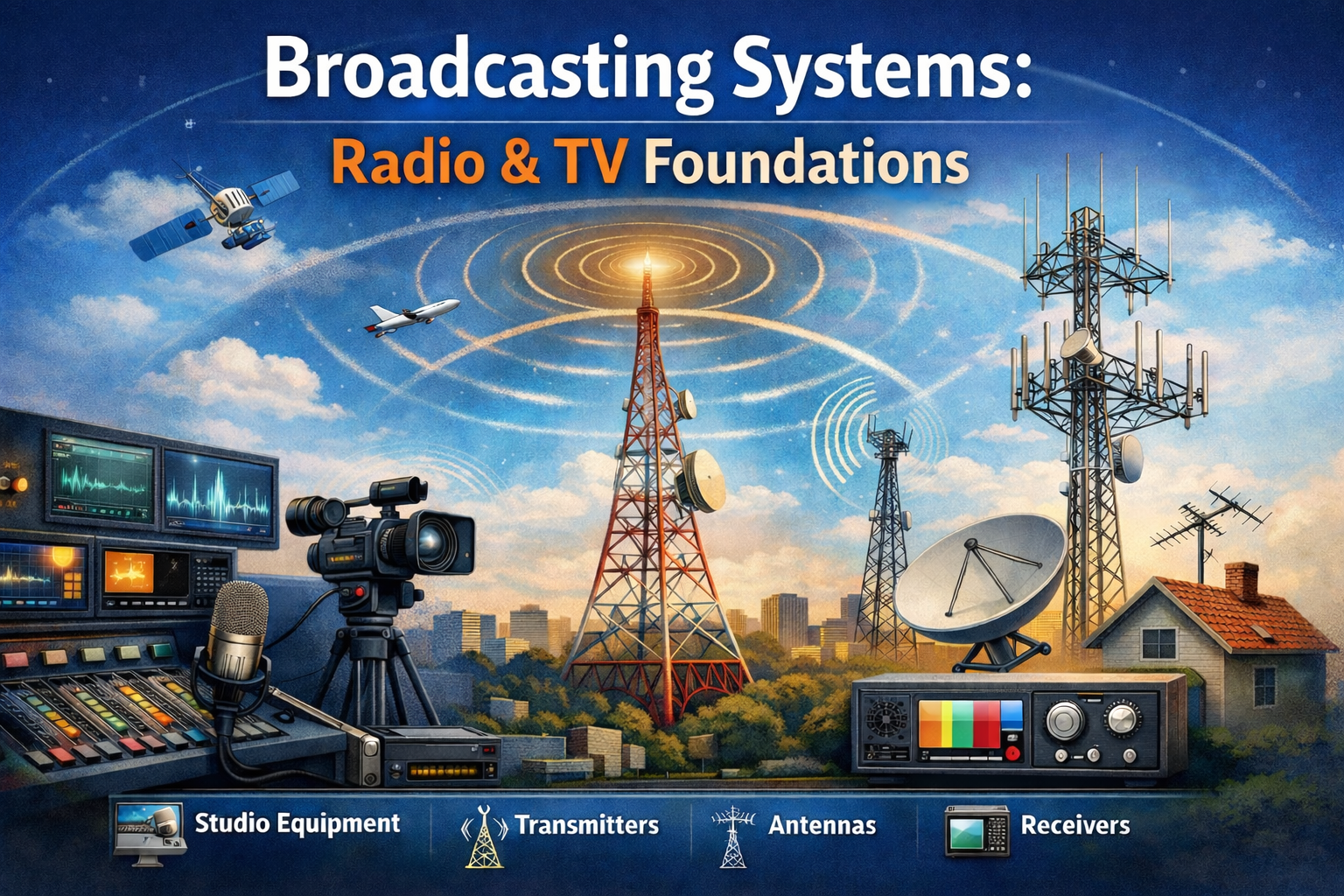
Broadcast systems are based on five major elements:
- Studio equipment – records and ready content.
- Transmitters – change signals into broadcast frequencies.
- Antennas – emission of signals into space.
- Signal propagation mechanisms- transport signals over distances.
- Receivers – decode messages to be consumed by the audience.
These elements work in a chain with one another, creating a continuous communication.
3.3 Signal Conversion
Sound and images are physical phenomena. Microphones and cameras transform these phenomena into electrical signals, thus making electronic manipulation and transmission possible.
3.4 The Physical and Technical Foundation of Broadcasting
3.4.1 Audio and Video Signal Recording: Studio equipment
Broadcast production starts within the studio.
Audio Capture
Sound waves are converted into an electrical signal by microphones, which detect the vibration of the diaphragm. There are various types of microphones as they are special:
- Live sound dynamic microphones.
- Studio clarity condenser microphones.
- Visual Capture
The image sensors on television cameras are CCD or CMOS chip electrical converters of light. These sensors accept the brightness and color data in the form of digital information.
Signal Processing
Prior to transmission, the signals are transmitted through:
- Audio mixers
- Video switchers
- Equalizers and processors
- Digital editing systems
Processing is to provide clarity, balance and adherence to broadcast standards.
3.4.2 Encoding and Modulation
Raw signals are not efficient in long distances travel without alteration.
Modulation
Modulation is a combination of a baseband signal (audio/video) and a carrier frequency.
The common radio modulation techniques are:
- AM (Amplitude Modulation)
- FM (Frequency Modulation)
Television broadcasting employs more complicated digital modulation schemes, including the Orthogonal Frequency Division Multiplexing (OFDM). Encoding helps to compress the signal to save on bandwidth and maintain quality.
3.4.3 Transmitters: Broadcast Signal Powering
Transmitters are the driving forces of the broadcasting systems.
Their functions include:
- Amplifying encoded signals.
- Changing signals into radio frequency energy.
- Supplying energy to transmission antennas.
Powerful transmitters enable signals to signify whole cities or areas. Broadcast range and signal reliability are dependent on transmission power.
3.4.4 The field of electromagnetic radiation and antennas
Electrical signals are transformed into electromagnetic waves using the antenna.
The important features of an antenna are:
- Frequency range
- Directionality
- Height and placement
Taller transmission towers enlarge the coverage area since they reduce the physical barriers. Television antennas are usually used in VHF and UHF frequencies and allow good audiovisual transmission.
3.4.5 Signal Propagation
After they are sent, they are transferred in the atmosphere by the propagation of the electromagnetic waves.
There are three significant modes of propagation:
- Ground wave propagation – It travels along the surface of the earth (as in AM radio).
- Skywave propagation – reflecting off the ionosphere, long-distance radio reception is possible.
- Line-of-sight propagation – applied to television and FM signals.
Signal strength can be affected by environmental factors like buildings, terrain and weather.
3.4.6 Signal Decoding and Receivers
The communication cycle is finished with audience devices.
Radio and television receivers carry out a number of technical functions:
- Antenna-based signal detection.
- Frequency tuning
- Demodulation
- Signal amplification
- Audio/video reconstruction
TV sets also decode the compressed digital information into images and audio in sync.
3.5 Digitalisation in Broadcasting
Contemporary broadcasting is growing more and more dependent on digital technology.
3.5.1. Digital Compression
The compression standards decrease the size of data without compromising the quality.
3.5.2 Error Correction
Digital systems have error detection to reduce distortion of the signal.
3.5.3 Multi-Platform Integration
Internet streaming is now in harmony with broadcast signals, allowing the 2-way distribution approaches.
Digital broadcasting is more efficient in terms of spectrum, and it has increased the spectator experience through the use of high-definition forms.
4.0 Theoretical Review
4.1 Shannon-Weaver communication model
This model is a model that is based on a sequence of activities performed by individuals in order to convey their thoughts effectively in an organizational context.
The conceptual framework of the Shannon-Weaver model views communication as a communication process that involves a sender, an encoder, a channel, a decoder and a receiver (Shannon and Weaver, 1949). Physically, this model is implemented by broadcasting technologies:
- Studio equipment = encoder
- Transmission channel = electromagnetic spectrum.
- Television/radio sets = decoder.
Signal interference, atmospheric disruption, or equipment constraints are all concepts related to noise in broadcasting.
4.2 Technological Determinism Theory
According to technological determinism, media technologies influence the pattern of communication and interaction in society (McLuhan, 1964). Broadcasting infrastructure defines immediacy, reach of the audience and sensory involvement.
5.0 Methodology
In this research, the qualitative descriptive approach is used on the basis of:
- Analysis of engineering handbooks of broadcasting and academic literature.
- Radio and television operational processes comparative technical synthesis.
- Theory: The conceptual interpretation between communication theory and engineering systems.
The methodology is explanatory and not experimental, and is, therefore, easy to understand by media learners.
6.0 Findings
According to the analysis, the following main findings can be made:
- Broadcast systems are technologically configured to run in a chain of sequential engineering connecting production and reception.
- Geographic range is determined by transmitters and antennas.
- Efficient transmission of electromagnetic waves takes place through signal modulation.
- Decoding and amplification are processes of reconstructing signals in the receivers.
- Digital technologies increase efficiency; however, relying on traditional broadcast infrastructure.
These results affirm the fact that broadcast communication depends on closely knit together physical and electronic systems.
7.0 Discussion
Communication theory is physically exhibited in broadcasting through the technical structure, which shows how engineering systems work. Documentation and decoding processes are enshrined in the theoretical communication models supporting the association between technology and message delivery.
Moreover, the knowledge of broadcasting infrastructure can make media personnel realize the constraints of production, including bandwidth, signal interference and transmission rules. There is no replacement but continuity in the transition of digital broadcasting, where the systems are built on top of the traditional systems.
8.0 Conclusion
Radio broadcasting and television broadcasting are still considered to be two of the most powerful communication technologies due to their capacity in spreading information at high speed and large scale. Under the ability of this is a complex technical infrastructure that includes studios, transmitters, antennas, propagation systems, and receivers.
This article elucidates the engineering mechanisms that underlie electronic media by giving information on how signals are captured, processed, transmitted and decoded. The knowledge of these foundations will help students as well as media enthusiasts to have the necessary knowledge on how broadcast communication works in practice.
The digital innovation in broadcasting keeps changing the way broadcasting is performed, yet its physical and technical principles are essential in the information exchange in the world.
9.0 Recommendations
- Simple broadcast engineering knowledge should be incorporated into the media education programs.
- Theoretical communication studies should be complemented by practice in the laboratory.
- Future studies are needed to examine the intersection between internet distribution technology and broadcasting technology.
References
Baran, S. J. (2019). Introduction to mass communication: Media literacy and culture. McGraw-Hill Education.
McLeish, R. (2015). Radio production. Routledge.
McLuhan, M. (1964). Understanding media: The extensions of man. McGraw-Hill.
Shannon, C. E., & Weaver, W. (1949). The mathematical theory of communication. University of Illinois Press.
Sterling, C. H., & Kittross, J. M. (2002). Stay tuned: A history of American broadcasting. Lawrence Erlbaum Associates.
Whitaker, J. C. (2013). Television broadcasting technology. McGraw-Hill Professional.



I just learned something new today, thank you for sharing.