Introduction
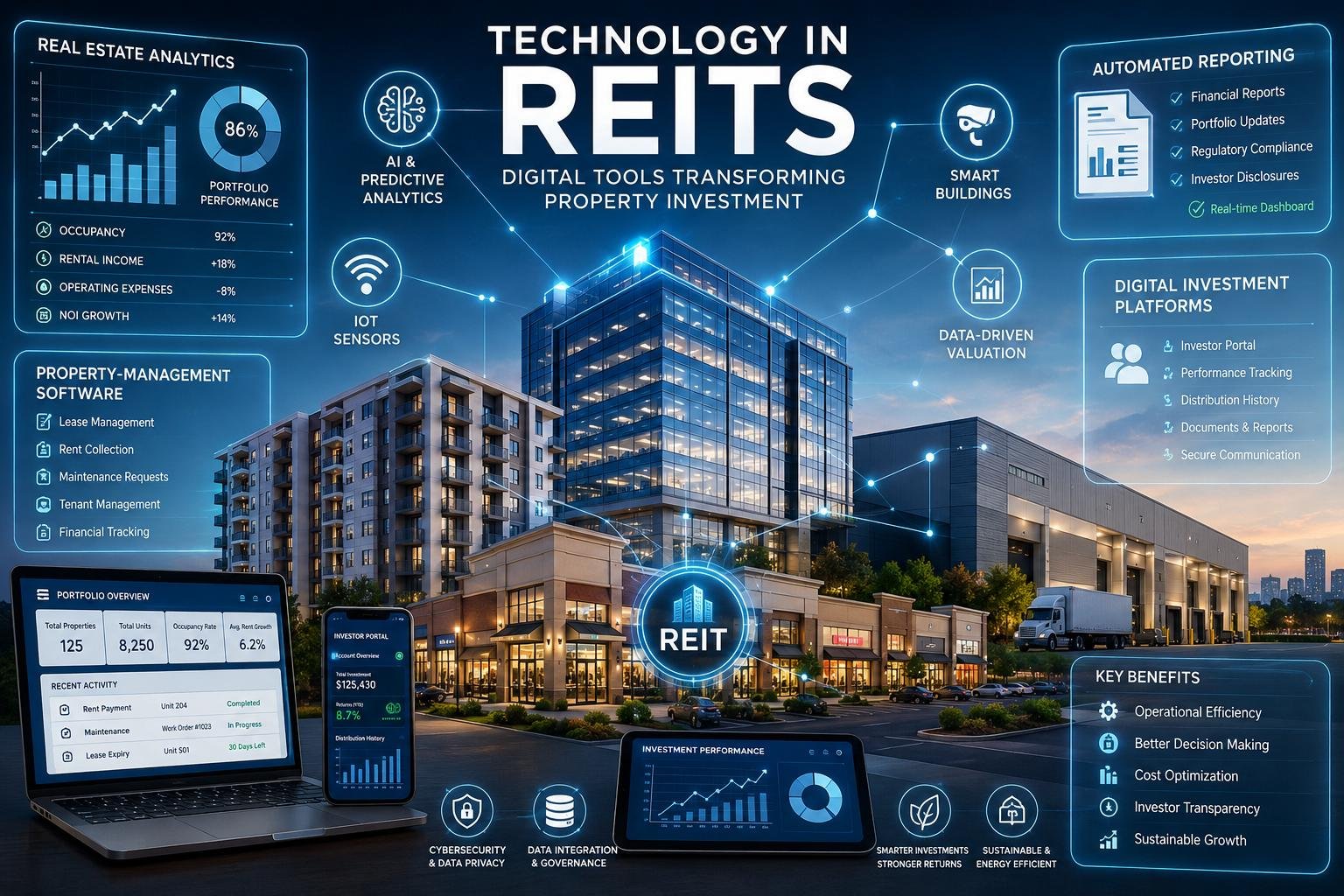
The traditional way that Real Estate Investment Trusts (REITs) have managed real estate portfolios with income-producing properties has been to rely on the management skills of their property managers, financial analysts, brokers, accountants, and other professionals. But the digital technology landscape is rapidly evolving and altering the way REITs acquire, operate, evaluate and finance properties. The use of property-management software is one of the most significant advancements, as it enables property teams to manage and organize elements like lease management, maintenance activities, tenant details, rent collection and operations data through a unified electronic system. In addition to property management, REITs are increasingly leveraging real estate analytics, artificial intelligence (AI) and the Internet of Things (IoT) sensors, automated reporting systems, digital investment platforms, and data-driven valuation models. The technologies enable REITs to make quicker decisions, minimize inefficiencies in operations, communicate more effectively with investors, and have a better understanding of their assets. The modern REIT is becoming much more than a building owner and manager, as technology plays an ever-increasing role in the financing of real estate.
Application of Technology in REIT
With hundreds of properties in their portfolios, spanning various locations and property types, technology has become important for REITs. A REIT can hold office buildings, shopping centers, warehouses, apartment communities, hospitals, data centers, hotels and other niche real estate properties. As a result of managing such a portfolio, the amount of information regarding tenants, leases, rent payments, operating expenses, occupancy requirements, maintenance needs, energy usage, property values, financing plans and returns on investment is enormous. Digital systems enable this information to be gathered and arranged more effectively than any other paper or unconnected system. REIT professionals can access comprehensive platforms that provide them with data on their portfolio and help them see changes in performance without the need to use multiple spreadsheets or manual records. This enhances the visibility of the organization and enables managers to focus on analyzing data and making strategic decisions, instead of collecting data from a variety of sources.
Operational Efficiency of Property-Management-Software
One of the most useful technologies for REITs is property-management software, which aids in the daily operations that are needed to manage real estate assets. Another way to keep your properties organized and running smoothly is through modern platforms that can help with managing leases, tenant records, rent collection, work orders, maintenance schedules, vendor relationships, and property-level financial information. In a REIT with a big portfolio, it may be extremely useful to have these functions linked via one digital environment, as it can lower administrative complexity. Property managers have the ability to track if rent was paid, upcoming lease dates, maintenance issues, and property expenses without fully relying on manual methods. Automation can also minimize the risk of human errors that might occur due to duplicate data entry or using spreadsheets that are not up to date. If the data is available at the property level, and comes in a structured format, REIT executives can make comparisons of buildings, and determine which ones need attention. This establishes a tighter link between this daily issue of property administration and the overall financial goals of the REIT.
Real Estate Analytics and Real Estate Portfolio Decision Making
Real estate analytics is a tool that can help REITs to use an abundance of real estate data to inform their investment decisions. Analytical tools can evaluate occupancy rates, rental income, operating costs, tenant attrition, lease length, geographic return, property returns and more. These indicators can be evaluated on a portfolio basis to identify successful properties and those that may need to be improved. Another potential use of analytics for REITs is to find trends that might not be discernible when looking through data manually. For instance, if the property has lower occupancy rates and higher maintenance costs, it may not be as competitive as it used to be. Likewise, an increase in rental income in a specific market might spur a REIT to pursue more acquisitions in that market. These can be communicated to executives and investment teams using data visualization tools like dashboards, charts, and performance indicators, which can help them make decisions and gain a better understanding of complex information faster.
AI in REIT Investment and Management
AI is enhancing REITs analytical capabilities by enabling them to analyze large volumes of data and make predictions. By analyzing the past performance of rentals, tenant behavior, property information, market trends, economic data, and more, AI can aid in making accurate predictions. AI can assist in predicting tenant turnover, estimating rental demand, detecting abnormal expense trends, or assessing which homes might need repairs, to name just a few instances. AI can help in investment analysis by sifting through a pool of potential acquisitions and matching them to specific financial and operational metrics. It can also facilitate analysts in handling a substantial amount of documents, such as leases, contracts, inspection reports and financial statements. AI does not supplant the need for a professional judgment, however. Unexpected events, such as political decisions, economic shocks, demographic trends, infrastructure development and more, can impact real estate markets. Thus, AI has its most value added when it’s aiding experienced professionals as opposed to replacing them.
Internet of Things and Smart Buildings Sensor Technologies
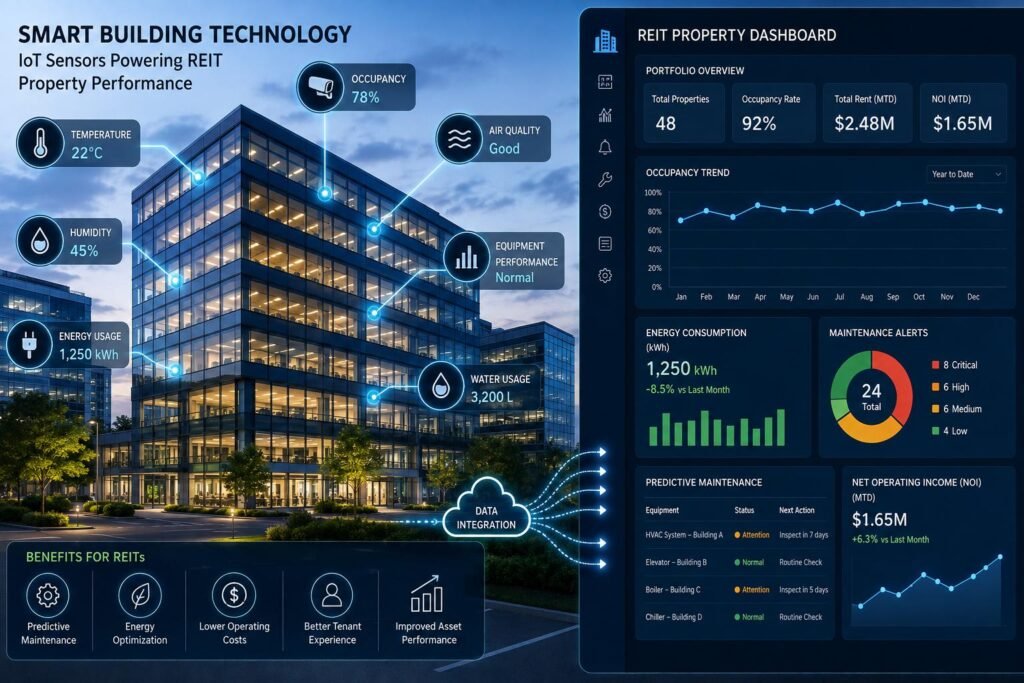
Another technology impacting REITs’ monitoring and management of physical properties is the Internet of Things. Various sensors can be placed all over the buildings to gather data on temperature, humidity, electricity consumption, water usage, equipment performance, building occupancy, air quality and other parameters. This can produce a continuous flow of information which can give a building manager insight into building use. Managers don’t have to wait for equipment failure to take action; when sensor data shows unusual changes, it can point to a potential future issue. By doing so, this method can contribute to predictive maintenance, thereby helping to avoid expensive repairs and tenant downtime. The internet of things can also help to optimize energy use, as it can help to spot where buildings are using more energy than necessary, whether it be electricity or heating and cooling. For REITs, these enhancements can help to decrease operating expenses, improve the tenant experience, and possibly even boost the performance of their properties. Smart-building technology, as a result, links up physical asset management to financial goals.
AI-Based Predictive Maintenance and Asset Monitoring
Traditional methods of property maintenance are often based on routine or tenant/employee reporting of issues. Technology helps REITs to shift to more predictive practices. Monitoring building systems with sensors and connected equipment can continuously track building activity and alert for potential abnormal operation that could lead to a significant failure. For example, a data set from a heating, ventilation and air conditioning system might indicate that something is wrong. This data can be used in a digital system to alert maintenance staff before the equipment fails. For large REIT portfolios, there is value in predictive maintenance as it can cause large sums of money if there are a number of small problems across a lot of properties. Digital monitoring also allows managers to have a history of the performance of equipment to identify those that have recurring issues, and whether the equipment should be replaced or repair costs repaid repeatedly. REITs can benefit from better asset life, asset cost management, less downtime and preserving the quality of assets that provide rental income for investors through better maintenance planning.
Investor Access to Digital Investment Platforms
Technology also is transforming the REIT/Investor dynamic. Making real estate investing information available to investors through digital investment platforms makes it easier for investors to keep in touch without relying solely on the traditional communication methods. Investor materials, financial reports, portfolio updates, performance information, distribution histories, property developments and more can be served to investors on one portal. Investors can also track their investments on some online platforms via computers and mobile devices. This will make it more convenient and can enhance transparency if information is clearly and consistently presented. As the overall rise of digital investing has occurred, real estate investing has become accessible to those who don’t have the resources or expertise to invest in real estate themselves. The public trading of REITs offers a relatively easy way to invest in real estate, and new digital platforms are bringing new methods to the way investors can engage with real estate-related opportunities. Technology is hence facilitating the integration of property markets to the broader digital investment landscape.
Automation of Reporting and Financial Transparency
Reporting is a key element of REIT business as information is needed by investors, regulators, lenders, managers and other stakeholders to ensure they have accurate information regarding the financial and operational performance of the REIT. Preparing reports used to involve spreadsheets, manual document preparation, verification and cross-reference with other departments and much more. Much of this can be automated by having connected databases send data to automated reporting systems, which produce standardized reports. This can save on repetitive administrative tasks and enable financial professionals to concentrate on the results and any unusual changes. Automated dashboards can also enable management to get more regular updates than just periodic reporting cycles. For instance, executives can track the performance of their portfolios, rental income, expenses and occupancy in real-time on dashboards. While automation can help to ensure that all reports are accurate, it cannot prevent an inaccurate report from being produced if the source data is inaccurate. The quality of financial reports continues to be maintained with strong controls, validation procedures and human review.
Data-Driven Property Valuation
Technology has the potential to impact REIT investment decisions in many ways, and one of those ways is through property valuation. Traditional valuation analysis includes an analysis of rental income, comparison properties, capitalization rates, market conditions, property quality and anticipated future cash flows. These are being fed into digital valuation systems which can analyze these and other factors as well as much larger sets of data, and may be able to generate more nuanced property and market valuations. These data can cover historical transactions, rental trends, demographic data, economic indicators, geographic characteristics and other factors that are relevant. These factors are then used in more sophisticated analytic models to uncover relationships between these factors and property value. This can be useful for REITs to consider when determining the valuation of a property they’re looking to acquire, or if they’re thinking about selling a property they already have, whether it’s an attractive price or not. While automated valuation is certainly helpful, it must be used with caution, given the fact that real estate values are extremely local and changing market conditions can drastically affect real estate prices. While technology can assist in gathering the evidence that can be presented to the decision makers, professional expertise is still required in determining the final investment view.
The Use of Technology and Cross Property Performance Comparison
Digital systems have one key benefit in that different properties can be compared, but on a consistent measure. A REIT can have properties across multiple cities or countries, making it hard to perform a direct analysis on the portfolio when there is a difference in information formats. Important indicators like occupancy, rental growth, operating expense, maintenance costs, tenant retention and NOI can be standardized on central digital platforms. This enables managers to detect any differences between properties and look into why those differences occur. If the occupancy is high and operating costs are unusually high, a different approach may be necessary than if the occupancy is low and the costs are high. The comparisons can also be used to assist capital allocation decisions. In the event that a REIT does not have enough money for improvements, information can be used to identify which properties are most promising for a successful additional investment. Technology therefore helps to make the portfolio management process more comprehensive, more integrated, and more evidence-based, an investment process based on a series of individual decisions around the stocks.
Cybersecurity, Data Privacy, and Technology Risks
While technology offers significant benefits, it also presents new risks for REITs, too. Property systems can include information on tenants, employees, suppliers, leases, financial transactions, building operations, and investors that could be sensitive. If there is a cyber-security breach confidential information could be revealed or essential property services could be disrupted. Another risk of IoT devices is that they can leave new vulnerabilities for hackers to exploit when they aren’t secured and updated properly. REITs need to thus view cyber security as a risk management challenge, not one that is purely technical in nature. Data quality is another issue. When the information is incorrect, it can be propagated through the property-management or analytics system, and generate inaccurate reports and investment decisions. One potential pitfall of AI models is that they can draw incorrect conclusions based on incomplete or biased data. Digital transformation will only enhance organizational resilience if access controls, cybersecurity processes, data governance, system testing, employees training and human oversight are in place.
The Future of Technology in REITs
Technology for REITs will continue to become increasingly interwoven and connected with property-management systems, financial systems, analytics, AI applications, IoT networks, and investor communication. These systems can more and more easily share information with each other and jointly develop a connected digital environment instead of working as distinct technologies. A building could generate operational data via its sensors, property-management software could organise all the information, analytics could identify patterns in building performance, AI could predict potential issues and financial systems could work out the impact on level of building returns. This holistic approach may enable REITs to adapt faster to fluctuations in demand by their tenants, operating costs, asset values, and market opportunities. As digital twins, more complex predictive analytics, automated workflows and more complex AI applications become a reality, REITs will be able to gain a better understanding of their properties. Meanwhile, effective organizations will have to strike a balance between innovation and cyber security, compliance, data quality, and technology good governance.
Conclusion
Technology is changing the REIT landscape by bringing together the real-world of property ownership with the analyzing and financial power of today’s digital technology. Property-management software is used to coordinate the daily management of properties, while real estate analytics is used to gain an understanding of the performance of the real estate portfolio. Predictive analytics and decision-making, thanks to artificial intelligence; asset monitoring enhanced by IoT sensors and communication and accessibility for investors, via digital investment platforms. Automated reporting can eliminate repetitive administrative tasks and data-driven valuation models can offer more substantiation to support the acquisition decision, portfolio management and asset-disposition decisions. Rather these technologies complement the invaluable role of the experienced property managers, financial analysts, investment professionals and valuation experts. Rather, they provide tools to those professionals to better understand more complex portfolios. The competitive edge will shift to those REITs that can harness reliable information, successful technology, investment intelligence and good risk management. Thus, technology is transforming the process of how real estate investments are decided, measured, communicated and managed all at the REIT level.
Get more well researched information about Technology in REITs here.