Introduction
In every business, accounting is a key component as it gives financial information that can be used to analyze its performances, make decisions, manage the resources and comply with the legal requirements. But companies are not always making use of the same accounting information for all objectives. There are two critical systems, tax accounting and financial accounting. While both are built on the foundation of accurate records of a business’ finances, they serve different function and have different rules and reporting requirements. Tax accounting primarily concentrates on identifying taxable income and the quantity of tax that a business should owe based upon the applicable tax laws. Financial accounting, however, is concerned with providing an accurate picture of a firm’s financial situation and performance to its shareholders, investors, lenders, regulators and others. Knowing the difference between these systems will help business owners avoid preparing financial statements or tax returns incorrectly.
What is Tax Accounting?
Tax accounting is a method of accounting that was developed specifically for tackling taxation. This is its main function a determination of taxable income, deductions, tax credits, and other factors, which impact an individual or business’s taxable income, are identified. The tax accounting principles do not necessarily follow the accounting principles used to prepare general purpose financial statements, but are instead based on the principles set by the relevant taxing authority. Depending on the jurisdiction and nature of the business, tax rules can provide guidance on the timing of the recognition of income, what expenses are deductible, depreciation of assets, and losses. As such, tax accounting makes it a business’s duty to keep records to back up any of the numbers reported on a tax return. A business can start with its accounting profit, and make special adjustments that are required by tax law to determine its taxable income. That’s why tax accounting is a crucial component of compliance and tax planning.
What is Financial Accounting?
Financial accounting is the process of recording, classifying, summarizing and reporting of business transactions so as to generate the financial statements. It is designed to convey valuable financial data regarding a company to those who require grasping the financial wellness and functionality of the company. The users involved can be business owners, shareholders, investors, lenders, suppliers, employees, regulators and management. The accounting principles and reporting standards that are generally used in financial accounting are often based on International Financial Reporting Standards or national accounting standards as may be applicable. The resulting financial statements are normally the income statement, statement of financial position, statement of cash flows and statement of changes in equity. Financial accounting is not so much about minimizing or calculating tax liability, as tax accounting is. Rather it aims to give a uniform and comprehensible view of the economic activities of the business. Financial accounting provides a means of assessing profitability, liquidity, assets, liabilities, cash flows and the overall financial performance of an organization with a high degree of accuracy.
Taxable Income vs. Accounting Profit
Tax accounting and financial accounting differ in the concept of taxable income as opposed to accounting profit, and this is one of the most important differences. In general, the amount of profit that a business reports as a result of recognizing the revenue and expenses under the financial reporting framework applied by the business. Taxable income is the income that is recognized for tax purposes, in accordance with the rules of tax legislation. These two numbers may not be the same as tax authorities can recognize revenues, expenses, deductions, and losses differently than Financial Accounting Standards. For instance, a cost incurred by a company may not be 100 per cent deductible for tax purposes. Likewise, under tax law, a deduction might be allowed at a later period than the financial statements’ expense recognition. Therefore, a business that is profitable may show one amount as a profit and another as taxable income and both figures would be correct.
Differences between Accounting Profit and Taxable Income
Generally, the differences between accounting profit and taxable income occur because of the different objectives of financial reporting standards and tax legislation. Financial accounting is to present a true and fair picture of the business activity and tax accounting is to adhere to the statutory provisions for calculating taxes. A couple of common differences are related to depreciation. A business can use an accounting method and useful life that it believes is appropriate to the requirements for financial reporting, but may have another depreciation rate or method set out in tax legislation. There can also be timing differences if the revenue or expenses are recognized for one purpose (financial reporting) in one period and another purpose (tax purposes) in a different period. Some differences are temporary and could be reversed in subsequent periods, while some will not be reversed in subsequent periods since an item that is recognized for accounting purposes will never be recognized for tax purposes. Knowing these differences helps accountants properly reconcile accounting profit to taxable income and address the question of why an accounting profit does not equal the taxable income.
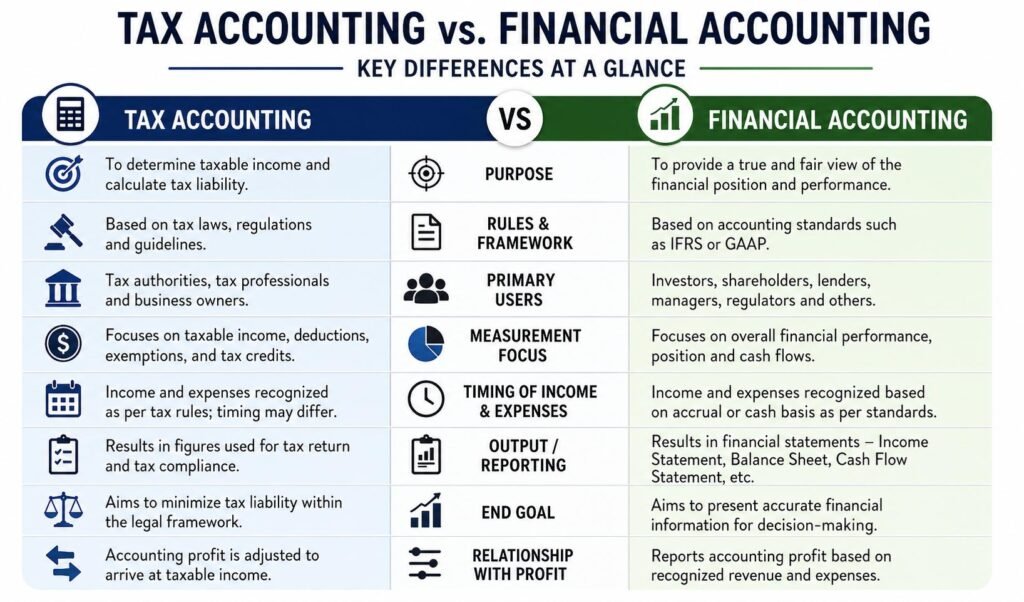
Differences between Tax Accounting and Financial Accounting.
The first big difference lies with the reason. The function of tax accounting is mainly to determine and assist in meeting tax requirements while the function of financial accounting is to provide information to stakeholders. The other difference is the rules that are applied. The tax accounting applies to tax laws and regulations and the financial accounting applies to the recognized accounting standards and policies. The third difference is user of information. Tax accounting information is especially relevant for tax authorities, tax professionals and tax compliance tax owners; financial accounting information is relevant for a wider range of stakeholders such as investors and lenders. The other difference is one of measurement. There may be certain deductions, exemptions, credits or depreciation methods allowed under the tax rules which differ from what is required under the financial reporting. Last but not least, there may be different ways of accounting for income and expenses in the two systems, and different timing of them. The differences also make it impossible for a company to simply copy its financial statements onto its tax return, without making certain tax adjustments.
Accounting Records’ Role in Tax Compliance
Good accounting records are essential for good tax compliance. While accounting systems may give different results in both tax accounting and financial accounting, they will both rely on information regarding the business transactions. Companies need to have well organized sales and purchase records, keep payroll, operating expenses, asset and liability records, bank records etc. and have records of other relevant activities. A variety of supporting documents, including invoices, receipts, contracts, bank statements, and payment records can serve as evidence for items included in financial statements and tax returns. Poor record keeping could make it hard to know which expenses qualified for a tax deduction, how much to report, or why the reported expenses are accurate, or how to reconcile differences; or answer questions from the taxing authority. An efficient accounting system also simplifies the job for the accountant: this will help them have the ability to trace transactions from the primary source document to the accounting records and then to financial reports or tax computations. Record keeping should not be considered as an administrative burden, it is a crucial control measure which safeguards the business’s financial records and compliance issues.
Why Businesses Need Both Systems
Tax accounting and Financial accounting are both important in the business as each has its own purpose but complementary. Financial accounting assists management and other stakeholders to understand the performance of the business such as whether it is making sustainable profits, whether it has more or less than it needs to operate and whether it is using its resources effectively. Tax accounting is responsible for proper calculation and reporting of tax liabilities, as per the tax laws. The use of only financial accounting might lead to a calculation of taxes that fails to take into account some of the statutory requirements, and the use of only tax accounting might lead to financial information that is less useful for management, investors, lenders and other stakeholders. Having two perspectives gives a company the ability to make informed commercial decisions, whilst at the same time fulfilling tax obligations. Both can report on the same transaction data, but use different rules when preparing the reporting and tax forms. This helps to increase transparency, decrease confusion and increase the strength of the financial management process.
Choosing the Right Accounting Method for Tax Reporting
The method of accounting for tax reporting will be determined by the tax laws governing it, the type of business and the reporting requirements set forth by the tax authority. A cash basis may be allowed by some businesses for some tax purposes; an accrual basis may be required or allowed by other businesses. In cash accounting, the transactions are generally treated as if cash has been received or paid, with the exception of the tax rules. Income and expenses are typically recognized when earned or incurred; not when cash is received or paid under accrual accounting. The difference can make all the difference in the world with regard to when income becomes taxable and expenses become deductible. Business owners should therefore choose an accounting method that is not based on some kind of logic for simplicity or the resultant tax effect. Rather they should decide what the legal way is and which is suitable to their situation and use it regularly. In some instances, the rules are complex or subject to frequent change, and professional accounting or tax advice may be required.
Common Errors Business Owners should Steer Clear of.
There are a number of issues that business owners can face if they don’t know the difference between tax accounting and financial accounting. A common error is for the profit to be said to be reported on an income statement but not reported as taxable income. The other is considering all expenses of a business to be deductible for taxes. Depending on the nature of the expense, tax legislation may limit, postpone or prohibit a specific deduction. Businesses can also make mistakes because they don’t keep their personal and business transactions distinct or keep adequate supporting documentation or because they don’t properly keep transactions in the same way. The other risk is implementing accounting procedures that are not understood by the individual, and therefore do not have the desired impact on tax reporting and financial statements. These errors can lead to inaccurate tax returns, unanticipated liabilities, tax fines and/or inaccurate accounting data. With good bookkeeping practices, regular bookkeeping reconciliations, good documentation and checking tax adjustments prior to filing, these risks can be minimized.
Effective Management of Both Systems by the Professional
To deal with tax and financial accounting effectively, it is important to coordinate, rather than consider the two as two completely distinct processes. A business can keep a good general ledger as a record of the business transactions and then use the right adjustments to make tax computations. While accounting software can be used to classify transactions, create financial reports, monitor spending, and record transactions, it isn’t an excuse to not exercise professional judgment. Accountants should take care to keep track of transactions that could be treated differently for financial and tax purposes, and should keep reconciliation schedules to account for any material differences between the accounting profit and the taxable income. It is also important to keep constant communication between business owners, bookkeepers, accountants and tax professionals to avoid any misunderstandings. It is important for businesses to keep an eye on any changes in the tax laws and accounting standards, as they may evolve over time. A well-organized review prior to the financial statements and tax returns are completed can result in discovery of errors at an early stage, and give management increased assurance regarding the accuracy of information being reported.
Conclusion
While there is a link between tax accounting and financial accounting, it is not identical. Financial accounting gives a framework and understanding about how a business is performing and where they are going; Tax accounting uses tax laws to decide taxable income and tax obligations. Accounting profit and taxable income may not be equal due to various factors, such as the difference in the objectives and the difference in the rules. The differences may be due to depreciation methods, timing rules, non-deductible expenses, tax incentive or other statutory requirement. As a business owner, it’s crucial to grasp the difference for informed decision making, financial statements, and tax obligations. The first step to this is to keep proper and accurate accounting records, understand the tax implications of key transactions, cross-check financial results with tax and consult an expert if needed. With effective management of both systems, businesses can enhance their financial reporting processes, mitigate compliance risks, and establish a solid base for sustained growth and success.
Get more well researched information about Tax Accounting vs. Financial Accounting here.