Introduction
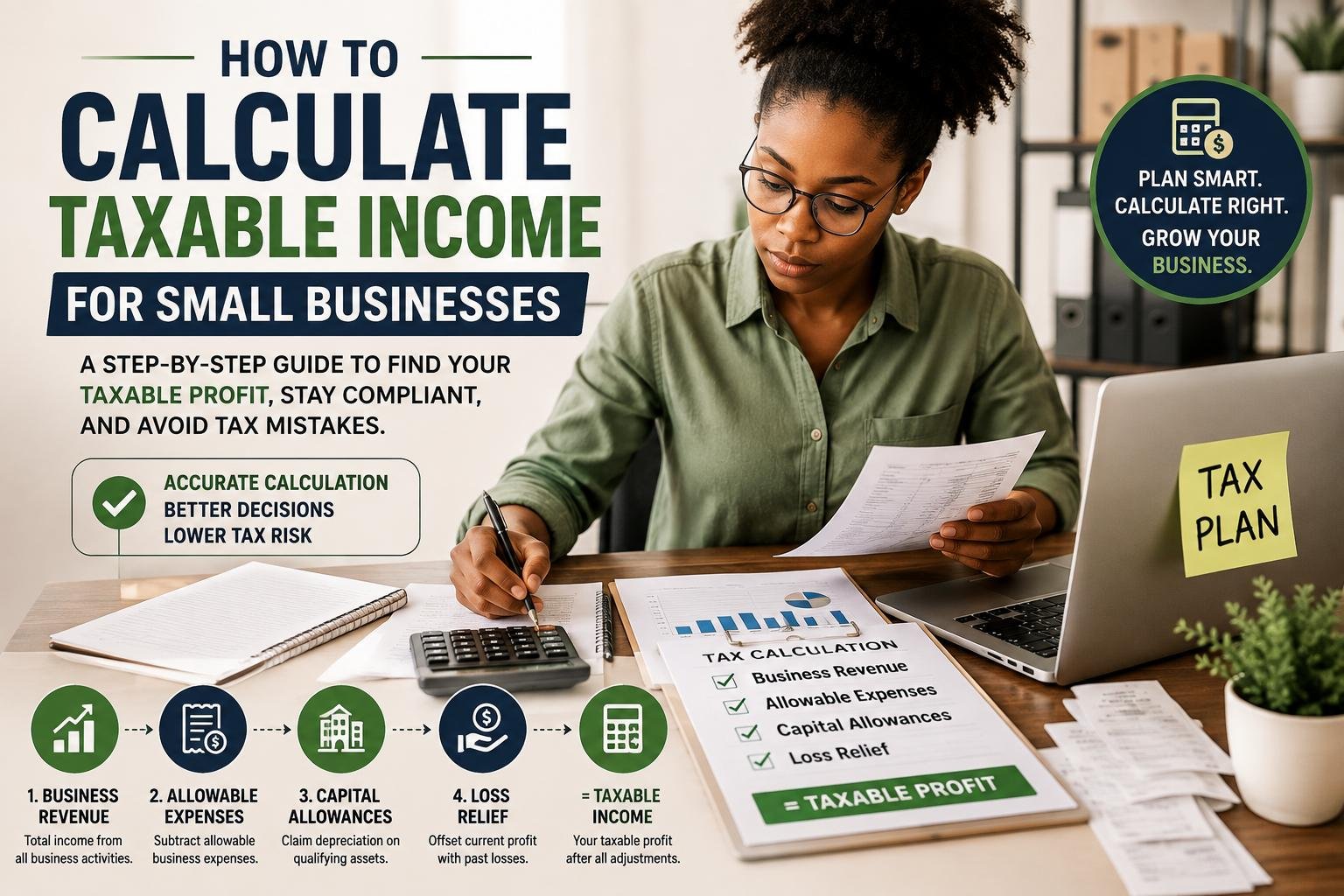
When a small business is in operation, it is one of the most crucial financial tasks to calculate taxable income, as the actual tax amount will depend on this. Taxable income is not just the amount of money that flows into a business bank account, it is the amount of money that can be determined as taxable income after identifying the income that is taxable, subtracting the expenses that are allowed under the tax laws of the nation, and making the adjustments required by tax laws. The basic formula used in calculating taxable income is to start with business income and then deduct allowable business expenses, but also includes certain adjustments, including capital allowances and qualifying loss relief. The process of understanding this can help business owners keep a better track of their records, establish a better financial statement and prevent them from taking on either more or less tax than what the law dictates.
Understanding Taxable Income
Taxable income is income that is still subject to tax following the tax deductions, adjustments, allowances and reliefs. It’s important to note that the distinction between taxable income and total revenue is that total revenue is the total amount of money the business receives from selling goods or services before expenses are taken into account. Even if a business ends up with only a small taxable profit after subtracting proper costs, it may have a much bigger sales figure to keep their taxable profit status. Even with a small taxable profit after deducting proper costs, a business could have a high sales figure to maintain its taxable profit status. Also, taxable profit and accounting profit may not be the same after tax due to the fact that there may be differences between the tax accounting principles and the accounting principles. Business owners should not assume that the profit that is presented in their financial statements is the profit from which they should calculate tax. The tax computation should be done in accordance with the particular rules of the business and its jurisdiction.
Basic Formula for Calculating Taxable Income.
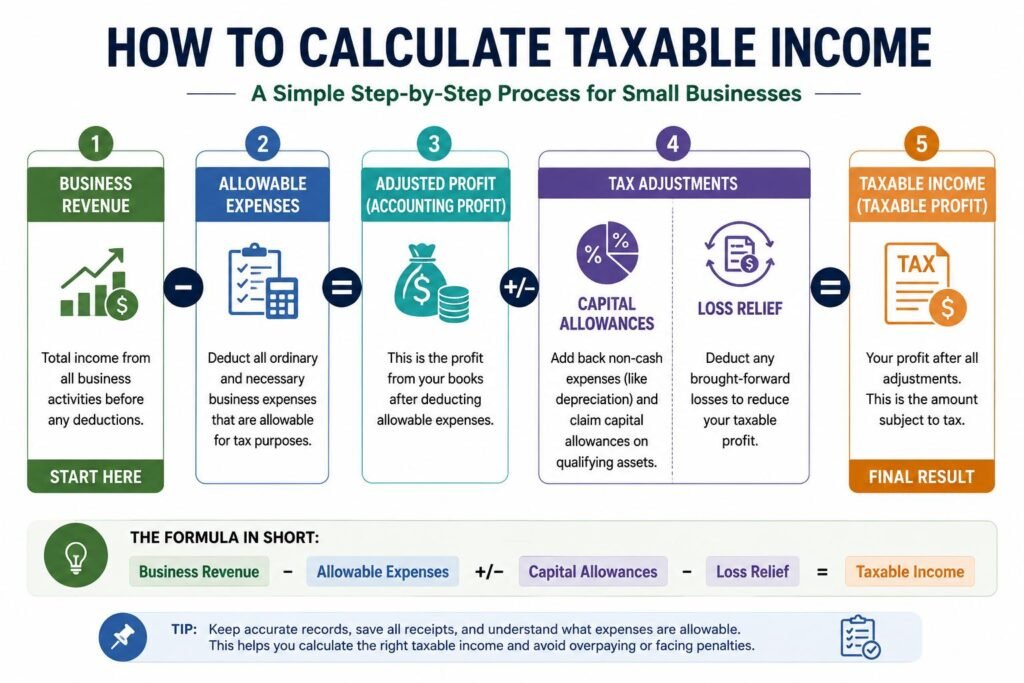
It’s helpful to visualize the calculation of taxable income as a series of subtractions rather than just one subtraction. The general formula is: Taxable Income = Taxable Business Revenue – Allowable Business Expenses – Applicable Reliefs + Applicable Tax Adjustments – Qualifying Loss Relief (with the application of capital allowances and applicable tax adjustments as per the jurisdiction). The details of the presentation may be different depending on the tax laws of the country and whether the tax payers are individuals, partnerships, corporations or other forms of business organization. The function of the formula is to translate the business’s financial statements from its records to what is reported for tax purposes. Thus the calculation should start with the sound accounting records and should adjust for items that have special treatment under tax law as compared with “regular” accounting transactions.
Step 1: Calculate your Total Business Revenue.
The first step towards determining the total revenue of the business for the tax period is to calculate the total revenue. It can be income from the sale of products, professional services, consulting activities, commissions, subscriptions, rental activities or other ordinary business activities as appropriate to the nature of the enterprise. To ensure that no income is miss-reported or double counted, business owners should compare their sales figures and other documents, such as invoices, receipts, bank statements, point-of-sale reports, etc. Revenue should also be recognized as per the tax rules under which revenue is deemed to be taxable revenue and not only the cash revenue received during the year. For small businesses, it’s especially crucial to keep business and personal transactions separate, as it can be challenging to determine the actual cash flow of the business.
Step 2: Modify Business Revenue for Tax Purposes
After total revenues are fixed, it is necessary to know what part of the revenue should go into the taxable-income calculation. Not all the transactions in a company’s books will be treated equally for tax purposes. Exceptions, exclusions, special treatment and special rules may apply to some receipts based on the relevant legislation. Accounting entries may also be made that boost reported income without being the same when it comes to taxable operating income. For instance, some gains, reimbursements, grants or investments may need to be considered. So, instead of mechanically moving numbers from the income statement, businesses should make a reconciliation of accounting revenue and taxable revenue. This adjustment period is necessary so that even a minor classification mistake doesn’t impact the final tax bill, and doesn’t cause issues during a tax evaluation or audit.
Step 3: Determine Allowable Business Expenses.
Once the taxable revenue has been determined, the next step is to identify any expenses that the law allows the business to deduct. Expenses are typically costs that are incurred in the business activity used to generate business income, but the specifics of what expenses would be allowable vary by tax jurisdiction. Typical examples could involve employee pay, rent, utilities, professional fees, insurance, advertising, business travel and transportation, repairs, or administrative expenses. The essential rule is that an expense should be allowed to deduct from the income subject to tax, only if it meets the necessary tax conditions. Invoices, receipts, contracts, payment records, payroll records and anything else that backs up each deduction should be retained by business owners. Just because an expense is on the books doesn’t necessarily make it tax deductible. Well-documented expenses show that the expense was made and not just a personal one, that it was related to the business, and that it is required for the deduction.
Step 4: Separate Allowable and Non-allowable Expenses.
A frequent error in determining taxable income is to take all of the expenses included on the financial statements. There are some allowable expenses that are deductible that may be prohibited and/or restricted by tax legislation, even though they are valid accounting costs. Personal expenses are a significant example since a business owner is not allowed to generally deduct personal expense from a business account. Some of the other costs may be limited, if they have a portion of private use or penalties, non-business use, or special tax treatment. The right way to do this is to line item review the income statement and determines the tax treatment of each expense either fully deductible, partially deductible, non-deductible, or some other tax treatment. This helps to establish a definite link between accounting profit and taxable profit and helps minimize the likelihood of over-deducing.
Step 5: Calculate Business Profit before Tax Adjustments
Once all the revenue has been identified and expenses have been identified and allowed for the taxable business is calculated prior to certain tax-specific adjustments. Simplified calculation: Taxable Revenue – Allowable Operating Expenses = Preliminary Tax Profit. For instance, a small company’s gross revenue is $100,000 and operating revenue expenses that qualify for tax benefits are $65,000, then its initial income would be $35,000. This figure is helpful, but isn’t necessarily the total taxable income, so there may be other adjustments you need to make. Some things can alter the final tax computation, including accounting depreciation, capital expenditure, past losses, exempt income, disallowed expenses and capital allowances. The example also illustrates why it is important to use the correct categories of figures in calculating tax, rather than just using the tax rate on the figures available in a bank account or on the total sales.
Step 6: Make Adjustments for Accounting Items That Tax Law Treats Differently
Settling the accounting profit with tax profit is the next step. The different objectives of financial accounting and tax accounting can result in the recognition of income and expenses being different. Depreciation can be booked as an expense on a business’s financial statements, for instance, or an alternate capital allowance system may be in place for the tax system rather than allowing accounting depreciation as a direct deduction. Likewise, an accounting provision cannot be allowed a tax deduction unless certain legal requirements are met. This implies that a tax computation is generally based on accounting profit and missing expenses are added back before the accounting profit is calculated with deductions or allowances allowed by tax law. This is made easier by keeping a tax reconciliation schedule as this clearly outlines the reasons for the difference between accounting profit and the taxable profit.
Step7: State out Capital Allowances
Capital Allowances are especially relevant for businesses that buy assets that they use for a longer period than 1 year in the accounting period. These can be items such as machinery and equipment, computers, vehicles, furniture, or other assets used as a part of the business. The tax legislation may allow for capital allowances on the amount of expenditure to be made, based on the rate, category, period and/or conditions of the capital expenditure. Note that the rules vary considerably from place to place, and should be based on rates and classifications determined by the tax authority. A fixed-asset register for a business should be kept and contained the date of the purchase, its cost, the business’s description, the use of the asset by the business and any other information that is needed to support the claim. When calculating taxable profit, the calculations of capital allowances can have a significant impact on the calculations, which is why good records of the assets and correct classification are important in the preparation of a tax computation.
Step 8: Qualifying Loss Relief
Under the tax laws, there are conditions under which businesses can take advantage of loss relief in the event of a tax loss. Tax loss occurs when taxable income from business for a specific time period is less than the allowable deductions and adjustments allowed. In some jurisdictions, losses may be able to be carried forward to offset prior profitable years and/or some losses may be able to be used in other ways. It is important that businesses don’t presume that an accounting loss will necessarily be recognized for tax purposes, as tax losses are determined under the tax rules. Owners should also have clear records of where and how much unused losses are and watch for any statutory time limits or restrictions. Insufficient utilization of the loss relief available to the business could mean that the business fails to pay tax on profits which are covered by the loss relief in law.
Step 9: Calculate the Final Taxable Income.
After the revenue adjustments, allowable expenses, non-deductible expenses, capital allowances and qualifying loss relief have all been taken into account, the business is then able to calculate their final taxable income. A simple example is shown to demonstrate the process. Let’s say that a business generates $120,000 in revenue and $70,000 in allowable operating expenses, which results in a $50,000 in initial profit. Make the accounting costs of $5,000 non-deductible but add back and the capital allowances of $8,000 are deductible. If the business also has $7,000 of allowable loss relief, the simplified calculation would be $50,000 + $5,000 – $8,000 – $7,000, producing taxable income of $40,000. This example does not reflect an actual tax calculation as the deductions, allowances, rates and loss rules are dependent on the specific tax jurisdiction and business structure.
Common Mistakes to Avoid When Calculating Taxable Income
When small businesses take the calculation of taxes for granted as an extension of bookkeeping, they can find themselves in a predicament that can be very expensive. Two common mistakes include claiming all business expenses, and not booking income from any source other than the primary business bank account/payment processor. Also, some owners neglect to keep records of expenses, intermingle personal and business transactions, take account depreciation on the books instead of capital allowances as mandated by tax law, or forget to report tax losses from prior years. Further, if businesses calculate tax based on the gross sales (i.e. total sales minus the cost of goods sold) rather than taxable profit, this can result in the business paying excessive tax. However, failing to report income or deductions that do not have supporting documentation may lead to penalties, interest, and/or underpayment or further investigation. These problems will be easier to spot if there is a consistent bookkeeping monthly process.
How Proper Record-Keeping Supports the Calculation
Reliable business records are vital to accurate taxable-income calculations. Small businesses should keep records of their sales, invoices, receipts, payroll, payments to suppliers, payments from banks, asset purchases, loans, taxes and any other matters that are important to their finances. It may be helpful to keep a separate business bank account from which to pay for business expenses instead of personal expenses, and to use accounting software to manage income and expenses all year long. The business owner should also keep all records of substantial items purchased and deducted and keep a current asset list of the business’s fixed assets and tax adjustments. With this in mind, businesses should regularly reconcile their accounts, rather than waiting till tax day to do so and try to reconstruct a whole year of transactions. Good records enable the final tax computation to be completed more quickly, give evidence for deductions, and give an owner a better idea of the company’s financial performance throughout the year.
Difference between Taxable Income and Taxable Profit
Taxable income and taxable profit are sometimes used interchangeably in talking about business and sometimes not. Depending upon the company, taxpayer, and tax system of the country, there could be different definitions for the two terms. The principal idea for a business is typically the gross income that a business is allowed to have taxed, less allowed deductions and adjustments. The calculation can start from the accounting profit and then proceed with various deductions and additions to the profit to arrive at the tax base. This is of importance because financial statements are meant to be read by owners, managers, investors, lenders, and other owners of the business, and tax calculations are meant to be read by the taxman to determine liability in accordance with legislation. Thus, a profitable business could have accounting profit but still a taxable profit and a business with an accounting loss could have other amounts subject to different tax treatment.
Final Checklist for Small Business Owners
A small business owner should use every detail of the total taxable income calculation, starting from the beginning and all the way to the end before filing a tax return. Verify that all taxable sales and/or revenue has been realized, tax records are in accord with bank statements and sales records, and personal transactions have been separated from business deductions. Check each significant expenditure and decide if it is deductible, limited or non-deductible and ensure that there are supporting documents available. Review the fixed asset register and work out any capital allowances at the business rates and criteria. Last but not least, check previous tax losses and see if there is any tax loss relief that may be available. Tax laws vary from country to country and may also change, so businesses should check with the tax authority or a tax expert before tax filing to ensure they are aware of the requirements at the time of filing.
Conclusion
Accurately determining taxable income is more than simply taking the expenses off the top of the sales. Before being able to calculate the allowable tax deduction, small businesses must first determine what their taxable revenue is, what their allowable expenses are, make any necessary adjustments to non-deductible bookkeeping items, apply the relevant capital allowances, and consider the use of qualifying loss relief. Financial record-keeping is important all year round and accounting profit must be reconciled with the accounting rules adopted for tax purposes otherwise the process is much harder. Furthermore, treatment of expenses, assets, loss and exemptions and other adjustments varies by tax jurisdiction and business structure. Small business owners can minimize unnecessary mistakes, manage finances more effectively, make better business decisions and fulfill tax obligations without compromising on accuracy and responsibility by grasping the calculation and maintaining good supporting records.
Get more well researched information about Calculate taxable income for small businesses here.