Introduction
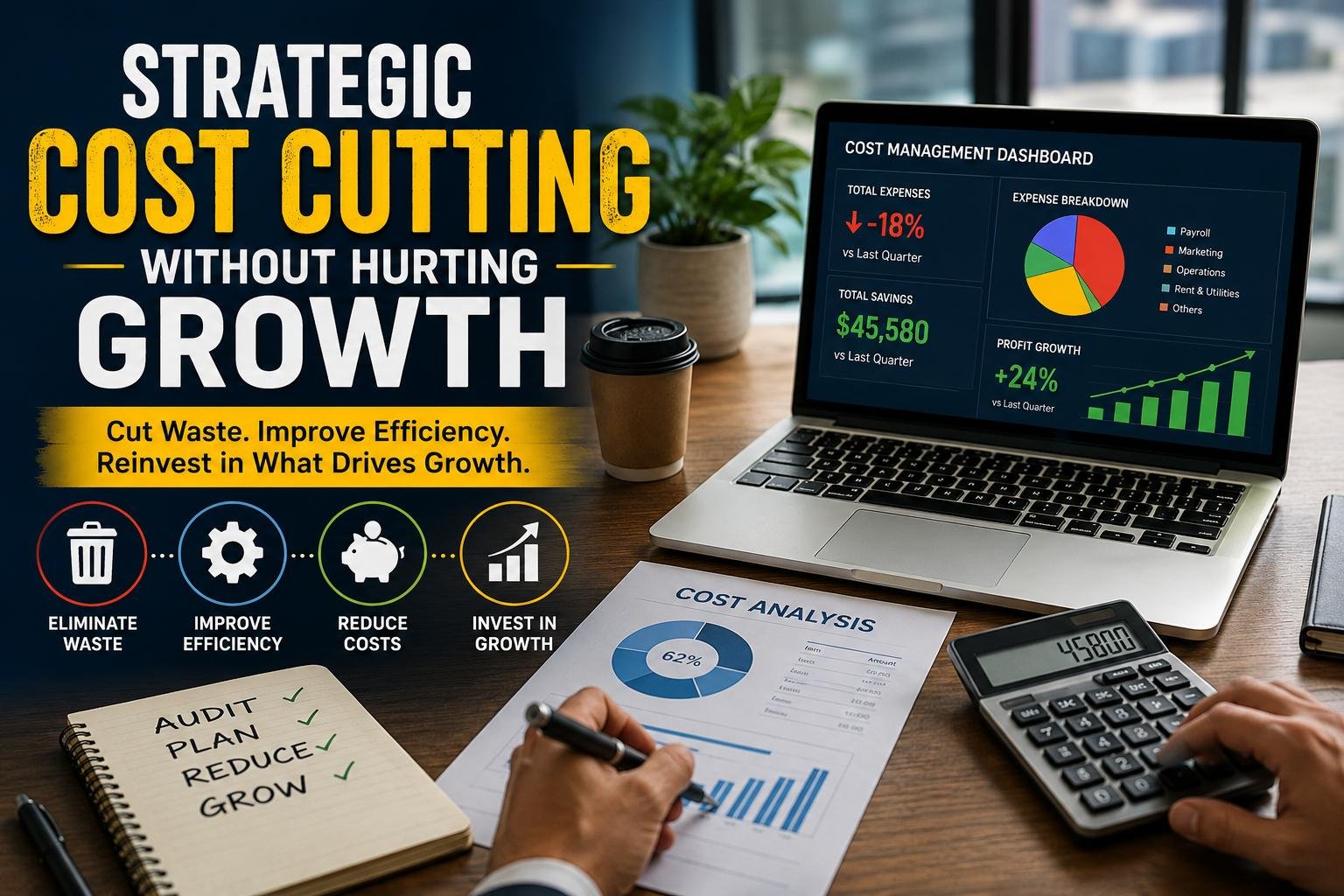
The term cost cutting is often interpreted as spending less, but there are many steps to take in order to cut costs effectively. Unplanned cuts can result in weak customer service, lower employee productivity, poor product quality and even the loss of the investments that can enable a company to expand. But strategic cost management is more focused, it seeks to recognize wasteful, inefficient and low-value payments and supports those that are directly linked to revenue, customer satisfaction, innovation and competitive advantage. The goal of managers and entrepreneurs is not to make the business as cheap as possible but to make every naira, dollar or pound of the business work harder. If cost cutting is linked to budgeting, financial analysis and business priorities, then the savings can be reinvested into worthwhile priorities that enhance profit, but do not impact long-term growth.
Make Sure your Spending is Strategically Optimized.
Strategic cost cutting involves taking deliberate steps to cut or remove costs which are not adding value and keeping spending on those which are helping to achieve the company’s most important objectives. This is important because all the costs of a business are not the same. For instance, canceling a software subscription that isn’t necessary for the growth of a business may have little impact, whereas canceling an effective marketing program could ultimately result in lower sales in the future. Likewise, if a supplier is negotiated to provide better terms, margins can improve and customer complaints and returns can be avoided, while, in contrast, choosing a lower quality supplier, simply because he/she can be found at a lower price, can lead to customer complaints and possible returns. The first step then in a strategic approach is to determine what each expense does for the business. Managers need to consider if a cost can generate revenue, satisfy customers, improve the efficiency of operations, ensure compliance, enhance employee performance, and/or support future company growth. Expenses that do not result in measurable value should be given a higher priority than expenses that contribute to maintaining the competitive position of the company.
1. Conduct a thorough Audit of Expenses.
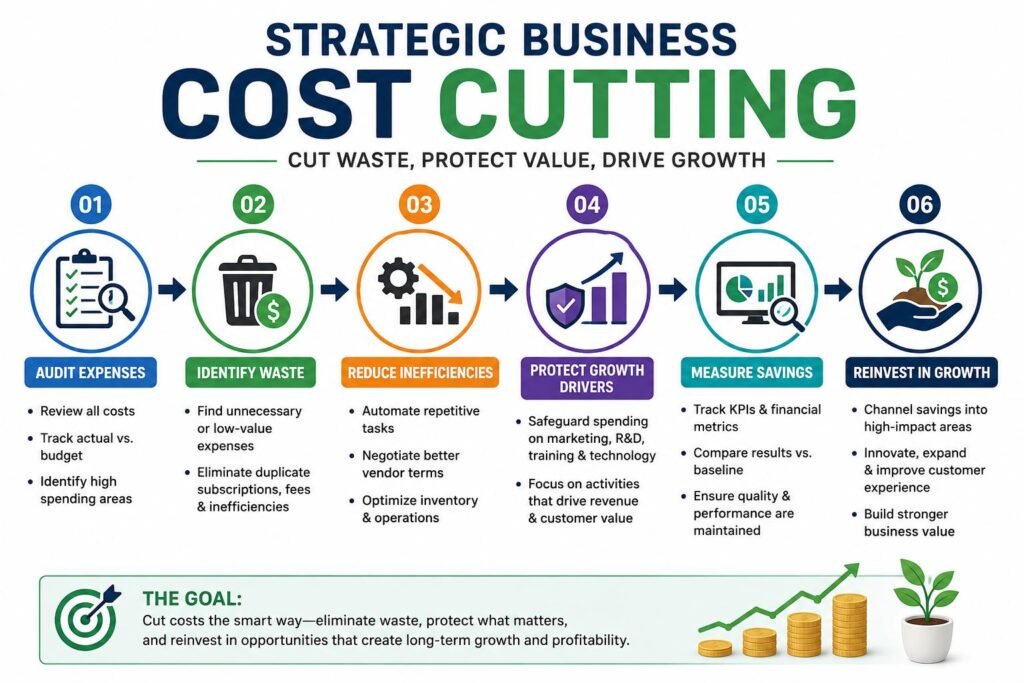
The first step in reducing costs strategically is to perform a detailed audit of the costs of the business. The total impact of the small recurring expenses can be significant over a 12 month period but often overlooked by many companies, because it seems so insignificant at the time. The expenses that an expense audit should include are rents, utilities, payroll, software subscription, advertising, transportation, insurance, professional services, office supplies, inventory, bank charges, telecommunications, maintenance, and supplier payments. The managers should track and compare the actual spending versus the budget, and determine those categories that are the most often over budget. It also helps to divide the spending into the categories of essential, growth, discretionary and potentially wasteful spending. This helps decision makers to understand where funds are being spent rather than make assumptions. Regularly reviewing expenses also simplifies the task of finding duplicate subscriptions, unused services, unnecessary fees, inefficacies, etc., and spending habits that might not show up in financial statements every month.
2. Budgeting to Identify Waste
A healthy budget should not only forecast the amount of money a company would like to spend, it should also reflect the total amount of money that the company is actually going to spend. It should facilitate management’s decision to whether planned spending is needed, reasonable and contributes to business objectives. When a company must revisit its cost structure, or when a business is undergoing a change, then zero-based budgeting can be especially helpful because the managers must be able to account for all expenditures and explain why they are necessary. Another technique that is useful is variance analysis, which involves looking at the difference between budgeted quantities and actual quantities, and then explaining the differences. When the costs of electricity, advertising, transportation, and/or administration are always above budget, the management can go to the root of the problem rather than chalk it up to the next budget. Businesses can also establish spending limits which must be authorized for larger purchases. Such budgeting techniques provide financial discipline and increase managers’ information regarding cost-cutting.
3. Emphasize Practical ways to Reduce Costs
If businesses want to make further cost savings then they need to make a change that will make them more efficient, and not cut back on costs in all departments. Business owners can use a helpful guide to cost-cutting measures to examine particular methods for reducing their high operating costs. The major concept is to measure the impact of each possible saving on customers, employees, revenue, quality and future growth. For instance, more labor-intensive administrative tasks can be eliminated by sending these processes to automation, and employees can devote more time to other activities that have a greater value. Merging suppliers can lead to improved purchasing conditions and cancelling unused subscriptions can save money right away with minimal to no impact on operations. Instead of making serious structural changes, businesses could improve their profitability with low-risk saving first so as it will cause no unnecessary disruption.
4. Revise Vendor/ Supplies Contracts
In addition, there may be significant savings to be achieved through vendor negotiations since suppliers are often more flexible than businesses think. Businesses should re-evaluate contracts periodically – not take the price and terms of the contract for granted. Where applicable, management may ask for volume discounts, extended payment terms, lowered delivery charges, combination pricing, better warranties and prepaid discounts. Another good idea is to get some competitive quotes when renewing large contracts as it gives you something to compare to if the price isn’t competitive. But the lowest price shouldn’t necessarily be the decisive factor. A supplier who has a dependable product that is delivered on time might be more valuable than a lower cost supplier if he or she is unreliable. Strategic vendor management takes into account the total cost associated with the problem areas, delivery failures, administration, and the cost to switch vendors. Good supplier relationships can achieve savings maintaining service reliability.
5. Improve Stock and Minimize Stock Waste
Having too much inventory can consume a considerable amount of business capital, especially when businesses acquire more inventory than they can sell for a reasonable period. Overstocking results in storage costs, the likelihood of damages or obsolescence, and the loss of funds to other priorities. But understocking can also be detrimental since there may be several times in which the product is not in stock and sales opportunities may be lost, which can result in customer dissatisfaction. To set more suitable inventory levels, businesses should rely on the past trends in sales, demand forecasts, the lead time of suppliers, and seasonal fluctuations. Special attention should be paid to slow moving products, and close monitoring of fast moving products to avoid stockouts. Frequent stock taking can also identify obsolete stock, recording errors, theft and damage. By managing the inventory well, unnecessary storage costs, unnecessary buying and unnecessary cash flow will be reduced. The goal is to carry the appropriate level of inventory to be used effectively to sell goods.
6. Minimize Waste and Not Reduce Production
Many overheads can be cut without impacting the core products and services offered by the company. Businesses can look to such areas as office space, utilities, telephony, printing, administrative supplies, travel, and unnecessary meetings for potential office savings. A company might find, for instance, that they are paying rent on office space which isn’t used much by their employees or having to use several communication systems which serve the same purpose. Companies can consider the possibility of hybrid working, shared office, energy-efficient equipment, digital documentation, etc. to minimize overheads. But managers are advised not to make across-the-board cuts that have the potential to negatively impact employee productivity. An office that is cheaper could mean longer commutes or less than ideal working environments and also reduce the equipment that employees need to work with, which can negatively impact their productivity. Each reduction in the overhead should therefore be evaluated on its impact on productivity and employee performance. The greatest savings is often from eliminating waste but not the elimination of materials which an employee actually needs.
7. Reduce Repetitive Administrative Tasks
By reducing repetitive manual tasks, technology can aid businesses in cutting costs. Certain things like invoice processing, payroll management, managing appointments, tracking expenses, reminders to customers, reporting, data input and entry can be partially automated with the right software. Automation does not equate to replacing employees, it allows the employees to focus more time on activities that demand judgment, creativity, and relationship building and problem-solving. Businesses need to do a calculation of the return on investment before buying new technology, however. If the software solution required is more expensive than the lab our and inefficiency it is saving, it is not a cost saving solution. Other factors to take into account should include implementation costs, training, integration, maintenance and security. If chosen correctly, automation can minimize administrative mistakes, speed up processing times, enhance visibility of the financials, and give the business the ability to process more transactions without a corresponding rise in expenses.
8. Protect Growth-Driving Expenses
A major risk in cutting costs is cutting what can seem like discretionary costs but are actually productivity costs that produce future revenue. Some costs such as marketing, product development, employee training, customer service, technology, and sales, can all be considered as a cost, but each of these costs directly supports growth. The percentage cut for each department should be determined by the performance and the strategic value of the department rather than applying the same percentage cut to all departments. A marketing campaign that consistently yields profitable customers doesn’t necessarily need to be abandoned because the company would like to cut back on their marketing dollar. In the same way, decreasing employee training can lower costs in the short term, but can lead to productivity and retention issues down the road. The smart way to go is to find those investments that will give measurable returns and safeguard them from loss. The emphasis should be on low value activities, inefficiencies, duplication and unnecessary overheads; and growth drivers, to the extent that their funding should be provided to continue to produce results.
9. Thoroughly Review Employee Costs.
One of the biggest costs for a business is payroll, so it is a crucial place to look at when analyzing money. But cutting employee costs by indiscriminate layoffs or wage cuts could have a negative impact on employee morale, productivity, customer service and institutional knowledge. The starting point is to consider if the employees are working on low value tasks that can be streamlined, automated, outsourced or automated. Workload can also be analyzed by managers to identify if the number of employees required is in line with the demand. Having multiple employees cross-trained can be beneficial in providing increased flexibility and reducing reliance on one employee for critical operations. Measuring performance can be a way of determining what activities are using up resources for less than the value. If a business needs to hire personnel, it may want to think about the best staffing option for a part-time, full-time, contract or freelance hire. The goal of the change should be increased worker productivity, not fewer workers. A more productive workforce means a much larger value generation compared to a larger less efficient workforce.
10. Review the Marketing and Customer Acquisition Costs for your business.
Marketing isn’t the line item you can cut if the budget gets cut, Marketing is not a line item that you can sacrifice if budgets are tight! Customer acquisition cost, conversion rates, customer lifetime value, return on advertising spend and revenue from various marketing channels are metrics that businesses should consider. This analysis helps you to recognize activities that have a good ROE and those that have a bad ROE. For instance, a company might find that one of its marketing channels generates a ton of leads, but very few customers, and a different one generates fewer leads but more quality customers. Management doesn’t have to make a blanket reduction across the marketing budget, but can channel funds toward more successful channels. Low cost avenues like referrals, email marketing, educational content, partnerships, customer retention, and organic search visibility also should be taken into consideration for businesses. Strategic marketing cuts should make it more efficient, and should not compromise the company’s ability to attract and keep customers.
11. Enhance Cash Flow with improved Payment Management
Combining the two, cost management becomes much more effective, alongside strong cash-flow management. Even a prosperous business may find itself facing financial problems if customers pay late and suppliers and/or employees demand prompt payment. Hence, the business should monitor the payment terms for their customers, the invoicing process, outstanding receivables, and the suppliers’ payment schedule. Promptly sending out invoices, providing fair payment options, following up on delinquent accounts and setting up solid credit policies will help speed up the collection of cash. Meanwhile, companies can engage suppliers on reasonable terms of payment without hurting their relations. This improves cash-flow management, lower the requirement for costly short-term loans and provide management with increased flexibility in the event of unexpected expenses. It can also be more strategic in making cost-cutting decisions as the business is more cognizant of both when money flows in and when it flows out. In small businesses, where there might not be substantial financial reserves, safeguarding the liquidity becomes even more crucial.
12. Measure Savings using KPIs
Reduction in costs should be assessed only after the project is implemented as a planned cost reduction may not be a real cost reduction. The managers need to set key performance indicators to demonstrate the financial and operational outcomes of a cost cutting program. Some of these can be useful measures such as operating expenses on revenue, gross profit margin, net profit margin, inventory turnover, employee productivity, customer acquisition cost, supplier costs and cash conversion. Other quality metrics to track include customer complaints, returns, delivery time, staff turnover, and service response time. This eliminates the possibility of companies ‘playing’ that it’s saved money on one item, but then has to pay for some other item. For instance, a lesser provider may possibly have lower buying price, and higher product returns. Ideally, a successful cost-saving project will lower overall costs and not adversely impact key performance measures.
13. Save and Invest in High Impact Opportunities.
The end goal of strategic cost reduction should not be to save money for as long as possible. The best place for companies to spend recovered money is in the long term. The money saved can be reinvested in profitable marketing campaigns, new technology, employee training, product improvement, customer experience, market expansion, or improved cash reserves, to name a few. This leads to a vicious circle of efficiency, rather than working in opposition to growth. One such case is if a business can save on unnecessary payments for subscriptions and renegotiate contracts with suppliers, then management can use the money saved to enhance the sales system, or to develop a new product with high market potential. A reinvestment decision should be based on future returns and priorities of the business still. What matters is that cost reduction is used as a viable funding source. Management is not just trying to shrink the business, seeking instead ways to increase its efficiency and strength and make it more competitive.
14. Create a Continuous Cost Management Process
Cost control is not something that should be considered a once a year procedure, starting only when profits fall. Businesses are subject to evolving circumstances and costs, supplier costs and expectations, technology, and market conditions, all of which may vary from month-to-month during the year. It is therefore important that managers set up regular financial reviews, including the monitoring of expenses on a monthly basis, and strategic cost reviews on a quarterly basis. Every review can look at the actual spend expenditure against the budget, analyze for serious expenditure deviations, check supplier performance, review inventory levels and determine if major expenditure is providing value. Departments can also be encouraged to make efficiency suggestions as employees are often more aware of the operational inefficiencies than are senior management. Continuous cost management establishes a culture where employees consider value, productivity and resource allocation as a normal part of their job. A more sustainable method of emergency cost-cutting is this solution because issues can be resolved before turning into a serious threat to profitability.
Conclusion
In order to do so, it is necessary to be disciplined, to have financial transparency and to have a clear sense of what creates value for the company. The goal isn’t just to save money, but to cut out waste, work more efficiently, renegotiate better terms, utilize the resources better and divert funds to activities that will help the company grow in the future. When conducted carefully, expense audits, careful budgeting, negotiation with vendors, inventory optimization, automation, review of overheads, analysis of employee productivity, and measurement of employee performance can help to give businesses healthier margins. Meanwhile, managers have to shield the growth drivers of effective marketing, customer service, innovation, technology and employee development. Not all businesses with low costs are strong businesses, but all businesses that have the best spending-to-result ratio are strong businesses. Proactively, entrepreneurs and managers can enhance profitability now and build new capacity supporting sustainable growth in the future with cost management as a continuous component of financial planning.
Get more well researched information about Strategic business cost cutting here.