Introduction
Financial statements are one of the most vital tools in analyzing the financial condition of business. They show clearly the income and value of a business, what it possesses, what it owes and how cash flows in and out of the business. Good financial statements are valuable to small business owners for decision making, securing financing, tax compliance and pinpointing areas for improvement. The accounting students and finance practitioners benefit from understanding the accounting process because it offers them the solid ground to conduct financial analysis and reporting duties.
Accounting records are often thought to be too complex or only appropriate for large businesses, making financial reporting challenging for many small businesses. For any business, no matter its size, the accuracy and organization of financial statements are beneficial. They enable business owners to track profitability, control costs, analyze liquidity and make future plans to grow their business. The financial statements are also considered to be more credible with the lenders, investors, suppliers, and regulatory authorities as they are willing to enter into business relations with the entity after they have the evidence of its financial performance.
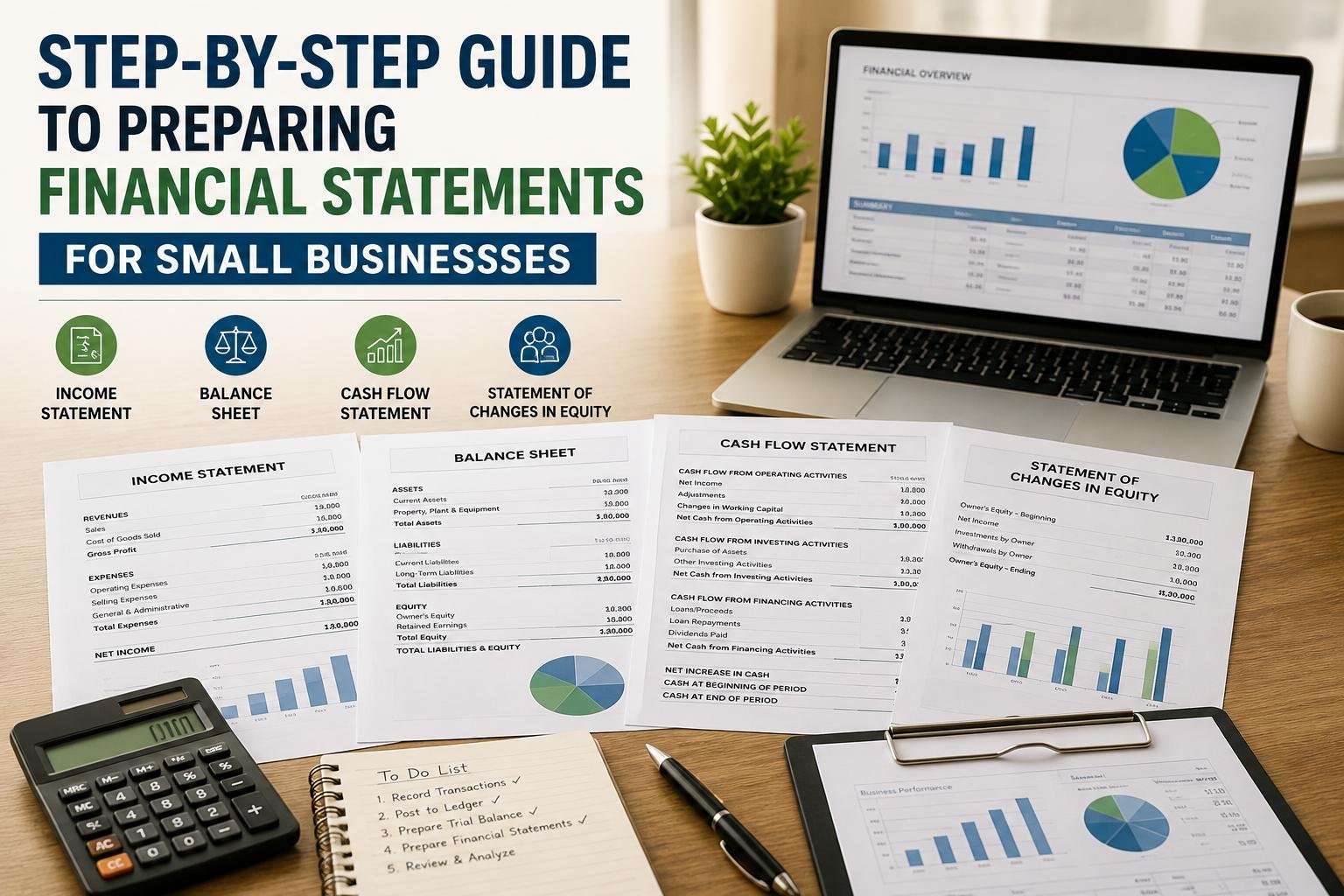
In this article, we will explore how to create the four major financial statements that businesses use: income statement, balance sheet, cash flow statement and statement of changes in equity, and learn how to do it step-by-step. It describes the purpose of each statement, explains how it is prepared, and illustrates how a business can effectively use these reports for evaluating the performance and financial health of the business.
Understand the Purpose of Financial Statements.
Financial statements convert the raw accounting data and information into useful information for which the stakeholders can understand and interpret. Each business activity, from sales to purchases, payments and investments, has an impact on one or both of the financial statements. If these reports are prepared accurately, then the management decision made would be based on fact instead of assumptions. Financial statements show revenue growth, expense management, asset use, debt service and cash availability, and are key to helping you plan strategically and optimize your operations.
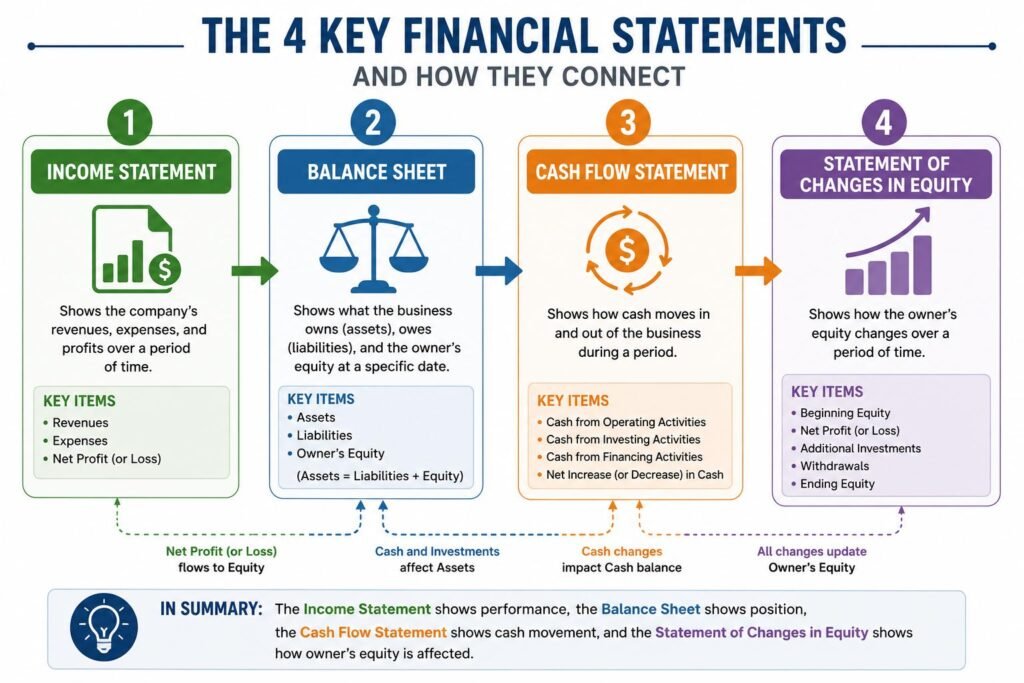
The 4 main financial statements can be used to provide a comprehensive financial overview. The income statement is concerned with profitability for a period of time. The balance sheet is a financial position statement as of a certain date. Cash flow statement – the causes of cash coming in and out of the business, and the statement of changes in equity, how owners’ equity has increased or decreased over the reporting period. Together these reports offer a greater depth of understanding on sustainability, potential growth and financial stability.
Preparing before Creating Financial Statements
Businesses need to have up to date and accurate accounting records before preparing any financial statement. This process starts with the recording of transactions in journals and posting of the transactions to ledger accounts. After the transactions are properly classified, a trial balance is drawn to check that the total of debits match the total of credits. All discrepancies found at this point should be addressed prior to moving on to preparing the financial statements.
Adjusting entries as well should be made at the end of the accounting period. These adjustments include the recording of accrued expenses, prepaid expenses, depreciation, outstanding revenues and inventory changes. Financial statements without adjustments can provide false information that can impact management’s decisions and external reporting needs. The quality of financial statements is highly dependent on the accuracy of the financial statements’ underlying accounting records and the preparation of accounting adjustments prior to the issuance of financial statements.
The Income Statement: A Measure of Profitability.
Also known as the profit and loss statement, the income statement indicates whether a company made a profit or suffered a loss in a given accounting period. It is a summary of the revenues collected and the costs of those revenues. This is especially significant as profit or loss can be a vital factor in the survival and growth of a business in the long term future. The income statement is a document that is often examined by investors, lenders and business owners to gain insight into the company’s operating efficiency and earnings performance.
For any business that wants a bit more guidance on making the income statement, this helpful guide will help them understand more and improve their financial reporting practices.
1. Calculate Revenue
In preparing an income statement, the first step is to calculate the total income of the business for the accounting period. Depending on business nature, income can be generated from sales of goods, service fee, commission, interest or rental income. Only proceeds from operations in the reporting period be included, not to be dependent on receipt of cash. This is done in accordance with the accrual accounting principle which treats revenue as having been earned, not when it is received.
Businesses need to take the time to double check invoices, receipts, sales information and customer accounts to make sure that all of the business’s revenue has been recorded properly. Not accounting for revenue will underestimate the performance of a business, and may result in issues at audit or tax assessment time.
2. Cost of Goods Sold is calculated.
Cost of goods sold is the direct expense of the company for products sold during the period, for a product-oriented business. This comprises raw materials, direct wages and manufacturing costs specifically used for production. For services, direct costs of service delivery may be the same for service businesses.
Profit from operations is calculated by subtracting the cost of goods sold from revenue; it is a measure of the profitability of the basic business operations before operating expenses are taken into account. By keeping track of gross profit margins, businesses can assess their pricing strategies and production efficiency.
3. The next step is to record Operating Expense
Operating expenses are the costs to run the business that do not relate to the production of a product. Some of these include salaries, rent, utilities, insurance, advertising, supplies, transportation, depreciation and professional fees. These costs should be classified correctly to help in analyses and budgeting.
When the operating expenses are deducted from the gross profit, the result is operating profit. This number is indicative of the profitability of a company’s main business operations and is not necessarily indicative of non-operating items like financing costs or investment gains.
4. Net Profit is calculated
The final step is to add the non-operating income and expenses, including interest income, interest expense and taxes. The resultant figure is net profit or net income – the net is the income that is left after deducting all of the expenses from the total income. Net profit is one of the indicators that is most closely watched to determine how well the business is doing because it shows if the business is profitable enough to return a profit to the owners and investors.
Balance Sheet Preparation
The balance sheet shows a snapshot of the financial position of a business as of a particular date. It is based on the concept of accounting equation, which is:
Assets = Liabilities + Equity
This equation shows that all the resources used by business are financed either by borrowing or owner’s contribution. While the income statement is used to report the results of operations over a period of time, the balance sheet reports financial position at a particular time.
1. List the Current and Non-Current Assets.
An asset is a resource that the business controls that is likely to benefit the business in the future. Current assets are assets that may be turned into cash within one year and consist of cash, accounts receivable, inventory and prepaid expenses. Non-current assets are assets that are expected to benefit for several years and consist of property, equipment, machinery and vehicles as well as intangible assets like patents and trademarks.
The value of assets should be adjusted to reflect any asset impairment losses and depreciation where applicable. Correct asset reporting is vital to the measurement of the needs for liquidity, efficiency and investment.
2. Determine Current and Long Term Liabilities.
The obligations to others outside of the company are known as liabilities. Current liabilities are those that will be paid within the next year and include the sum of accounts payable, accrued expenses, wages payable, taxes payable and short-term loans. Long-term liabilities are those that are due after one year, such as bank loans, mortgages and bonds payable.
Businesses can use an understanding of liabilities to determine the risk to the financial situation and the ability to pay back the debt. If the business is profitable, but has too many debts, it can still be facing solvency issues.
3. Determine Owners’ Equity.
Owners’ equity is the stake left in the business for the owner(s) after the business’s debts are paid. Typical contents of equity consist of owner’s capital, retained earnings and any other contributions received in the reporting period. Retained earnings are the profits earned but not distributed to the owners of a business.
When total assets is equal to combined value of liabilities and equity, the balance sheet is complete. If the equation is not balanced, checking for calculation or classification errors and correcting them as soon as possible is important.
Preparing Cash Flow Statement
The cash flow statement helps to demonstrate how cash is working in the business in a reporting period. Even a profitable business can find that it has financial problems because it doesn’t have enough cash to pay its bills. That is why the cash flow statement is the most useful of the small business financial statements.
Cash flows can be broken down into three categories: operating activities, investing activities, and financing activities. This classification is useful to enable the users to understand the source of cash and its usage.
1. Calculate the Cash flows from Operating Activities.
Operating activities are those activities that are the primary function of the company that generate revenue. Any money paid by customers and any money paid to suppliers, employees or service providers would be considered cash. It could be prepared using either the direct method or the indirect method, with the indirect method being used in practice.
Positive operating cash flow means that normal operations of the business provide sufficient cash flow to cover the operations without forcing the business to take on substantial external funding sources.
2. Record Investing Activities
Investing activities include the purchase and sale of long-term assets (including equipment, vehicles, buildings, investments, etc.). The sale of assets brings in cash inflows and the purchase of machinery brings out cash outflows. Investing activities monitoring gives information about the expansion plans and long-lasting strategic priorities.
Investing cash flows can be negative, particularly during growth periods, as a small company is spending much money on equipment and infrastructure for future operations.
3. Record Financing Activities
Activities of financing are activities conducted with owners and lenders. This can involve such transactions as loans, repayments of loans, the issuance of shares and the payment of dividends. These activities help us understand how the business is financed for operations and investments.
If a business always needs to secure funding for its activities in order to run, there is a chance that it will need to enhance its efficiency or profits in order to be sustainable over time.
4. Determine the Net Change in Cash
Once all cash flows from operating, investing and financing activities have been added together, the net change in the cash position of the business during the period is calculated. When this is added to the opening cash balance the result is the closing cash balance, the same as the closing cash figure entered on the balance sheet.
How to prepare for the Statement of Changes in Equity?
The statement of changes in equity is used to explain the changes in the equity during the accounting period. This statement is sometimes ignored in smaller businesses, but it does give valuable information on retained earnings, owner’s contribution, withdrawals and profits made by the business.
This statement starts with opening balances for equity and accounts for equity increase by adding capital contribution adjustments, net profit, dividend payments, and owner’s withdrawals. The closing balance is the same as the equity section of the balance sheet.
In the case of partnerships or corporations that have several owners or shareholders, this declaration is particularly significant as it offers transparency on ownership and distributions. This report is usually read by investors to gain insight into the business’s profit retention and/or distribution and whether the business invests profits to generate future growth opportunities.
Reviewing and Verifying Financial Statements
Preparing financial statements is not complete without a review and ensuring that they are accurate and consistent. A comparison of net income from the income statement with the retained earnings adjustments on the statement of changes in equity should be done to ensure that there is consistency. The cash balance at the bottom of the cash flow statement should match the cash balance that is displayed on the balance sheet. Likewise, total assets should always be equal to the total liabilities and equity.
Other analytical procedures like ratio analysis can also detect irregular patterns (or errors). Large deviations from the expected amounts in any of the accounts should be investigated to see if they are caused by actual events or errors in accounting. Reliability and confidence in financial reporting outputs are enhanced with thorough Review procedures.
Using Financial Statements to Assess Business Performance
Financial statements are not only useful in summarizing past performance, but they can also be used as a basis for future decision making. Profitability Ratios from the income statement can be used to measure operational efficiency and pricing effectiveness. The liquidity ratios computed from the balance sheet are used to see how well the company can pay its short-term debts. Solvency ratios are used to assess the long-term financial health of a business, while cash flow analysis is used to identify the business’s ability to generate cash flow to support its operations and investments.
The business owner can analyze the current performance with that of the past and detect the trends and future challenges. Financial statements are utilized to gauge creditworthiness by lenders and to gauge return potential and financial risk by investors. Financial reporting that is transparent also holds employees, suppliers, and regulatory bodies accountable and trustworthy.
Common Mistakes to Avoid During Preparation
The most often made errors in preparing financial statements are often not taking into account the adjusting entries at the time of the report. Expenses that have accumulated depreciation and prepaid expenses are often overlooked, resulting in misleading financial statements. A frequent problem would be mixing personal and business transactions that would skew profitability and financial position.
Certainly, the classification of assets and liabilities may also be inadequate to enhance the usefulness of the financial statements for decision making. It is crucial that businesses carry out proper documentation, so they can reconcile their bank accounts regularly, and scrutinize reports carefully before finalizing. Errors can be minimized and the quality of reporting improved by implementing accounting software and taking professional advice as required.
Conclusion
Financial statements are fundamental and a crucial tool for running and appraising any business, big or small, in any sector. The income statement is a measure of profitability, the balance sheet shows a picture of financial position, the cash flow statement shows a picture of liquidity and the statement of changes in equity explains changes in ownership interests. These reports, when combined, give businesses a full picture of the health of their business and can help them make informed decisions.
Learning how to prepare financial statements will help small business owners gain control and add credibility to their business with their lenders and investors. The preparation process proficiency will enhance in analytical and technical capacities of accounting students and finance professionals in their work. A well-structured approach and the discipline of keeping accurate financial accounting records allows businesses to create robust financial statements that enable them to grow, sustain and thrive in the long run.
Get more well researched information about Step-by-Step Guide to Preparing Financial Statements for Small Businesses here.